
AI search and traditional search represent two different discovery systems built on distinct retrieval, ranking, and presentation models. In comparison of search, traditional search engines surface indexed documents and organize results through ranking systems that prioritize relevance, authority signals, and link-based evaluation, requiring users to navigate result pages to extract information. AI search engines operate through generative search frameworks that retrieve information from multiple sources and synthesize direct answers, shifting visibility from ranked positions to answer inclusion.
The difference between AI search vs traditional search changes how queries are processed, how optimization is applied, and how authority is established. Traditional search optimization centers on rankings, crawlability, and click-driven visibility, while AI search optimization focuses on semantic relevance, entity consistency, and answer eligibility. Authority in traditional search relies on page-level signals and backlinks, whereas generative search evaluates contextual accuracy, source reliability, and cross-source agreement.
As AI-powered search engine technologies expand across conversational interfaces and answer-first environments, visibility increasingly depends on how information is selected, summarized, and reused, which defines new optimization requirements and shapes future search behavior.

What is AI Search?
AI search is a discovery model in which AI-powered search engines retrieve information from multiple sources, interpret context, and generate direct answers instead of ranked lists of links. AI search systems combine retrieval and generation to produce synthesized responses that resolve user intent within the interface, reducing the need for navigation. This model defines AI-powered search engines as answer-centric systems that prioritize relevance, accuracy, and contextual understanding over document ranking alone.
AI search operates through answer-first interaction. Users receive complete responses immediately, which shifts visibility from page positions to answer inclusion. AI in search engines evaluates whether content can be selected, summarized, and reused as part of a generated answer.
AI search relies on retrieval-augmented generation. AI search retrieves information from indexed sources, trusted databases, and real-time content, then generates responses grounded in retrieved data. This mechanism limits unsupported generation and ties answers to external sources.
AI search is delivered through conversational interfaces. Queries are processed as natural language interactions, allowing follow-up questions, refinement, and multi-turn context. This interaction model changes how queries are interpreted and how content is reused across sessions.
AI search produces context-aware responses. AI systems adapt answers based on query intent, prior context, and semantic relationships, which enables more precise and relevant outputs than traditional search engines.
What is an AI Search Engine?
An AI search engine is a search system that uses artificial intelligence models to understand query intent, retrieve information from multiple sources, and generate synthesized answers instead of returning ranked lists of links. AI search engines rely on natural language processing (NLP), large language models (LLMs), and vector-based retrieval to interpret meaning, context, and relationships between concepts.
AI search engines operate through answer-first retrieval. Queries trigger retrieval-augmented generation workflows where relevant documents are selected, evaluated, and summarized into a single coherent response, often with citations.
AI search engines support conversational and multi-turn interactions. Context persists across follow-up queries, enabling refinement, clarification, and deeper exploration without restarting the search.
AI search engines prioritize semantic understanding over keyword matching. Query processing focuses on intent, entities, and conceptual relevance instead of exact term frequency.
AI search engines present results as synthesized responses. Visibility in an AI search engine depends on inclusion inside generated answers.
How does AI Search Ranking System Work?
AI search ranking systems work by selecting information sources based on query intent, contextual relevance, and factual consistency before generating a synthesized answer.
How does AI search retrieve information? AI search retrieves information by converting queries into semantic vectors, identifying entities and constraints, and matching them against indexed passages using vector search combined with classical retrieval signals.
How do AI systems synthesize answers from multiple sources? AI systems synthesize answers through retrieval-augmented generation, where selected passages are evaluated for alignment, consistency, and source reliability, then combined into a single coherent response.
How do AI search engines present results to users? AI search engines present results as direct answers with supporting citations, maintaining conversational context across follow-up queries to refine responses without restarting discovery.
What does an AI tool for searching optimize? An AI tool for searching optimizes answer accuracy, semantic clarity, and contextual usefulness, which determines selection, citation, and reuse inside AI-generated responses.
How Visibility Works in AI Search
Visibility in AI search refers to the inclusion of a brand, entity, or source inside AI-generated answers through mentions and citations during response generation. AI-powered search engines determine visibility at the answer level, where only a limited set of sources is selected for retrieval and synthesis. Inclusion depends on semantic relevance, factual consistency, and source reliability evaluated before an answer is generated.
How do mentions and citations create visibility in AI search? Mentions and citations indicate that an AI system has selected a source as eligible for reuse inside an answer. Mentions introduce a brand or entity within generated text, while citations attribute specific facts or claims to identifiable sources. Citation inclusion strengthens perceived authority because AI systems apply confidence thresholds before attributing information.
What does share of voice mean in AI-generated answers? Share of voice in AI answers measures how frequently a brand appears compared to competitors across a defined query set. A higher share of voice reflects broader topical coverage and stronger reuse patterns across related questions. AI share of voice represents competitive presence inside synthesized responses, not page-level impressions.
How does zero-click exposure affect visibility in AI search? Zero-click exposure occurs when users consume complete answers directly within AI interfaces without visiting external pages. AI search amplifies zero-click behavior by satisfying intent immediately. Visibility persists through repeated exposure inside answers, even when referral traffic does not occur.
Which Browsers Incorporate AI Features?
Browsers that incorporate AI features fall into two distinct categories of AI-native browsers and AI-augmented browsers. AI-native browsers are designed around artificial intelligence as the primary interaction layer, where search, navigation, and task execution occur through AI systems by default. AI-augmented browsers are traditional web browsers that embed AI features into existing workflows, such as search assistance, content summarization, and contextual help, without replacing standard browsing behavior.
The main 11 browsers that support AI search are listed below.
Dedicated AI-Native Browsers
- Perplexity Comet. Perplexity Comet centers browsing around AI-assisted research, where the system retrieves sources, synthesizes answers, and provides citations during navigation.
- ChatGPT Atlas. ChatGPT Atlas integrates a conversational AI agent into the browser interface, enabling multi-step task execution and research assistance.
- Dia Browser. Dia Browser embeds AI across tab management and workflow context, allowing the system to interpret user intent across multiple sessions.
- Kosmik. Kosmik applies AI to visual research and content discovery by monitoring user activity and suggesting related materials.
- Fellou. Fellou uses autonomous AI agents to perform repetitive browsing tasks, data extraction, and workflow automation.
- Sigma Browser. Sigma Browser emphasizes local AI execution, where agents operate on-device to reduce external data exposure.
Mainstream Browsers with Integrated AI Features
- Microsoft Edge. Microsoft Edge integrates AI through Copilot, supporting conversational queries, page summarization, and cross-tab context analysis.
- Google Chrome. Google Chrome incorporates AI through Gemini-powered features, including AI Overviews, contextual summaries, and intelligent tab organization.
- Brave Browser. Brave Browser includes AI-powered search summaries and the Leo assistant for contextual interpretation and query handling.
- Opera. Opera integrates the Aria AI assistant for conversational interaction, content summarization, and writing support.
- Arc Browser. Arc Browser applies AI to navigation efficiency, including link previews, tab grouping, and contextual summaries.
What Is Traditional Search?
Traditional search is an index-based information retrieval model where search engines crawl, store, and rank web documents to match user queries and return an ordered list of results. Traditional search operates by mapping keywords in a query to indexed documents, scoring relevance through ranking algorithms, and presenting visibility based on position within search engine results pages.
Traditional search relies on index-based retrieval, where crawlers continuously collect web pages and store them in a searchable index. Queries trigger keyword-to-document matching, which evaluates term presence, proximity, and historical performance signals. Ranking-driven visibility determines exposure, as higher-ranked pages receive the majority of attention and clicks. Link-based authority functions as a core trust signal, where backlinks, anchor text, and linking domains influence perceived relevance and credibility.
The traditional search model defines discovery through ranked lists, where optimization targets crawlability, keyword alignment, and authority accumulation to improve position and traffic acquisition.
What Is a Traditional Search Engine?
A traditional search engine is a web product that delivers ranked lists of web pages in response to user queries through a search interface. Examples of traditional search engines include Google Search (pre-AI Overviews) and Bing, which act as navigation layers between users and external websites.
Traditional search engines consist of visible, user-facing components. These include a query input field, a Search Engine Results Page (SERP) composed of blue links, snippets, ads, and rich results, and interaction controls such as pagination, filters, and vertical tabs. The SERP functions as a browsing interface where users select sources and leave the platform to obtain answers.
From a business perspective, traditional search engines expose a webmaster-controlled optimization surface. Website owners influence visibility through page-level optimization, link acquisition, metadata, and technical compliance, all designed to improve how pages appear and perform inside the SERP environment.
How Does Traditional Search Work?
Traditional search works through a sequential operational pipeline where search engines discover web pages, organize content, evaluate relevance and authority, and present ranked links on a results page.

Firstly, the traditional search ranking system begins with crawling, where automated bots discover new and updated web pages by following hyperlinks across the open web. Secondly, discovered pages enter indexing, during which textual content, metadata, links, and structural elements are stored inside a searchable index. Thirdly, ranking algorithms evaluate indexed pages using relevance signals, link-based authority metrics, freshness indicators, and quality classifiers. Fourthly, SERP construction assembles scored pages into a standardized results interface containing organic listings, ads, and enriched result formats. Finally, the answer type presented to users consists of ranked links and snippets that require a click-through for full information access.
How Visibility Works in Traditional Search
Visibility in traditional search depends on page ranking positions within the Search Engine Results Page and user interaction with those positions.
SERP positions determine exposure because higher-ranked pages receive greater visual prominence and user attention. Visibility remains click-through dependent, since users must select a result to access content, making impressions alone insufficient for value capture. Ranking visibility fluctuates due to ranking volatility, where algorithm updates, competitor activity, content changes, and link shifts alter page positions over time. As a result, visibility requires continuous optimization to maintain stable rankings and traffic flow within a competitive, position-driven environment.
Do Answer Engines Function the Same Way as Traditional Search Engines?
No, answer engines do not function the same way as traditional search engines. Answer engines and traditional search engines operate on fundamentally different information-processing models, which affects how results are selected, presented, and consumed.
Answer engines rely on retrieval and generation. They retrieve relevant information from indexed sources or live data connections and then synthesize that information into a direct, natural-language response. This process combines retrieval systems with generative models that construct answers dynamically, often integrating multiple sources into a single output.
Traditional search engines rely on ranking systems. They evaluate documents stored in an index and order them based on relevance and authority signals. Users receive a ranked list of links and must navigate individual pages to extract answers, which defines classic search behavior.
Answer engines deliver direct answers, while traditional search engines deliver link-based results. In gen AI vs Google comparisons, AI search systems prioritize synthesized responses with citations, whereas Google-style search prioritizes ranked documents. This distinction explains why comparing traditional and AI search results rankings focuses on synthesis quality in AI search and positional visibility in traditional search.
What Are the Core Differences Between AI Search vs Traditional Search?
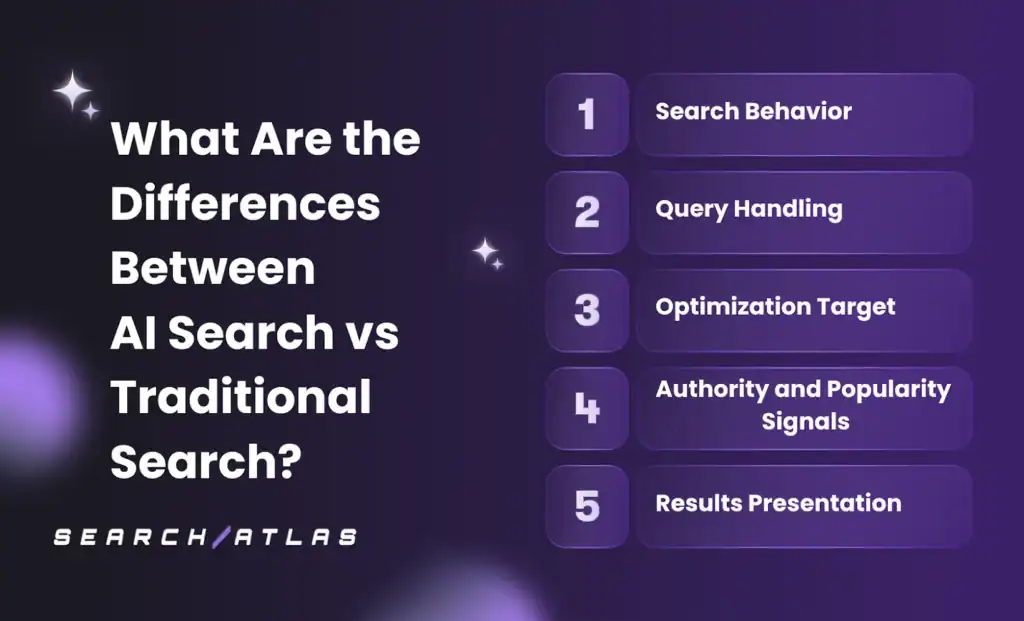
AI search and traditional search differ across how users interact with systems, how queries are processed, what optimization targets exist, which authority signals influence visibility, and how results are delivered. These differences shape discovery behavior, ranking logic, and visibility mechanics across search engine technologies and generative search systems.
The 5 key differences between GenAI searches vs traditional search engines are explained below.
1. Search Behavior
Search behavior describes how users interact with a search system to obtain information. Search behavior matters because it determines whether discovery happens through exploration or through direct resolution. In traditional search, users scan ranked result pages, compare links, and click through multiple sources to assemble an answer. Visibility depends on position and user choice across a list of results. In AI search, users expect immediate answers delivered inside the interface. AI search engines respond with synthesized explanations, follow-up prompts, and conversational continuity. Discovery happens inside a single interaction, and visibility depends on inclusion inside the generated answer instead of navigation patterns.
2. Query Handling
Query handling defines how a system interprets and processes user input. Query handling matters because it affects relevance, precision, and intent alignment. Traditional search engines process queries as keyword-driven requests, mapping terms to indexed documents and retrieving pages that match lexical patterns and historical relevance signals. Each query operates independently. AI search engines process queries as intent-rich prompts, preserving conversational context and semantic relationships across turns. Queries expand, refine, and evolve within a session, allowing AI search to interpret meaning, constraints, and follow-up intent without requiring reformulation.
3. Optimization Target
The optimization target defines what content creators and businesses optimize to gain visibility. Optimization target matters because it determines which actions increase exposure. In traditional search, optimization targets include page-level ranking factors such as keywords, backlinks, internal links, and technical performance that influence position within search results. In AI search, optimization targets focus on answer eligibility, citation inclusion, and semantic clarity that allow content to be retrieved, synthesized, and reused inside generated responses. Visibility depends on how well information supports extraction, reasoning, and reuse across AI-powered search systems.
4. Authority and Popularity Signals
Authority and popularity signals define how trust and credibility influence visibility. Authority matters because search systems prioritize reliable sources. Traditional search engines rely heavily on link-based popularity signals, domain authority, and historical performance to estimate trust. Visibility increases through accumulated backlinks and engagement metrics. AI search engines evaluate authority through factual consistency, entity recognition, topical completeness, and corroboration across multiple sources. Popularity contributes, but authority emerges from repeated validation and accuracy across contexts, which supports stable inclusion inside AI-generated answers.
5. Results Presentation
The results presentation describes how information is delivered to users. Results presentation matters because it determines how visibility converts into attention. Traditional search engines present results as ranked lists of links with titles, snippets, and rich results. Users control discovery by choosing which result to open. AI search engines present synthesized answers, summaries, comparisons, and recommendations directly within the interface, often with citations. Visibility occurs at the answer level, where presence inside the response defines exposure without requiring user navigation.
The comparison of search between AI search and traditional search shows a shift from ranking-driven discovery to answer-driven visibility, reshaping how optimization, authority, and results function across modern search environments.
How Optimization Strategies Differ Between Traditional Search and AI Search
Optimization strategies differ between traditional search and AI search because each system evaluates, selects, and presents information using different mechanisms. Translating system-level differences into execution-level actions clarifies how visibility is earned in rankings versus answers. The execution differences between traditional search optimization and AI search optimization are outlined below.
- Target of optimization. Traditional search optimization targets page-level ranking factors such as keyword placement, backlink profiles, internal linking, and technical performance to improve SERP positions. AI search optimization targets answer eligibility by structuring information so AI systems can retrieve, interpret, and reuse it during response generation.
- Content structure requirements. Traditional search favors comprehensive pages optimized around keyword clusters and navigational depth. AI search favors clearly segmented content with direct answers, explicit entities, and self-contained explanations that support extraction and synthesis.
- Authority-building approach. Traditional search builds authority primarily through backlinks and domain-level trust signals. AI search builds authority through factual consistency, corroboration across sources, and repeated accurate reuse inside generated answers.
- Visibility measurement. Traditional search measures success through rankings, impressions, and click-through rates. AI search measures success through citations, mentions, share of voice inside answers, and zero-click exposure.
- Update and maintenance cadence. Traditional search updates content to protect rankings and freshness signals. AI search updates content to correct interpretation drift, reinforce accuracy, and align with evolving AI retrieval patterns.
Optimization strategies shift from ranking control to answer inclusion as discovery moves from traditional search engines to AI-powered search systems, which require execution that prioritizes clarity, extractability, and reuse.
How to Optimize for Specific AI Platforms?
Optimizing for AI platforms requires aligning execution with how each system retrieves, evaluates, and presents information. Different AI systems prioritize different mechanisms, which means optimization must follow platform logic instead of generic AI SEO tactics.
The core optimization approaches by AI platform type are outlined below.
- Optimize for retrieval-first systems. Retrieval-first systems prioritize accessing accurate, well-structured source material before any synthesis occurs. Optimization focuses on clean HTML, clear information hierarchy, strong topical coverage, and explicit answers that can be retrieved independently. Content clarity and accessibility determine whether information enters the retrieval layer at all.
- Optimize for citation-driven systems. Citation-driven systems select sources to reference directly inside generated answers. Optimization centers on factual precision, consistent terminology, verifiable claims, and alignment with authoritative third-party sources. Repeated accuracy across contexts increases reuse probability and citation frequency.
- Optimize for conversational systems. Conversational systems support multi-turn interactions and contextual follow-ups. Optimization emphasizes intent-complete answers, context continuity, and modular explanations that remain accurate when referenced across multiple turns. Clear entity definitions prevent drift during extended conversations.
- Optimize for hybrid search platforms. Hybrid platforms combine ranked results with AI-generated answers. Optimization balances traditional crawlability and authority signals with answer-ready structure, ensuring content performs in both ranked listings and synthesized responses without fragmentation.
- Optimize for entity-centric systems. Entity-centric systems organize information around entities and relationships rather than pages. Optimization requires consistent entity naming, explicit attributes, clear relationships, and corroborated facts across multiple sources so AI systems can resolve identity and context reliably.
AI optimization paths align execution with platform mechanics, ensuring visibility is earned through retrieval eligibility, citation trust, conversational stability, and entity resolution.
How Should Businesses Adapt to Hybrid Search Environments?
Hybrid search environments combine ranked search results with AI-generated answers, which means visibility depends on performance across both retrieval models at the same time. Businesses must adapt execution so content remains competitive in classic SERPs while qualifying for extraction, synthesis, and citation inside AI answers.
The steps businesses should follow to adapt to hybrid search environments are listed below.
- Maintain technical SEO foundations. Maintain crawlability, indexability, and performance signals by keeping clean site architecture, fast page loading, mobile usability, and stable URLs. Technical SEO foundations ensure search engines and AI crawlers access, parse, and store content reliably. Technical stability protects visibility during algorithm changes and AI system updates (clean HTML, logical internal linking, consistent URL structure).
- Structure content for answer extraction. Structure content using clear headings, concise definitions, ordered lists, and direct answers placed early in sections. Answer-oriented structure allows AI systems to extract precise statements for summaries, citations, and conversational responses. Extractable content increases reuse across AI search, featured answers, and zero-click interfaces (definitions, step lists, comparison tables).
- Build entity-level authority. Build entity-level authority by defining the business, products, and topics consistently across pages and external references. Entity authority signals include clear terminology, topical coverage, third-party mentions, and structured data. Strong entity signals allow AI systems to resolve meaning accurately and reuse information without confusion (Organization schema, author attribution, consistent naming).
- Measure AI visibility alongside rankings. Track presence in AI-generated answers, citations, and mentions in addition to traditional rankings and traffic. AI visibility metrics reveal whether content appears during answer generation, not only during link-based searches. Combined measurement prevents blind spots where rankings remain stable, but AI exposure declines (citation frequency, answer mentions, AI share of voice).
Hybrid search adaptation requires a unified execution model that preserves technical SEO, enables answer extraction, strengthens entity authority, and measures AI visibility together rather than separately.
Platforms like Search Atlas centralize these workflows by combining technical audits, content structuring guidance, entity analysis, and AI visibility tracking in one system, which reduces fragmentation across teams and keeps optimization aligned with how hybrid search systems operate.
What Tools Do You Need for AI Search Success?
AI search success requires tools that measure answer-level visibility, validate entity understanding, and optimize content for citation inside AI-generated responses. SERP analysis shows that AI search optimization relies on four functional tool categories, each aligned with how AI-powered search engines retrieve, synthesize, and cite information.
The required tool categories you need for AI search success are listed below.
- AI visibility and answer monitoring tools. AI visibility tools track brand mentions, citations, and share of voice inside AI answers across platforms such as ChatGPT, Perplexity, and AI-powered search results. Tools like the Search Atlas LLM Visibility Tool replace position tracking with answer-level measurement, which reflects how AI systems expose brands in zero-click environments. The Search Atlas LLM Visibility Tool measures citation frequency, detects competitive displacement, and maps which entities and topics AI systems reuse most often (mentions, citations, answer share).
- AI-focused SEO and content optimization platforms. AI SEO platforms analyze content structure, semantic coverage, and question alignment to improve extractability for AI systems. AI-focused SEO and content optimization platforms evaluate whether content answers queries directly, uses clear entity definitions, and matches AI-preferred formats such as lists and comparisons. Search Atlas supports this layer by connecting topical maps, entity coverage, and optimization guidance into one workflow (entity alignment, topical depth, answer structure).
- Entity and topical authority analysis tools. Entity analysis tools evaluate whether content defines entities, attributes, and relationships consistently across a site. AI systems rely on entity clarity to resolve meaning and reuse information accurately.
- Analytics tools for AI-driven traffic and outcomes. Analytics tools track how AI exposure translates into engagement and conversions after AI-mediated discovery. Platforms such as Google Analytics 4 (GA4) and reporting layers connect AI referral traffic to downstream outcomes, which validates whether AI visibility produces business value. Search Atlas integrates AI visibility signals with performance data to align optimization actions with measurable results.
AI search success depends on combining visibility tracking, entity validation, and answer optimization into a single system of measurement and execution. Search Atlas consolidates AI capabilities into a single platform, which aligns optimization with how AI search engines select, cite, and present information.
Does AI Search Use the Same Ranking Signals as Traditional Search?
Yes, AI search uses traditional ranking signals for retrieval and adds generation-layer evaluation for answer construction. AI search systems rely on ranked web documents as inputs, which means relevance, authority, freshness, and link-based signals still influence which sources are eligible for selection. After retrieval, AI systems apply generation logic that evaluates clarity, factual consistency, and citation suitability to assemble answers.
How Much Traffic Does AI Search Currently Drive?
AI search currently drives approximately 1% of global website traffic, while growing at a triple-digit rate year over year. Exposure Ninja data shows that AI platforms generated 1.13 billion referral visits in June 2025, representing a 357% increase compared to June 2024. Despite this rapid growth, AI search remains a smaller traffic source than traditional search today. The impact of AI search is disproportionately high because AI-referred visitors convert at 14.2%, compared to 2.8% from Google Search, which makes AI traffic more commercially valuable than its volume suggests.
Which AI Search Platform Sends the Most Traffic?
ChatGPT sends the highest volume of identifiable AI referral traffic among AI platforms. ChatGPT dominates conversational search usage and produces the most trackable outbound referrals among AI systems. Google AI Overviews generates large-scale exposure inside Search, but produces fewer outbound clicks because answers appear directly on the results page. Perplexity and Copilot contribute smaller but measurable traffic volumes, mainly for research-oriented queries.
Do AI Overviews Hurt Organic Click-through Rates?
Yes, AI Overviews reduce organic click-through rates for informational queries. AI Overviews satisfy informational intent directly on the results page, which increases zero-click behavior. CTR decline concentrates on definitions, explanations, and comparisons, while transactional and navigational queries show less impact. Visibility shifts from page visits to citation presence, which changes how performance must be measured.
Does Google Use AI in Search?
Yes, Google uses AI extensively in search, but Google Search does not function as a pure generative AI system. Google Search integrates AI models to improve query understanding, ranking interpretation, spam detection, and result relevance, while preserving an index-based retrieval and ranking framework. Features such as AI Overviews and AI Mode introduce generative components, but these operate on top of traditional search infrastructure rather than replacing it.
How is generative AI worse than Google searching? Generative AI is not worse than Google Search, and Google Search is not replaced by generative AI. Google Search prioritizes ranked links, verified sources, and click-based discovery, while generative AI systems prioritize synthesized answers and conversational responses. Google blends both approaches by using AI to interpret intent and summarize information, while still relying on indexed documents, authority signals, and SERP-based visibility. This distinction explains why comparisons such as AI vs Google search describe complementary systems rather than direct replacements.
What Search Engine Does Not Use AI?
No major modern search engine operates without AI-based systems. All large-scale search engines use machine learning for relevance scoring, spam detection, and query understanding. The distinction between traditional search and AI search refers to interface behavior and answer generation, not to the absence of AI in underlying systems.
Will AI Search Eventually Replace Traditional Search Engines?
No, AI search expands discovery formats while traditional search remains necessary. AI search excels at direct answers and synthesis, while traditional search supports exploration, verification, and comparison across multiple sources. Search ecosystems evolve toward hybrid models that combine ranked results with generated answers. Replacement narratives oversimplify user behavior, which continues to require both answer delivery and document navigation.