
The difference between Answer Engine Optimization and Traditional SEO defines how modern search visibility operates across AI-mediated environments rather than only through ranked link systems. AEO and Traditional SEO represent 2 connected but distinct visibility models that determine how content is selected, presented, and trusted by search engines and AI answer systems instead of how pages rank alone.
The core difference between AEO and Traditional SEO lies in the stage of search interaction each controls. Traditional SEO governs page discovery and traffic acquisition, while Answer Engine Optimization governs answer delivery and response inclusion. Businesses now optimize for both because AI systems shape understanding and trust before users interact with websites.
Together, AEO and Traditional SEO define a hybrid visibility model where content competes for ranking placement and answer inclusion simultaneously. This evolution explains why understanding how AEO differs from Traditional SEO is now essential for achieving sustained visibility in AI-driven search environments.

What Is Answer Engine Optimization (AEO)?
Answer Engine Optimization (AEO) is a search optimization framework that structures content to appear directly as answers inside AI-powered search and voice systems. Answer Engine Optimization AEO targets visibility inside ChatGPT, Google AI Overviews, Gemini, Perplexity, and voice assistants rather than traditional link-based rankings.
Answer Engine Optimization governs how AI systems extract, select, and present information during answer generation. AEO shifts optimization from click acquisition to answer inclusion, which changes how brands compete for visibility. This shift defines what is AEO and positions it as a distinct search discipline.
What is the primary focus of AEO? Answer Engine Optimization focuses on answering questions directly inside the search interface rather than redirecting users to websites. Answer Engine Optimization produces zero-click visibility because AI systems present the answer without requiring a page visit. This focus matters because user behavior now centers on immediate resolution rather than navigation.
Why does AEO matter for modern search? Answer Engine Optimization matters because modern search now happens inside generated responses rather than ranked result pages. Answer Engine Optimization determines whether a brand appears inside the answer itself. This appearance defines visibility in AI-mediated discovery environments.
How Does AEO Work?
Answer Engine Optimization works by structuring content so AI systems extract, trust, and cite answers directly from a source. AEO restructures content to match question intent, response format, and authority expectations. This restructuring ensures that AI systems surface a brand inside the response layer.
Answer Engine Optimization shifts optimization from page ranking to answer inclusion inside AI-generated responses. This shift matters because AI systems now resolve queries through synthesized answers rather than ranked result lists.
What Is the Core Mechanism Behind AEO? The core mechanism of Answer Engine Optimization is direct answer structuring aligned with AI retrieval and citation logic. AEO formats content for Large Language Models (LLMs) detect clear question-answer pairs. This detection matters because AI systems prioritize explicit answers over narrative content.
Answer Engine Optimization compresses information into concise, authoritative responses. These responses fit AI response limits and voice delivery constraints. This fit increases reuse probability inside generated answers.
How Visibility Works in AEO?
Answer Engine Optimization visibility works by placing content inside AI-generated answers rather than positioning pages inside ranked result lists. AEO visibility shifts exposure from page placement to answer placement inside ChatGPT, Google AI Overviews, Perplexity, and Bing Copilot. AI systems now mediate discovery through synthesized responses instead of navigable result pages.
What is answer-level visibility in AEO? Answer-level visibility in Answer Engine Optimization refers to direct mentions of a brand or its information inside generated AI answers. Answer-level visibility places the source inside the response narrative rather than outside it as a clickable link. Answer-level visibility determines whether a brand participates in the answer layer.
What is citation-based visibility in AEO? Citation-based visibility in AEO refers to explicit source attribution inside AI responses. Citation-based visibility attaches a brand name or domain to a specific claim presented by the AI system. Citation-based visibility signals that an AI system selected a source as credible enough to reference publicly.
What is the share of voice in AEO? Share of voice in AEO measures how frequently a brand appears across AI-generated answers for a defined topic set. Share of voice inside AI responses reflects competitive dominance because AI systems often present only a limited number of sources per answer.
What is zero-click in AEO? Zero-click exposure in AEO occurs when users receive complete answers without visiting a website. Zero-click exposure positions the brand inside the answer while eliminating page visits.
AEO visibility depends on how AI systems extract small, intent-matched content blocks rather than evaluating full pages. These content blocks answer a single question with high factual precision and structural clarity. This extraction model explains why AEO visibility replaces ranking-based visibility in AI-driven search environments.
What Is Traditional SEO (Search Engine Optimization)?
Traditional SEO is the legacy model that optimizes websites for ranked visibility inside traditional search engines. Traditional SEO targets organic placement inside list-based search engine results pages on Google and Bing. This model matters because ranked visibility historically defined how users discovered information online.
Traditional SEO refers to the process of improving a website presence in unpaid search results to increase both the quantity and quality of organic traffic. Traditional SEO aligns website content and technical infrastructure with how search engines crawl, index, and rank pages.
What does traditional SEO optimize? Traditional SEO optimizes website content and technical structure so search engines crawl, index, and rank pages correctly. Traditional SEO optimizes keyword relevance, site architecture, page speed, and mobile usability. These attributes define whether a page qualifies for competitive organic placement.
What does traditional SEO focus on? Traditional SEO focuses on earning organic visibility through relevance, accessibility, and authority. Traditional SEO emphasizes making pages understandable to search engines and useful to users at the same time. Traditional SEO prioritizes keyword alignment, content relevance, technical accessibility, and backlink-based authority. These attributes define whether a page qualifies for competitive organic placement.
Why is traditional SEO considered a legacy model today? Traditional SEO is considered a legacy model because it optimizes for ranked links rather than synthesized answers. Traditional SEO operates in an environment where users select pages from lists instead of consuming generated responses. Traditional SEO still supplies the indexed, authoritative content that AI systems retrieve and summarize.
What Is a Traditional Search Engine?
A Traditional Search Engine is a computer system that retrieves and ranks web pages to present users with a list of relevant hyperlinks. A Traditional Search Engine operates inside platforms (Google, Bing, and Yahoo). This system matters because it organizes the open web into navigable, ranked results rather than synthesized answers.
A Traditional Search Engine refers to a retrieval-based information system that crawls, indexes, and ranks billions of web documents. A Traditional Search Engine responds to queries by returning structured result pages composed of URLs, titles, and snippets. This response format defines how users interact with search through link selection rather than answer consumption.
What does a traditional search engine return to users? A Traditional Search Engine returns ranked lists of web pages rather than direct, synthesized answers. A Traditional Search Engine presents results as hyperlinks ordered by estimated relevance and authority. This format matters because users must choose which page to open to obtain the information.
How does a traditional search engine differ from AI-Driven search systems? A Traditional Search Engine differs from AI-driven search systems because it retrieves ranked documents rather than generating answers. A Traditional Search Engine uses formulaic algorithms to score and order pages. This scoring model contrasts with generative systems that synthesize responses from multiple sources.
How Does Traditional SEO Work?
Traditional SEO works by aligning website content, technical quality, and authority signals to achieve ranked visibility inside traditional search engines. Traditional SEO produces rankings by matching pages to query intent and validating those pages through performance and trust signals. This alignment matters because ranking systems compare pages across relevance, accessibility, and authority.
Traditional SEO refers to a manual and long-term optimization model focused on improving visibility for broad, non-location-specific queries. Traditional SEO relies on human expertise rather than automated execution systems.
How does traditional SEO achieve ranked visibility? Traditional SEO achieves ranked visibility by aligning content relevance, technical quality, and authority signals. Traditional SEO combines content optimization, technical optimization, and authority development into a unified ranking model. These mechanisms define how Traditional SEO produces rankings.
How Visibility Works in Traditional SEO?
Traditional SEO visibility works by positioning pages inside ranked result lists rather than placing content inside generated answers. Traditional SEO visibility shifts exposure from answer placement to page placement inside organic search engine results pages. Traditional search engines mediate discovery through navigable links instead of synthesized responses.
Traditional SEO visibility depends on how high a page appears in the ranked list for a given query. This dependence matters because user attention concentrates on the first visible results.
What is ranking-based visibility in traditional SEO? Ranking-based visibility in Traditional SEO refers to exposure created by a page position within a ranked list of results. Ranking-based visibility increases as a page ranks higher because users interact more frequently with top positions.
Why does traditional SEO visibility depend on ranking positions? Traditional SEO visibility depends on ranking positions because users select results based on list order rather than content synthesis. Traditional SEO presents discovery through navigation across ranked links.
What mechanisms determine traditional SEO visibility? Traditional SEO visibility emerges from the interaction between relevance, authority, and technical accessibility. Traditional SEO visibility increases when search engines identify a page as relevant to a query, trustworthy among alternatives, and technically accessible.
Traditional SEO visibility therefore reflects cumulative performance across multiple evaluation layers rather than a single optimization factor.
Do Answer Engines Function the Same Way as Traditional Search Engines?

No, answer engines do not function the same way as traditional search engines. Answer engines and traditional search engines both provide information, but they operate through different models. This difference matters because each system defines how users discover and consume content.
Answer engines refer to AI-driven systems that synthesize information from multiple sources into a single conversational response. This synthesis resolves the query directly rather than redirecting the user. Traditional search engines refer to retrieval-based systems that crawl, index, and rank web pages. This retrieval model returns ranked links that require navigation.
Answer engines therefore function as resolution systems, while traditional search engines function as retrieval systems. This functional distinction explains why AEO and SEO require separate visibility strategies.
What Are the Core Differences Between AEO and Traditional SEO?
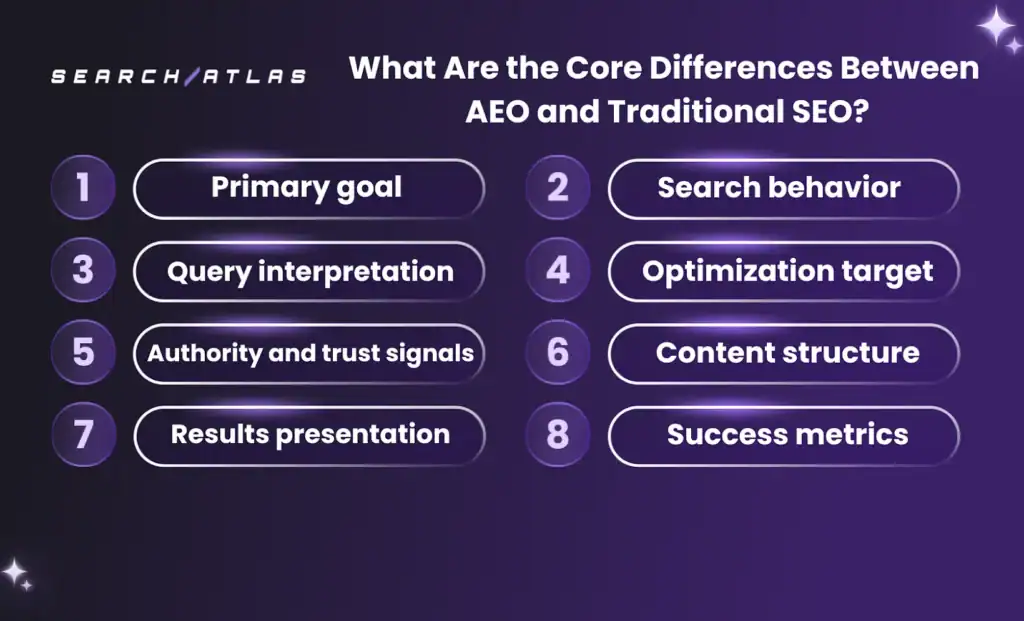
The core differences between AEO and Traditional Search SEO lie in how each system defines visibility, interprets queries, structures content, and measures success across modern search environments. These differences affect how information is retrieved, how authority is established, and how brands gain visibility across AI-driven and search engine–driven interfaces.
The core differences between AEO and Traditional SEO are below.
| Answer Engine Optimization | Traditional Search Engine Optimization | |
| Primary goal | Focuses on delivering direct and precise answers to AI-powered search users rather than driving visits to websites. | Focuses on ranking pages higher on traditional search engines to drive organic website traffic. |
| Search behavior | Serves conversational, AI-driven, and voice queries that often result in zero-click searches. | Serves keyword-driven, text-based searches designed to maximize clicks and website traffic. |
| Query interpretation | Optimizes for semantic understanding and natural-language questions. | Optimizes for keyword matching in ranked links using short, keyword-centric phrases. |
| Optimization target | Optimizes for answer eligibility by producing concise, structured answers extractable by AI systems. | Optimizes pages for ranking through algorithmic evaluation and relevance scoring. |
| Authority and trust signals | Builds authority through semantic clarity, direct answers, entity reliability, and citation inside AI summaries. | Builds authority through backlinks, domain age, organic traffic, and ranking performance. |
| Content structure | Structures content as short, conversational, factual, and easily extractable blocks using schema, Q&A, lists, and tables. | Structures content as long-form, keyword-rich documents designed to rank and drive clicks. |
| Results presentation | Appears as AI summaries, featured snippets, voice answers, and cited responses inside AI platforms. | Appears as blue links, rich snippets, and SERP features designed to encourage clicks. |
| Success metrics | Measures success through AI visibility percentage, citation frequency, share of voice in AI, zero-click impressions, and brand mentions. | Measures success through organic traffic volume, keyword rankings, CTR, and conversion rate. |
How Optimization Strategies Differ Between Traditional SEO and AEO?
Optimization strategies differ between Traditional SEO and AEO because each system evaluates, retrieves, and presents information through different mechanisms. Translating system-level differences into execution-level actions clarifies how visibility is earned through ranked pages versus AI-generated answers.
The differences in strategies between Traditional SEO and AEO are outlined below.
- Target of optimization. Traditional SEO targets page-level ranking factors (keyword placement, backlink profiles, internal linking, and technical performance) to improve SERP positions and drive traffic. AEO targets answer eligibility by structuring content so AI systems extract, interpret, and reuse information inside featured snippets, AI summaries, and voice answers.
- Content format requirements. Traditional SEO favors long-form, comprehensive pages optimized around keyword clusters and navigational depth. AEO favors structured data, FAQs, and concise, direct answers that AI systems easily parse and present.
- Keyword and query strategy. Traditional SEO focuses on short and long-tail keyword phrases aligned to search demand. AEO adapts to natural language, conversational, and question-based queries.
- Authority and trust construction. Traditional SEO builds authority through backlinks, traffic signals, and on-site engagement. AEO builds authority through brand trust, verified information, and consistent accuracy across platforms so AI models select the content confidently.
- Technical optimization focus. Traditional SEO emphasizes site structure, speed, mobile performance, and backlink acquisition. AEO emphasizes schema markup and structured data to define context and content roles for AI systems.
Optimization strategies now extend from ranking control to answer inclusion as AI-driven systems prioritize direct responses. This shift requires execution that combines discoverability through SEO with extractability and citation through AEO.
How to Optimize Specifically for AEO?
Optimizing for Answer Engine Optimization requires structuring content so AI systems extract, trust, and reuse answers directly. Answer Engine Optimization targets visibility inside ChatGPT, Gemini, and voice assistants rather than page rankings. This target matters because AI systems now mediate how users receive information.
Answer Engine Optimization relies on schema markup, passage-level clarity, and entity-based formatting. These mechanisms make content extractable, credible, and eligible for AI-generated answers. Answer Engine Optimization optimization focuses on direct answers written in natural language with explicit entity definitions. This format enables AI systems to identify factual boundaries and response-ready content.
How Businesses Can Adapt to Hybrid SEO and AEO Environments?
Businesses adapt to hybrid SEO and AEO environments by aligning content creation, technical structure, and authority building with how both search engines and AI answer systems evaluate and present information.
Hybrid environments select content based on crawlability, semantic relevance, entity clarity, and factual consistency across ranked and generated search interfaces. Effective adaptation improves ranked visibility, answer inclusion, citation, and reuse inside AI-generated responses rather than relying only on link-based discovery.
The 6 methods for businesses to adapt to hybrid SEO and AEO environments are listed below.
- Shift content strategy from keywords to answers.
- Implement technical AEO and structured data.
- Build authority and trust across ranked and AI systems.
- Adopt hybrid success metrics beyond traffic and rankings.
- Operationalize hybrid execution inside workflows.
- Select a unified platform that measures and executes both layers.
1. Shift Content Strategy From Keywords to Answers
Shifting content strategy from keywords to answers ensures that content satisfies both ranking algorithms and AI answer extraction systems. Hybrid environments prioritize content that resolves user intent directly while preserving depth for navigational discovery. Question-based queries, conversational phrasing, and direct answer placement in the first 40 to 60 words improve both featured snippet eligibility and AI citation likelihood. Topic clusters and pillar pages reinforce authority while enabling answer reuse across AI systems. A practical takeaway involves structuring each page with a clear answer first and comprehensive context immediately after.
2. Implement Technical AEO and Structured Data
Implementing technical AEO and structured data enables machines to interpret content roles and relationships explicitly. Schema markup for FAQ, HowTo, and Q&A clarifies context for AI systems while preserving traditional crawlability and indexing for search engines. Clear heading hierarchies, short paragraphs, and mobile readiness improve extraction and voice usability at the same time. Hybrid environments reward machine-readable formatting because it reduces ambiguity during retrieval and presentation. A practical takeaway involves treating structured data as a visibility layer rather than a compliance feature.
3. Build Authority and Trust Across Ranked and AI Systems
Building authority and trust across ranked and AI systems ensures that content qualifies for both ranking and citation. Traditional authority derives from backlinks and engagement, while AI trust derives from consistency, corroboration, and entity recognition across platforms. Hybrid environments evaluate authority holistically rather than by channel. A practical takeaway involves aligning brand presence and factual consistency across web, social, and industry sources.
4. Adopt Hybrid Metrics for Success
Adopting hybrid metrics ensures that performance reflects both ranked discovery and AI-mediated visibility. Rankings and traffic measure navigational success, while AI citations, featured snippet acquisition, voice impressions, and brand mentions inside AI contexts measure answer-level influence. Hybrid environments require visibility measurement beyond clicks because exposure increasingly occurs without page visits. A practical takeaway involves tracking AI visibility alongside traditional KPIs rather than replacing one with the other.
5. Select a Unified Platform That Executes Both Layers
Selecting a unified platform ensures that measurement and execution occur across both ranked and generated visibility surfaces. Hybrid environments require tools that track keyword rankings, crawlability, and backlinks while simultaneously monitoring citation frequency, AI presence, and competitive displacement inside AI-generated answers. Systems like Search Atlas LLM Visibility tool allows teams to monitor how brands appear, are cited, and are displaced inside AI-generated answers and connect those insights directly to content, technical, and authority workflows. This structure converts AI exposure into an operational signal rather than a passive metric. A practical takeaway involves prioritizing platforms that transform AI visibility into executable optimization actions.
What Tools Do You Need for AEO and SEO Success?
The tools needed for AEO and SEO success measure, manage, and optimize visibility across both traditional search engines and AI-generated answer systems. These tools must track ranked visibility, citation presence, and competitive exposure inside AI-powered interfaces while enabling execution across content, technical SEO, and authority operations.
The 6 tools for AEO and SEO success are Search Atlas, Bear AI, Gauge, Profound, Peec AI, and Surfer SEO.
- Search Atlas. Search Atlas tracks brand visibility across AI-powered answer systems and traditional search environments in one platform. Search Atlas measures citation frequency, AI presence, keyword rankings, and competitive displacement across both SERPs and AI-generated answers. Search Atlas connects AEO, SEO, GEO, and AIO workflows with content optimization, technical execution, and authority building. This unified execution capability makes Search Atlas the most complete system for combined AEO and SEO success.
- Bear AI. Bear AI tracks citations and content references across AI engines and suggests content improvements based on observed answer patterns. Bear AI emphasizes AI visibility monitoring and recommendation-driven content updates, which supports teams focused on improving answer inclusion after visibility gaps appear.
- Gauge. Gauge monitors prompts and query-level performance across AI systems and provides data-driven recommendations. Gauge emphasizes prompt analytics and response-level tracking, which fits teams that prioritize understanding how AI systems interpret and surface brand content.
- Profound. Profound offers multi-LLM tracking and competitive analysis across AI-powered platforms. Profound identifies where brands appear, which queries trigger visibility, and which competitors displace them inside AI-generated answers. Profound fits organizations focused on diagnostics and large-scale monitoring rather than execution.
- Peec AI. Peec AI tracks brand mentions across AI-generated answers and competitive responses. Peec AI emphasizes brand presence monitoring and comparative visibility, which supports teams that prioritize awareness and reputation tracking inside AI systems.
- Surfer SEO. Surfer SEO creates AI-optimized content by aligning pages with ranking and semantic patterns observed across top-performing search results. Surfer SEO emphasizes content creation and on-page optimization, which fits teams that focus on producing pages engineered for both traditional SEO and AI-assisted visibility.
Among available tools, Search Atlas provides the most complete AEO, AIO, GEO, and SEO workflow because it connects AI visibility tracking directly to execution across content, technical SEO, and authority operations inside one system.
Does AEO Use the Same Ranking Signals as Traditional SEO?
No, Answer Engine Optimization (AEO) does not use the same ranking signals as Traditional SEO, although AEO builds on many of them. Answer Engine Optimization evaluates content for answer inclusion, while Traditional SEO evaluates content for ranked placement.
Answer Engine Optimization refers to optimizing content for extraction and citation inside AI-generated responses. Traditional SEO refers to optimizing pages for ranked placement inside organic result lists. These definitions explain why AEO evaluates content at the answer level while Traditional SEO evaluates content at the page level.
How do AEO and traditional SEO differ in signal focus? AEO and Traditional SEO differ because AEO prioritizes structure and entity clarity while Traditional SEO prioritizes keyword relevance and link authority. Answer Engine Optimization formats content for question-answer retrieval, while Traditional SEO formats content for ranking comparison.
Where do AEO and traditional SEO still share signals? AEO and Traditional SEO share foundational signals related to trust and accessibility. Experience, Expertise, Authoritativeness, and Trustworthiness (E-E-A-T) influence which sources AI systems cite. Technical health and backlinks still act as credibility filters. These shared signals explain why Traditional SEO remains a prerequisite for AEO effectiveness.
Does AEO Reduce Traditional Organic Click-Through Rates?
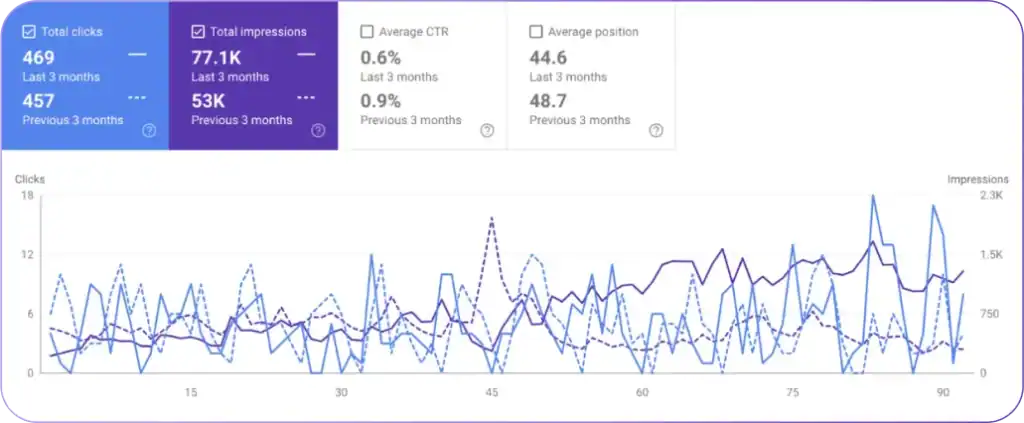
Yes, Answer Engine Optimization (AEO) reduces traditional organic click-through rates by shifting user attention from links to answers. Answer Engine Optimization accelerates zero-click behavior because AI systems resolve queries directly inside the interface. This shift matters because users no longer need to visit pages to obtain basic information.
Answer Engine Optimization affects Traditional SEO performance by compressing the discovery funnel. AI-powered summaries and AI Overviews satisfy informational intent before navigation occurs. This satisfaction reduces the number of clicks available to ranked pages.
Answer Engine Optimization therefore changes what visibility means in search environments. Visibility now depends on answer inclusion and citation rather than on link selection alone. This redefinition explains why traditional click-through rates decline even as overall search usage continues to grow..
Does Google Support AEO?
Yes, Google supports the principles of Answer Engine Optimization (AEO) even though Google does not use the term officially. Google supports Answer Engine Optimization by prioritizing direct answers through AI Overviews, Featured Snippets, and other answer-focused result formats instead of relying only on ranked blue links. This support matters because Google increasingly surfaces information as resolved answers rather than navigation paths.
Google operationally enables AEO through its search presentation layer. AI Overviews synthesize information from trusted sources, and Featured Snippets extract concise passages that directly answer questions. These systems reward content that presents clear definitions, structured explanations, and factual consistency, which aligns with AEO execution rather than traditional page-level ranking alone.
Google does not require a separate AEO strategy distinct from Search Engine Optimization. High-quality SEO practices that emphasize clarity, structure, entity definition, and authority enable both ranked visibility and answer inclusion. Content that satisfies SEO quality standards remains eligible for AI Overviews and answer extraction without additional optimization layers.
Google therefore supports AEO functionally rather than formally. The shift appears in how results surface information, measure usefulness, and reduce reliance on clicks.
Will AEO Replace Traditional SEO?
No, Answer Engine Optimization (AEO) will not replace Traditional SEO because AEO and Traditional SEO operate together over the same foundation. Answer Engine Optimization extends Search Engine Optimization rather than displacing it.
Answer Engine Optimization builds on Traditional SEO by adapting content for AI-powered, conversational, and voice-driven search environments. Traditional SEO establishes ranked visibility and domain authority, while Answer Engine Optimization governs how that same content becomes extractable and citable inside AI-generated answers. This division defines complementary roles rather than substitution.
Answer Engine Optimization therefore functions as an evolution of Traditional SEO rather than a replacement. Structured data, entity-based formatting, and machine-readable content upgrade how optimized pages perform inside AI systems. This upgrade preserves the foundational role of Traditional SEO while extending visibility into answer-driven interfaces.
A hybrid strategy that integrates Traditional SEO and Answer Engine Optimization defines the future of search visibility across ranked and generative environments.