AI is a powerful tool for writing product descriptions because it enables faster content creation, scalable workflows, and consistent messaging across large product catalogs. Businesses use AI to generate initial drafts, refine messaging, and adapt descriptions for different audiences and platforms. The most effective approach is to treat AI as a collaborative assistant that enhances human creativity and efficiency rather than replacing it.
One of the main advantages of using AI in product description writing is speed and scalability. AI generates multiple variations of descriptions in seconds, which helps teams manage large inventories and maintain consistent formatting across products. This capability allows businesses to test different messaging styles, optimize descriptions for SEO, and quickly update content when product details change.
The quality of AI-generated descriptions depends heavily on the inputs provided. Clear and detailed prompts that include product features, benefits, target audience, tone, and use cases lead to more accurate and relevant outputs. Generic or vague instructions often result in repetitive or broad content, while structured guidance helps produce descriptions that align with brand identity and user intent.
Human review remains an essential part of the process. AI-generated content needs to be edited to verify factual accuracy, refine tone, and ensure alignment with brand voice. This step helps remove generic phrasing and adds specific insights that make descriptions more persuasive and unique. Combining AI efficiency with human judgment leads to stronger and more reliable content.
AI supports optimization by helping structure descriptions, incorporate relevant keywords naturally, and adapt messaging for different channels such as ecommerce platforms, marketplaces, and social media. This flexibility allows businesses to maintain consistency while tailoring content to specific contexts.
What Is a Product Description?
A product description is marketing content that explains what a product is, what it does, and why it is worth buying. A product description combines factual information with persuasive language to guide purchasing decisions and reduce uncertainty during evaluation. Product descriptions exist as a core element of ecommerce because they replace the in-store experience with structured, informative, and conversion-focused content.
When did product descriptions become essential? Product descriptions became essential in the mid-1990s with the rise of ecommerce platforms that required detailed product information for remote purchasing. Early online stores needed structured content to replace physical inspection and salesperson interaction, which established product descriptions as a standard component of every product page. This shift transformed descriptions from simple catalogs into strategic marketing assets that influence visibility, trust, and conversion.
How does a product description differ from other types of marketing content? A product description differs from advertisements and brand storytelling because it focuses on a single product and drives direct purchase intent. Advertisements generate awareness, while product descriptions convert that awareness into action through clarity, detail, and persuasion. Product descriptions combine elements of technical documentation and sales copy, which creates a balance between factual accuracy and emotional appeal.
What information does a product description include? A product description includes core product data, functional features, and practical details that define the product. Product descriptions present specifications like size, material, and functionality, while connecting those features to real-world benefits and use cases. This structure ensures that readers understand both what the product is and how the product fits into their needs.
Why do product descriptions influence purchasing decisions? Product descriptions influence purchasing decisions because they reduce uncertainty and build confidence through clear, relevant information. Strong descriptions answer common questions, highlight differentiators, and create a mental image of product use. Product descriptions are fundamental to online retail success because 80% of customers conduct research before buying, which makes detailed descriptions critical for informed decisions.
How do product descriptions impact SEO and performance? Product descriptions impact SEO and performance by improving keyword relevance, content depth, and search visibility across product pages. Fully optimized descriptions increase rankings, drive organic traffic, and expand product discoverability. Continuous A and B testing of headlines, call-to-action text, and formatting improves performance over time, while monitoring sales metrics and customer feedback refines messaging and maximizes conversions.
What makes a product description effective? An effective product description uses precise language, structured formatting, and clear benefit-driven messaging. Effective descriptions connect features to outcomes, maintain consistent tone, and align with search intent. This combination improves readability, strengthens trust, and increases the likelihood of purchase by guiding the reader from interest to decision.
What Is the Difference Between Features and Benefits in a Product Description?
Features and Benefits are elements in product descriptions, but they differ fundamentally in their focus and impact on customer perception. Features are product-centric, describing what a product is or does through objective characteristics like specifications, components, or functionalities. Benefits are customer-centric, explaining how a product improves a customer’s life by solving problems or fulfilling desires.
This distinction matters because while features provide factual information, benefits connect emotionally with customers, driving interest and influencing purchasing decisions more effectively.
| Aspect | Features | Benefits |
|---|---|---|
| Core Focus | Product-centric: What the product is or does (e.g., specifications, functions). | Customer-centric: How the product improves the customer’s life (e.g., solves pain, fulfills dreams). |
| Description Type | Objective characteristics, technical details, physical traits, performance metrics. | Subjective emotional outcomes, advantageous results, enhancements, value additions. |
| Language Cues | Typically uses “our” language (e.g., “Our product has…”). | Identifiable by “you” language (e.g., “You will experience…”). |
| Marketing Impact | Appears “me, me, me,” expecting customers to infer relevance; described as “lazy marketing.” | Significantly increases brand likability, generates interest, and drives sales by connecting emotionally. |
| Sales Influence | “Features tell,” providing information but often leaving prospective customers “yawning.” | “Benefits sell,” influencing buying decisions by showing a better future and pain avoided. |
| Customer Psychology | Appeals to the rational part of the brain; facts become relevant after interest is established. | Taps into subjective emotions, personal experiences, hopes, and dreams; people decide based on feeling. |
| Conversion to Purchase | Less likely to convert interest into purchases when used alone. | More likely to convert interest into purchases, especially when balanced with features. |
| SEO Visibility | Less likely to match conversational, long-tail search queries. | More likely to match conversational, hyper-specific, long-tail search queries, improving SEO. |
What are the features in a product description? Features are objective attributes that describe the product itself through measurable or observable details. Features include materials, dimensions, technical specifications, and functional capabilities that define how a product works. Features provide clarity and accuracy, which establish credibility and allow customers to understand what they are evaluating before making a decision.
What are the benefits of a product description? Benefits are outcome-driven explanations that translate features into real-world value for the customer. Benefits show how a product improves comfort, saves time, increases efficiency, or solves a specific problem. Benefits connect directly to customer intent because they answer the question of why the product matters in a practical or emotional context.
Why does the distinction between features and benefits matter for conversions? The distinction matters because features inform while benefits persuade, and persuasion drives purchasing decisions. Features alone require the reader to interpret relevance, which creates friction and reduces engagement. Benefits remove that friction by making value explicit, which increases clarity, interest, and likelihood of conversion.
Why does AI often produce feature-heavy product descriptions? AI often produces feature-heavy descriptions because training data contains structured product catalogs and manufacturer specifications. This data format emphasizes attributes rather than outcomes, which leads AI to default to descriptive but non-persuasive content. Without explicit instruction, AI prioritizes listing characteristics instead of translating those characteristics into customer value.
How does the feature to benefit the conversion formula improve product descriptions? The feature to benefit conversion formula improves product descriptions by structuring content as a feature followed by an outcome and supported by proof. A feature becomes persuasive when it connects to a clear result, and that result becomes credible when supported by a specific example or use case. This structure ensures that every product detail contributes directly to the buying decision.
How can prompts enforce the correct balance between features and benefits? Prompts enforce balance by requiring each feature to include a corresponding outcome written from the customer perspective. A structured instruction that maps each feature to a clear benefit ensures that descriptions remain focused on value rather than raw data. This approach creates consistent, conversion-focused content that aligns product information with customer expectations and intent.
What Makes a Good AI Product Description?
AI-generated product descriptions are marketing copy designed to educate potential customers about a product’s features, functions, and benefits, while encouraging or enticing them to buy. Effective product descriptions increase sales and conversion rates.
What are the key characteristics of effective AI product descriptions? Effective AI product descriptions are compelling, optimized, and benefit-oriented, attracting potential customers and closing sales. Product descriptions target relevant keywords and phrases for improved search engine rankings and organic traffic. Product descriptions focus on benefits, not just features, translating technical specifications into real-world value.
Effective AI product descriptions are target audience-focused and on-brand with a consistent voice. Product descriptions are tailored to the target customer, speaking directly to them, and adapting style. Product descriptions match the brand’s unique tone and personality, for example, “witty and informal” or “luxurious and aspirational,” maintaining consistency across multiple products and platforms.
Effective AI product descriptions prioritize SEO and searchability, readability, and scannability. Product descriptions include relevant keywords naturally in titles, descriptions, meta descriptions, and image alt text without “keyword stuffing.” Product descriptions use Natural Language Processing (NLP) for better understanding by search engine crawlers. Product descriptions are clear, concise, and easy to scan, utilizing short paragraphs, headers, bullet points, and bold text for important information, especially for mobile viewing.
Effective AI product descriptions are persuasive and accurate, proactively addressing frequently asked questions. Product descriptions convince potential customers that the product meets their needs, often using conversion-driven language that focuses on emotional benefits first. Product descriptions provide correct information about the product, which requires human oversight for fact-checking. Product descriptions incorporate answers to common customer questions directly into the description.
Effective AI product descriptions leverage research and social proof, producing natural-sounding content. Product descriptions mention product testing, certifications, awards, or customer reviews, though AI’s ability to generate these authentically requires human input. Product descriptions produce human-like content that organically incorporates targeted keywords, avoiding robotic or generic phrasing. Product descriptions adapt messaging based on insights into customer preferences.
Effective AI product descriptions utilize emotional storytelling for viral impact. Product descriptions combine emotional storytelling, platform-specific language, and clear product details. Product descriptions lead with how the product makes someone feel, creating a more engaging and memorable experience for potential customers.
What is the AI workflow for optimal product description output? The AI workflow for optimal product description output involves inputting basic product details and configuring keywords and SEO parameters. Product details include the product name, category, key features, materials, dimensions, warranty, benefits, unique selling points, and target demographic. Users input target SEO keywords (primary and secondary) or use AI suggestions to enhance search engine visibility.
The AI workflow defines tone and voice, and sets constraints and format for the product descriptions. Tone and voice descriptors include “professional and informative,” “witty and informal,” “luxury,” or “Gen Z.” Constraints and format specify length, such as “under 150 words,” and structure, such as a “catchy headline,” “three bullet points,” a “bullet list of 5 key features,” a “paragraph on benefits,” or a “short section on technical specifications.”
The AI workflow provides model descriptions or examples, includes comparisons or use cases, and requests a call-to-action. Users offer an example of a preferred product description to guide style, structure, and detail. Users request the inclusion of comparisons or specific use cases to provide context. Users ask for a compelling call-to-action, “request a custom quote” or “schedule a product demonstration.”
What essential human oversight and best practices are required for AI product descriptions? Essential human oversight and best practices for AI product descriptions include critical human oversight, editing, and review. Human oversight is essential for accuracy, nuance, cultural and linguistic relevance, brand voice alignment, and avoiding AI hallucinations. Human editors check for accuracy, validate technical details, fine-tune messaging, and ensure alignment with brand standards.
Fact-checking is crucial for all AI-generated content to reduce the risk of inaccuracies or misleading information. Human editors tweak AI-generated content to be more natural, which reduces the risk of Google penalties for “poor-quality content created with AI.” Humans inject emotional appeal, addressing pain points and aspirations that AI overlooks.
A hybrid approach is recommended for AI product descriptions, combining AI generation with manual modification. This approach aligns content with brand voice and facilitates A/B testing. AI relies on accurate and detailed product information inputs to generate relevant descriptions. Clear prompts are essential, using clear language, specifying word count, defining tone, including SEO keywords, and highlighting product benefits.
How to Write Product Descriptions with AI: Step-by-Step Workflow
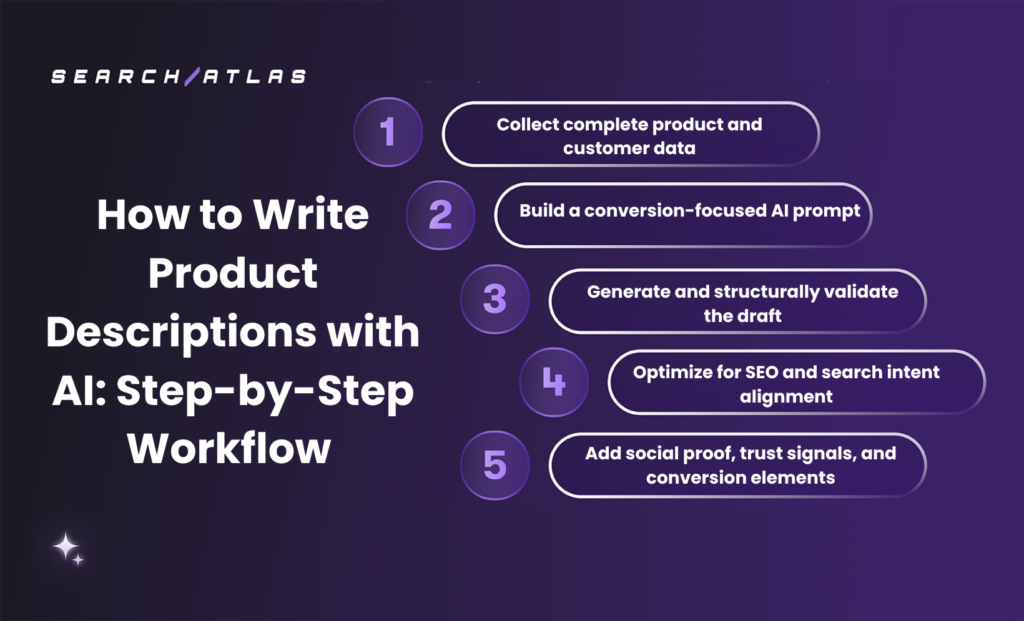
AI product descriptions work best when the process follows a structured workflow that combines product data, customer insight, search intent, and human review. AI product description generators use natural language processing and large language models to produce clear, persuasive copy at scale, but output quality depends on the quality of the inputs and the validation process. A strong workflow improves speed, consistency, SEO performance, and conversion potential while keeping descriptions aligned with brand voice and buyer intent.
The 5 steps to write product descriptions with AI are listed below.
- Collect complete product and customer data
- Build a conversion-focused AI prompt.
- Generate and structurally validate the draft.
- Optimize for SEO and search intent alignment.
- Add social proof, trust signals, and conversion elements.
1. Collect Complete Product and Customer Data
Collecting complete product and customer data is the foundation of effective AI product description writing because AI depends on structured, relevant inputs to generate accurate and persuasive copy. Product data needs to include the product name, category, technical specifications, dimensions, materials, warranty, use cases, and differentiators. Customer data needs to include the target audience, purchase motivations, pain points, and preferred language style. This step matters because weak input creates weak output, and poor data quality remains one of the main reasons AI content projects fail. Strong data collection improves relevance, reduces factual errors, and gives AI the context needed to write descriptions that match buyer expectations. Complete data collection improves accuracy and creates the conditions for consistent performance across large catalogs.
2. Build a Conversion-Focused AI Prompt
Building a conversion-focused AI prompt is the step that turns raw product data into persuasive product copy. A strong prompt defines the product clearly, identifies the target audience, sets the desired tone, specifies the format, includes required keywords, and states the call to action. This step is essential because AI defaults to generic output when the prompt lacks structure or specificity. A conversion-focused prompt guides the model toward benefits, differentiators, and purchase motivation instead of vague summaries. The strongest prompts do not stop at listing product features. The strongest prompts translate every feature into a buyer outcome. The most effective structure follows a simple conversion formula, which is feature, benefit, proof. This structure keeps the copy specific, persuasive, and credible. A well-built prompt improves consistency, reduces editing time, and produces descriptions that align with brand voice, search intent, and conversion goals.
3. Generate and Structurally Validate the Draft
Generating the draft is only one part of the workflow. Structural validation determines whether the draft is usable, readable, and aligned with product page goals. AI generates descriptions quickly, but speed alone does not guarantee clarity or quality. The draft needs to be checked for structure, factual accuracy, formatting, and brand alignment. A strong product description usually includes a clear opening, key product details, buyer-oriented benefits, and a direct call to action. The draft needs to stay concise, easy to scan, and free of contradictions or vague claims. This step is important because AI-generated descriptions often need refinement for tone, nuance, and natural flow. Human review remains essential for validating technical information, removing weak phrasing, and strengthening persuasive language. Structural validation improves readability, preserves trust, and ensures the final copy performs as both product information and sales content.
4. Optimize for SEO and Search Intent Alignment
Optimizing AI product descriptions for SEO and search intent alignment improves visibility, discoverability, and relevance in both traditional and AI-powered search environments. Product descriptions need to include primary and secondary keywords naturally, answer customer questions clearly, and reflect the language buyers actually use when searching. Search optimization is not just about keyword inclusion. Search optimization is about semantic clarity, content structure, and intent matching. A strong SEO description explains what the product is, who the product is for, and why the product matters. This step improves rankings because search engines and AI systems prefer content that is clear, structured, and easy to extract. Product descriptions perform better when headings, formatting, short paragraphs, and clear answers support readability. SEO optimization makes descriptions easier to find, while search intent alignment makes descriptions more useful once buyers arrive on the page.
5. Add Social Proof, Trust Signals, and Conversion Elements
Adding social proof, trust signals, and conversion elements strengthens the final product description by reducing hesitation and increasing purchase confidence. Product descriptions become more persuasive when they include evidence that the product performs well for real buyers. This evidence comes from ratings, reviews, testimonials, usage numbers, certifications, guarantees, or product-specific proof points. Social proof matters because buyers often look for reassurance before making a purchase, especially in online environments where they cannot physically inspect the product. Trust signals reinforce credibility, while conversion elements guide action. Clear calls to action, benefit-focused phrasing, guarantees, and customer validation work together to increase the likelihood of purchase. This final step matters because even strong descriptive copy loses impact if the page lacks proof and momentum. Social proof and trust signals turn product interest into buying confidence, which makes them a critical part of any AI-assisted product description workflow.
How to Optimize AI Product Descriptions for Ecommerce SEO?
AI product description optimization for ecommerce SEO uses structured prompts, search-intent alignment, and readable content architecture to improve visibility and conversion at scale. Ecommerce SEO teams use AI to generate large volumes of product copy quickly, but strong performance depends on how well the content matches buyer queries, product context, and search engine requirements. Effective optimization improves rankings, increases product discoverability, and creates product pages that are useful for both shoppers and AI-driven search systems.
What does it mean to optimize AI product descriptions for ecommerce SEO? Optimizing AI product descriptions for Ecommerce SEO means creating content that matches buyer queries, uses relevant keywords naturally, and presents information in a structured, easy-to-interpret format. This process ensures that product pages rank for the right searches and provide immediate value once users arrive. Optimization combines keyword strategy, content structure, and persuasive messaging to connect search visibility with conversion performance.
Why is search intent alignment critical for product descriptions? Search intent alignment is critical because product pages need to match what buyers expect to find when they search. Descriptions that reflect transactional and commercial intent answer questions about use cases, benefits, and differentiation. This alignment improves relevance, increases click-through rates, and reduces bounce because users find exactly what they are looking for without confusion or mismatch.
How can AI optimize SEO-friendly product descriptions? AI optimizes SEO-friendly product descriptions by generating content that adheres to style guides and SEO best practices. AI-generated descriptions incorporate focused keywords and links without keyword stuffing, ensuring readability and human engagement. Key characteristics include search-intent value, structured formatting, and the inclusion of structured data like product features and user reviews. AI ensures accuracy and uniqueness, focusing on benefits over features.
How to Optimize AI Product Descriptions for AI Search and LLM Citations?
Semantic search optimization for AI product descriptions involves structuring content for machine readability, enhancing review quality, building authority, ensuring technical accessibility, maintaining content freshness, and aligning with query intent. These strategies collectively improve content visibility and citation rates across various LLMs and AI search platforms. Effective AI search optimization relies on fundamental SEO principles, focusing on indexability, helpful content, and trust signals.
What does it mean to optimize product descriptions specifically for AI systems? Optimization means structuring each product description so it clearly defines the product, explains who it is for, and states why it performs better in specific use cases. AI systems prioritize descriptions that provide direct answers, explicit attributes, and contextual explanations. Product descriptions need to move from generic marketing language to precise, decision-oriented content that supports comparison, reasoning, and justification.
How does structure within a product description impact AI extraction? Structure determines whether a product description becomes usable input for AI systems. Product descriptions that follow a clear hierarchy with direct answers, defined sections, and logically grouped information improve extraction accuracy. The first lines need to define the product and its primary value because AI systems prioritize early content during retrieval. Question-driven sections inside the description increase visibility because they mirror how users ask questions in AI interfaces.
Why do product descriptions need to explain “why this product wins”? AI systems generate recommendations by comparing alternatives, not by reading isolated descriptions. Product descriptions need to include comparative framing, specific use cases, and measurable advantages. Statements that connect features to outcomes with clear reasoning provide the logic that AI systems reuse in generated answers. Descriptions that explain performance in context, rather than listing attributes, receive higher citation frequency because they resolve decision-making queries.
How do reviews strengthen AI-optimized product descriptions? Reviews extend product descriptions with real-world validation, which AI systems treat as high-confidence signals. Product descriptions that integrate insights from detailed reviews gain stronger visibility because reviews provide context, outcomes, and comparative feedback. Specific reviews that mention use cases, improvements, and quantified results contribute directly to AI synthesis. Generic reviews without detail provide no usable signal and reduce the effectiveness of the overall product page.
What authority signals need to include product descriptions for AI citations? Authority in product descriptions depends on verifiable claims, consistent brand information, and evidence-backed statements. Product descriptions that include data points, usage context, and clear sourcing increase trust. AI systems evaluate whether the same product information appears consistently across multiple sources. Consistency across descriptions, structured data, and external mentions strengthens entity recognition and improves citation likelihood.
How does structured data enhance product description visibility in AI search? Structured data converts product descriptions into machine-readable attributes that improve retrieval precision. Product schema, review schema, and FAQ schema define relationships between product features, ratings, and use cases. This structured layer increases information density and allows AI systems to extract key attributes directly without ambiguity. Product descriptions supported by a comprehensive schema appear more reliably in AI-generated outputs.
Why does freshness matter for product descriptions in AI environments? Product descriptions need to reflect current product details, updated specifications, and recent feedback because AI systems prioritize recent and relevant information. Regular updates signal accuracy and reliability, which increases retrieval frequency. Product descriptions that remain static lose visibility over time because models favor content that reflects the latest available data.
How to Prompt AI for Different Product Description Formats?
Effective AI prompting directly correlates with the quality of AI output. Prompt engineering, the art of crafting precise instructions, unlocks the full power of AI in ecommerce to drive conversions, strengthen branding, and save time. Smarter prompts consistently lead to smarter output.
What are the general principles for effective AI prompting? General principles for effective AI prompting include recognizing that AI output quality directly depends on input quality, understanding prompt engineering as the art of crafting precise instructions, and leveraging prompt engineering to unlock AI’s full power in ecommerce. Prompt engineering drives conversions, strengthens branding, and saves time. Smarter prompts consistently lead to smarter output.
What strategies improve AI product description prompts? Strategies for crafting better AI product description prompts involve using the latest AI models, defining tasks clearly, focusing on features and customer benefits, providing structured prompts, and guiding AI with specific personas and tones of voice. Employing the latest and most capable AI models simplifies prompt engineering and yields optimal results.
Focusing on features and customer benefits enhances product descriptions. Feature-based content reduces customer questions, builds trust, and demonstrates professionalism. Benefit-driven prompts translate features into advantages, connecting with customer needs and desires, and tend to increase conversions. Combining main features with benefits creates convincing descriptions.
Providing structure to prompts makes them more effective and yields consistent results. Google’s five-step prompt engineering framework (Task, Context, References, Evaluate, and Iterate) offers a robust starting point. Breaking main tasks into smaller prompts avoids incorrect results from information overload.
Guiding AI with a persona and tone of voice provides confidence, structure, and relevance to the output. Assigning AI a role, such as “luxury brand copywriter,” helps it generate content with an elegant, aspirational tone. For example, a prompt asks AI to “Write an elegant, aspirational 120-word product description for a skincare serum.”
What effective prompting techniques apply to different formats? Effective prompting techniques for different formats include specificity, target audience definition, tone and style setting, format specification, model description provision, SEO keyword inclusion, comparisons or use cases, call-to-action requests, iterative refinement, and prompt library maintenance. These techniques ensure AI generates tailored and high-quality content.
Target audience definition clearly states the intended B2B buyer (procurement managers, engineers, or C-suite executives), to tailor language and content. A prompt specified, “Create a product description targeting plant managers and engineering teams in medium to large-scale chemical processing facilities.” This ensures relevant messaging.
Tone and style setting instructs AI on the desired tone, such as professional, technical, or conversational, for brand voice consistency. A prompt specifies, “Use a professional, technical tone suitable for engineers and plant managers. Include industry-specific terminology where appropriate.” This maintains brand identity.
Format specification explicitly outlines the desired structure for the AI output. For example, a prompt instructs, “Structure the product description as follows: 1) A brief introduction (2-3 sentences), 2) A bullet list of 5 key features, 3) A paragraph on benefits to the business, and 4) A short section on technical specifications.” This ensures consistent output.
Model description provision offers an example of a preferred product description to guide AI on style, structure, and detail level. This few-shot prompting technique helps AI emulate desired output characteristics. SEO keyword inclusion provides a list of relevant keywords for natural integration, prioritizing human readability. A prompt specifies, “Incorporate the following keywords naturally throughout the product description: ‘high-efficiency industrial pump,’ ‘chemical processing equipment,’ ‘corrosion-resistant pump,’ and ‘IoT-enabled industrial equipment.’” This optimizes content for search engines.
Comparisons or use cases are requested from AI to enrich product descriptions. Instructing AI to include comparisons with alternatives or specific use cases provides additional value to customers. Call-to-action requests instruct AI to conclude product descriptions with a compelling call-to-action. This guides customers toward desired next steps, such as “Learn more” or “Request a demo.” Iterative refinement involves refining prompts based on initial AI output. This process allows for continuous improvement and optimization of prompt effectiveness.
Prompt library maintenance involves maintaining a library of successful prompts for efficiency and consistency across various content generation tasks. This resource streamlines future content creation.
What are the key elements of a good product description for AI to emulate? Key elements of a good product description for AI to emulate include clear and simple explanations of the product’s purpose, demonstrations of product usefulness, alignment with brand style and tone, inclusion of a small story or emotion, and selling without sounding like a sales pitch. These elements create engaging and effective descriptions.
What are the basic elements of a good AI prompt? Basic elements of a good AI prompt include defining the target audience, specifying the tone and style, and listing required information such as features, benefits, and emotions. For example, a prompt states, “Write a short and inspiring description for a girls’ sports bag aimed at teens, with a fun and modern tone. Include benefits like being waterproof and having multiple compartments.”
What advanced AI tactics improve descriptions?
Advanced AI tactics for better descriptions include adopting a user perspective, incorporating storytelling, and requesting multiple versions of descriptions. These tactics enhance the creativity and relevance of AI-generated content. User perspective involves instructing AI to “Imagine you’re a customer who just bought this product. How would you describe the experience?” This approach generates more relatable and empathetic descriptions.
Including storytelling involves instructing AI to “Add a short, two-sentence story about how this product improves everyday life.” Storytelling creates emotional connections with customers. Multiple versions involve instructing AI to “Write three versions of the same product description – one formal, one creative, one humorous.” This provides diverse options for different marketing needs.
What is a prompt template structure for handcrafted food products? A prompt template structure for handcrafted food products sold on platforms includes specifying the product type, product name, key features, ideal usage for consumers, and relevant SEO keywords. This structure ensures comprehensive and targeted descriptions.
What are the six key components of AI prompting best practices? Six key components of AI prompting best practices include making implicit context explicit, leveraging examples through few-shot prompting, embracing iteration, and including Task, Context, Examples, Persona, Format, and Tone in the prompt. These practices optimize AI output quality.
How does one prepare product information for AI input? Preparing product information for AI input involves providing detailed product data, including the product name and category, technical specifications or ingredients, materials or composition, size/dimensions/weight, warranty/return policies, and key benefits and unique selling points. AI relies on accurate and detailed inputs, with more detailed input leading to better AI output.
How does AI optimize descriptions for SEO? AI optimizes descriptions for SEO by incorporating primary and secondary keywords, writing meta titles and meta descriptions, using short sentences for better readability, adding geo-specific keywords, and structuring content with headings, bullet points, and short paragraphs. These capabilities enhance search engine visibility.
How does one address different product description formats and mass generation?
Addressing different product description formats and mass generation involves using tools like Google Sheets with GPT extensions, eCommSlim for Shopify, or Shopify App Store plugins to generate varied output lengths and styles from raw supplier data. Users often seek to generate “50x product’s features on mass provided in one column” and repeat the process for “short descriptions” and “further descriptions.”
What is the current prompt structure and goals for top-ranking descriptions? The current prompt structure for top-ranking descriptions uses spreadsheet input data with columns for Keyword 1, 2, 3, and Feature 1, 2, 3, aiming for an output in tab format. Desired SEO outcomes include an all-green score on Yoast’s real-time content analysis, a high Flesch reading ease score, a focus on unique product details and selling points, and a diverse mix of adjectives.
What suggestions improve prompts through meta-prompting and example-based prompting? Suggestions for prompt improvement include meta-prompting and example-based prompting. Meta-prompting involves asking ChatGPT to rate the current prompt and offer three suggestions to make it a “10,” often using a “double prompt approach” where ChatGPT first crafts the perfect prompt. Example-based prompting involves finding top-ranking product descriptions and using them as examples in the prompt.
How to Scale AI-Generated Product Descriptions Across a Product Catalog?
AI tools scale product content creation by automating mundane tasks, significantly reducing content production time, and ensuring brand consistency across large catalogs. AI-powered platforms generate thousands of product descriptions in parallel, optimizing content for SEO and enabling rapid market expansion into over 40 languages. These systems liberate content teams for high-value strategic work, improving user experience and enhancing customer satisfaction.
What is the process for scaling AI-generated product descriptions?
The process for scaling AI-generated product descriptions involves preparing and syncing product data, enriching product data, and generating SEO keyword suggestions. Product information imports from e-commerce platforms, PIMs, or spreadsheets. Detailed data, which includes name, category, specifications, ingredients, materials, size, weight, warranty, benefits, and unique selling points, provides accurate AI inputs for precise output. AI fills missing details, extracts attributes from images, unifies data, and validates for accuracy, processing millions of SKUs and reducing onboarding time by up to 50%. The platform recommends relevant keywords based on live data for each product and category.
The process continues with crafting standardized AI prompts, generating content in brand voice, and reviewing and editing outputs. Clear language, specified word counts, and tone, which includes SEO keywords and highlighting product benefits, craft standardized AI prompts. A prompt library maintains consistency. AI, pre-trained on brand voice, produces descriptions for the entire catalog in parallel, grounded in product data. Human oversight is critical for accuracy, nuance, cultural and linguistic relevance, tone, style, and validating technical details. Most brands find that 80 to 90% of AI-generated descriptions require zero human editing, 10 to 15% need minor tweaks, and 2 to 5% require significant revision.
The process concludes with translating or localizing content, direct publishing or uploading, and testing and optimization. Localized versions are created in multiple languages, adapting to local phrasing, spelling, and terminology. Approved descriptions push directly to e-commerce platforms or PIMs or are uploaded with SEO meta tags. Continuous testing of AI-generated content, including A/B testing different versions, monitors conversion rates, dwell time, and click-through rates, adjusting based on performance data. AI generates or refines product images, including background cleanup, lifestyle scenes, and upscaling.
What are the strategic implementation considerations for AI-generated product content? Strategic implementation for AI-generated product content requires defining clear objectives and key performance indicators (KPIs) for AI-generated content. AI tools need to align with brand voice and messaging. AI solutions integrate into existing content go-to-market (GTM) AI platforms. Continuous monitoring and optimization of AI-generated descriptions occur based on performance data.
Strategic implementation balances AI-generated content with human oversight. AI accelerates time-to-market by rapidly generating and deploying descriptions. AI enhances customer experience by tailoring descriptions to specific personas. AI optimizes for conversions by analyzing customer behavior. AI streamlines workflows, freeing teams for higher-level strategic activities.
What are the quality control strategies for AI-generated product content? Quality control strategies for AI-generated product content include confidence scoring, comparative analysis, and customer feedback integration. AI systems assign confidence scores, routing low-confidence descriptions for human review. Regular comparison of AI output against best human-written content uses readability and SEO metrics. Customer questions and reviews refine AI parameters.
Quality control involves periodic human audits and competitive benchmarking. Experienced reviewers spot-check 5 to 10% of AI-generated descriptions monthly. AI descriptions compare against top competitors. Human editors ensure brand voice consistency, catch “nonsensical, incorrect, or inappropriate content,” and prevent Google penalties for poor-quality AI content.
What are the common challenges and solutions for AI-generated product content? Common challenges with AI-generated product content include generic output, keyword stuffing, and inconsistent technical accuracy. Generic output is resolved by enriching product data with category-specific attributes and providing more brand voice examples. Keyword stuffing is resolved by setting maximum keyword density thresholds, 1 to 2% for primary keywords, and emphasizing natural language. Inconsistent technical accuracy is resolved by prioritizing data hygiene and validating technical details in the product database.
Additional challenges include brand voice drift and integration friction. Brand voice drift resolves by conducting regular brand voice audits, refreshing example libraries quarterly, and retraining on best-performing content. Integration friction resolves by starting with CSV exports and manual imports, then pursuing full API integration.
How is the ROI of AI-generated product content measured? The ROI of AI-generated product content measures through time savings, search visibility improvements, and conversion rate changes. Time savings are quantified by measuring hours saved, such as 1,000 hours annually for 1,000 products with quarterly updates, equivalent to half an FTE. Search visibility improvements track ranking for product keywords, organic traffic to product pages, which increases by 15-40% within 90 days, and indexed pages. Conversion rate changes compare conversion rates for AI-generated content, which typically maintains or improves by 5-15%.
ROI measurement includes catalog coverage and team capacity liberation. Catalog coverage tracks the percentage of the catalog with optimized descriptions and time-to-market for new products, which reduces from weeks to hours. Team capacity liberation quantifies the value of strategic initiatives pursued by content teams. A mid-sized e-commerce brand with 2,000 products saves $50,000 annually in direct labor costs and generates $150,000 in incremental revenue.
What companies use AI in product catalog scaling? Companies using AI in product catalog scaling include Farfetch and Walmart. Farfetch automates product descriptions and titles using AI, accessing images, brand details, and customer reviews. Walmart employs AI to automate the creation of high-quality product content by assessing product data and customer feedback.
What are the Common Mistakes When Writing Product Descriptions with AI?
Writing product descriptions with AI creates speed and scale advantages, but weak inputs and weak review processes often turn that advantage into generic, inaccurate, or low-converting copy. AI performs best when it works inside a structured workflow with clear product data, brand guidance, and human validation.
AI performs poorly when teams expect polished, persuasive, and conversion-ready descriptions from a vague prompt and no review. A clear understanding of these mistakes improves content quality, protects trust, and increases the likelihood that AI-assisted product descriptions actually support search visibility and sales.
The common mistakes when writing product descriptions with AI are listed below.
- Over-reliance on automation. Over-reliance on automation weakens product descriptions because AI produces fluent copy that sounds complete even when the copy contains errors, missing context, or weak persuasion. Teams often skip review because AI speeds up production, yet speed without validation creates risk. Product descriptions need fact-checking, tone control, and brand alignment before publication. AI is strong at drafting. AI is not strong at independently guaranteeing accuracy, originality, and conversion quality across every product page.
- Lack of originality and repetitive content. AI often produces repetitive product descriptions because AI learns from existing patterns and tends to default to statistically common phrasing. This pattern creates generic copy that sounds interchangeable across brands, products, and categories. Product descriptions lose persuasive power when they repeat the same openings, adjectives, and transitions. Repetition makes products feel less distinct, weakens brand identity, and reduces emotional impact. Strong product descriptions need specific angles, differentiated value, and wording that sounds tied to the actual product rather than to AI defaults.
- Inaccuracy and outdated information. AI makes product descriptions inaccurate when it fills knowledge gaps with plausible language instead of verified facts. Product pages are especially vulnerable because details such as dimensions, compatibility, warranty terms, ingredients, and features change frequently. AI presents outdated or fabricated details with full confidence, which makes the error harder to catch. Inaccurate product descriptions damage trust, increase returns, and create compliance problems. Product copy needs to reflect current product data, not approximate language generated from incomplete context.
- Lack of relevance and specificity. AI weakens product descriptions when the output stays broad instead of addressing the real buyer, use case, or differentiator. Generic copy often describes the product category instead of the specific product on the page. This mistake reduces relevance because the content fails to explain why the product fits a certain customer, solves a certain problem, or performs well in a certain context. Specificity drives both conversions and visibility. Product descriptions need concrete details, use-case framing, and buyer-oriented language to feel useful and convincing.
- Plagiarism and duplicated language risk. AI creates plagiarism risk in product descriptions because similar prompts often produce similar outputs and familiar phrasing. AI systems are trained on large volumes of existing content, which increases the likelihood of recycled sentence structures or repeated wording across pages. This problem becomes more serious in large catalogs where dozens of products end up sounding almost identical. Duplicate or derivative copy weakens differentiation, creates legal risk, and reduces search performance. Product descriptions need editing that removes repeated language and restores brand-specific expression.
- Cultural insensitivity and bias. AI makes product descriptions culturally weak or inappropriate because AI training data reflects uneven perspectives, assumptions, and language patterns. Product descriptions written without cultural awareness sound too direct, too informal, or disconnected from audience expectations in different regions and communities. This mistake matters more in global ecommerce, where word choice, humor, and tone affect trust and clarity. AI-assisted product descriptions need review for relevance, sensitivity, and local fit before publication.
- Overuse of emojis and icons. AI often overuses emojis and decorative symbols when prompts ask for engaging or social-style copy without boundaries. This mistake makes product descriptions feel noisy, juvenile, or misaligned with the brand. Excessive emoji use reduces readability, weakens trust, and distracts from product value. Product pages need clarity and persuasive structure more than visual gimmicks. Strong product descriptions use emphasis sparingly and keep the focus on benefits, proof, and buyer confidence.
- Fancy, fluffy language and jargon. AI often writes product descriptions with inflated wording because AI tries to sound polished, elevated, or persuasive without always understanding what clarity requires. This creates vague adjectives, business jargon, and overly formal phrases that add length without adding meaning. Product descriptions lose strength when simple value becomes complicated language. Buyers want to understand the product quickly. Strong product copy uses direct language, concrete outcomes, and readable phrasing that explains value without sounding exaggerated.
- Weak or vague verbs. Weak verbs make product descriptions less persuasive because they reduce information scent and blur the product’s actual value. AI often defaults to verbs like explore, discover, elevate, or unlock because those verbs appear frequently in marketing data. These verbs sound familiar, but they often fail to explain what the product actually does or what the buyer actually gains. Strong verbs create clarity, energy, and specific outcomes. Product descriptions convert better when actions feel concrete rather than abstract.
- Making simple ideas sound complicated. AI frequently over-explains straightforward products because AI predicts plausible continuations word by word and tends to expand instead of simplify. This pattern creates unnecessary complexity around basic functions, benefits, or usage instructions. Product descriptions become harder to scan and less effective when they turn simple ideas into long, layered explanations. Simplicity matters in ecommerce because buyers make fast evaluations. Product descriptions need to reduce friction, not increase it. Clear copy almost always outperforms inflated copy on product pages.
- Missing or vague calls to action. AI-generated product descriptions often end weakly because prompts focus on the product but fail to specify the desired conversion action. Without a clear direction, the description may summarize features without guiding the next step. Product pages need momentum. That momentum comes from copy that encourages action through clear, relevant calls to action tied to purchase intent. A strong CTA does not need to sound aggressive. A strong CTA needs to sound obvious, useful, and connected to the product and buyer stage.
- Generic, robotic tone and lost brand voice. AI makes product descriptions sound robotic when the prompt lacks clear voice rules, examples, and brand constraints. AI defaults to safe, polished, average-sounding copy because AI is trained on common patterns from across the internet. This default tone removes personality, weakens distinctiveness, and makes products feel less memorable. Brand voice is one of the main factors that separates one product page from another in a crowded market. Product descriptions need wording that reflects how the brand actually speaks and sells.
- Ignoring document structure. Poor structure weakens AI-written product descriptions because even accurate information performs badly when it appears in the wrong order or without a clear flow. AI generates sentences, but AI often misses how the page needs to guide the buyer from recognition to understanding to decision. Product descriptions need a structure that introduces the product clearly, connects features to benefits, answers obvious concerns, and closes with direction. Structure affects readability, scanning behavior, and conversion. Strong product pages do not just contain information. Strong product pages sequence information effectively.
- Asking for too much without specifics. Vague prompts create weak product descriptions because AI cannot infer missing product context, customer intent, or brand requirements with enough precision. A prompt like “write a product description” gives AI almost no direction, which leads to bland, generic copy. Strong prompts define the product, audience, tone, format, differentiators, keywords, and desired action. AI performs much better with clear boundaries. Most low-quality product descriptions start with low-quality prompting, not with low-quality tools.
- Not tailoring content to brand or channel context. Product descriptions fail when teams publish the same AI copy everywhere without adapting to the product page, marketplace, ad surface, or audience expectation. A Shopify product page, an Amazon listing, and an email promotion do not require the same structure or voice. AI generates variations quickly, but only if the prompt and review process account for context. Product descriptions need channel-specific optimization to maintain clarity, compliance, and conversion strength.
- Sharing confidential product or business data. Teams make a serious mistake when they paste sensitive product information, internal strategy, pricing plans, or unreleased product details into unsecured AI tools. Free or personal AI tools introduce privacy, compliance, and ownership risks when employees use them without policy guidance. Product description workflows often involve data that feels routine but is still commercially sensitive. AI use needs governance. Safe AI-assisted writing depends on approved tools, clear internal rules, and careful handling of proprietary information.
What are the Best AI Tools for Writing Product Descriptions?
The best AI tools for writing product descriptions improve speed, consistency, SEO performance, and brand alignment across ecommerce catalogs. The 10 best AI tools for writing product descriptions are listed below.
1. Search Atlas
2. Describely
3. Jasper
4. Hypotenuse AI
5. Copy.ai
6. Writesonic
7. Shopify Magic
8. Grammarly
9. ChatGPT
10. Claude
1. Search Atlas. Search Atlas is the best AI tool for writing product descriptions because it combines SEO research, semantic optimization, and ecommerce content production inside one platform. Content Genius analyzes top-ranking pages, generates structured drafts, maps keyword relationships, and adds ecommerce semantic variation, which makes product copy stronger for both search visibility and buyer clarity. Scholar evaluates content for clarity, query relevance, factuality, and information gain, which gives teams a second optimization layer before publishing. Search Atlas is strongest for brands that want product descriptions tied directly to rankings, internal linking, and large-catalog search growth instead of standalone copy generation.
2. Describely. Describely is one of the best AI tools for writing product descriptions because it is built specifically for ecommerce catalogs and bulk product content workflows. Describely generates SEO-optimized descriptions across thousands of products, supports bulk generation, syncs to storefronts, and enriches missing catalog data before generation. The platform is especially strong for retailers with large SKU counts because it combines bulk AI generation, catalog imports, brand rules, and publish-ready output in one workflow. Describely fits teams that need scale first and want product descriptions, bullet points, and meta content generated across entire catalogs instead of one product at a time.
3. Jasper. Jasper is one of the best AI tools for writing product descriptions because it is strong at brand consistency and controlled messaging. Jasper Brand IQ and Brand Voice let teams upload brand examples, infer voice rules, and keep outputs aligned with tone, style, and messaging guidelines. Jasper has a dedicated product description generator and product description app, which makes it useful for teams that care more about voice precision and brand governance than bulk catalog operations alone. Jasper is strongest for brands that want product descriptions to sound on-brand across multiple channels and teams.
4. Hypotenuse AI. Hypotenuse AI is one of the best AI tools for writing product descriptions because it combines bulk generation, product data enrichment, and SEO-focused ecommerce workflows. Hypotenuse generates product descriptions from product details, images, or web-enriched data, and it supports bulk imports for large inventories. The platform emphasizes on-brand product descriptions, missing attribute enrichment, and SEO-ready catalog content, which makes it useful for ecommerce teams that need both copy generation and product data cleanup. Hypotenuse is especially strong for brands that manage large product databases and want description generation tied to structured product information.
5. Copy.ai. Copy.ai is one of the best AI tools for writing product descriptions because it is fast, flexible, and well-suited for generating multiple variations from the same product inputs. Its product description generator supports different tone-of-voice options, and its broader workflows support product marketing and ecommerce copy creation at speed. Copy.ai works well for teams that want to test angles, messaging variants, and channel-specific copy quickly. Copy.ai is strongest for marketers who need variation and speed more than deep catalog enrichment or technical SEO controls.
6. Writesonic. Writesonic is one of the best AI tools for writing product descriptions because it produces fast drafts, supports SEO workflows, and offers product description generation inside a broader writing suite. Writesonic provides a dedicated product description generator, SEO tools, and multilingual content support, which makes it useful for stores that need quick drafts and search-friendly copy across markets. Writesonic is strongest for teams that want fast benefit-focused descriptions and lighter workflows rather than deep catalog management.
7. Shopify Magic. Shopify Magic is one of the best AI tools for writing product descriptions because it is built directly into Shopify workflows and makes description generation easy for merchants already inside the platform. Shopify Magic uses the product title and keywords provided by the merchant to generate product description suggestions, and Shopify positions it as a free AI-powered feature across store workflows. Shopify Magic is strongest for small and mid-sized merchants who want convenience, native integration, and quick generation inside the admin without adding another tool to the stack.
8. Grammarly. Grammarly is one of the best AI tools for writing product descriptions because it improves sentence-level clarity, grammar, and engagement while offering a dedicated AI product description generator. Grammarly is not a catalog-scale ecommerce platform, but it is useful for polishing descriptions, strengthening phrasing, and tightening feature-benefit language. Grammarly fits teams that already have product copy drafts and want cleaner, more readable final descriptions before publishing.
9. ChatGPT. ChatGPT is one of the best AI tools for writing product descriptions because it handles iterative rewriting, prompt-based variation, and custom description workflows very well. Jasper, Describely, Shopify, and other specialized tools are stronger in ecommerce-specific execution, but ChatGPT remains highly useful for custom prompts, feature-to-benefit rewrites, tone experiments, and first-draft generation. ChatGPT is strongest for teams that want flexibility and are willing to build their own product description process through prompt structure and human review rather than relying on a fixed ecommerce workflow. OpenAI product details change frequently, so exact workflow features need to be verified inside the current product experience.
10. Claude. Claude is one of the best AI tools for writing product descriptions because it produces clear, controlled, and natural-sounding drafts from detailed prompts. Claude is not a dedicated ecommerce product description platform, but it performs well in structured rewriting, long-context prompt handling, and voice-sensitive drafting. Claude is strongest for teams that want nuanced descriptions, cleaner phrasing, and better prompt interpretation during editing and refinement stages. As with ChatGPT, product-writing workflows depend on how the team structures prompts and review steps rather than on native ecommerce catalog features.
When Should You Not Use AI for Product Descriptions?
Do not use AI for product descriptions in situations where accuracy, compliance, emotional nuance, or cultural sensitivity define success. Product descriptions that involve regulated categories require exact language, verified claims, and strict adherence to legal standards. Medical devices, financial products, supplements, and complex technical equipment demand precision that AI alone does not guarantee. AI generates fluent descriptions that contain subtle inaccuracies, outdated specifications, or unsupported claims, which creates legal and reputational risk. Human validation becomes mandatory in these contexts to ensure every statement reflects real product capabilities and approved wording.
Do not use AI as the primary writer for luxury, premium, or brand-driven product descriptions because these categories depend on tone precision, storytelling, and emotional positioning. Luxury product descriptions communicate exclusivity, craftsmanship, and identity through carefully chosen language. AI tends to default to generic phrasing that removes distinction and weakens brand perception. Product descriptions in these segments require intentional voice, creative direction, and narrative control that reflect the brand’s positioning and audience expectations.
Do not use AI without review for culturally sensitive products or global markets where tone, references, and phrasing need to align with regional expectations. AI lacks full contextual awareness and produces language that feels inappropriate, overly direct, or disconnected from cultural norms. Human oversight ensures that product descriptions remain relevant, respectful, and aligned with the intended audience.
What Legal and Compliance Considerations Apply to AI Product Descriptions?
Legal and compliance considerations for AI-generated product descriptions focus on accuracy, accountability, intellectual property, and regulatory alignment. Businesses hold full responsibility for every product description they publish, regardless of whether AI generated the content. AI functions as a drafting system, not as a legal entity, which means any misleading claim, incorrect specification, or non-compliant statement remains the company’s liability.
Product descriptions need to present accurate, verifiable information about features, performance, and limitations. AI generates exaggerated benefits or implied guarantees that are not supported by the product, which creates risk under consumer protection laws. Clear, factual language prevents deceptive claims and ensures alignment with regulatory requirements across industries.
Intellectual property considerations require that product descriptions remain original and owned by the business. AI-generated text resembles existing content because of training data patterns, which introduces the risk of duplication or derivative phrasing. Reviewing and editing content ensures ownership, originality, and protection against infringement.
Regulatory expectations for AI usage continue to evolve, with increasing focus on transparency, traceability, and responsible deployment. Product description workflows need to include defined review processes, documentation, and governance standards that control how AI is used. Human oversight remains essential because compliance depends on verification, judgment, and accountability.