
The difference between AEO, AIO, and GEO defines how modern search visibility now operates across AI-driven environments rather than traditional ranking systems. Answer Engine Optimization, Artificial Intelligence Optimization, and Generative Engine Optimization represent 3 connected layers that determine how content is interpreted, selected, and presented by AI systems instead of how pages rank inside link lists.
AEO aligns content for direct answers inside featured snippets and voice responses. AIO aligns content for machine readability and reuse by AI systems. GEO aligns content for citation and integration inside AI-generated summaries. Together, these models shift visibility from page placement to answer inclusion, AI usability, and generative authority.
The core difference between AEO, AIO, and GEO lies in the stage of AI interaction each controls. AEO governs answer delivery, AIO governs machine interpretation, and GEO governs generative source selection. Businesses now optimize for AEO, AIO, and GEO concurrently because AI-mediated search shapes discovery, trust, and conversion before website interaction occurs.
Together, AEO, AIO, and GEO define a new optimization model where content competes for inclusion inside answers, usability inside AI systems, and authority inside generated explanations. This evolution explains why understanding the difference between AEO, AIO, and GEO is now essential for achieving sustainable visibility in AI-driven search.
What Is AEO (Answer Engine Optimization)?
Answer Engine Optimization (AEO) is a search and content optimization framework that controls how AI-powered answer systems interpret, select, and present information inside generated answers. Answer Engine Optimization connects content visibility to answer engine retrieval, which moves optimization away from rankings and toward being cited inside AI-generated responses.
Answer Engine Optimization governs how answer engines, conversational AI, and voice assistants consume structured content, extract entities, and return authoritative answers. Answer Engine Optimization ensures content appears inside synthesized answers instead of remaining limited to ranked web pages.
What does Answer Engine Optimization optimize in AI-driven search? Answer Engine Optimization optimizes how content becomes retrievable, citable, and reusable by AI systems during answer generation. Answer Engine Optimization prioritizes entity clarity, factual precision, and semantic alignment so answer engines select a brand as a trusted reference.
What systems does Answer Engine Optimization operate across? Answer Engine Optimization operates across AI-powered search interfaces, voice assistants, and conversational answer engines. These systems generate responses by selecting factual entities and authoritative sources from multiple indexed environments.
Why does Answer Engine Optimization matter for digital visibility? Answer Engine Optimization determines whether a brand appears inside AI-generated answers instead of remaining invisible inside traditional listings. Users now ask questions and receive synthesized responses, which makes Answer Engine Optimization a control system for brand presence inside AI interfaces. This control defines what is AEO in modern search environments driven by artificial intelligence.
What Is AIO (Artificial Intelligence Optimization)?
Artificial Intelligence Optimization (AIO) is a content and system optimization framework that controls how artificial intelligence systems interpret, select, and apply information across AI-driven environments. Artificial Intelligence Optimization determines how large language models (LLMs), recommendation systems, and AI-powered platforms consume data, extract entities, and generate decisions.
What does Artificial Intelligence Optimization optimize in AI-driven ecosystems? Artificial Intelligence Optimization optimizes how data and content become retrievable, interpretable, and reusable by AI systems during decision and generation processes. Artificial Intelligence Optimization prioritizes semantic structure, predictive relevance, and machine-readable clarity so AI systems process information efficiently.
Why does Artificial Intelligence Optimization matter for digital strategy? Artificial Intelligence Optimization determines whether a brand and its data influence AI-generated outputs instead of remaining invisible inside human-facing interfaces. Users increasingly interact with AI-mediated systems, which makes Artificial Intelligence Optimization a control layer for digital relevance. This definition establishes what is AIO in the context of future-ready content and artificial intelligence driven system strategies.
What Is GEO (Generative Engine Optimization)?
Generative Engine Optimization (GEO) is a search and content optimization framework that controls how generative AI systems interpret, select, and reference information inside AI-generated answers. Generative Engine Optimization connects brand visibility to large language model retrieval, which moves optimization away from rankings and toward citation inside AI responses.
Generative Engine Optimization governs how generative engines consume structured content, extract entities, and construct authoritative answers.
What does Generative Engine Optimization optimize in AI-driven search? Generative Engine Optimization optimizes how content becomes retrievable, citable, and reusable by large language models during answer generation. Generative Engine Optimization prioritizes entity clarity, factual accuracy, and semantic alignment so AI systems select a brand as a trusted source. This optimization defines whether information influences AI responses directly.
Why does Generative Engine Optimization matter for digital visibility? Generative Engine Optimization matters because users increasingly rely on AI engines for direct answers instead of navigating ranked links. Generative Engine Optimization determines whether a brand appears inside generated responses or remains invisible across AI interfaces.
This definition answers what is GEO by framing Generative Engine Optimization as a control layer for authority and relevance in AI-first search environments.
How Do the Objectives of AEO, AIO, and GEO Differ from Each Other?
The objectives of AEO, AIO, and GEO differ because each framework optimizes a different layer of AI-mediated information delivery. AIO controls machine interpretability, AEO controls direct answer delivery, and GEO controls inclusion inside synthesized AI outputs. This separation matters because AI systems now retrieve, answer, and generate information through distinct operational stages.
What is the objective of AIO? Artificial Intelligence Optimization exists to make content understandable, usable, and processable by AI systems. Artificial Intelligence Optimization targets how AI systems read, classify, and reuse information across digital environments. Artificial Intelligence Optimization focuses on semantic structure, machine readability, and predictive relevance so AI systems process content efficiently.
What is the objective of AEO? Answer Engine Optimization exists to make content appear as the direct answer to a specific user question. Answer Engine Optimization targets how AI-powered answer engines extract and present concise factual responses. Answer Engine Optimization focuses on short-form precision, entity clarity, and immediate response satisfaction.
What is the objective of GEO? Generative Engine Optimization exists to make content cited and integrated inside AI-generated summaries. Generative Engine Optimization targets how generative systems select authoritative sources during synthesis. Generative Engine Optimization focuses on authority, factual reliability, and cross-context semantic alignment.
The objective differences between AIO, AEO, and GEO matter because AI search operates through layered decision systems instead of a single ranking mechanism. AIO enables AI understanding, AEO enables AI answering, and GEO enables AI synthesis. This layered structure explains why modern optimization requires all 3 frameworks operating together.
What Is the Practical Difference Between AEO, AIO, and GEO?
The practical difference between AEO, AIO, and GEO lies in their operational focus, execution method, user group, and visibility outcome inside AI-mediated search systems. Answer Engine Optimization controls direct answer delivery, Artificial Intelligence Optimization controls machine interpretability, and Generative Engine Optimization controls generative inclusion.
The practical differences between AEO, AIO, and GEO are below.
| Answer Engine Optimization | Artificial Intelligence Optimization | Generative Engine Optimization | |
| Focus | Focuses on delivering direct, concise answers to specific user queries. | Focuses on making content understandable and reusable by AI systems. | Focuses on getting content cited inside AI-generated summaries. |
| Purpose | Exists to satisfy immediate user intent through instant answers. | Exists to enable AI systems to interpret and process content correctly. | Exists to influence how generative AI constructs long-form responses. |
| Primary Users | Serves users who interact with voice search, featured snippets, and instant answers. | Serves AI systems that analyze, summarize, and reuse digital content. | Serves users who consume synthesized AI responses across AI search interfaces. |
| Practical Outcome | Produces visibility through featured snippets, voice responses, and direct answers. | Produces machine-level content usability across AI platforms. | Produces authority inside AI-generated overviews and summaries. |
| Core Strategy | Structures content as short, factual, query-aligned answers. | Structures content for semantic clarity and machine interpretability. | Structures content for depth, authority, and generative compatibility. |
| Success Metric | Measures success through answer inclusion and response accuracy. | Measures success through AI comprehension and content reuse. | Measures success through citation frequency and generative presence. |
Do AEO, AIO, and GEO Operate Differently Compared to Traditional SEO?
Yes, AEO, AIO, and GEO operate differently compared to traditional SEO because they optimize for AI-mediated visibility rather than page ranking alone. Traditional Search Engine Optimization prioritizes ranking web pages in organic results, while Answer Engine Optimization, Artificial Intelligence Optimization, and Generative Engine Optimization prioritize inclusion inside AI-driven answers and synthesized outputs.
How Does AEO Operate Differently from Traditional SEO? AEO operates differently from traditional SEO because AEO targets direct answer delivery instead of page ranking. AEO structures content to appear as the definitive response in featured snippets, voice assistants, and instant answers. This operational shift prioritizes concise, factual, and question-aligned content over long-form ranking pages.
How Does AIO Operate Differently from Traditional SEO? AIO operates differently from traditional SEO because AIO targets machine interpretability rather than human navigation behavior. AIO structures content so AI systems read, classify, and reuse information efficiently. This approach focuses on semantic clarity, structured data, and content cleanliness instead of keyword density and backlink volume.
How Does GEO Operate Differently from Traditional SEO? Generative Engine Optimization operates differently from traditional SEO because Generative Engine Optimization targets inclusion inside AI-generated summaries rather than retrieval alone. Generative Engine Optimization ensures content becomes a cited or synthesized source inside systems (ChatGPT, Perplexity, and Google AI Overviews).
How Do the Audience Targeting Approaches Differ in AEO, AIO, and GEO?
The audience targeting approaches in AEO, AIO, and GEO differ because each framework addresses a different user behavior within AI-mediated search systems. Answer Engine Optimization targets immediate question-driven behavior, Artificial Intelligence Optimization targets behavior patterns across automated systems, and Generative Engine Optimization targets research-driven interaction inside generative interfaces.
How Does AEO Target Its Audience? Answer Engine Optimization targets users who seek instant, direct answers to specific questions. Answer Engine Optimization captures users who interact with voice assistants, featured snippets, and instant answer boxes. This audience expects concise, factual responses without navigating full web pages.
How Does AIO Target Its Audience? Artificial Intelligence Optimization applies audience targeting through behavior-driven and data-driven personalization. Artificial Intelligence Optimization reaches users whose behavior AI systems analyze across platforms to predict interests and automate content delivery. Artificial Intelligence Optimization applies machine learning to large datasets to identify patterns and optimize delivery at scale.
How Does GEO Target Its Audience? Generative Engine Optimization targets users who engage in complex, conversational, and research-oriented interactions with AI systems. Generative Engine Optimization reaches users who explore topics, compare options, and request multi-step explanations. GEO prioritizes authoritative, semantically rich content that generative models parse, summarize, and cite. This approach ensures brand inclusion inside AI-generated narratives.
When Should a Business Focus on Optimizing for AEO, AIO, and GEO?
A business needs to focus on optimizing for AEO, AIO, and GEO immediately and in parallel with traditional SEO. Answer Engine Optimization, Artificial Intelligence Optimization, and Generative Engine Optimization operate on AI-driven visibility layers that traditional Search Engine Optimization does not control.
Immediate and concurrent execution matters because AEO, AIO, and GEO operate on different but interdependent visibility layers. AEO captures demand, AIO enables AI comprehension, and GEO secures generative authority.
Can AEO, AIO, and GEO Be Implemented Simultaneously?
Yes, AEO, AIO, and GEO can and should be implemented simultaneously. Answer Engine Optimization, Artificial Intelligence Optimization, and Generative Engine Optimization operate as complementary execution layers rather than competing strategies.
AEO, AIO, and GEO operate together because each framework governs a different stage of AI-mediated information flow. Answer Engine Optimization controls how content appears as direct answers, Artificial Intelligence Optimization controls how AI systems interpret content, and Generative Engine Optimization controls how AI systems synthesize content into narratives.
How Should Overlapping Areas Between AEO, AIO, and GEO Be Managed?
Overlapping areas between AEO, AIO, and GEO require a unified, layered execution strategy rather than isolated optimization tasks. Answer Engine Optimization, Artificial Intelligence Optimization, and Generative Engine Optimization share content, structure, and authority dependencies across AI-driven search environments. This overlap matters because AI systems evaluate content holistically rather than through separate optimization silos.
A unified strategy builds one authoritative content foundation and adapts it across all 3 layers. GEO establishes authority for generative systems, AIO structures that content for machine interpretability, and AEO extracts direct answers from that same structure. This layered execution prevents duplication and preserves functional separation.
Shared structural decisions enable simultaneous optimization without conflict. Schema and machine-readable formatting strengthen AI comprehension, generative citation, and answer extraction at the same time. Short, factual answer blocks enable featured snippets and citable generative segments using the same content.
This model works because AEO controls answer delivery, AIO controls AI usability, and GEO controls generative authority over a single content foundation.
How Can Companies Implement AEO to Improve Answer-Based Search Visibility?
Answer Engine Optimization requires shifting from keyword-focused publishing to an answer-first content model that aligns with how AI systems extract and deliver responses. AEO succeeds when content satisfies user queries directly inside AI answers, voice responses, and featured snippets rather than relying on page navigation alone.
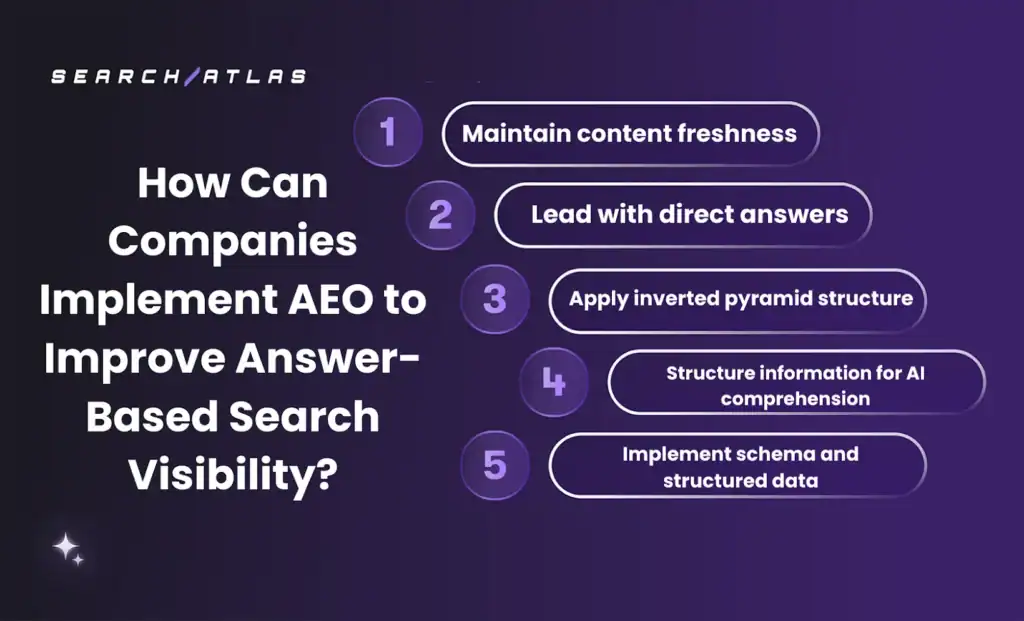
The 5 main ways companies implement AEO to improve answer-based search visibility are listed below.
1. Maintain content freshness. Answer engines favor content that reflects current information, accurate facts, and up-to-date context. Regular audits, structured updates, and intent alignment signal credibility and trust. These signals increase the probability that AI systems reuse and cite the content.
2. Lead with direct answers. AEO content needs to present the answer immediately instead of building toward it gradually. AI systems prioritize content that resolves the user question within the first response block. This format reduces ambiguity and increases eligibility for answer extraction.
3. Apply inverted pyramid structure. Answer-first formatting places the critical response at the beginning and follows with supporting explanation. This structure enables AI systems to extract the core information quickly and present it without distortion.
4. Structure information for AI comprehension. Clear hierarchies, logical flow, and semantic relationships allow AI systems to interpret meaning reliably. Descriptive headings, numbered sections, and consistent entity usage create information pathways that AI can follow and reuse accurately.
5. Implement schema and structured data. Structured data clarifies content meaning and context for AI systems and search engines. FAQ, HowTo, and Product schema formats increase the likelihood that content appears directly inside AI answers and featured snippets.
Is It Possible for Businesses to Use AI Tools to Optimize for AEO, AIO, and GEO?
Yes, businesses use AI tools to optimize AEO, AIO, and GEO simultaneously. Answer Engine Optimization, Artificial Intelligence Optimization, and Generative Engine Optimization depend on AI systems for content analysis, structure validation, and visibility measurement across AI-driven search environments.
AI tools enable optimization by analyzing user intent, extracting entities, and identifying patterns that determine whether content qualifies for answers, AI reuse, and generative inclusion. These tools process large datasets to detect how content performs across featured snippets, voice responses, and generative summaries at the same time.
Search Atlas is an AI-powered, agentic SEO and AI Search platform that executes optimization across AEO, AIO, and GEO through system-level automation. LLM Visibility by Search Atlas measures how brands appear inside AI-powered answers and chatbot responses. LLM Visibility tracks brand mentions, sentiment, share of voice, and placement across systems (ChatGPT, Gemini, and Perplexity). This measurement matters because traditional tools do not capture visibility inside AI-generated responses.
Which Tools Are Most Effective for Optimizing for AEO, AIO, and GEO?
The most effective tools for optimizing for AEO, AIO, and GEO combine AI visibility tracking with operational pathways that connect insights to content and technical execution. These tools measure answer inclusion, generative citations, and AI-driven brand presence while enabling remediation inside the same workflow.
The 6 leading tools that define this category across AEO, AIO, and GEO are listed below.
- Search Atlas. Search Atlas tracks and executes optimization across AEO, AIO, and GEO from a unified operating system. Search Atlas measures brand visibility inside AI-generated answers across systems (ChatGPT, Google AI Overviews, Gemini, and Perplexity) through the LLM Visibility feature. This execution focus makes Search Atlas the most complete platform for AI-era search optimization.
- Profound. Profound operates as an enterprise-grade tracking and measurement platform designed to optimize brand visibility across AI search environments. Profound analyzes content gaps by comparing tracked prompts against large-scale conversation datasets to identify missing, high-value queries.
- Writesonic. Writesonic combines AI search monitoring with content execution workflows. Writesonic identifies technical barriers (AI crawler blocking and surfaces) prioritized visibility issues inside a unified dashboard.
- Goodie AI. Goodie AI specializes in AEO and GEO through action-driven optimization flows. Goodie AI converts AI visibility data into structured editorial and semantic change recommendations designed to secure brand mentions inside AI responses.
- Gauge. Gauge is an enterprise platform built for AIO and GEO. Gauge generates large prompt sets based on real keyword demand rather than curated queries to evaluate how AI models respond to actual user intent.
- AIclicks. AIclicks tracks and optimizes brand visibility across conversational AI systems (ChatGPT, Gemini, and Claude). AIclicks monitors thousands of AI answers monthly for brand and industry queries and connects traditional SEO signals with AI-driven visibility.
Among available tools, Search Atlas provides the most complete AEO, AIO, and GEO workflow because it connects AI visibility tracking directly to execution across content, technical SEO, and authority operations inside one system.
Which Optimization Method Is Better for Content Discovery Between GEO and AIO?
GEO is better than AIO for content discovery because Generative Engine Optimization directly controls whether AI systems cite and recommend a brand inside generated answers. Artificial Intelligence Optimization prepares content for AI interpretation, while Generative Engine Optimization determines whether that content appears inside AI-mediated discovery surfaces.
What role does AIO play in content discovery? Artificial Intelligence Optimization enables content discovery by making content readable and usable by AI systems. Artificial Intelligence Optimization focuses on semantic structure, consistent entities, and machine-readable formatting so AI systems can process content correctly.
What role does GEO play in content discovery? Generative Engine Optimization drives content discovery by determining whether AI systems select and cite content inside generated answers. Generative Engine Optimization prioritizes authority, factual reliability, and cross-context semantic alignment so AI systems treat content as source-worthy.
Why is GEO more decisive for content discovery than AIO? Generative Engine Optimization is more decisive because it governs output selection rather than input readiness. AIO prepares content for AI consumption, while GEO controls whether that prepared content becomes visible to users through AI systems.
Which Optimization Method Is Better for Direct Answers Between AEO and GEO?
Answer Engine Optimization is better than Generative Engine Optimization for securing direct answers because Answer Engine Optimization targets immediate, precise response delivery. Generative Engine Optimization influences citation inside long-form AI summaries rather than short-form answer extraction.
What makes AEO better for direct answers? Answer Engine Optimization specializes in short-form, query-aligned answer selection. Answer Engine Optimization structures content to appear as featured snippets, voice responses, and instant answers for queries. This specialization matters because answer engines prioritize concise, factual blocks for direct response delivery.
Where does GEO fit in direct answer visibility? Generative Engine Optimization contributes indirectly to direct answers by reinforcing source authority rather than controlling answer extraction. Generative Engine Optimization ensures AI systems recognize content as trustworthy during synthesis. This contribution matters because authoritative sources receive higher selection probability across AI systems.
Why is AEO more decisive than GEO for short answers? Answer Engine Optimization is more decisive because it governs answer formatting and extractability. Generative Engine Optimization governs citation inside generated narratives rather than direct response rendering.
What Metrics and KPIs Should Businesses Track to Measure the Success of AEO, AIO, and GEO Strategies?
Measuring the success of AEO, AIO, and GEO requires shifting from traffic-based indicators to visibility and influence indicators inside AI-driven search environments. These strategies succeed when AI systems select, reuse, and reference content rather than when users simply click a link.
The 6 main metrics that define performance across AEO, AIO, and GEO are listed below.
- AI visibility frequency. AI systems increasingly surface content without driving visits. This metric tracks how often AI interfaces surface a brand inside generated answers across platforms. A rising frequency signals growing relevance inside AI-mediated discovery.
- Citation prominence. Placement inside an AI answer matters as much as appearance itself. This metric measures how early or late a brand appears within generated responses. Earlier placement increases perceived authority and recall.
- Domain-level inclusion. AI systems often generalize trust across entire domains. This metric tracks how frequently any page from a domain appears inside AI-generated answers. A high rate signals domain-wide authority rather than isolated success.
- Brand context framing. AI does not only mention brands but frames them. This metric evaluates whether AI presents a brand in a positive, neutral, or negative context. Favorable tone strengthens trust and downstream selection probability.
- Conversational continuation. AI-driven search often continues through follow-up questions rather than single interactions. This metric measures how often users request more information after a brand appears inside an AI answer. Sustained conversation indicates influence rather than surface exposure.
- AI readiness signals. AI systems rely on structural compatibility and crawl behavior. This metric evaluates how often AI-specific crawlers access a site and how quickly content updates propagate into AI answers. Faster propagation reflects strong machine-level accessibility.
Together, these metrics redefine performance for AEO, AIO, and GEO by measuring whether content influences AI systems rather than only how users navigate websites.
Which Optimization (AEO, AIO, GEO) Delivers the Fastest Measurable Results?
Answer Engine Optimization delivers the fastest measurable results because AEO targets direct answer visibility rather than long-term authority accumulation. AIO and GEO operate as foundational and authority layers that mature over longer cycles.
Answer Engine Optimization produces rapid results by structuring content for featured snippets, voice responses, and AI answers. AI systems (Google AI Overviews, Gemini, and Siri) extract these concise answers directly from formatted content blocks.
AIO enables AI readability and GEO builds generative authority, but both require sustained signal accumulation. AEO functions as the fastest delivery mechanism for measurable AI-era visibility.
How Are AEO, AIO, and GEO Evolving with AI-Driven Search Engines?
AEO, AIO, and GEO are evolving as execution layers for AI-driven search because AI systems now prioritize intent, structure, and authority over keyword matching alone. AEO controls direct answer delivery, AIO controls machine-readable content structure, and GEO controls citation inside AI-generated outputs.
Answer Engine Optimization now prioritizes concise, factual responses for zero-click visibility. Artificial Intelligence Optimization now prioritizes semantic structure and schema for machine interpretability. Generative Engine Optimization now prioritizes authority and source selection inside generative narratives.
Will Traditional SEO Eventually Be Replaced by AEO, AIO, and GEO?
No, traditional SEO will not be replaced by AEO, AIO, and GEO because the future of SEO depends on the same foundational signals that SEO already establishes. AI systems evaluate credibility, clarity, authority, and contextual strength before selecting or citing content.
AEO, AIO, and GEO operate on top of SEO foundations rather than in place of them. These frameworks control answer delivery, machine usability, and generative authority using the trust signals that SEO creates. This layering preserves SEO relevance while expanding visibility.
Will Traditional SEO Eventually Extend to Include AEO, AIO, and GEO?
Yes, traditional SEO is evolving to include AEO, AIO, and GEO as integrated execution layers. SEO now expands beyond ranking into direct answers, AI interpretation, and generative citation. This expansion defines SEO as a holistic, AI-first optimization model rather than a keyword-only discipline.