SEOQuake alternatives are SEO tools and browser extensions that replace SEOQuake for on-page analysis, SERP metrics, keyword data, link checks, and technical insights. These tools offer deeper analysis, cleaner interfaces, and more actionable SEO data than basic browser overlays.
Many SEOQuake reviews highlight its limitations for modern SEO workflows. The extension provides quick page-level metrics but lacks historical data, advanced keyword research, backlink intelligence, and guided optimization.
SEOs and marketers who need clearer insights, scalable workflows, or integrated SEO platforms often look for alternatives that move beyond surface-level metrics.
SEOs, marketers, and agencies choose an SEOQuake alternative when they need richer SERP analysis, better keyword data, or technical SEO beyond browser snapshots. The best SEOQuake alternatives in 2026 are Search Atlas, Keyword Surfer, and Detailed.
What are the Best SEOQuake Alternatives?
The best SEOQuake alternatives for 2026 cover SERP analysis, keyword research, backlink insights, rank tracking, technical audits, traffic intelligence, and on-page SEO checks.
Some tools work as lightweight browser extensions, while others are full SEO platforms designed for continuous monitoring, reporting, and competitive research.
The best SEOQuake alternatives for 2026 are listed below.
| # | SEOQuake Alternative | Best For | Price |
| 1 | Search Atlas | Best SEOQuake alternative | $99 to $399/month |
| 2 | SEO Minion | SERP analysis and on-page checks | $7 to $25/month |
| 3 | Keyword Surfer | In-browser keyword data | Free |
| 4 | Screaming Frog | Technical SEO crawling | Free to $279/year |
| 5 | Ubersuggest | Keyword and competitor insights | $29 to $99/month |
| 6 | Google Search Console | First-party search performance data | Free |
| 7 | Surfer SEO | On-page SEO and content scoring | $79 to $179/month |
| 8 | Google Analytics 4 | Traffic and engagement metrics | Free to ~$50,000/year |
| 9 | Keywords Everywhere | SERP keyword metrics | Free to $25/month |
| 10 | Similarweb | Traffic and competitor intelligence | $125 to $333/month |
| 11 | BrightEdge | Enterprise SEO and content performance | Custom pricing |
| 12 | Yoast SEO | WordPress on-page optimization | Free to €118.80/year |
| 13 | Link Grabber | Extracting links from any page | Free to $4/month |
| 14 | WooRank | Instant SEO audits | Free to paid plans |
| 15 | Sitechecker | Site audits and rank tracking | $89 to $449/month |
| 16 | Jasper Everywhere | AI content optimization | $69/month to custom |
| 17 | Detailed SEO | In-browser SEO page analysis | Free |
| 18 | Auto Page Rank | PageRank and link metrics | Free to $19.97/month |
| 19 | Mangools | Rank tracking and SERP insights | $19.43 to $58.44/month |
| 20 | Rank Math SEO | WordPress SEO automation | Free to $59.99/month |
| 21 | AIOSEO | On-site WordPress SEO enhancements | Free to $749/year |
| 22 | Nightwatch | Advanced rank tracking | $39/month+ |
| 23 | Conductor | Enterprise-level SEO analysis | Custom pricing |
| 24 | PageOptimizer Pro | On-page testing and recommendations | $56/month+ |
| 25 | Raven Tools | SEO reports and site audits | $49 to $479/month |
| 26 | Seobility | Technical SEO monitoring | Free to $200/month |
| 27 | Serpstat | All-in-one SEO data and keyword research | $69 to $499/month |
| 28 | Moz Pro | Authority metrics and on-page SEO | $49 to $299/month |
| 29 | SE Ranking | Rankings, audits, and backlink checks | $65 to $359/month |
| 30 | Ahrefs | Backlink and competitor research | $129 to $1,499/month |
| 31 | Semrush | Comprehensive SEO and SERP data | $139/month+ |
1. Search Atlas: Best SEOQuake Alternative
Search Atlasis an all-in-one SEO and PPC automation platform built for teams that need more than browser-level metrics. The platform manages rankings, technical audits, content optimization, local SEO, backlinks, and reporting from one system.
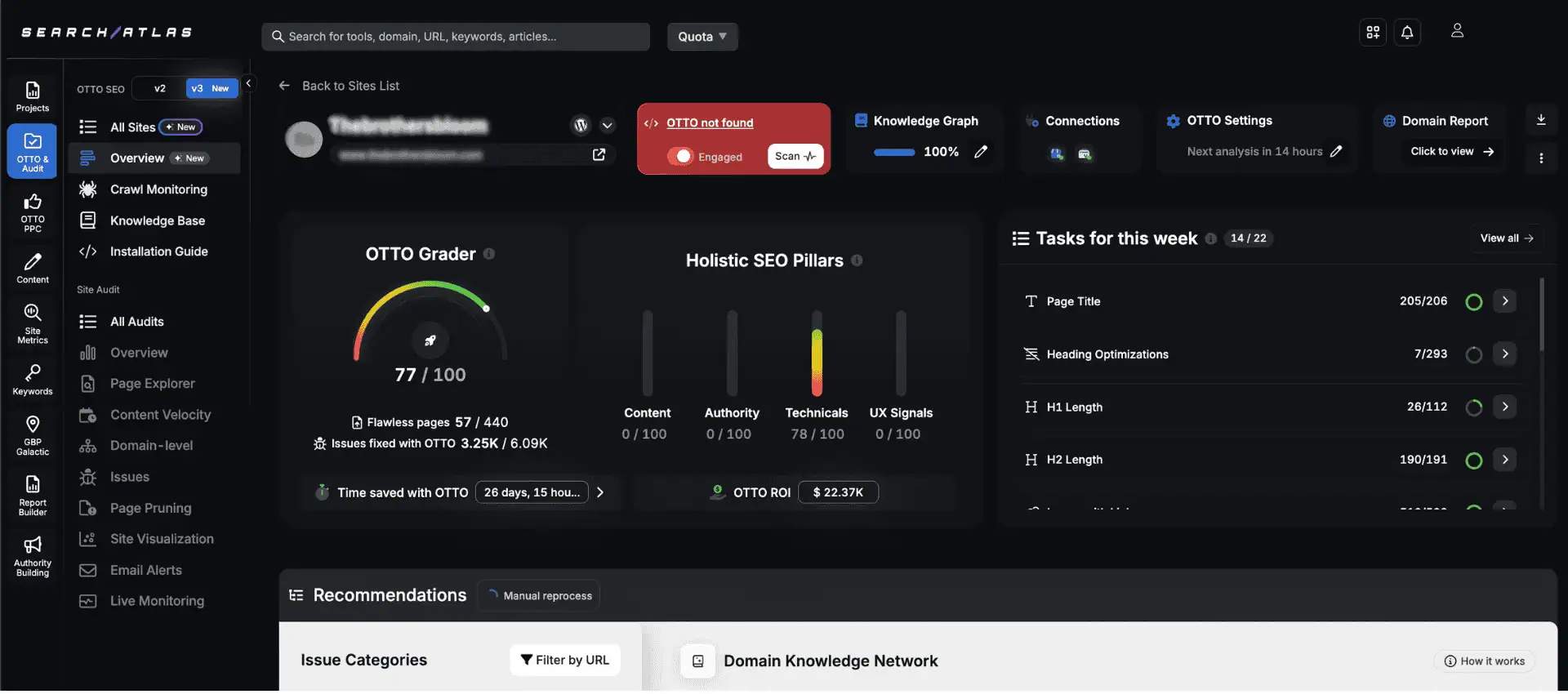
Unlike SEOQuake, which surfaces static page data, Search Atlas connects directly to Google Search Console (GSC), Google Business Profile (GBP), Google Analytics (GA4) and Google Ads to deliver live, verified performance signals.
At the platform level, every Search Atlas plan includes OTTO SEO, the autonomous AI system. OTTO SEO identifies on-page issues, improves internal linking, deploys schema, resolves technical errors, automatically.
As an alternative to SEOQuake, Search Atlas stands out for turning analysis into execution. SEOQuake displays page attributes and link counts, but stops short of action. Search Atlas closes that gap with automation, content intelligence, and technical fixes applied directly to the site.
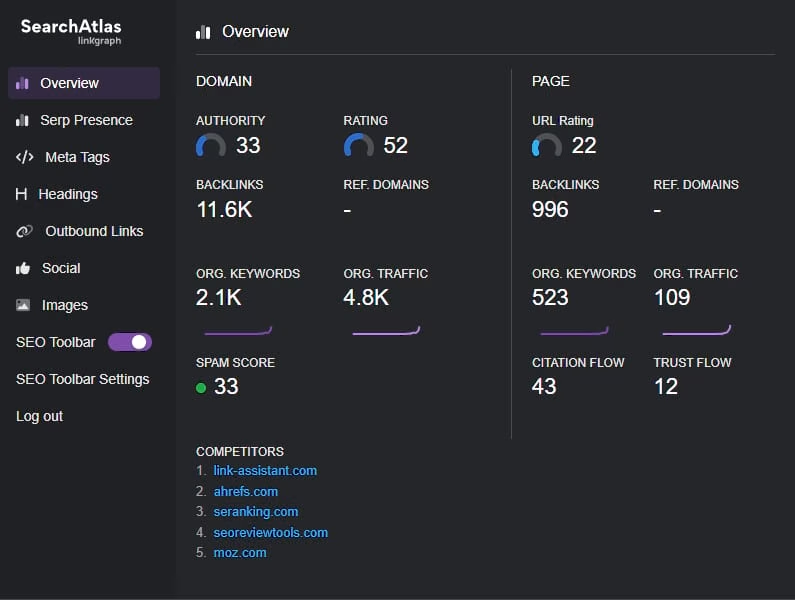
The Search Atlas Chrome Extension brings this capability into the browser. The extension delivers real-time SEO data, technical checks, and keyword insights without disrupting workflow. Instead of overwhelming overlays, it provides focused diagnostics such as broken links, metadata gaps, indexing signals, and performance context pulled from GSC. SEOQuake offers metrics. Search Atlas adds direction.
For content execution, Content Genius replaces static keyword density checks with SERP-based intelligence. It analyzes ranking pages, maps entities, recommends structure, and guides optimization while writing. SEOQuake does not provide content workflows, NLP guidance, or real-time SERP alignment.
Search Atlas pricing ranges from $99 to $399 per month, which replaces the need for SEOQuake plus separate tools for content optimization, audits, rank tracking, and reporting.
Pros of Search Atlas review include actionable browser insights, automated execution, advanced content optimization, verified data, and unified workflows across SEO tasks. The primary drawback is a learning curve for teams moving beyond basic extensions, though onboarding and guided workflows reduce friction quickly.
2. SEO Minion: Best SEOQuake Alternative for SERP Analysis and On-Page Checks
SEO Minion is a browser-based SEO extension designed for practical, day-to-day SEO analysis directly inside the browser. SEO Minion focuses on inspecting on-page elements, validating technical signals, and testing how pages appear and behave in search results.
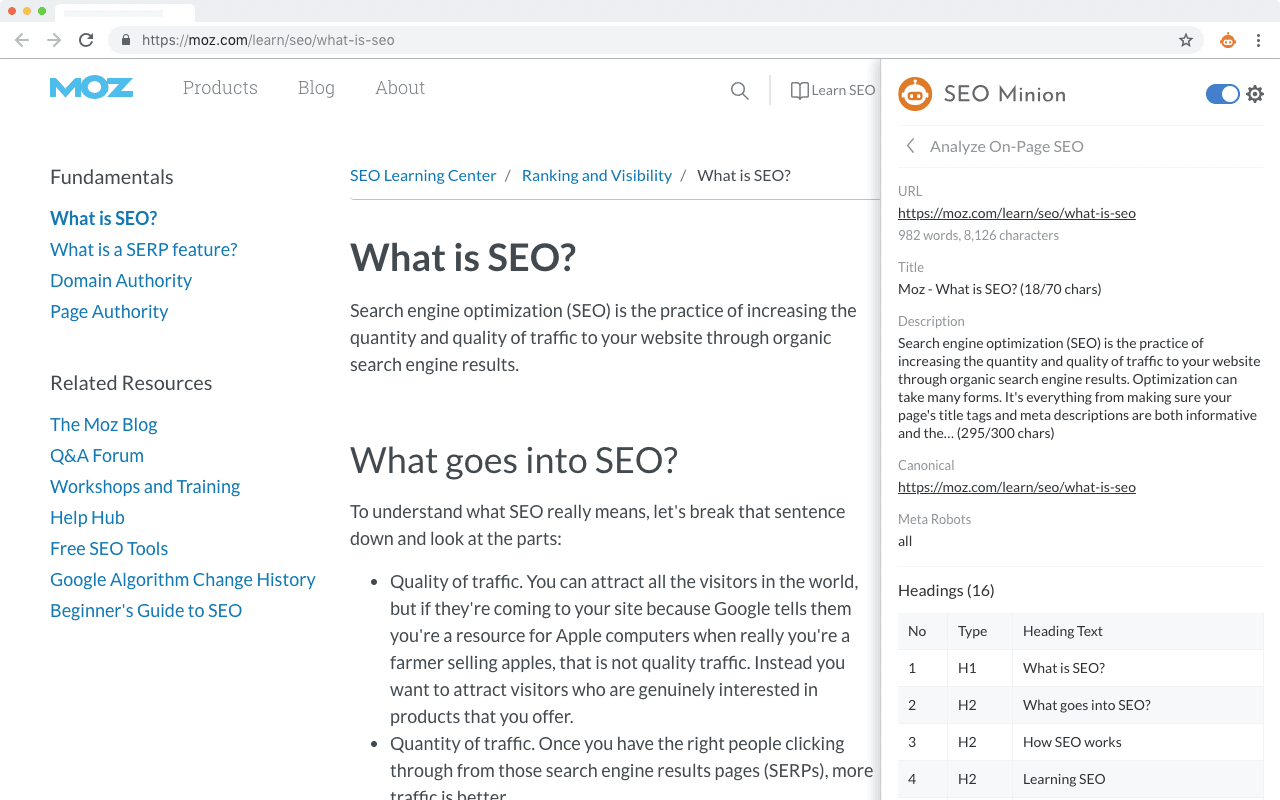
SEO Minion goes further than SEOQuake for SERP inspection and on-page validation. The extension emphasizes actionable checks such as SERP previews, hreflang validation, and broken link detection rather than surface-level metrics.
Core features in SEO Minion include on-page analysis for meta tags, headings, Open Graph data, and structured markup. The extension highlights internal and external links, identifies broken links, validates hreflang implementations, and compares raw HTML against rendered DOM to uncover JavaScript-related SEO issues.
SEO Minion is a paid tool with pricing ranges from $7 to $25 per month, available through the Keywords Everywhere Silver and Gold plans required for full functionality.
Pros of SEO Minion include detailed on-page diagnostics, fast broken link identification, real-time SERP previews, and hreflang validation. Cons include dependence on a separate subscription and limited backlink metrics compared to dedicated link analysis platforms.
3. Keyword Surfer: Best SEOQuake Alternative for In-Browser Keyword Data
Keyword Surfer is a free Chrome extension developed by Surfer SEO that displays keyword data directly inside Google search results. Keyword Surfer simplifies keyword research by showing essential metrics without leaving the SERP.

Keyword Surfer delivers faster and clearer in-browser keyword insight than SEOQuake. Keyword Surfer focuses on search volume visibility, keyword suggestions, and competitor content metrics, while SEOQuake concentrates on page attributes and technical indicators.
Core features in Keyword Surfer include real-time search volume estimates, related keyword suggestions, overlap metrics, and keyword collections that export as CSV files. The extension displays competitor page data such as word count, keyword usage, and estimated traffic, with coverage across more than 70 countries for location-specific research.
Keyword Surfer is a free tool with no paid plans or recurring costs.
Pros include instant keyword metrics inside SERPs, a clean interface, easy keyword organization, and broad geographic coverage. Cons include limited backlink insight, no authority scoring, and fewer technical SEO diagnostics than full browser audit tools.
4. Screaming Frog: Best SEOQuake Alternative for Technical SEO Crawling
Screaming Frog SEO is a desktop-based website crawler built for deep technical SEO audits and large-scale site analysis. Screaming Frog SEO scans URLs to evaluate metadata, internal linking, duplicate content, page speed, and overall site structure.
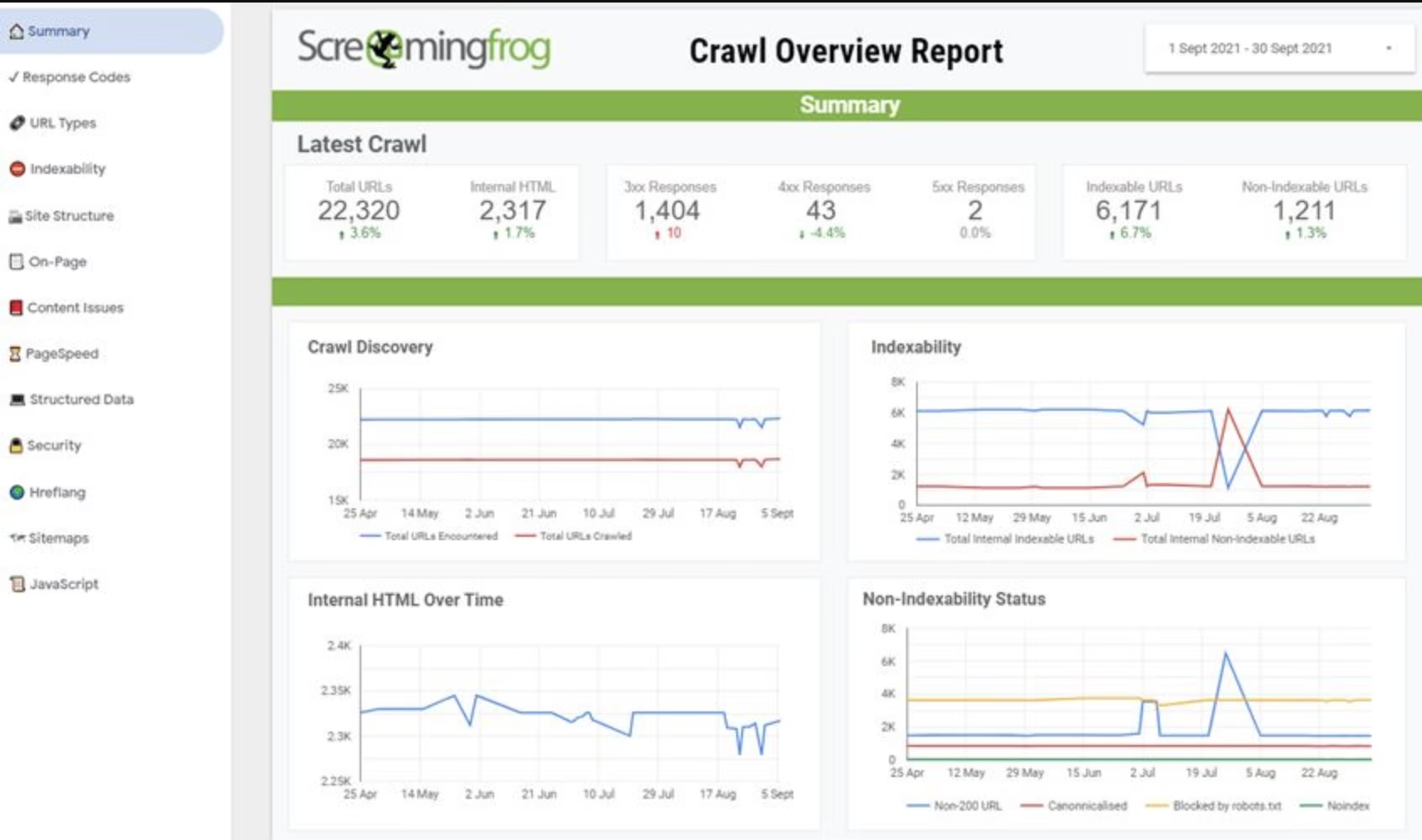
Screaming Frog delivers far deeper technical crawling capabilities than SEOQuake. Screaming Frog handles full-site audits, JavaScript rendering, and advanced data extraction, while SEOQuake focuses on lightweight, page-level metrics inside the browser.
Core features in Screaming Frog include real-time crawl monitoring, configurable extraction rules, and crawl comparisons that surface structural changes over time. The crawler processes both static and JavaScript-rendered pages while collecting titles, headings, links, canonicals, directives, and response codes.
Screaming Frog offers a free version limited to 500 URLs. The paid license costs $279 per year, unlocking unlimited crawling, advanced configuration, and integrations with GA4 and GSC.
Pros of Screaming Frog review include fast and detailed crawl reports, flexible exports, and strong technical depth. Cons include a steeper learning curve for non-technical users and no built-in rank tracking or backlink database.
5. Ubersuggest: Best SEOQuake Alternative for Keyword and Competitor Insights
Ubersuggest is a browser-based SEO platform designed for freelancers, content creators, and small teams. Ubersuggest combines keyword research, competitor analysis, site audits, and AI-assisted content ideas in a simplified interface.

Ubersuggest provides broader keyword and competitor intelligence than SEOQuake. Ubersuggest surfaces search volume trends, keyword difficulty, competitor overlap, and content opportunities, while SEOQuake limits insight to on-page metrics.
Core features in Ubersuggest include keyword discovery with difficulty scoring, daily rank tracking, backlink analysis, and site health audits. The platform highlights competitor keywords, assigns site health scores, and surfaces content ideas tied to search demand.
Ubersuggest is a paid tool with pricing ranges from $29 to $99 per month, with plans scaling by usage and features. Lifetime plans are available, offering a lower long-term cost compared to subscription-only tools.
Pros of Ubersuggest include intuitive navigation and affordable pricing. Cons include smaller backlink datasets, and limited scalability for advanced SEO programs.
6. Google Search Console: Best SEOQuake Alternative for Search Performance Data
Google Search Console is a free SEO platform provided by Google that reports how websites perform in Google Search. GSC delivers first-party data on visibility, indexing, and technical health.
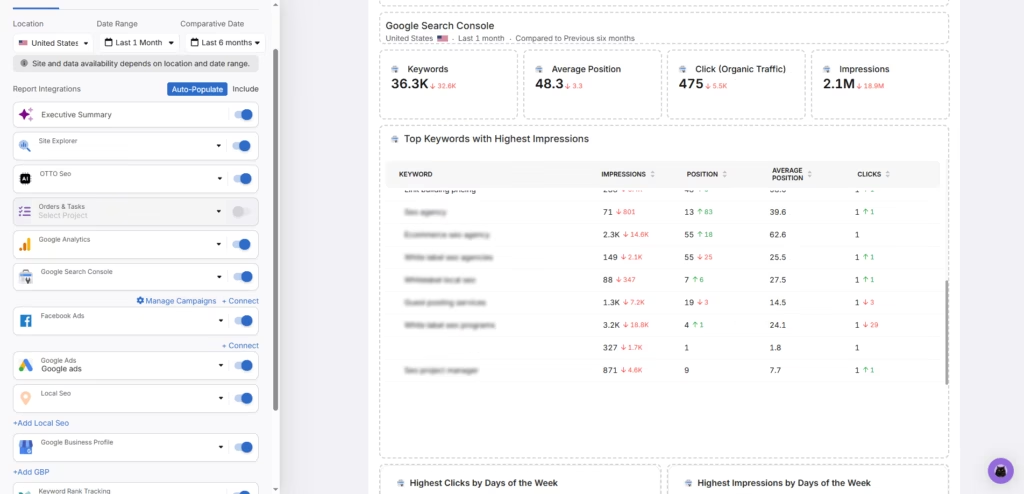
Google Search Console provides more accurate performance data than SEOQuake for owned properties. The platform reports real impressions, clicks, click-through rates, and average positions directly from Google, while SEOQuake estimates metrics based on external sources.
Core features include the Performance report for query and page visibility, Indexing reports for crawl and coverage status, Core Web Vitals for experience signals, and URL Inspection for page-level diagnostics.
GSC is a free tool with no project limits, though API access enforces usage quotas for Search Analytics queries.
Pros of GSC include reliable first-party data, free access, and comprehensive performance reporting. Cons include delayed reporting, sampled data for long-tail queries, and a learning curve for beginners.
7. Surfer SEO: Best SEOQuake Alternative for On-Page SEO and Content Scoring
Surfer SEO is a content optimization platform built to improve on-page SEO through data-driven structure, keyword usage, and content scoring. Surfer SEO analyzes top-ranking pages and converts SERP patterns into clear optimization guidelines for writers and SEO teams.
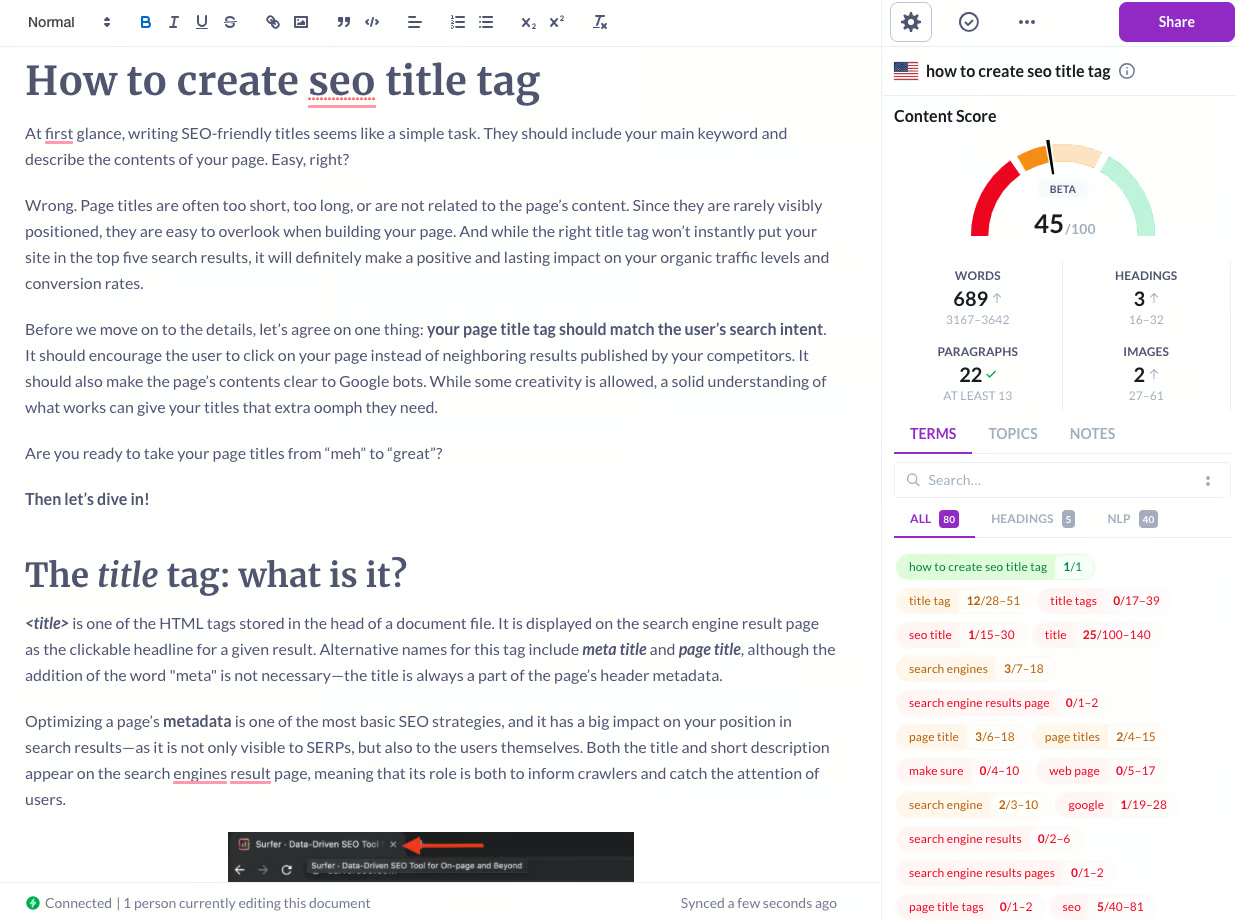
Surfer SEO delivers stronger on-page SEO guidance and content scoring than SEOquake. Surfer SEO functions as a dedicated optimization system that evaluates structure, term coverage, and competitive benchmarks, while SEOquake focuses on surface-level metrics inside the browser.
Core features in Surfer SEO include the Content Editor with real-time scoring, keyword and entity recommendations, competitor comparisons, and NLP-based coverage analysis. The platform connects optimization rules directly to ranking pages, which creates clearer direction during drafting and updates.
Surfer SEO is a paid tool with pricing ranges from $79 to $179 per month. Entry plans include content audits and optimization tools, while higher tiers expand collaboration limits, AI usage, and API access.
Pros of Surfer SEO review include precise content scoring, strong SERP alignment, and international SEO support. Cons include a learning curve for beginners and limited flexibility for highly specialized or non-search-driven writing.
8. Google Analytics: Best SEOQuake Alternative for Traffic and Engagement Metrics
Google Analytics 4 is a web analytics platform built to measure traffic, engagement, and conversions across websites and applications. GA4 tracks user behavior through an event-based model that captures every interaction across devices and sessions.
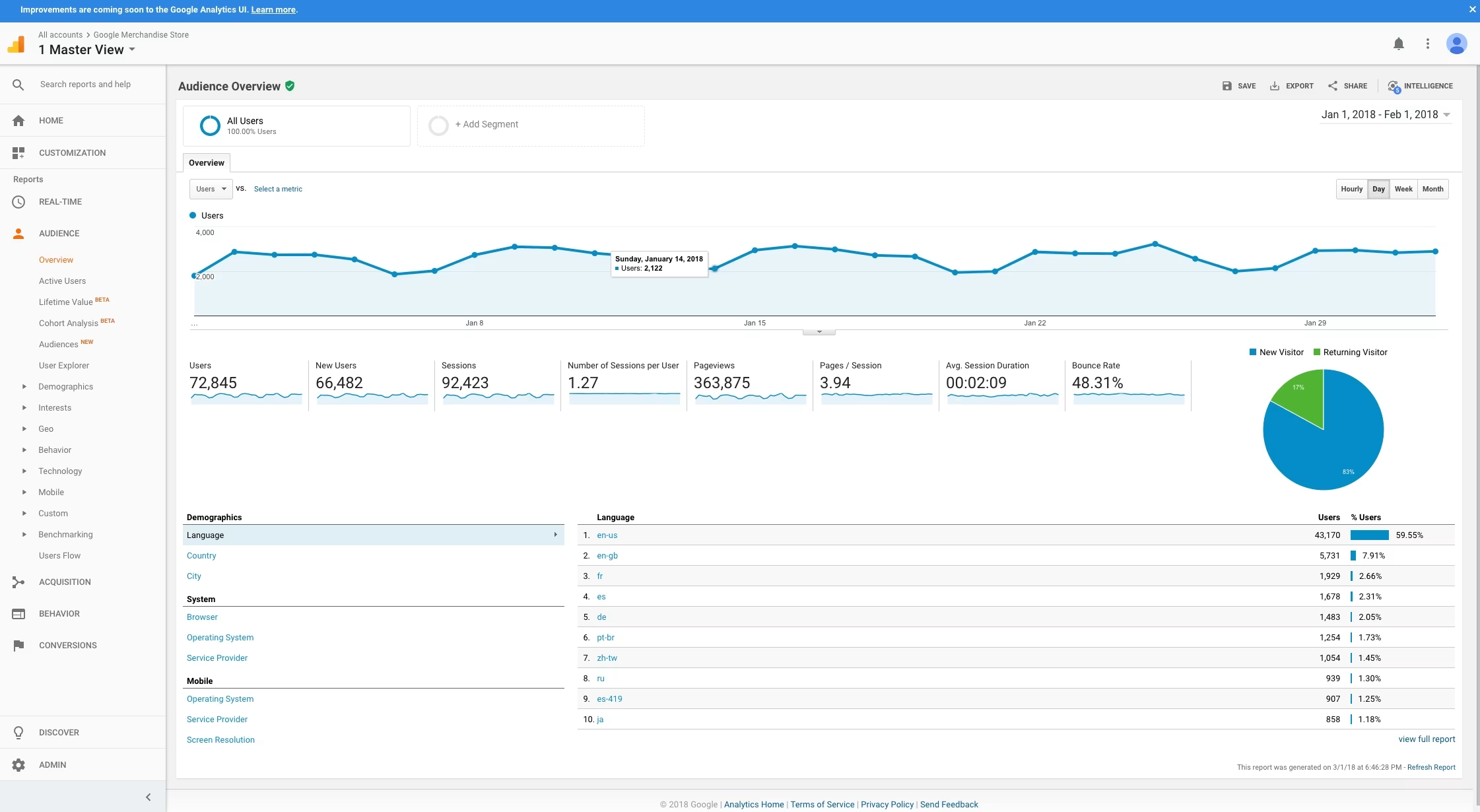
GA4 provides deeper traffic and engagement insights than SEOquake. GA4 connects content performance to real user behavior and business outcomes, while SEOquake focuses on static SEO metrics without behavioral context.
Core features include event-based tracking, real-time reports, conversion measurement, and predictive metrics powered by machine learning. GA4 integrates with BigQuery and Looker Studio, which enables advanced analysis and custom reporting.
Google Analytics 4 is a free tool for standard accounts. The enterprise version, GA4 360, is a paid solution with pricing around $50,000 per year for large organizations.
Pros include first-party data accuracy, deep engagement analysis, and strong integration with Google’s ecosystem. Cons include a steep learning curve, limited default dashboards, and higher complexity than simple browser extensions.
9. Keywords Everywhere: Best SEOQuake Alternative for SERP Keyword Metrics
Keywords Everywhere is a browser-based SEO extension that displays keyword metrics directly inside search results. Keywords Everywhere shows search volume, CPC, competition, and related keyword ideas across Google and other platforms.
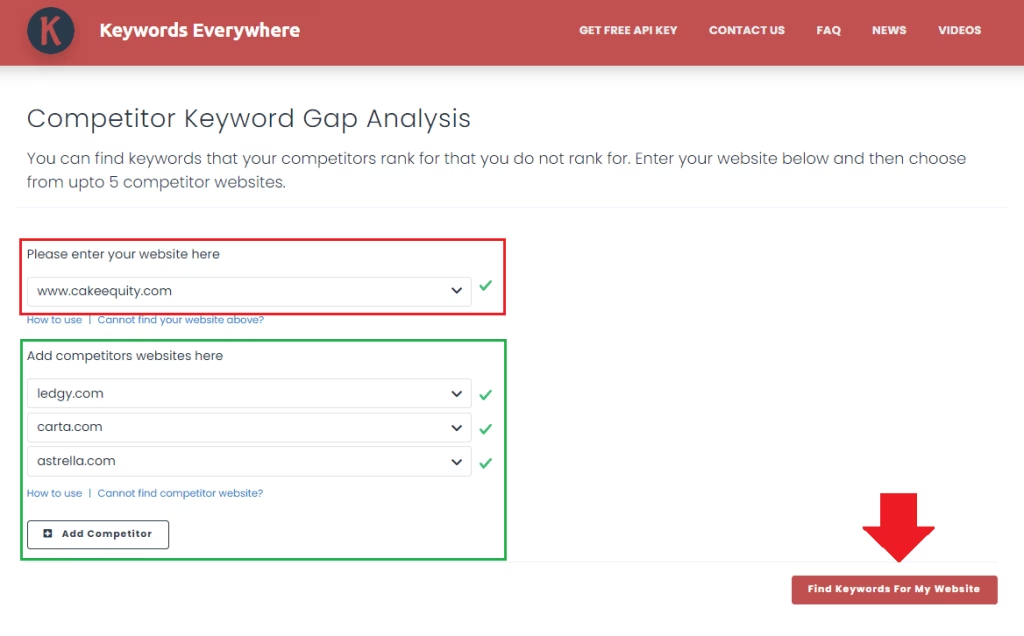
Keywords Everywhere delivers clearer SERP-level keyword metrics than SEOQuake. Instead of surface diagnostics, Keywords Everywhere focuses on keyword opportunity signals, cost data, and trend visibility that speed up early-stage research. SEOQuake emphasizes page attributes, while Keywords Everywhere centers on keyword economics and demand.
Core features include in-SERP search volume and CPC data, keyword difficulty scores, keyword density analysis, and competitor gap insights. The extension tracks top keywords for any domain, bulk keyword imports, and exposes Moz-based authority metrics alongside Google Trends, Search Console, and Keyword Planner integrations.
Keywords Everywhere is a paid tool with pricing ranges from $5 to $25 per month when billed annually. A limited free version provides basic keyword suggestions and widgets, while paid plans unlock full keyword metrics and competitive analysis.
Pros of Keywords Everywhere include instant keyword visibility inside SERPs, multi-platform data coverage, and strong cost efficiency. Cons include credit-based usage limits and weaker backlink analysis than dedicated link tools.
10. Similarweb: Best SEOQuake Alternative for Traffic and Competitor Intelligence
Similarweb is a digital intelligence platform designed to estimate website traffic, audience behavior, and competitive positioning across markets. Similarweb aggregates large-scale data signals to model visits, engagement, and referral sources at domain level.
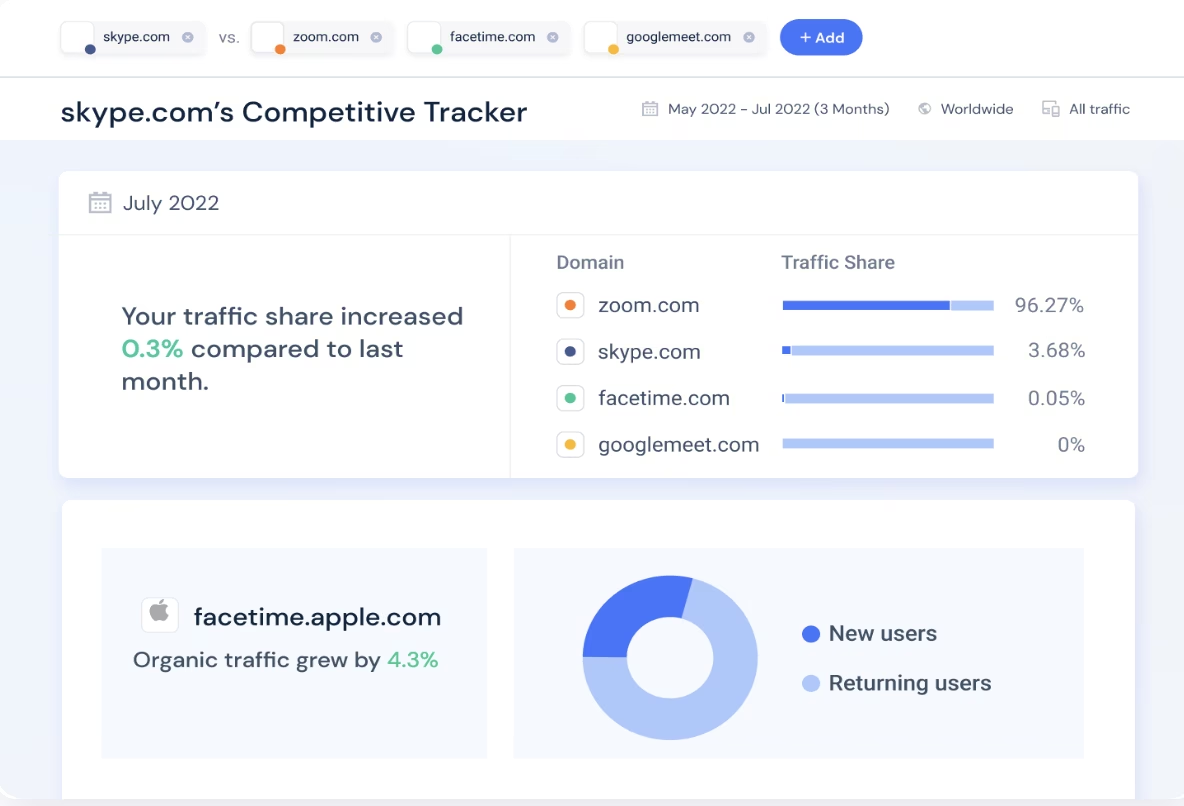
Similarweb offers a deeper competitor and traffic intelligence than SEOQuake. While SEOQuake reports page-level SEO signals, Similarweb focuses on market visibility, audience behavior, and channel distribution, which allows strategic analysis beyond on-page metrics.
Core features include traffic estimation for competing domains, geographic and demographic audience insights, engagement metrics such as visit duration and bounce rate, and keyword contribution analysis. These datasets map competitive landscapes and reveal growth opportunities across industries.
Similarweb is a paid tool with pricing ranges from $125 to $333 per month. Higher tiers expand keyword intelligence, SEO datasets, and competitive benchmarking. Enterprise plans use custom pricing for large-scale research needs.
Pros of Similarweb review include broad market coverage, strong competitor visibility, and clear traffic modeling. Cons include higher costs for smaller teams and less precision for low-traffic sites.
11. BrightEdge: Best SEOQuake Alternative for Enterprise SEO and Content Performance
BrightEdge is an enterprise SEO platform built for large organizations that manage complex search and content programs. BrightEdge connects keyword research, rank tracking, content optimization, and competitive intelligence into a unified system designed to measure SEO impact at scale.
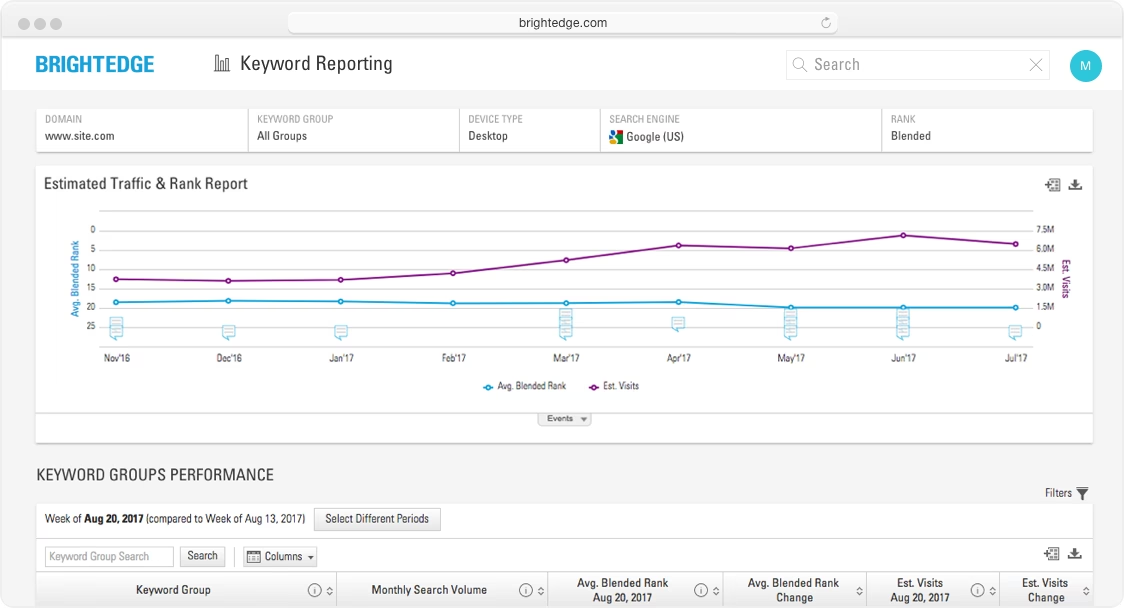
BrightEdge goes far beyond SEOquake by operating as a full enterprise SEO and content performance platform rather than a browser extension. BrightEdge focuses on demand forecasting, content gap detection, and AI-driven recommendations that tie SEO efforts directly to traffic, revenue, and engagement outcomes.
Core features in BrightEdge include Data Cube for market and keyword demand analysis, ContentIQ for large-scale technical and content audits, and StoryBuilder for unified performance reporting. These modules connect rankings, traffic, and engagement to measurable business impact.
BrightEdge pricing is custom, and costs are designed for mid to enterprise level budgets.
Pros of BrightEdge review include rank tracking at enterprise scale, and unified reporting that ties SEO to measurable outcomes. Cons of BrightEdge include limited flexibility for smaller businesses, and a learning curve that slows adoption for small teams.
12. YoastSEO: Best SEOQuake Alternative for WordPress On-Page Optimization
Yoast SEO is a WordPress plugin built to manage on-page optimization directly inside the CMS. Yoast SEO evaluates keyword usage, readability, metadata, and structured data during content creation.
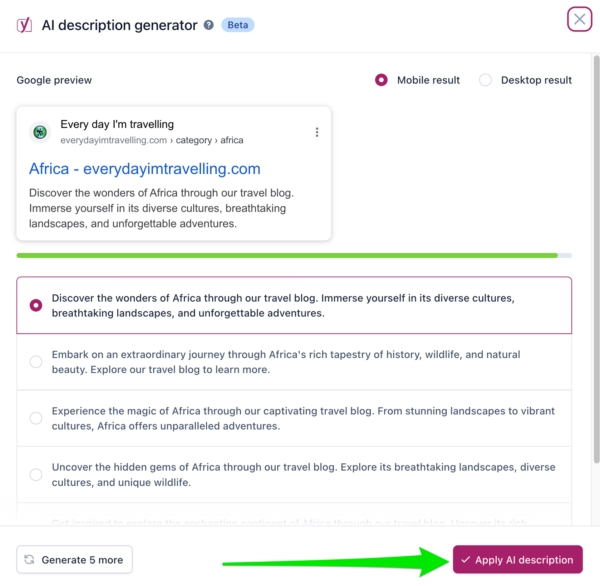
Yoast SEO provides stronger WordPress on-page optimization than SEOQuake. Yoast SEO embeds SEO guidance into the publishing workflow, while SEOQuake surfaces external diagnostics without influencing content structure or sitewide settings.
Core features in Yoast SEO include real-time SEO and readability scoring, keyword optimization checks, XML sitemap generation, schema markup, and Open Graph controls. The Premium version adds internal linking suggestions and AI-assisted title and meta description generation.
Yoast SEO is free for its core plugin. Yoast SEO Premium is a paid tool with pricing at €118.80 per year, which includes advanced features, support, and training access.
Pros of Yoast SEO review include a beginner-friendly interface, direct WordPress integration, and instant content feedback. Cons include reliance on keyword-based scoring and limited functionality beyond on-site optimization.
13. Link Grabber: Best SEOQuake Alternative for Extracting Links from Any Page
Link Grabber is a Chrome extension built to extract, filter, and export links from web pages at scale. Link Grabber focuses on fast link collection by allowing users to capture URLs directly from live pages without running full SEO audits.
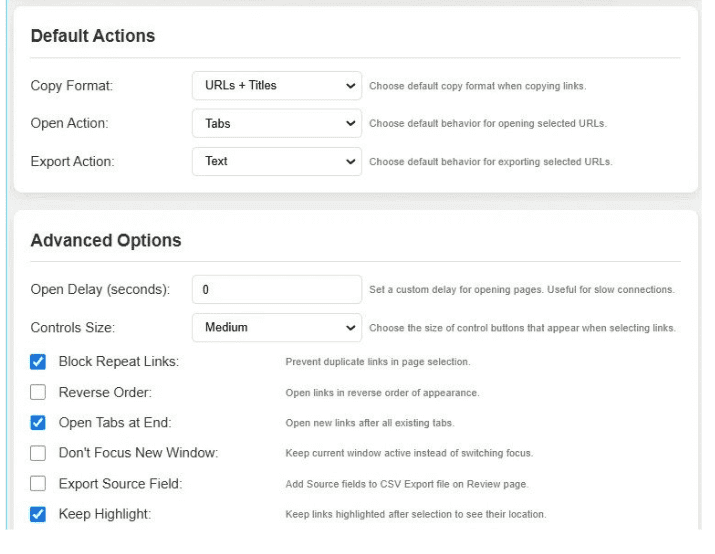
Link Grabber provides more efficient link extraction than SEOQuake. Link Grabber concentrates on bulk link collection and export workflows, while SEOQuake emphasizes general SEO metrics rather than large-scale link handling.
Core features in Link Grabber include single-click extraction of all page links, multi-page and multi-tab link collection, keyword-based filtering, hover-copy shortcuts, and flexible export formats. These controls allow precise selection and cleanup of URLs before analysis or outreach.
Link Grabber is available through a free plan, a paid plan at $4 per month, and a lifetime license priced at $96. The free version remains usable after the trial period with basic functionality.
Pros of Link Grabber include fast bulk extraction, and flexible pricing models. Cons include a more complex interface for first-time users and a learning curve for advanced features.
14. Woorank: Best SEOQuake Alternative for Instant SEO Audits
WooRank is a browser-based SEO analysis tool that generates instant website audits. WooRank evaluates on-page SEO, usability, mobile optimization, structured data, backlinks, and traffic signals through automated scoring.

WooRank emphasizes presentation and audit clarity more than SEOQuake. WooRank delivers structured reports with prioritized recommendations, while SEOQuake exposes raw metrics that require manual interpretation. The difference lies in guided insights versus diagnostic data.
Core features in WooRank include real-time SEO scoring, mobile-friendliness checks, structured data validation, backlink summaries, traffic insights, social media signals, and technology detection. The platform generates exportable reports that highlight optimization gaps and competitive benchmarks.
WooRank offers a free browser extension with limited analysis. WooRank is a paid tool with pricing ranging from approximately $50 to $80 per month for access to advanced audits, tracking, and reporting features.
Pros of WooRank include clear audit summaries, strong usability insights, and mobile optimization checks. Cons include restricted depth in the free version and gated access to detailed metrics behind paid plans.
15. Sitechecker: Best SEOQuake Alternative for Site Audits and Rank Tracking
Sitechecker is a cloud-based SEO monitoring platform built to audit websites, track rankings, and detect technical issues over time. Sitechecker centralizes site health checks, keyword monitoring, and reporting into a single dashboard designed for ongoing SEO management.
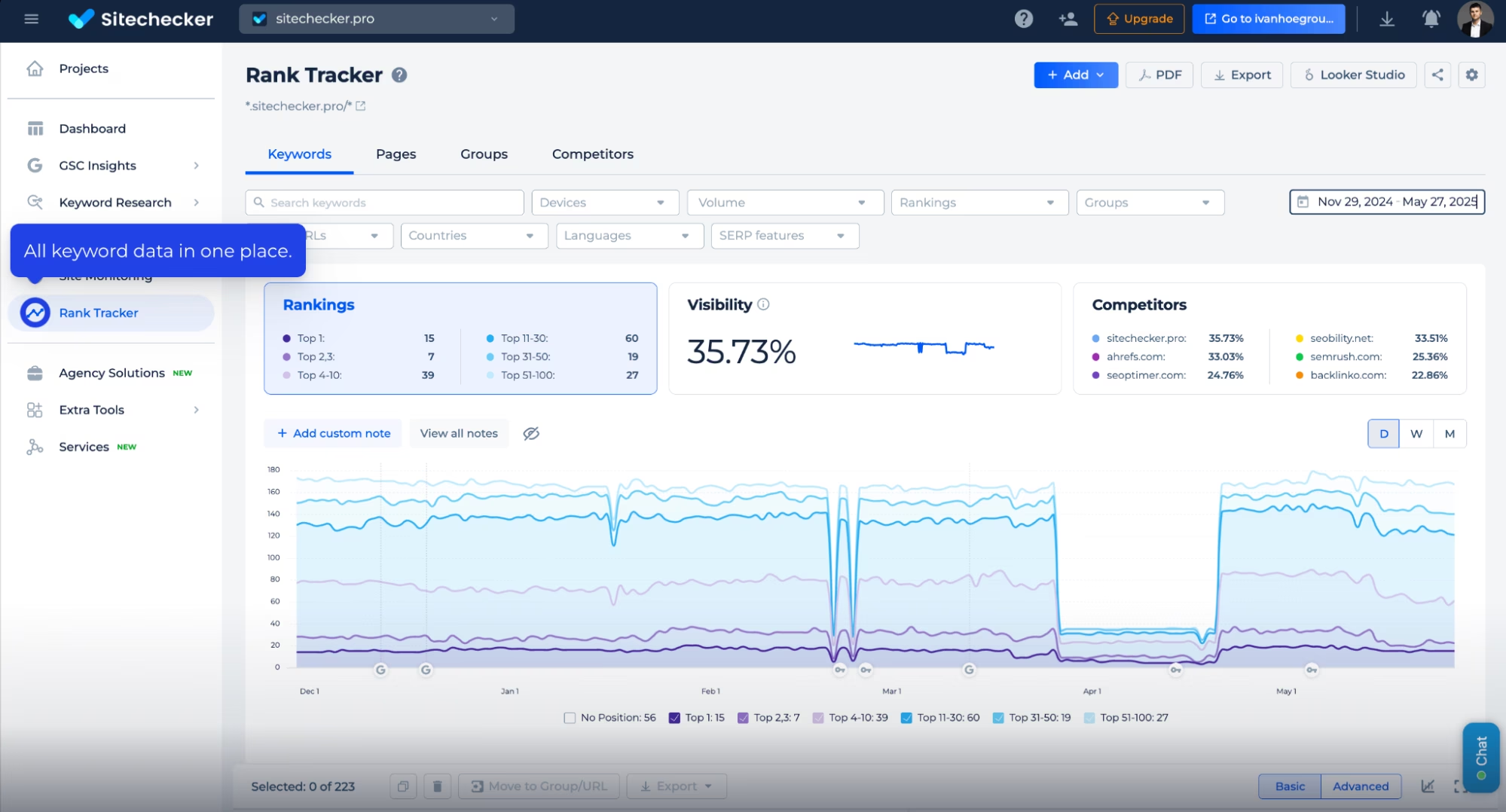
Sitechecker provides deeper site audits and rank tracking than SEOQuake. Sitechecker operates as a continuous monitoring and reporting system, while SEOQuake functions as a browser extension focused on quick, page-level diagnostics.
Core features in Sitechecker include automated site audits covering more than 300 technical and on-page issues, keyword rank tracking, on-page SEO analysis, GSC and GA4 data enrichment, and white-label reporting for agencies.
Sitechecker is a paid tool with pricing ranges from $89 to $449 per month. Enterprise plans use custom pricing based on scale, reporting needs, and API access.
Pros of Sitechecker include continuous monitoring, detailed audit coverage, strong reporting customization, and white-label support. Cons include limited backlink analysis depth and fewer competitive research features compared to larger SEO suites.
16. Jasper Everywhere: Best SEOQuake Alternative for AI Content Optimization
Jasper Everywhere is a browser extension that embeds AI writing and editing capabilities directly into web-based tools. Jasper Everywhere enables in-context content creation and optimization across platforms without switching applications.
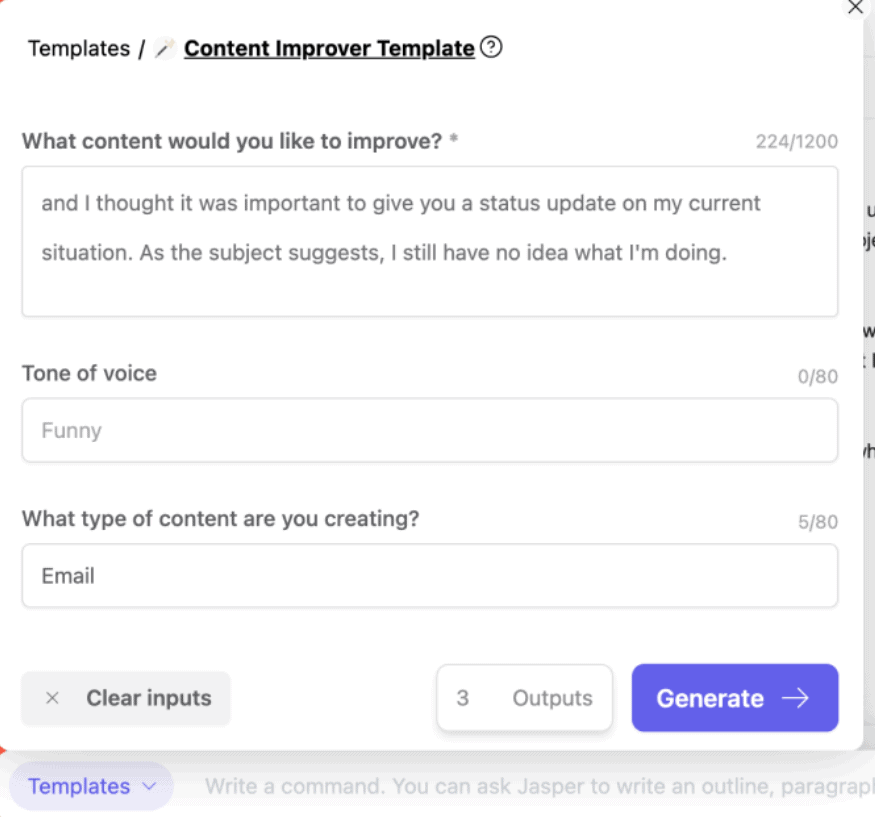
Jasper Everywhere offers stronger AI-driven content optimization than SEOQuake. Jasper Everywhere focuses on real-time writing, rewriting, and refinement inside live workflows, while SEOQuake surfaces static SEO metrics without content creation support.
Core features in Jasper Everywhere include AI-assisted writing, sentence rewrites, tone adjustments, content expansion or shortening, and clarity-focused revisions. The extension connects to a library of more than 90 marketing-focused AI tools, offers over 80 languages, and generates plagiarism-free content.
Jasper Everywhere is a paid tool with pricing ranges from $69 per seat per month to custom Business plans. Access requires an active Jasper subscription, and no free version is available.

Pros of Jasper Everywhere include deep integration with popular web tools, flexible in-browser editing, and multilingual AI support. Cons include reliance on Jasper’s paid ecosystem and occasional tone or factual inconsistencies in generated output.
17. Detailed: Best SEOQuake Alternative for In-Browser SEO Pages and Extensions
Detailed SEO is a free browser extension built to surface page-level SEO data directly inside Chrome and Firefox. Detailed SEO exposes titles, meta descriptions, heading structure, schema markup, and indexation signals in one click without inspecting source code.
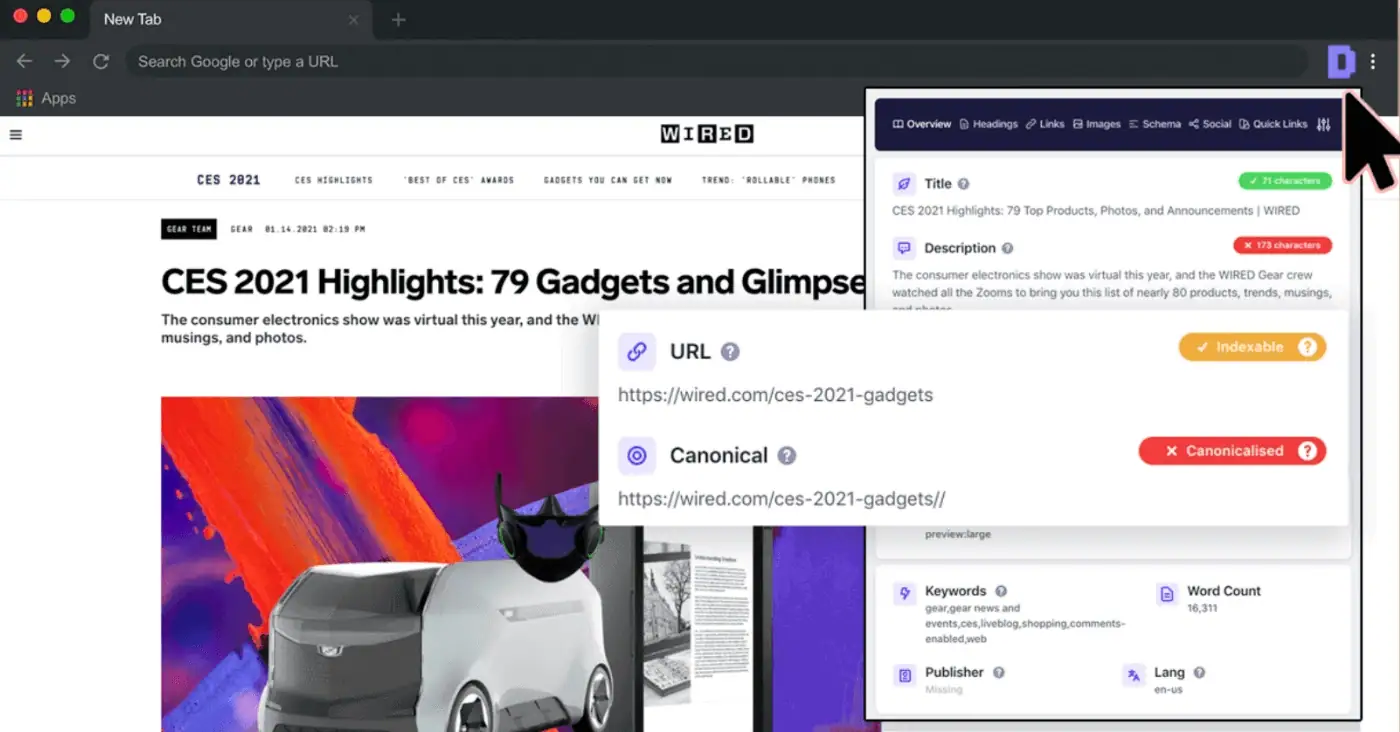
Detailed SEO delivers cleaner in-browser SEO diagnostics than SEOQuake. Detailed SEO focuses on fast, uncluttered page audits and clear technical signals, while SEOQuake presents broader overlays that often require additional filtering to interpret.
Core features in Detailed SEO include one-click extraction of title tags, meta descriptions, heading hierarchy, image attributes, structured data, indexability status, sitemap references, and canonical signals. The extension integrates with external tools for deeper analysis while keeping on-page reviews lightweight and fast.
Detailed SEO is a free tool with no paid plans or usage limits.
Pros of Detailed SEO include speed, simplicity, and clear presentation of critical on-page elements. Cons include limited advanced analysis, no rank tracking, and reliance on external tools for deeper competitive or backlink insights.
18. Auto Page Rank: Best SEOQuake Alternative for PageRank and Link Metrics
Auto Page Rank is an SEO platform designed to accelerate content indexing and surface link-based authority signals at URL level. Auto Page Rank focuses on rapid visibility by combining indexing automation with simplified authority metrics.
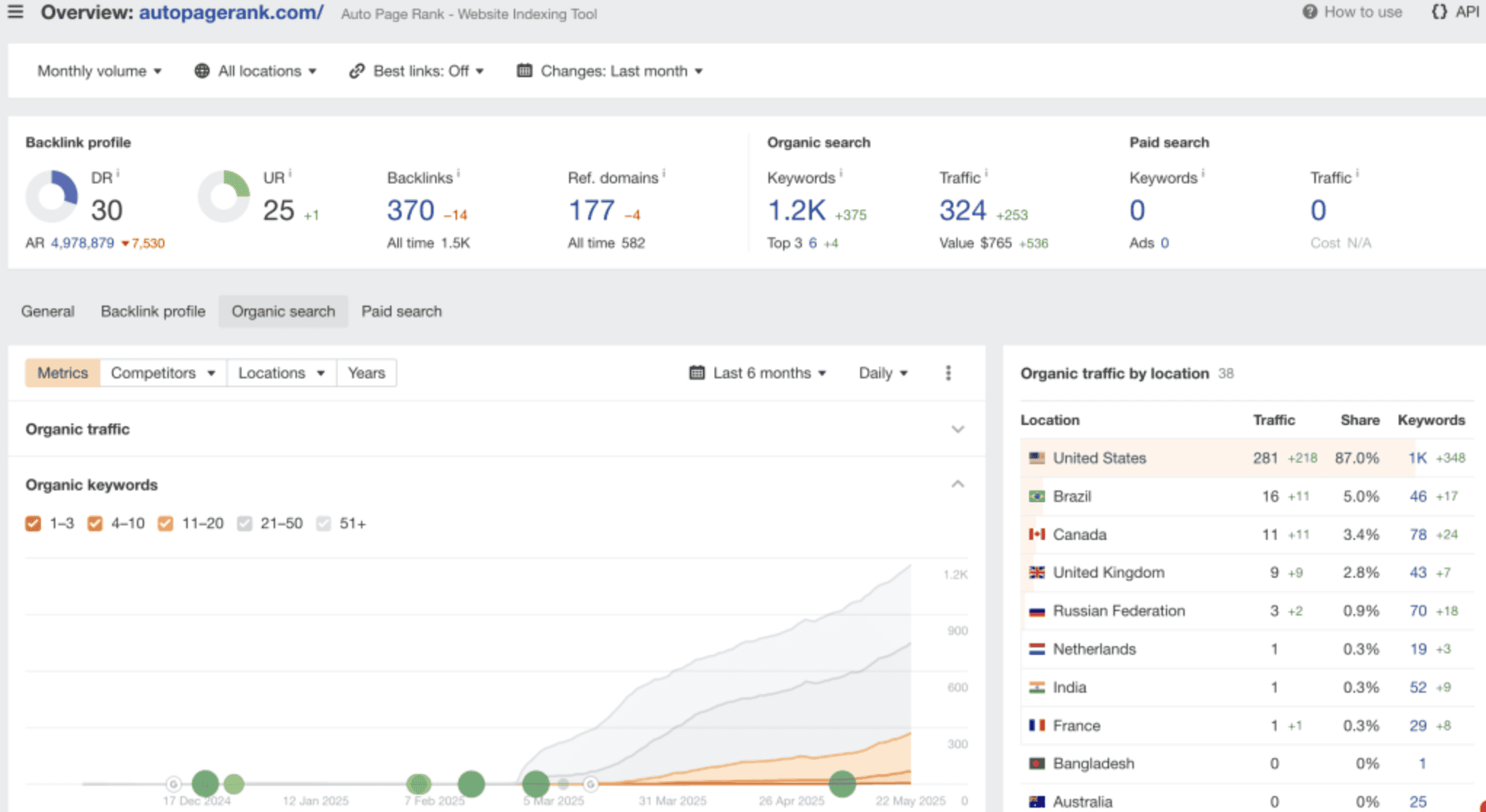
Auto Page Rank emphasizes link value and indexing speed more than SEOQuake. Auto Page Rank centers on URL authority snapshots and fast indexing workflows, while SEOQuake prioritizes general on-page overlays and page attributes.
Core features in Auto Page Rank include automated URL submission for near-instant indexing, page-level authority scoring, link signal snapshots, and AI-assisted content generation for continuous publishing. The platform tracks indexing status in real time and highlights which pages gain visibility fastest.
Auto Page Rank is a paid tool with pricing ranges from free access to $19.97 per month. The free trial allows limited daily indexing, while the paid plan increases indexing volume across unlimited sites.
Pros of Auto Page Rank include fast indexing, simple authority signals, and beginner-friendly automation. Cons include limited technical SEO depth and the need for complementary tools to manage broader optimization strategies.
19. Mangools: Best SEOQuake Alternative for Rank Tracking and SERP Insights
Mangools is an SEO toolkit built for keyword research, rank tracking, and SERP analysis inside a clean, beginner-friendly interface. Mangools targets bloggers, small businesses, and agencies that need reliable SEO data without complex technical workflows.
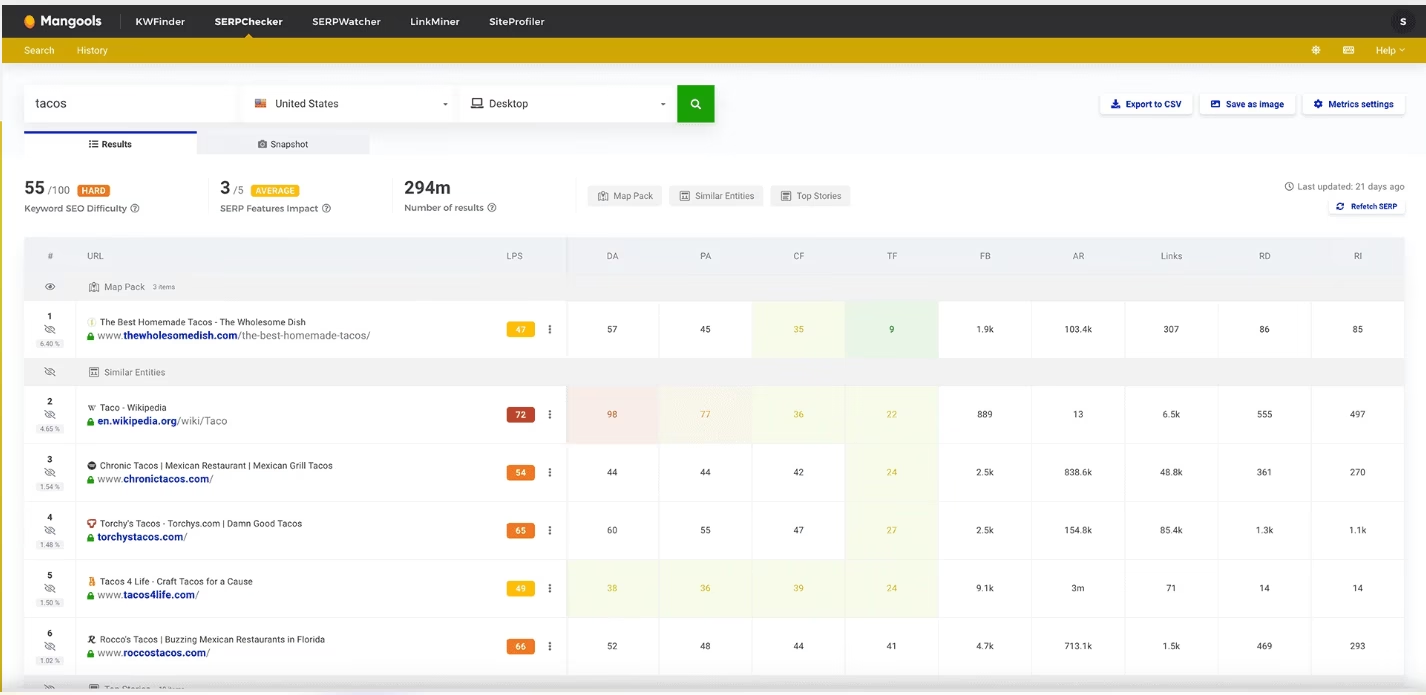
Mangools delivers stronger rank tracking and SERP insight than SEOQuake. Mangools operates as a full web-based SEO suite with continuous tracking and competitive context, while SEOQuake functions as a browser extension that surfaces one-time, page-level metrics.
Core features in Mangools include KWFinder for keyword discovery with volume and difficulty scores, SERPChecker for visual SERP competition analysis, and SERPWatcher for tracking ranking changes across devices and locations. These tools provide ongoing visibility into keyword performance rather than static snapshots.
Mangools is a paid tool with pricing ranges from $19.43 to $58.44 per month when billed annually. A 14-day free trial is available without a credit card.
Pros of Mangools review include an intuitive interface, efficient keyword research, and affordable pricing for entry-level users. Cons include limited data depth and fewer advanced technical SEO capabilities for large or enterprise teams.
20. Rank Math SEO: Best SEOQuake Alternative for WordPress SEO Automation
Rank Math SEO is a WordPress plugin designed to automate on-page and technical SEO tasks directly inside the CMS. Rank Math centralizes metadata management, schema markup, optimization checks, and performance tracking in one dashboard.
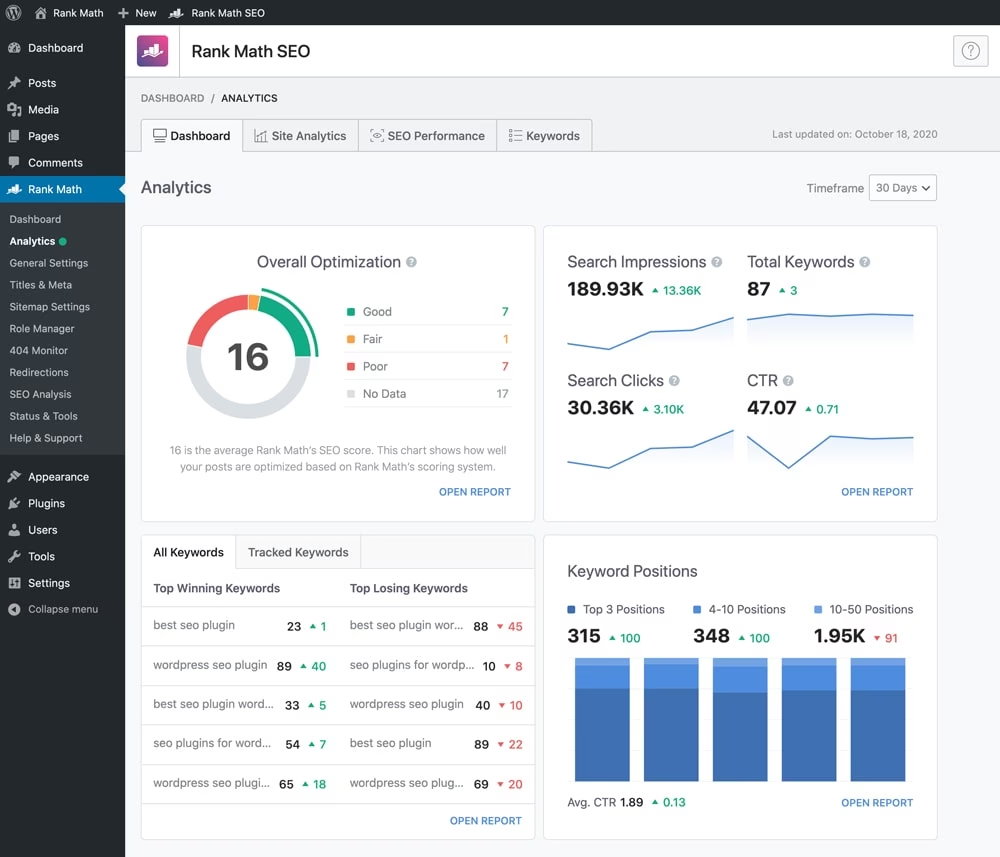
Rank Math SEO provides deeper WordPress SEO automation than SEOQuake. Rank Math applies SEO rules and enhancements directly to site content, while SEOQuake acts as an external diagnostic tool without execution capabilities.
Core features in Rank Math SEO include automated meta tag generation, advanced schema markup, keyword rank tracking, readability analysis, image SEO, redirection management, and built-in content analysis. Optional AI modules extend content recommendations and optimization workflows.
Rank Math SEO offers a free version. Rank Math SEO is a paid tool with pricing ranges from $7.99 to $59.99 per month depending on plan level and billing cycle.
Pros of Rank Math SEO include flexible keyword optimization, automation depth, and strong schema support. Cons include premium features locked behind paid tiers and additional costs for advanced AI tools.
21. AIOSEO: Best SEOQuake Alternative for On-Site WordPress SEO Enhancements
All in One SEO (AIOSEO) is a WordPress SEO plugin built to manage on-page optimization, technical SEO, schema, and sitewide SEO workflows from one interface. AIOSEO offers both beginner setups and advanced SEO configurations.
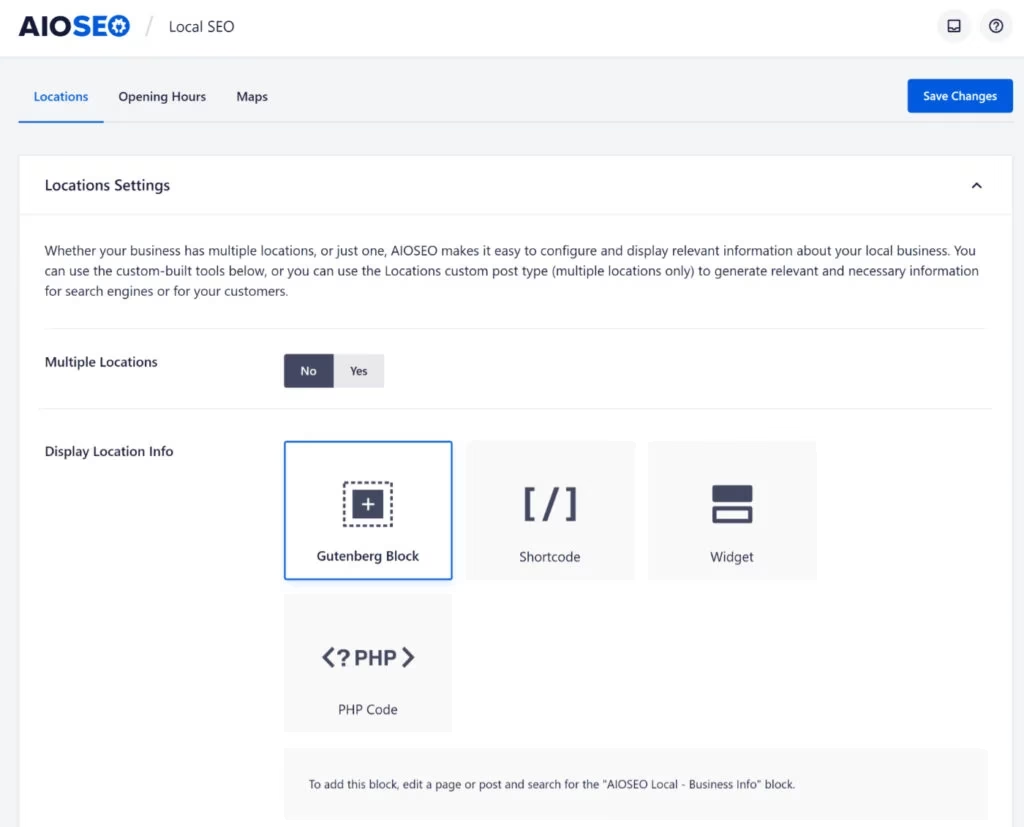
AIOSEO offers broader on-site SEO controls than SEOQuake. AIOSEO embeds optimization logic inside WordPress, while SEOQuake provides external page metrics without sitewide automation or configuration control.
Core features in AIOSEO include TruSEO on-page analysis, schema markup management, SEO revisions, keyword rank tracking, smart XML sitemaps, redirection tools, WooCommerce SEO, and local SEO modules. These features offer structured, site-level SEO execution.
AIOSEO offers a free version. AIOSEO is a paid tool with pricing ranges from $124 to $749 per year depending on feature access and site needs.
Pros of AIOSEO include strong automation, advanced schema support, and flexible technical SEO controls. Cons include higher pricing than basic WordPress plugins and premium tiers required for full functionality.
22. Nightwatch: Best SEOQuake Alternative for Advanced Rank Tracking
Nightwatch is an SEO monitoring platform built for agencies and growth teams that manage large keyword sets across multiple locations. Nightwatch tracks rankings across Google, Bing, YouTube, DuckDuckGo, and Google Local Pack with city- and ZIP-level precision.
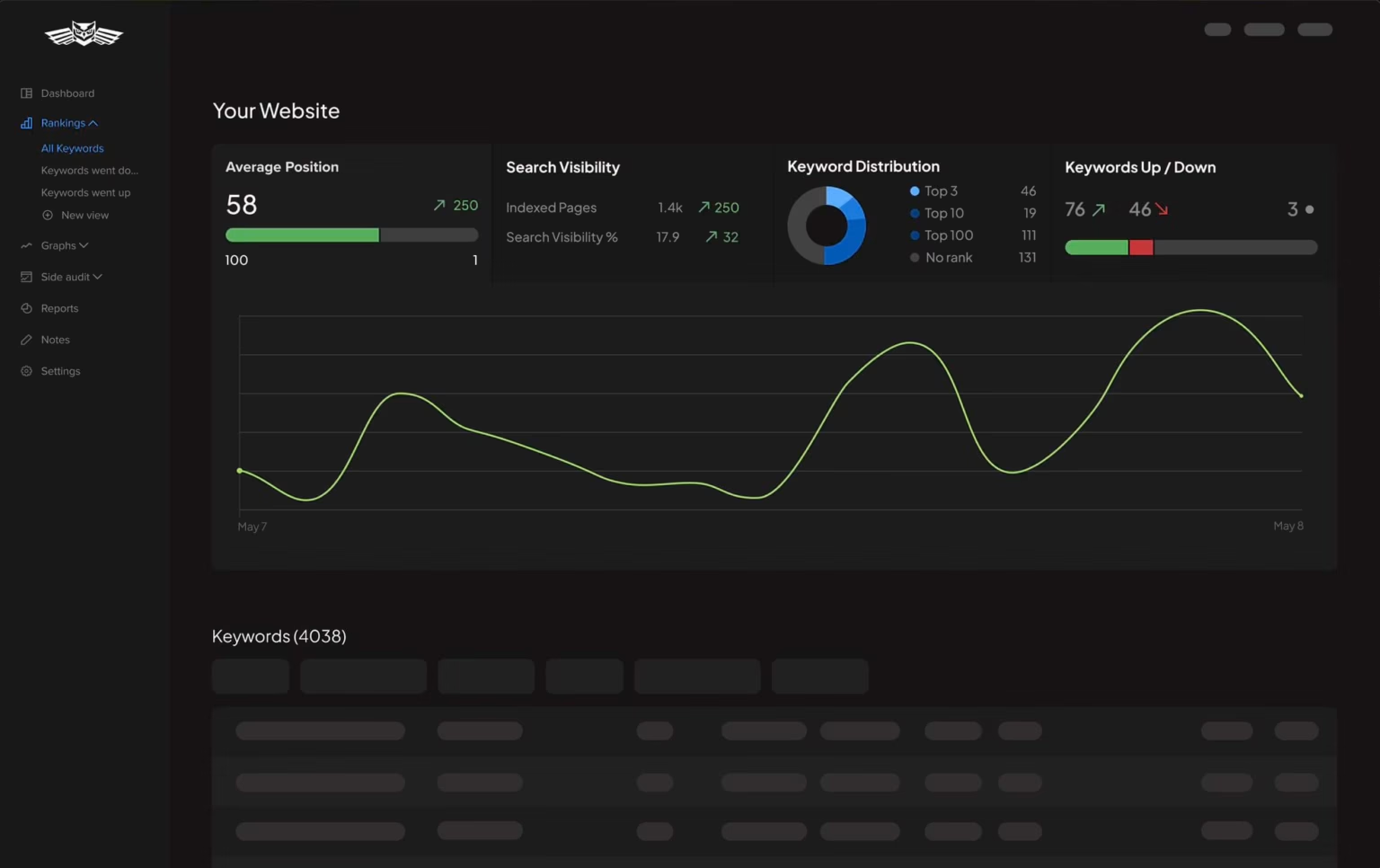
Nightwatch delivers deeper rank tracking capabilities than SEOQuake. Nightwatch operates as a dedicated rank intelligence platform with daily updates and granular segmentation, while SEOQuake provides basic, one-page SEO metrics through a browser extension.
Core features in Nightwatch include daily keyword tracking, SERP feature segmentation, Click Potential metrics, Search Visibility Score, and volatility monitoring. The platform offers white-label reporting, keyword grouping, API access, and emerging AI search visibility tracking across systems such as ChatGPT, Gemini, and Claude.
Nightwatch is a paid tool with pricing ranges from $39 per month upward, scaling by tracked keyword volume. A 14-day free trial is available, with no long-term contracts required.
Pros of Nightwatch include highly accurate rank data, advanced segmentation options, strong reporting visuals, and hyper-local tracking. Cons include the absence of backlink analysis, limited technical auditing features, and a learning curve for new users.
23. Conductor: Best SEOQuake Alternative for Enterprise-Level SEO Analysis
Conductor is an enterprise SEO platform designed for organizations that manage large websites and complex content operations. Conductor combines keyword research, rank tracking, content analysis, and competitive intelligence into a centralized system.
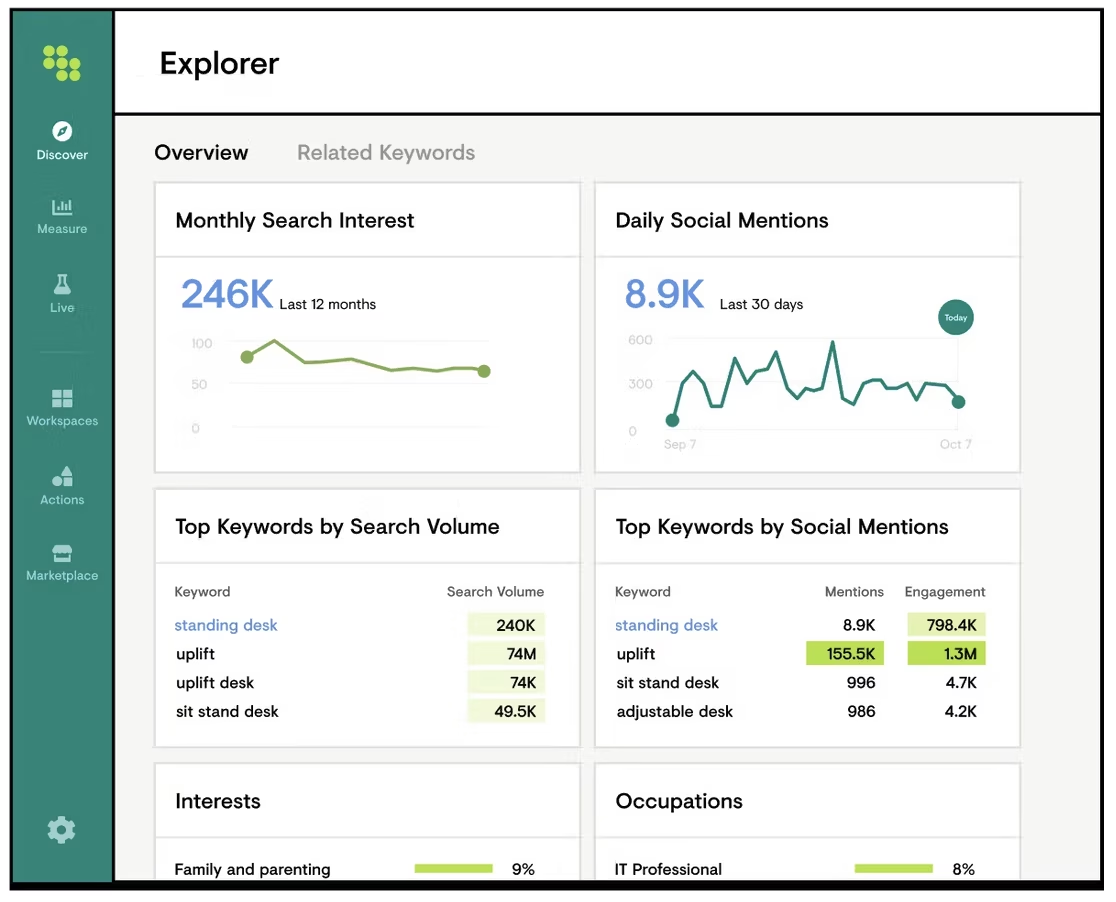
Conductor provides enterprise-grade SEO analysis beyond SEOQuake. Conductor offers large-scale reporting, workflow integration, and strategic guidance, while SEOQuake focuses on lightweight, page-level diagnostics.
Core features in Conductor include SERP visualization, content opportunity identification, technical site auditing, and integrations with tools such as Asana, Trello, and Jira. The platform delivers real-time dashboards and optional consulting services for strategy, migrations, and enterprise SEO execution.
Conductor is a paid tool with custom pricing based on site size, content volume, and data requirements. A three-week free trial is available for qualified organizations.
Pros of Conductor review include strong content intelligence, competitive benchmarking, workflow integrations, and executive-level reporting. Cons include higher cost, platform complexity for new users, and limited flexibility outside enterprise use cases.
24. PageOptimizer Pro: Best SEOQuake Alternative for On-Page Testing and Recommendations
Page Optimizer Pro is an on-page SEO platform built around controlled testing and data-backed experimentation. Page Optimizer Pro evaluates page structure, keyword placement, and competitor benchmarks to generate precise optimization targets.
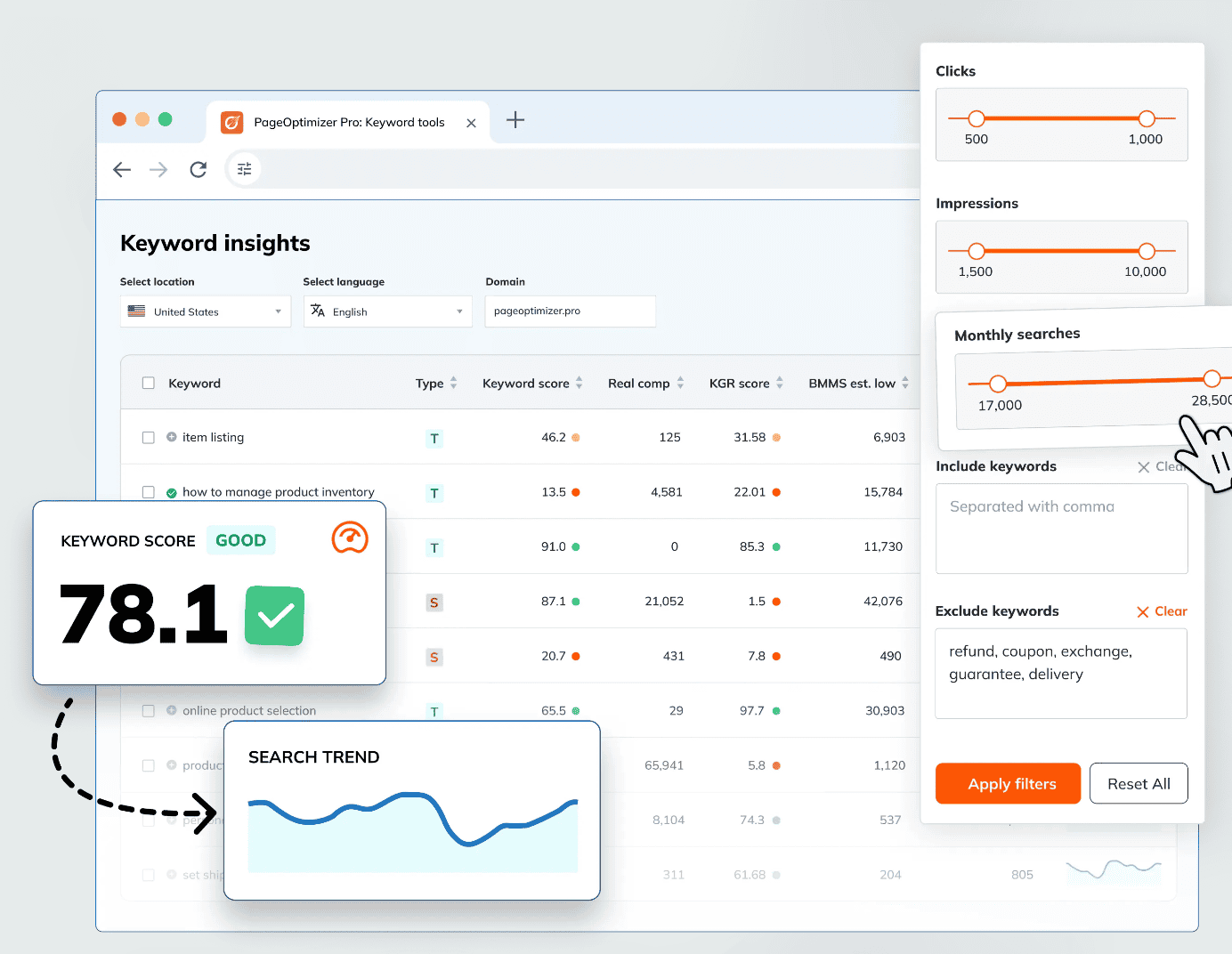
PageOptimizer Pro (POP) generally outperforms the SEOquake extension in on-page testing and recommendations because it is a dedicated, data-driven content optimization tool, while SEOquake is a broader, quick analysis browser extension
Core features in Page Optimizer Pro include a real-time Content Editor that scores keyword usage and structural strength, along with competitor comparisons across more than twenty-nine ranking factors. These signals form a focused optimization roadmap tied directly to ranking performance.
Page Optimizer Pro is a paid tool with pricing ranges from $56 per month to custom done-for-you plans.
Pros of Page Optimizer Pro include precise recommendations, proven ranking impact, and URL-specific optimization guidance. Cons include a narrow focus on on-page factors and the need for additional tools to cover technical SEO and keyword research.
25. Raven Tools: Best SEOQuake Alternative for SEO Reports and Site Audits
Raven Tools is a cloud-based SEO and digital marketing platform built for agencies and consultants managing multiple client campaigns. Raven Tools combines site audits, keyword tracking, backlink monitoring, and multi-channel reporting in one system.
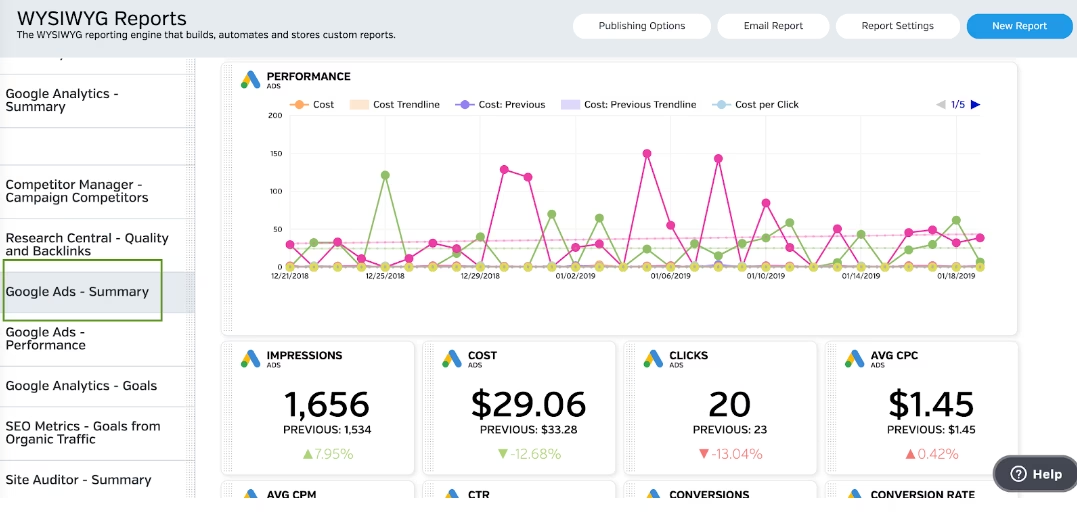
Raven Tools offers more comprehensive SEO reporting and audits than SEOQuake. Raven Tools offers campaign-level management and white-label reporting, while SEOQuake is designed for quick, page-level analysis without reporting workflows.
Core features in Raven Tools include a Website Auditor that scans sites for broken links, speed issues, and missing tags, plus customizable white-label reports covering SEO, PPC, social media, email, and call tracking.
Raven Tools is a paid tool with pricing ranges from $49 to $479 per month. A seven-day free trial provides full platform access.
Pros of Raven Tools review include strong client reporting, broad integrations, and scalable campaign management. Cons include limited technical SEO depth, fewer local SEO features, and slower backlink data refresh compared to specialized platforms.
26. SEObility: Best SEOQuake Alternative for Technical SEO Monitoring
SEObility is an all-in-one SEO platform built to audit websites for technical, structural, and on-page issues. SEObility crawls sites to evaluate internal linking, metadata, content quality, and performance factors that affect search visibility.
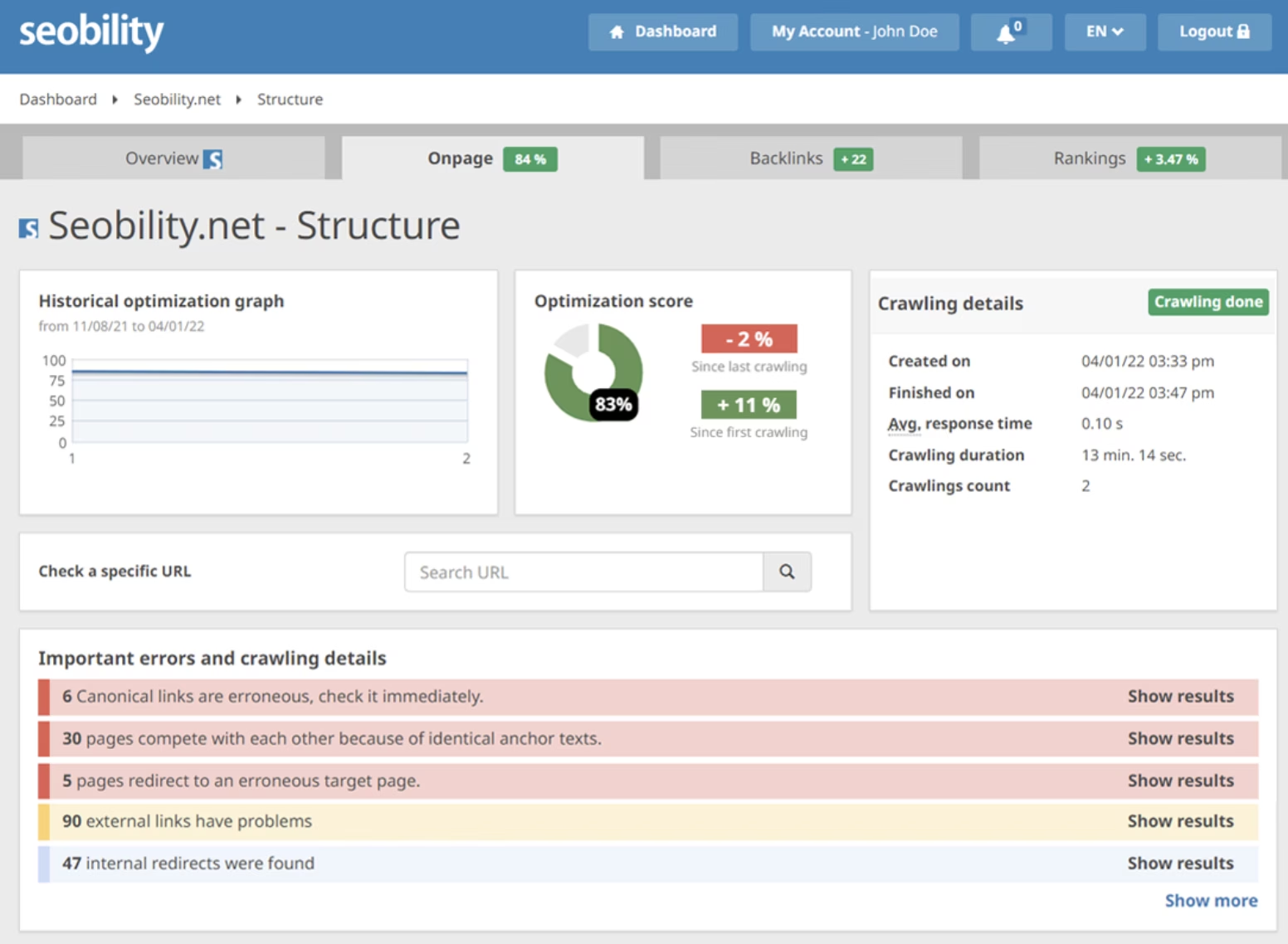
SEObility delivers more comprehensive technical SEO monitoring than SEOQuake. SEObility runs continuous site audits and issue tracking across entire domains, while SEOQuake focuses on quick, page-level metrics inside the browser.
Core features in SEObility include a Website Audit that checks more than 300 technical and on-page factors, identifying crawl errors, redirect chains, duplicate content, and indexation issues. The platform surfaces prioritized recommendations that allow stable site performance without enterprise-level complexity.
SEObility is a paid tool with pricing ranges from $50 to $200 per month. A free plan is available, while higher tiers expand crawl limits, reporting, and agency features.
Pros of SEObility include an intuitive interface, broad technical coverage, and actionable audit insights. Cons include limited depth compared to enterprise crawlers and occasional ambiguity in reported issues for non-technical users.
27. Serpstat: Best SEOQuake Alternative for All-in-One SEO Data and Keyword Research
Serpstat is an SEO and digital marketing platform built for freelancers, businesses, and agencies that need broad SEO data inside one system. Serpstat unifies keyword research, backlink analysis, rank tracking, technical audits, and competitor benchmarking.
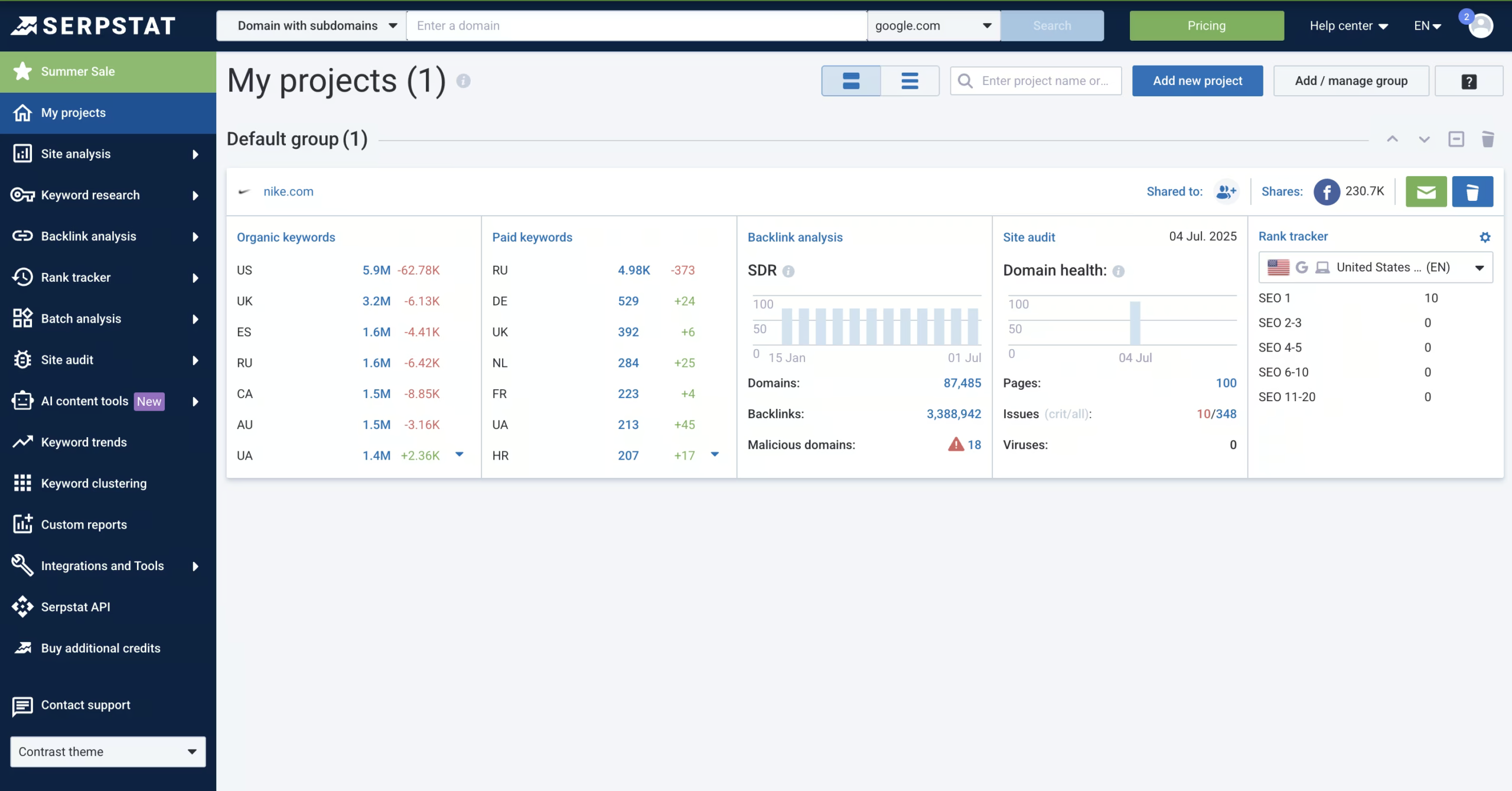
Serpstat provides wider SEO coverage than SEOQuake. Serpstat operates as a standalone research and monitoring platform, while SEOQuake offers basic on-page metrics without keyword databases or historical tracking.
Core features in Serpstat include keyword clustering with topic grouping, a domain audit system with optimization scoring, backlink comparisons across competitors, and local SEO tools. The platform offers JavaScript crawling and surface recommendations tied to technical health and site speed.
Serpstat is a paid tool with pricing ranges from $69 to $499 per month. A limited free plan is available for testing core functionality.
Pros of Serpstat review include access to large datasets, built-in collaboration tools, and balanced coverage across SEO and PPC. Cons include a smaller backlink index than specialist link tools and a steeper learning curve for beginners.
28. Moz Pro: Best SEOQuake Alternative for Authority Metrics and On-Page SEO
Moz Pro is a full SEO platform built around rank tracking, keyword research, and trusted authority metrics. Moz Pro monitors keyword visibility across local and national search results while providing historical SERP data for strategic analysis.
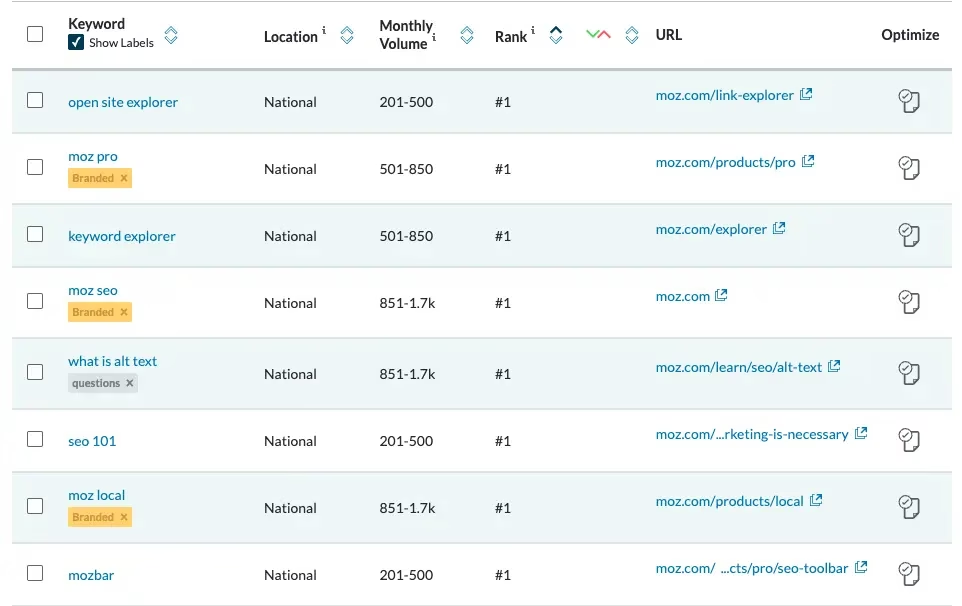
Moz Pro offers deeper authority metrics and structured on-page SEO analysis than SEOQuake. Moz Pro functions as a comprehensive SEO suite with historical data and proprietary metrics, while SEOQuake provides quick, surface-level insights through a browser extension.
Core features in Moz Pro include keyword rank tracking across desktop and mobile results, SERP feature detection, on-page optimization audits, and proprietary metrics such as Domain Authority and Page Authority. The platform emphasizes clarity, reporting consistency, and education for SEO teams.
Moz Pro is a paid tool with pricing ranges from $49 to $299 per month depending on feature access and tracked limits.
Pros of Moz review include an intuitive interface, trusted authority metrics, strong onboarding resources, and reliable reporting. Cons include fewer advanced capabilities than enterprise platforms and higher costs for entry-level plans compared to specialized rank trackers.
29. SE Ranking: Best SEOQuake Alternative for Rankings, Audits, and Backlink Checks
SE Ranking is an all-in-one SEO platform designed to manage keyword tracking, site audits, backlink monitoring, and competitor research from a single dashboard. SE Ranking balances feature depth with usability for agencies and in-house teams.
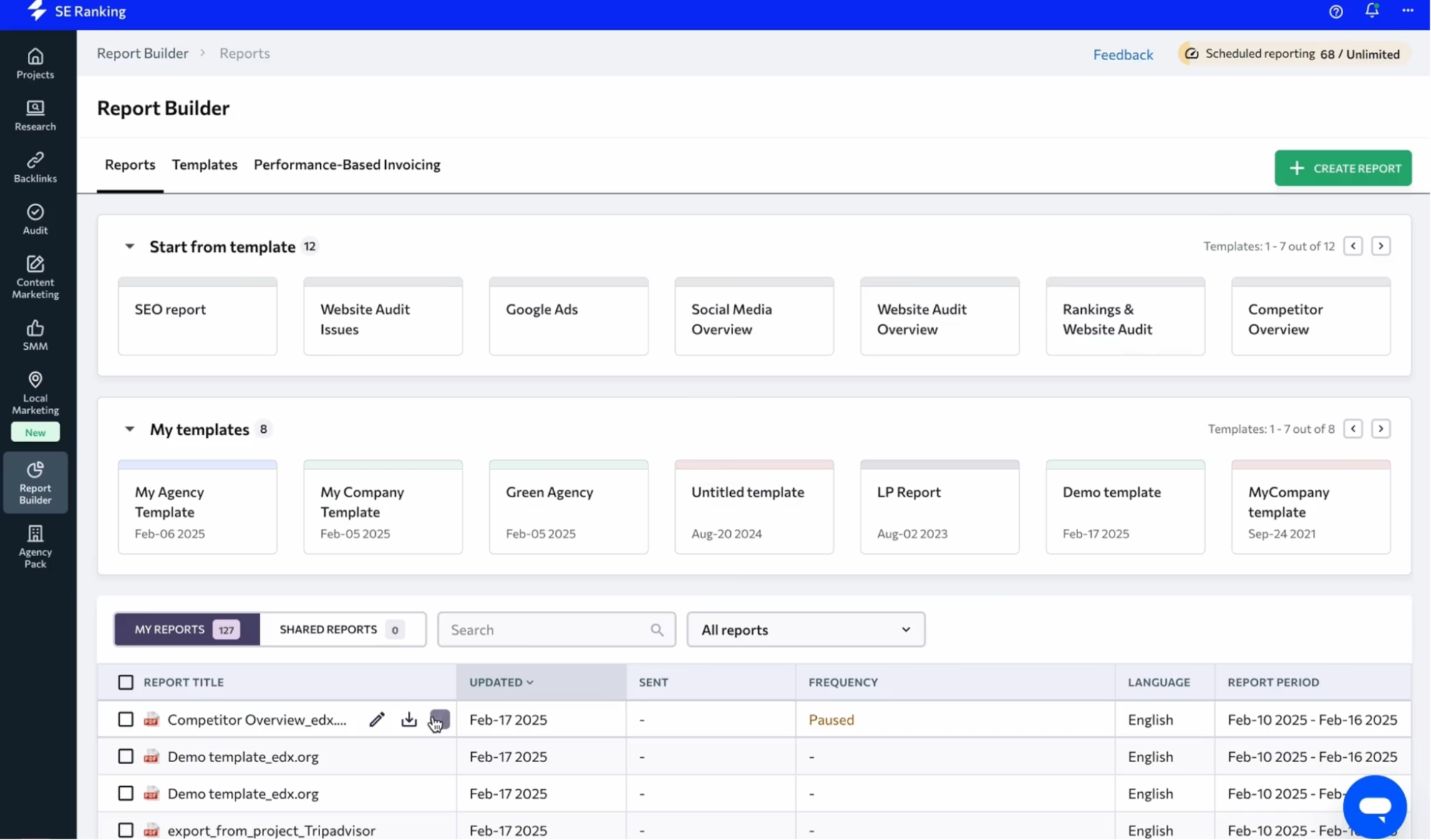
SE Ranking delivers broader SEO coverage than SEOQuake. SE Ranking offers continuous tracking and sitewide analysis, while SEOQuake focuses on quick, page-level metrics without historical or campaign context.
Core features in SE Ranking include a technical audit system with prioritized fixes, multi-engine rank tracking across Google, Bing, Yahoo, and YouTube, and backlink analysis for authority monitoring. Reporting tools offer white-label workflows and multi-project management.
SE Ranking is a paid tool with pricing ranges from $65 to $359 per month based on keyword volume, tracking frequency, and user seats. A 14-day free trial provides full platform access.
Pros of SE Ranking review include cloud-based access, clean interface design, and a complete SEO toolkit. Cons include a smaller backlink index than specialist tools and fewer advanced controls for highly technical users.
30. Ahrefs: Best SEOQuake Alternative for Backlink and Competitor Research
Ahrefs is a cloud-based SEO platform built for backlink analysis, competitor research, and organic visibility tracking. Ahrefs combines link intelligence, keyword research, rank tracking, and site audits in a single research-focused interface.
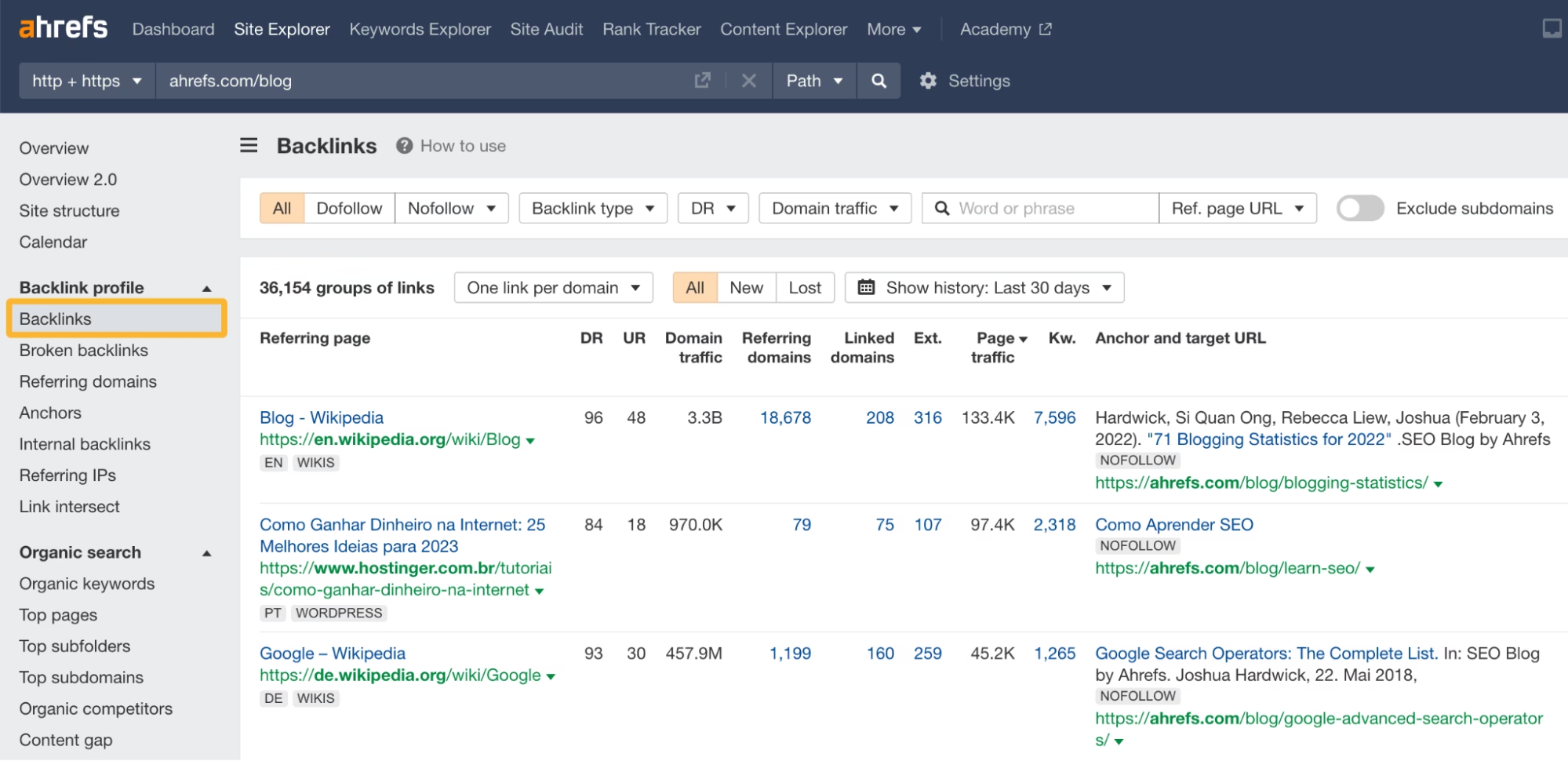
Ahrefs provides deeper backlink and competitor insights than SEOQuake. Ahrefs operates as a large-scale link intelligence system with historical data and competitive context, while SEOQuake surfaces lightweight page metrics inside the browser.
Core features in Ahrefs include backlink tracking with anchor text analysis, referring domain monitoring, historical link growth charts, and competitor backlink gap analysis. The platform extends this research with keyword explorers, rank tracking, and technical site audits.
Ahrefs is a paid tool with pricing ranges from $129 to $1,499 per month, depending on data limits, user access, and reporting depth. Limited free access exists through standalone tools such as the backlink checker and keyword generator.
Pros of Ahrefs review include industry-leading backlink data, fast performance, and a clean cloud-based interface. Cons include high subscription costs, feature restrictions by tier, and the absence of built-in AI content creation tools.
31. Semrush: Best SEOQuake Alternative for Comprehensive SEO and SERP Data
Semrush is an all-in-one digital marketing platform that covers SEO, paid search, content marketing, and competitive analysis. Semrush centralizes keyword research, rank tracking, backlink audits, and technical SEO alongside cross-channel insights.
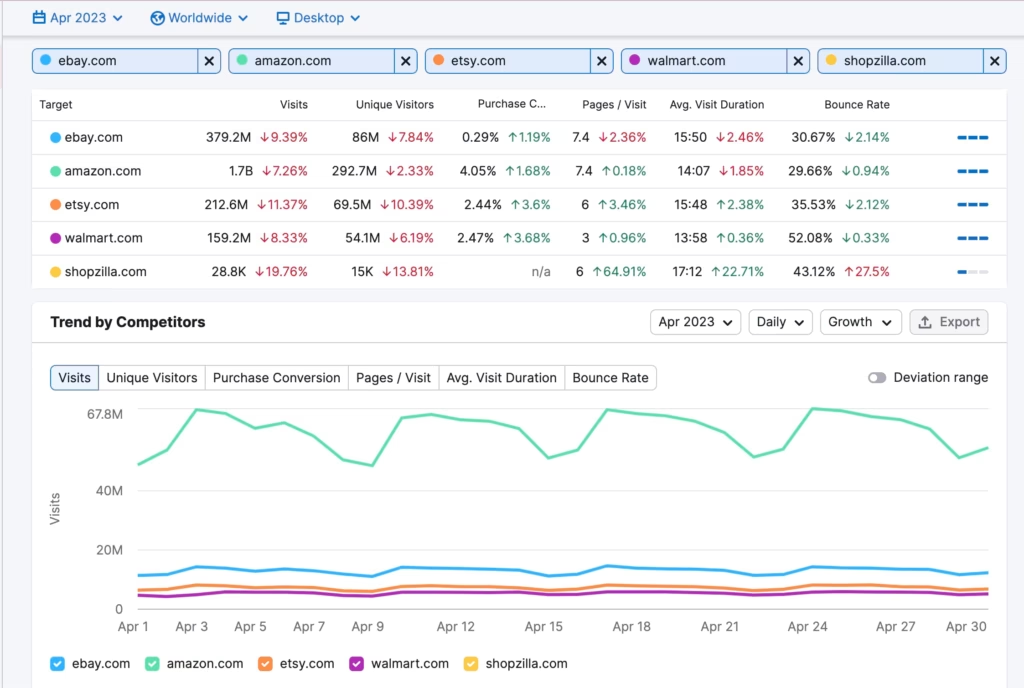
Semrush delivers broader SEO and SERP intelligence than SEOQuake. Semrush functions as a full marketing analytics suite with large datasets and competitive modeling, while SEOQuake focuses on quick, page-level checks without historical or strategic depth.
Core features in Semrush include competitor research across organic, paid, and content channels. The platform reveals keyword overlaps, backlink gaps, ad spend patterns, and traffic trends to identify growth opportunities.
Semrush is a paid tool with pricing starting at $139 per month. Higher tiers expand keyword limits, reporting depth, and user seats. A free trial is available for new accounts.
Pros of Semrush review include extensive competitor insights, reliable rank tracking, and a complete toolkit for SEO and paid teams. Cons include higher costs than mid-market tools and an interface that requires onboarding for smaller teams.
Why do People Seek Alternatives to SEOQuake Tool?
People seek SEOQuake alternatives because modern SEO workflows require more than surface-level metrics displayed in a browser. SEOquake delivers fast page data, but it stops short of explaining what those numbers mean or how to act on them. This gap slows teams that need clear direction, not just raw indicators.
SEOquake’s browser-based approach creates another limitation. The extension focuses on single-page snapshots and SERP overlays, which works for quick checks but breaks down when managing large sites, multi-location rankings, or ongoing campaigns. SEO professionals often need persistent tracking, historical trends, and centralized dashboards that browser tools do not provide.
Data depth is another common issue. SEOquake surfaces basic metrics, but it lacks advanced keyword research, backlink intelligence, competitive gap analysis, and technical crawling. As strategies grow more complex, users move toward platforms that connect keywords, links, rankings, and site health in one environment.
Workflow integration drives many users away as well. SEOquake operates in isolation, with limited reporting, collaboration, or automation. Agencies and in-house teams increasingly favor tools that integrate with audits, content planning, rank tracking, and client reporting rather than switching between extensions and standalone systems.
That combination of shallow analysis, page-level focus, limited scalability, and disconnected workflows leads many professionals to SEOQuake alternatives that deliver deeper data, clearer insights, and tools built for full SEO execution rather than quick inspection alone.
What to Look for in an SEOQuake Alternative?
The best SEOQuake alternatives deliver clearer insights, deeper data, and workflows that extend beyond page-level snapshots. A strong replacement replaces raw overlays with actionable context, scalable analysis, and tools that allow real SEO decisions rather than quick inspections.
The 6 features to look for in an alternative to SEOQuake are listed below.
- Actionable Metrics and Clear Guidance. Choose tools that explain what metrics mean and surface recommended next steps instead of listing raw numbers.
- Deeper Keyword and SERP Intelligence. Look for platforms that provide keyword difficulty, intent signals, SERP features, and historical movement rather than static rankings.
- Backlink and Authority Analysis. Strong alternatives include link quality evaluation, referring domain trends, and competitor backlink gaps, not just link counts.
- Technical SEO and Site Auditing. Prioritize tools that identify crawl issues, indexation problems, structured data errors, and performance risks across entire sites.
- Scalable Tracking and Reporting. Effective replacements offer ongoing rank tracking, historical comparisons, exports, and client or team reporting beyond the browser.
- Clean Interfaces and Workflow Integration. Pick tools that reduce screen clutter, integrate with broader SEO platforms or dashboards, and fit naturally into research, auditing, and planning workflows.
What is the Difference Between Semrush vs. SEOQuake?
The difference between Semrush and SEOQuake is that Semrush is a full-scale SEO and digital marketing platform built for deep research and ongoing optimization, while SEOQuake is a free browser extension designed for quick, on-page SEO checks.
The Semrush vs SEOQuake comparison highlights a clear functional split. SEOQuake surfaces instant metrics inside the browser, such as keyword density, internal and external links, and basic page attributes. Semrush operates at a broader level, combining keyword research, rank tracking, site audits, backlink analysis, and competitor intelligence inside one platform.
Both Semrush vs SEOQuake surface SEO data, but they serve different depths of analysis. Search Atlas moves beyond this divide by unifying real-time SEO data, content optimization, and automated execution through OTTO, Content Genius, and Scholar in a single system built for scalable performance.
Why is Search Atlas the Best SEOQuake Alternative?
Search Atlas is the best SEOQuake alternative because it transforms browser-level SEO checks into a complete execution system. Instead of showing isolated page metrics, Search Atlas connects keyword data, technical diagnostics, content intelligence, and automation inside one platform.
SEOQuake focuses on quick snapshots like keyword density and link counts, which often leave teams guessing what to fix next. Search Atlas goes further by using live GSCdata, SERP analysis, and entity modeling. SEOs review insights in the Chrome extension, then apply fixes through OTTO SEO without switching tools.
Search Atlas pricing starts at $99 per month and replaces SEOQuake plus separate tools for audits, content optimization, rank tracking, and reporting. For teams moving beyond surface-level metrics, Search Atlas delivers clearer insights, faster execution, and measurable SEO gains from one system.