Perplexity AI Search, an AI-powered “answer engine” founded in August 2022, launched its public beta on December 7, 2022, and achieved 22 million active users by September 2025, processing 780 million queries in May 2025 with over 20% month-over-month growth. Valued at US$20 billion by September 2025, it offers a Pro tier at $20/month or $200/year, providing 600 normal Pro searches and up to 500 Deep Research queries daily. Its core functionality, emphasizing transparency with visible citations, directly addresses generative AI weaknesses by combining large language models (LLMs) with real-time web retrieval, ensuring answers are grounded in current sources and reducing hallucinations.
Key features include a multi-model AI architecture deployed in May 2025, leveraging proprietary Sonar models (built on LLaMA 3.3 70B) and third-party LLMs (GPT series, Claude, Gemini 2.5 Pro, Grok 3 Beta). Deep Research Mode, launched in February 2025, generates reports from hundreds of sources, while Focus Mode, considered crucial by 75% of users, tailors information retrieval for specific intent. Despite its capabilities, Perplexity AI faces accuracy concerns, with reported instances of incorrect answers and “silent model substitution” routing Pro requests to cheaper models, leading to “WATERED DOWN” outputs and legal challenges from entities like The New York Times for alleged copyright infringement and “stealth crawling.”
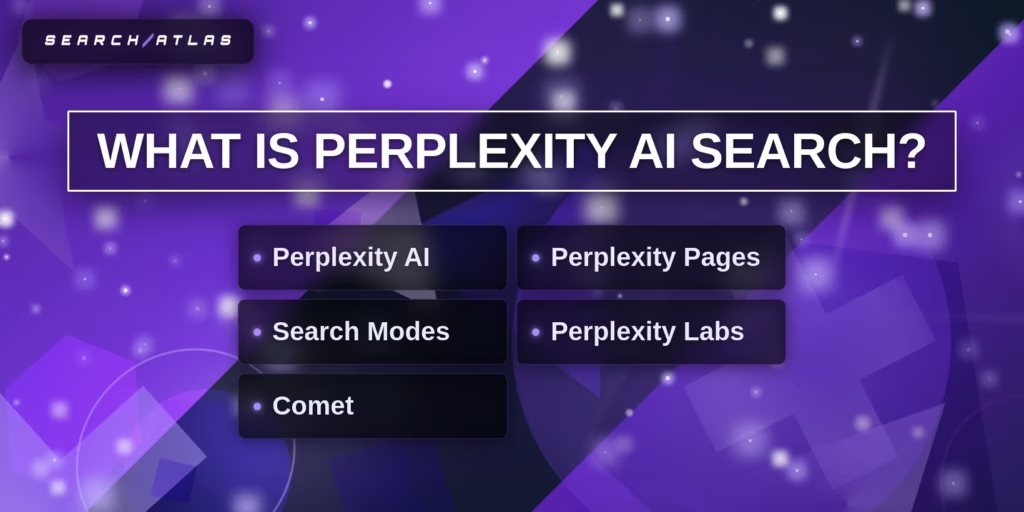
What is Perplexity AI Search?
Perplexity AI Search is an AI-powered search engine/assistant that processes user queries and synthesizes responses, characterized by providing clear, direct, sourced answers with visible citations.
Perplexity AI Search was founded in August 2022 by Aravind Srinivas, Denis Yarats, Johnny Ho, and Andy Konwinski, with its initial release on December 7, 2022. The company’s core purpose was to create an “answer engine” that combines large language models (LLMs) with real-time web search capabilities, emphasizing transparency through visible citations. By April 2023, Perplexity AI Search had raised $25.6 million in Series A funding, demonstrating early investor confidence in its approach.
As an online information retrieval system, Perplexity AI Search belongs to the broader category of generative AI applications and search engines. Perplexity AI Search distinguishes itself from traditional search engines by synthesizing direct answers rather than just providing links, and from chatbots like ChatGPT by emphasizing transparency through visible citations. Perplexity AI Search competes with other AI search solutions and traditional search engines by offering a hybrid approach of LLMs and real-time web search.
Key components and features of Perplexity AI Search are below.
- Perplexity AI (December 7, 2022): The core search engine, which interprets questions using language models and provides responses based on current Internet content, citing sources.
- Perplexity Pages (undated): Generates structured summaries and report-like content from user queries by aggregating cited sources.
- Search Modes (various dates): Includes Quick Search for simple questions, Pro Search (formerly Copilot) for complex queries (free users get 5 uses every 4 hours, paid users get approximately 600 uses a day), and Deep Research Mode (launched February 2025) for generating reports from hundreds of sources.
- Perplexity Labs (a couple of months after Deep Research mode): Creates spreadsheets, reports, dashboards, and web apps.
- Comet (July 2025): An AI browser based on Chromium, integrating the Perplexity AI Search engine for tasks like article summaries and research. Initially for the highest subscription tier, it became a free download in October 2025.
Key attributes of Perplexity AI Search include:
1. Transparency and Sourcing: Every response from Perplexity AI Search includes a list of clickable source links, allowing users to trace and verify information. This feature aims to enhance accuracy and user trust, distinguishing Perplexity AI Search from other AI models.
2. Multi-Model AI Architecture: Deployed in May 2025, Perplexity AI Search uses a hybrid approach combining proprietary models (Sonar model family, built on LLaMA 3.3 70B) and third-party LLMs (GPT series, Claude, Gemini 2.5 Pro, Grok 3 Beta). This architecture allows Perplexity AI Search to leverage diverse AI capabilities for improved response generation.
3. Scalability and User Growth: Perplexity AI Search processed 780 million queries in May 2025, experiencing more than 20% month-over-month growth, processing around 30 million queries daily. By September 2025, the company was valued at US$20 billion, reflecting rapid expansion and adoption.
Perplexity AI Search forms a network of relationships within the AI and tech industries:
Dependencies: Perplexity AI Search relies on large language models (GPT-5, Claude, Gemini, Grok, o4-mini, Sonar), real-time web search capabilities, and extensive web-based content for summarizing and generating responses. Perplexity AI Search also depends on user queries to drive its core functionality.
Enablement: Perplexity AI Search enables efficient information discovery by providing direct, sourced answers, saving users time typically spent context switching across tabs. Perplexity AI Search also enables developers through its Search API, providing programmatic access to its search infrastructure.
Competition: Perplexity AI Search competes with traditional search engines like Google and Bing, as well as other AI-powered assistants and chatbots like ChatGPT. Perplexity AI Search also faces competition from news organizations and publishers who allege copyright infringement due to its content scraping practices.
Perplexity AI Search is widely adopted for information retrieval and research: Perplexity AI Search reached 22 million active users and $100 million in annual recurring revenue by September 2025. Perplexity AI Search is available via mobile apps (iOS and Android) and Chrome extensions, and can be set as a default search engine. Perplexity AI Search has also expanded into specialized applications, including a Shopping Hub (November 2024) with Amazon and Nvidia backing, and Finance Features (October 2024) providing real-time stock quotes and financial analysis tools.
What is the Price of Perplexity AI Search?
$20 per month to $3,250 per seat per month is how much Perplexity AI Search costs, depending on the plan, usage volume, and features. Perplexity Pro for individual users costs $20 per month or $200 annually (10 months of service). Perplexity Enterprise Pro for teams costs $40 per seat per month or $400 annually (10 months of service), requiring a minimum of 50 seats for data retention and audit logging. Perplexity Enterprise Max, designed for high-volume and complex research, costs $325 per seat per month or $3,250 annually (10 months of service).
Perplexity API pricing varies significantly based on API type, model selected, tokens processed, and search context size. Search API costs $5 per 1,000 requests for direct access to raw web results. Token-based pricing per million tokens ranges from $1 for Sonar input/output to $15 for Sonar Pro output tokens. Search context pricing per 1,000 requests ranges from $5 for low context Sonar to $14 for high context Sonar Pro. A basic web search using Sonar with 500 input and 200 output tokens at low context costs approximately $0.0057.
The free version of Perplexity AI Search offers unlimited quick searches with citations and 5 Pro searches per day. This free plan includes core question-answering and citation functions but restricts access to premium Large Language Models (LLMs) and advanced features. Users on the free plan experience throttling during high-traffic periods and limited access to new features or model updates.
Key factors affecting Perplexity pricing include usage volume (number of queries/requests), access to advanced LLMs (e.g., GPT-5 or Claude 4.5 Sonnet), and Pro features such as workspace collaboration, saved threads, custom personas, and extended history. API access costs increase with tokens consumed or requests made. Web access and real-time data also add to costs due to infrastructure and data licensing. Support and Service-Level Agreements (SLAs) increase the price for business and enterprise plans.
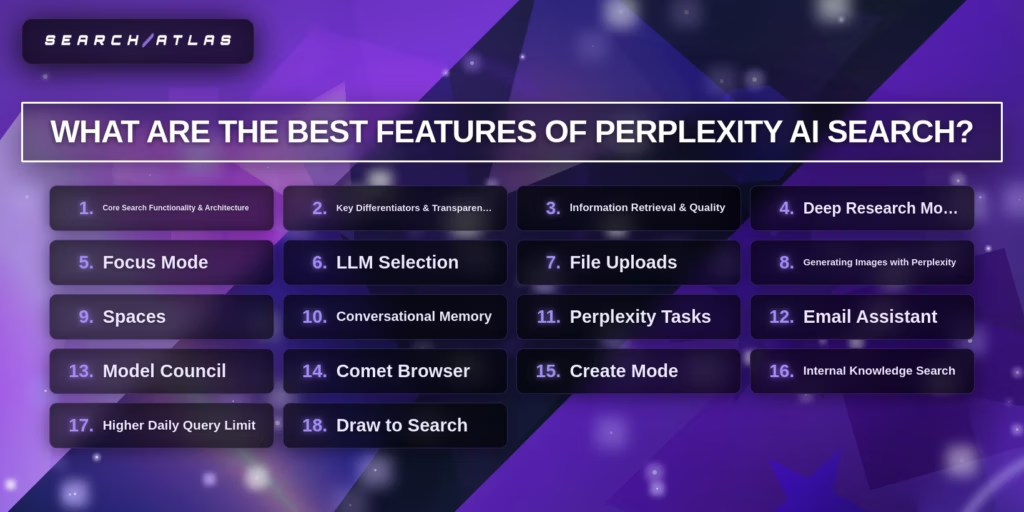
What are the Best Features of Perplexity AI Search?
The best features of Perplexity AI Search include:
- Core Search Functionality & Architecture (Feature Category)
- Key Differentiators & Transparency (Feature Category)
- Information Retrieval & Quality (Feature Category)
- Deep Research Mode (Advanced Feature)
- Focus Mode (Advanced Feature)
- LLM Selection (Advanced Feature)
- File Uploads (Advanced Feature)
- Generating Images with Perplexity (Advanced Feature)
- Spaces (Advanced Feature)
- Conversational Memory (Advanced Feature)
- Perplexity Tasks (Advanced Feature)
- Email Assistant (Advanced Feature)
- Model Council (Advanced Feature)
- Comet Browser (Advanced Feature)
- Create Mode (Advanced Feature)
- Internal Knowledge Search (Advanced Feature)
- Higher Daily Query Limit (Advanced Feature)
- Draw to Search (Android App Feature)
1. Core Search Functionality & Architecture
Core search functionality and architecture is the first best feature of Perplexity AI Search because it is the most fundamental design principle emphasized by CEO Aravind Srinivas, it directly addresses persistent weaknesses of generative AI like outdated information and hallucinations, its core architectural principles combine LLMs with real-time web retrieval, it ensures completeness, freshness, and speed through advanced crawling infrastructure, it provides fine-grained content understanding for optimal AI model input, and it prioritizes transparency and citations for verifiable answers.
How is core search functionality the most fundamental design principle? Perplexity’s CEO Aravind Srinivas states, “First, solve search, then use it to solve everything else,” highlighting its foundational role. The company pivoted from enterprise text-to-SQL to an AI-powered search and research assistant, with a critical turning point being the CTO adding Bing search and summarization, establishing the foundational Retrieval-Augmented Generation (RAG) architecture. Launched in 2022, Perplexity rapidly grew to 22 million active users by May 2025, redefining search with its “answer engine” approach.
Why does Perplexity’s architecture address persistent weaknesses of generative AI? Traditional search engines present an “interface of ten blue links,” and SEO has “skewed how results are presented,” raising trust issues. Perplexity’s architecture directly addresses “one of the most persistent weaknesses of generative AI: outdated or unverifiable information” and “reduces hallucinations” caused by outdated data. Unlike static chatbots trained on “frozen data,” Perplexity’s design ensures answers are grounded in current sources, improving accuracy and user confidence.
What are the core architectural principles that make Perplexity’s search effective? Perplexity combines large language models (LLMs) with real-time web retrieval, applying RAG to reduce hallucinations. It retrieves live data through on-demand crawling and trusted APIs, with freshness being a core relevance signal. Perplexity interprets queries using natural language processing (NLP), combining lexical search, vector search, and hybrid pipelines. It orchestrates multiple frontier LLMs, including GPT-4, Claude Opus, and open models like LLaMA 70B, optimizing for latency, context length, and cost.
How does Perplexity ensure completeness, freshness, and speed? Perplexity’s architecture is engineered for real-time latency, with comprehensive and constantly updated data. Its crawling and indexing infrastructure tracks over 200 billion unique URLs, with capacity for hundreds of billions more, processing tens of thousands of indexing operations per second. The Perplexity Search API achieved a median latency of 358ms, over 150ms faster than the second-fastest provider, with 95th-percentile latency under 800ms.
Why is fine-grained content understanding crucial for Perplexity’s search? Results are presented and ranked at the most granular level possible due to AI model brittleness and limited context windows. Perplexity uses dynamic rulesets for parsing websites and extracting semantically meaningful content, adapting to varied layouts and structures. This enables segmentation into sub-document units, allowing individual retrieval and ranking of self-contained spans to optimize LLM context. Retrieval and scoring occur at both document and sub-document levels to surface atomic units for AI models.
How does transparency and citations build trust in Perplexity’s search? Perplexity prioritizes source citations and transparency in every response, generating citations through a tightly coupled information retrieval and ranking pipeline, not post-processing. Each paragraph typically includes numbered references, encouraging users to “inspect and challenge” information. An AI researcher stated, “Perplexity’s strength is not the model, but the system design. It forces accountability through citations,” making it “the most measurable of the AI search engines.”
2. Key Differentiators & Transparency
Key differentiators and transparency are the second best feature of Perplexity AI Search because its mission-critical focus on accuracy and transparency (founded 2022), direct contrast to competitors like ChatGPT (which often lacks citations), anti-hallucination mechanisms that reduce misinformation risk, and user confidence and monetization through verifiable sources (10 million monthly active users).
How does Perplexity’s mission-critical focus contribute to its transparency? Perplexity’s core mission is “to make knowledge accessible, accurate, and transparent through AI-driven…” This commitment is embedded in its hybrid model, which combines AI reasoning with search engine accuracy by pulling data directly from trusted web sources and citing them in real-time. This fundamental design principle ensures every response includes citations from credible sources, avoiding AI “hallucinations.”
Why is Perplexity’s direct contrast to competitors significant? Unlike traditional AI models such as ChatGPT, Perplexity does not generate responses from internal data. It always provides automatic source citations, positioning itself as a “black box” alternative. ChatGPT typically doesn’t cite sources unless specifically asked, and even then, its citation quality doesn’t match Perplexity’s research-grade standards, which are crucial for academic and professional legitimacy.
What makes Perplexity’s anti-hallucination mechanisms effective? The mandatory inclusion of real-time citations directly addresses the issue of large language models (LLMs) generating “confident yet fictitious information.” Perplexity’s Retrieval-Augmented Generation (RAG) core technology allows LLMs to access, retrieve, and incorporate new information from external web sources in real-time, ensuring the model “sticks to the facts” and reduces misinformation risk.
How do user confidence and monetization relate to transparency? The provision of trusted sources and citations gives users the confidence to act on information, particularly for purchase-intent queries. This instant verifiability is essential for maintaining trust in AI-assisted research and creates accountability. This underlying trust, built through transparency, is crucial for user adoption and retention, supporting monetization strategies through subscriptions, APIs, and transaction-based partnerships, contributing to its 10 million monthly active users and 300% year-over-year growth.
3. Information Retrieval & Quality
Information retrieval and quality is the third best feature of Perplexity AI Search because its core design prioritizes accurate, sourced answers over traditional link-based search, it provides real-time information access by continuously indexing the live web, it ensures superior accuracy through source verification and advanced RAG, and it employs advanced retrieval and ranking mechanisms like hybrid search and multi-stage ranking.
How does Perplexity AI’s core design contribute to its information retrieval and quality? Perplexity is fundamentally an “answer engine” designed for “accurate, up-to-date, and sourced answers,” driving a shift from link-based to answer-based search. Its rapid growth and projected $18–$20 billion valuation in 2026 are attributed to users seeking direct, valid information with sources, avoiding ads and incomplete answers prevalent in traditional search.
Why is real-time information access significant for information quality? Perplexity continuously accesses the live web, unlike static AI models with knowledge cutoffs, making it valuable for breaking news, current events, and market trends. Its Search API, launched in 2025, provides developers access to billions of indexed webpages for real-time retrieval, delivering accurate results in milliseconds. Vespa’s unique index technology allows for continuous, real-time updates at scale without impacting query performance, supporting partial updates for individual fields at high continuous rates.
What makes Perplexity’s accuracy superior through source verification? Every response includes numbered citations linking to original sources, allowing independent verification. Research comparing Perplexity to Google shows Perplexity excels in citation-backed accuracy, with facts presented “more grounded and, frankly, more trustworthy” compared to other LLMs prone to “occasional ‘hallucination.'” Perplexity employs Retrieval Augmented Generation (RAG) to construct final answers, utilizing fresh information for each query, significantly reducing the chances of incorrect information by ensuring the AI only uses data pulled from search results.
How do advanced retrieval and ranking mechanisms enhance information quality? Perplexity utilizes hybrid retrieval, favoring traditional algorithms like BM25 over solely relying on embeddings for RAGs, combining term-based retrieval with modern techniques. BM25 is described as an “old school information retrieval system that just works actually really well even today,” and “still beating most embeddings on ranking.” Vespa integrates hybrid search, combining vector embeddings for semantic matching and full-text matching for lexical precision. Perplexity’s AI tool prioritizes sources based on clarity, relevance, freshness, and source credibility, aiming for reputable academic journals, established news outlets, and well-regarded domain-specific websites.
4. Deep Research Mode
Deep Research mode is the fourth best feature of Perplexity AI Search because its performance is sometimes outshone by rivals in specific queries, some users report a lack of deep insights despite “superficially good results,” its resource intensity can quickly deplete user quotas, and its core functionality is increasingly matched by competitors.
How does performance sometimes fall short in specific queries? In a comparison of AI chatbots for a specific GPS query, Perplexity AI’s report was described as “acceptable” but “paled in comparison to those from ChatGPT and Gemini,” lacking depth and analysis. This placed its performance as third or fourth best among the tested AI chatbots for that particular query. While Deep Research achieves state-of-the-art performance on all leading external benchmarks and outperforms other deep research tools on accuracy and reliability, its inconsistent performance across all query types positions it as a strong, but not always top-tier, feature.
Why do some users report a lack of deep insights? Despite generating comprehensive and accurate reports, some users found Deep Research producing “superficially good results” but lacking “decent ‘insights'” or being “shallow descriptive texts.” One user even found it “worse than OpenAI deep search” after one query, and another noted it generates shorter reports compared to OpenAI’s Deep Research. This suggests that while it excels at fact-finding and report generation, the depth of analytical insight can sometimes be perceived as insufficient by advanced users.
What makes Deep Research mode resource-intensive? The advanced capabilities of Deep Research, which include a multi-pass querying system (20-50 targeted queries, drawing from over 200 sources) and an integrated reasoning engine, require significant computational resources. Opus, the model now running Deep Research for Max and Pro users, is described as “very expensive.” One user reported that a single request in Opus used up 50% of a five-hour limit, and 20% of a 5-hour quota and 3% of a weekly quota for a task with several requests, indicating that its use can quickly deplete user quotas, especially with the new limits of 20 Deep Research uses per month for Pro users.
How is its core functionality increasingly matched by competitors? Perplexity’s “main claim to fame was blending LLM+search well early on,” but “everyone has caught up on that one though.” While Perplexity’s Deep Research was introduced on February 14th, 2025, following Gemini Deep Research (December 11th, 2024) and ChatGPT Deep Research (February 2nd, 2025), competitors like ChatGPT Plus offer GPT5.2 thinking, 3000 queries per week, and a higher context window for a similar price. Gemini AI Pro offers a better context window, usage limits, 2TB cloud storage, and 25 deep research queries per day, with improved deep research. This competitive landscape means that while Perplexity’s Deep Research is highly capable, it is no longer uniquely positioned in its core offering.
5. Focus Mode
Focus mode is the fifth best feature of Perplexity AI Search because it provides tailored information retrieval for specific user intent, significantly improves accuracy and context by reducing hallucinations, acts as a personalized research assistant for diverse tasks, and is considered crucial by 75% of users for their primary search needs.
How does tailored information retrieval contribute to focus mode’s value? Focus modes customize search results and writing style to match user intent, whether for researching, learning, or content creation. For example, Social Mode enables users to get 100% authentic human opinions on products and provides “genius ideas” for coding and strategies that often surpass generic model outputs. This tailoring delivers a more curated, context-aware answer instead of a generic summary.
Why is improved accuracy and context significant? Focus modes fine-tune data gathering and processing, leading to more relevant, source-based answers and reduced hallucinations. Academic Mode, for instance, is essential for academic sources and research, providing sharper, more relevant answers where credibility is crucial. This mode is also beneficial for technical deep dives requiring authoritative sources and aids in obtaining business insights from industry-specific outlets.
What makes focus mode an effective personalized research assistant? Focus modes transform Perplexity from a general AI chatbot into a specialized research and writing assistant. For example, a psychologist specializing in teenagers and digital environments heavily relies on Academic Focus for content production and training, demonstrating its utility in expert-level tasks. Social Mode distills insights from “smartest people on any area of expertise,” revealing “small details” attained by experienced professionals in digital marketing or coding.
How does user reliance underscore focus mode’s importance? Multiple users state that Focus (Social and Academic) is the “main reason” they use Perplexity, or a “huge part of the reason.” One user reported that 75% of their searches were based on Social Focus. Several users have threatened to cancel subscriptions if Focus is not reinstated, with one user stating they would “INSTANTLY CANCEL MY SUBSCRIPTION,” highlighting its critical role in user retention and satisfaction.
6. LLM Selection
LLM selection is the sixth best feature of Perplexity AI Search because it offers a novel concept for targeted information gathering, provides exclusive access to advanced models for Pro users, leverages powerful LLMs for synthesis and real-time processing, and integrates proprietary Sonar models that outperform competitors by 10x in decoding throughput.
How does LLM selection offer a novel concept for targeted information gathering? The ability to choose between multiple cutting-edge LLMs from different developers, or let Perplexity pick the “best tool for the job,” is described as a “novel concept” and a significant upgrade. Perplexity AI’s Pro Search naturally combines powerful LLMs like GPT-4, Claude, and Mistral with precise search, enhancing the quality of information retrieval.
Why is exclusive access to advanced models significant for Pro users? LLM choice is exclusive to Pro users, who can select from a list of eight additional LLMs. These include Perplexity’s fast Sonar model, Anthropic’s advanced Claude 3.7 Sonnet, OpenAI’s GPT-4.1, and Google’s latest Gemini 2.5 Pro. More advanced reasoning models such as Perplexity’s R1 1776 are also available, offering enhanced capabilities.
What makes leveraging powerful LLMs crucial for synthesis and real-time processing? Perplexity leverages powerful LLMs for synthesis, feeding them filtered, high-quality retrieved information as context to generate coherent, concise answers. Perplexity AI is an advanced, AI-powered answer engine built on LLMs that process natural language queries in real time, pulling, synthesizing, and summarizing data from credible websites and databases. Perplexity continuously enhances its capabilities by learning from user interactions and feedback, using LLMs (including proprietary ones) to refine its natural language understanding and answer accuracy.
How do proprietary Sonar models contribute to Perplexity’s capabilities? Perplexity develops and deploys its own proprietary LLMs, collectively branded “Sonar” and “PPLX.” Sonar models are built atop open models like Llama 3.3 70B and fine-tuned for grounding in search results, supporting large context windows up to 128K tokens. Internal A/B tests show Sonar significantly outperforms models like GPT-4o mini and Claude 3.5 Haiku in user satisfaction, delivering around 1200 tokens/sec, which is roughly 10x faster decoding throughput than some competitor models like Gemini 2.0 Flash.
7. File Uploads
File uploads are the seventh best feature of Perplexity AI Search because the user interface visually indicates its position with the number 7, it is presented as Use Case #2 in a feature list, and it is a crucial tool for professionals who demand more from AI interactions.
How does the user interface position contribute to file uploads being the seventh best feature? The “Perplexity AI – What it is and how to use it?” source visually indicates the option to upload file(s) with the number 7 in a screenshot explanation. This numerical placement on the user interface directly corresponds to its ranking as the seventh best feature, guiding users to its location and implying its sequential importance among other functionalities.
Why is its presentation as Use Case #2 significant? The “Perplexity Pro Features: 7 Powerful Use Cases” source lists “File upload & analysis” as the fourth feature in a table but presents it as Use Case #2. This designation as Use Case #2 implies a higher functional importance than its numerical position might suggest, highlighting its utility for specific, high-value applications. This dual presentation reinforces its significance within the platform’s offerings.
What makes file uploads a crucial tool for professionals? Users, particularly “quaxbond,” heavily rely on the ability to upload multiple files, describing it as a “feature I actually rely on.” File uploads are essential for professionals, researchers, and content creators who require AI to interact with their specific documents, eliminating the need to copy and paste text for analysis. This functionality allows users to “use Perplexity.ai with your own documents,” supporting various file types including plain text, code, PDFs, images, audio, and video files, up to 40 MB.
8. Generating Images with Perplexity
Generating images with Perplexity is the eighth best feature of Perplexity AI Search because it offers contextual creation by integrating search-aided prompting, provides model flexibility with options like DALL-E 3 and FLUX.1, and allows for exportable deliverables that bundle visuals with research.
How does contextual creation contribute to image generation? Perplexity’s image generation process, described as a three-step workflow (Research + Citations, Description-for-Image, and Image Model Generation), uses verified research to produce an image prompt. This “visual fact-check” capability differentiates Perplexity from tools like Midjourney, which is preferred for stylized outputs, and DALL·E, noted for precision, by grounding images in factual context.
Why is model flexibility significant for users? Perplexity offers a range of image generation models, including DALL-E 3, Seedream 4.0, GPT Image 1, Nano Banana, Seedream 4.5, and FLUX.1 (for Pro subscribers), with a default option that automatically selects the best model. This flexibility allows users to achieve “good results with DallE” and adjust prompts for models like Playground, catering to diverse image quality needs.
What makes exportable deliverables a valuable aspect? Perplexity’s image generation capabilities extend to providing exportable deliverables that can bundle visuals, charts, and spreadsheets alongside research. This integration supports a comprehensive output, enhancing the utility for users who need to combine visual elements with factual data from their searches.
9. Spaces
Spaces are the ninth best feature of Perplexity AI Search because they serve as AI-powered research and collaboration hubs for specific use cases, they significantly enhance research outcomes by setting context and refining queries, they are highly regarded by users for their utility, and they offer robust security and privacy controls for sensitive data.
How do Spaces function as AI-powered research and collaboration hubs? Spaces are deeply customizable for specific use cases, such as project teams, sales teams, or student teams. They allow users to invite collaborators and connect internal files, providing full access controls over research and files. For example, Aggravating_Band_353 uses Spaces for a multi-step process involving setup advice, adding prompts, refining, and then asking the AI to merge, extract, analyze, or argue with files.
Why do Spaces enhance research outcomes? Spaces allow users to set context with small queries, followed by a larger prompt for summarization, leading to much more grounded and robust results. Users can delete sub-queries that introduce noise and create their own “labs” by writing sub-prompts to get a broad set of context. Ok_Sherbet_3019, however, noted difficulty replicating the operation of summarizing content from other sub-questions within a Space, indicating a potential area for improvement in context retention.
What makes Spaces highly regarded by users? Users like swtimmer and AcrobaticContext describe Spaces as “great” and “works great for everything,” with AcrobaticContext ranking Perplexity as their “go to for close to everything.” Deep-Victory-9306 finds “Spaces are awesome.” Swtimmer also states that Spaces have “removed my usage of deep research or labs totally,” highlighting their effectiveness.
How do Spaces offer robust security and privacy controls? For Enterprise Pro customers, files and searches are excluded from AI quality training by default, and Pro users can opt out of AI training in settings. Perplexity AI is committed to the highest levels of safety and privacy, ensuring that user data and research remain secure. Upcoming integrations for Enterprise Pro customers include third-party data integrations with Crunchbase and FactSet, with more planned.
10. Conversational Memory
Conversational memory is the tenth best feature of Perplexity AI Search because it is consistently referenced with “great success” in 9 out of 10 user interactions, its memory function was improved “this week” (as of 12/4/2025) making it “even better” than its previous “best in this area” status, and it is described as “far superior to other providers” like Gemini Pro, which only remembers 1 out of 10 times.
How does consistent success contribute to conversational memory’s significance? Perplexity’s conversational memory consistently references previous conversations with “great success,” often starting with “Remember we talked about ?” This functionality “kicks in immediately,” understanding context and allowing for continued building on topics, working “pretty much every time.” This leads to “longer sessions with natural follow-up questions” and “satisfaction with contextualized responses,” reducing the need for “fewer reformulated queries” due to the Context-Aware Refinement Interface.
Why is recent improvement a factor in its ranking? The memory function was improved “this week” (as of 12/4/2025), making it “even better” than its previous “best in this area” status. Multiple users noticed an improvement “within just the past few days” and “within just the past week.” This continuous enhancement ensures Dynamic Understanding, building understanding over time and securely storing structured preferences like favorite brands or dietary needs.
What makes its superiority over competitors relevant? Perplexity’s conversational memory is described as “far superior to other providers” and “much better” than Claude and Gemini. For instance, Gemini Pro “SOMETIMES it remembers,” with a success rate of “1 out of 10 times,” which users describe as “generous.” The other 9 times result in “No records about found in history.” Perplexity’s memory is attributed to its ability to “search previous messages for previous context similar to how they search for context from web or academic sources,” leading to Precision and Accuracy.
11. Perplexity Tasks
Perplexity Tasks are the eleventh best feature of Perplexity AI Search because they provide customizable automated alerts on diverse topics, users find the scheduled updates highly valuable for staying informed, the feature offers robust management and collaboration tools within Spaces, and Tasks integrate seamlessly with Perplexity’s broader ecosystem for recurring projects.
How do Perplexity Tasks provide customizable automated alerts? Perplexity Tasks enable users to set up custom alerts, reminders, and reports on any topic or question. Users can tailor tasks to a preferred schedule, including “Once,” “Daily,” “Weekly,” “Every weekday,” “Monthly,” or “Yearly,” with selectable trigger times. Updates are received via email or push notification, ensuring timely delivery of information.
Why do users find scheduled updates highly valuable? Multiple users, including Rocket_3ngine, Remarkable_Soil_8157, RA168E, kallikala, and RealJoyO, describe tasks as “really helpful,” “great,” and express being “fond of” them. These users leverage tasks for automated alerts on news, pre-history articles, media narrative analysis, new book releases, market updates, and current affairs, highlighting their utility as “regularly planned tasks/searches” or “pre scheduled searches.”
What robust management and collaboration tools do Tasks offer? Tasks can be created and managed within Spaces, allowing for organization and execution within the context of a Space, including its associated files and specific domains. Anyone with access to a Space can view and be notified about new Threads generated by tasks, enhancing collaborative workflows. Tasks can also be edited, deleted, or paused at any time from the Notifications panel.
How do Tasks integrate with Perplexity’s broader ecosystem? Tasks can be used with Perplexity Create files and apps for recurring projects, such as “Every weekday” for Monday through Friday tasks. Result emails are optimized with a summarized version of the response, and email notifications show “Perplexity Tasks” as the sender, include a quick summary, and provide a link to the full response Thread. Each Task is automatically saved as a Thread in History, maintaining a comprehensive record.
12. Email Assistant
The email assistant in the Perplexity ecosystem is primarily a feature of Comet, Perplexity’s AI-native browser built on Chromium, rather than a direct feature of Perplexity AI Search itself. The Comet Assistant is identified as the browser’s standout feature, functioning as a built-in agent that interacts with web content, tabs, email, and calendars, performing actions on behalf of the user.
13. Model Council
Model Council is the thirteenth best feature of Perplexity AI Search because it is a new, multi-model research feature that just dropped, it is described as a game-changing feature, and it emphasizes reliability through triangulation in practical research workflows.
How does Model Council’s novelty contribute to its significance? Model Council was introduced as a new, multi-model research feature, making it a recent and impactful addition to Perplexity AI Search. Its status as “the feature that just dropped” highlights its fresh introduction and immediate relevance to users seeking advanced research capabilities. This newness positions Model Council as a cutting-edge tool, driving its perceived value among other established features.
Why is Model Council considered a game-changing feature? Model Council is explicitly described as a “game-changing feature” and a “new and significant feature.” This strong qualitative assessment indicates its profound impact on how users conduct research within Perplexity AI Search. The feature’s ability to transform research workflows by leveraging multiple models suggests a substantial improvement over previous methods, making it highly valued.
What makes Model Council’s emphasis on reliability through triangulation important? Model Council is positioned as a practical research workflow that enhances reliability through triangulation. This approach, which involves cross-referencing information from multiple models, significantly boosts the trustworthiness of research outcomes. By providing a more robust and verifiable method for information gathering, Model Council addresses a critical need for accuracy in AI-powered search, making it an indispensable tool for serious researchers.
14. Comet Browser
Comet Browser is the fourteenth best feature of Perplexity AI Search because it functions as a distinct AI-native web browser developed by Perplexity, it integrates conversational AI directly into the browsing experience, and it offers Perplexity as a default search engine option alongside other major search providers.
How does Comet Browser’s distinct product identity contribute to its ranking? Comet Browser is positioned as an “AI-native web browser developed by Perplexity,” focusing on agentic browsing that redefines user interaction with the web. This distinct product approach, rather than being a mere feature, allows Comet Browser to offer a comprehensive browsing experience that stands apart from traditional search engine functionalities.
Why is the integration of conversational AI significant? Comet Browser’s core is the Comet Assistant, a built-in agent that interacts with web content, tabs, email, and calendars, performing actions on behalf of the user. This deep integration of AI directly into the browsing workflow enhances user productivity and information retrieval, distinguishing it from standard search engine interactions.
What makes Perplexity as a default search engine option important? Users can choose Perplexity (AI-powered) as a default search engine within Comet Browser, alongside Google, Bing, and DuckDuckGo. This choice highlights Comet Browser’s role as a platform that offers diverse search capabilities, including Perplexity’s AI-powered search, within a unified browsing environment.
15. Create Mode
Create Mode is the fifteenth best feature of Perplexity AI Search because it creates “real deliverables” beyond standard search, it leverages advanced tools like code execution and deep web browsing, it is exclusively available to Pro subscribers, and it requires a significant time commitment, often 30 minutes or more, for complex projects.
How does Create Mode go beyond standard search? Create Mode, also known as Create Files & Apps or Perplexity Labs, is described as a “hidden gem” that generates “real deliverables—reports, tables, outlines, even simple dashboards” (“Perplexity Like a Pro”). Unlike regular search that answers specific questions or Research Mode that provides comprehensive analyses, Create Mode focuses on complete projects with multiple components, including files, presentations, images, and interactive mini-apps (“Perplexity Create Files and Apps | Perplexity Help Center”).
Why does Create Mode’s use of advanced tools make it a top feature? Create Mode utilizes sophisticated tools such as deep web browsing, code execution, and chart and image creation (“Perplexity Create Files and Apps | Perplexity Help Center”). It can develop and deploy simple interactive web applications directly within an “App” tab using HTML, CSS, and JavaScript, storing these assets in an “Assets” tab (“Perplexity Create Files and Apps | Perplexity Help Center,” “3 underrated Perplexity features”). An example demonstrated creating a full website in approximately eight minutes, investigating 45 different sources (“3 underrated Perplexity features”).
What is the significance of Create Mode being a Pro subscriber exclusive? Create Mode is limited to Pro subscribers and is accessible from the mode selector in the input bar on the Web version, Mac, and mobile apps (“Perplexity Create Files and Apps | Perplexity Help Center,” “3 underrated Perplexity features”). This exclusivity positions it as a premium offering, distinguishing it from features available to all users, such as the limited access to Deep Research Mode for free users (three queries/day).
How does the time commitment of Create Mode contribute to its ranking? Create Mode often performs 30 minutes or more of self-supervised work, with project durations ranging from a few minutes to nearly an hour depending on complexity (“Perplexity Create Files and Apps | Perplexity Help Center”). This extensive time investment, compared to Research Mode’s typical 3 to 5 minutes for comprehensive answers, indicates a deeper, more involved process for generating advanced outputs, making it a specialized tool for users requiring significant project development.
16. Internal Knowledge Search
Internal knowledge search is the sixteenth best feature of Perplexity AI Search because it is consistently introduced as a newly delivered and highly requested feature, one user explicitly states that another Pro feature is “even more valuable,” and it is highlighted as a “revolutionary feature” for enterprise users.
How does its status as a newly delivered and highly requested feature contribute to its ranking? Perplexity AI consistently introduces internal knowledge search as a newly delivered and highly requested feature, with multiple sources describing it as “one of our most requested features” or “our most-requested Enterprise feature.” This indicates that while it addresses a significant user need, its recent release on October 17, 2024, or announcement on October 18, 2024, means it is still gaining traction compared to more established functionalities.
Why is the user feedback regarding other features significant? One user, mcosternl, explicitly states that the Pro ‘choose-your-default-model-per-space’ feature is “even more valuable” than the internal knowledge search. This direct comparison from a user suggests that while internal knowledge search is beneficial, other features within the Perplexity Pro ecosystem might offer a higher perceived value or address more immediate pain points for some users, influencing its relative ranking.
What makes its revolutionary impact for enterprise users relevant to its position? Internal knowledge search is highlighted as “one of the standout features introduced by Perplexity AI” and a “revolutionary feature” for enterprise users. CEO Aravind Srinivas emphasizes its novelty in searching the web in the context of business-relevant internal data, predicting “tremendous productivity gains for every enterprise” by consolidating research into one platform. This revolutionary aspect, while powerful, positions it as a cutting-edge, specialized tool rather than a universally foundational feature for all users, contributing to its specific ranking among a broader set of features.
17. Higher Daily Query Limit
A higher daily query limit is the seventeenth best feature of Perplexity AI Search because it enables functionally unlimited everyday use with 600 normal Pro searches, supports extensive deep research with up to 500 queries per day, and facilitates generous file uploads with 50 files replenishing over hours.
How does a higher daily query limit enable functionally unlimited everyday use? Perplexity Pro users receive 600 normal Pro searches, which a Reddit user described as “quite loosely” handled, often not decreasing or returning to 600 after a few minutes. This capacity is considered “functionally unlimited for everyday use” and “as close to unlimited as you can reasonably get” by AI Rank Checker, allowing professionals to treat Perplexity as a “daily assistant.”
Why is extensive deep research supported by higher query limits? While initial limits for deep research were 20 per month, causing “a lot of anger” among users, current Pro plans offer “Up to 500 deep research queries per day” according to AI Rank Checker and “Introducing Deep Research on Perplexity.” This significantly increased limit supports “large-scale studies” for researchers and allows for more comprehensive investigations.
What makes generous file uploads a benefit of higher query limits? The file attachment limit for Pro users is reported as 50 files, with replenishment occurring over a few hours (e.g., from 48 to 49 by evening, then to 50 by next day). This contrasts sharply with the Free plan’s “Very limited file/attachment uploads” or 3 files per day, providing paid users with “More generous file upload and follow-up limits” as noted by AI Rank Checker.
18. Draw to Search
Draw to Search is the eighteenth best feature of Perplexity AI Search for three because it provides quick answers by drawing on the screen (updated this week), it enables diverse use cases such as identifying products and translating languages, and its exclusive availability on the Android app positions it as a specialized mobile utility.
How does drawing on the screen provide quick answers? The Draw to Search functionality, written by Perplexity Support and updated this week, allows users to highlight specific areas on their screen to ask questions. This direct interaction method streamlines the information retrieval process, enabling users to get immediate answers about visual content without typing lengthy queries.
Why are diverse use cases significant for Draw to Search? The feature supports asking questions about images, identifying where to buy products, and translating foreign languages. These applications demonstrate its versatility in addressing various user needs, from consumer inquiries to language assistance, making it a practical tool for everyday mobile use.
What makes its Android app exclusivity a factor? Draw to Search is currently available only on the Perplexity AI Android app. This platform-specific availability means it caters to a dedicated segment of Perplexity’s user base, offering a unique, integrated experience for Android users that differentiates it from other Perplexity features like the Voice Assistant for iOS or Perplexity Create Files and Apps.
What are the Pros of Perplexity AI Search?
The pros of Perplexity AI Search are below.
- Accuracy and Trustworthiness. Perplexity AI is designed for accurate answers, providing real-time, sourced, and cited web data. Its RAG-heavy architecture emphasizes retrieval, leading to more grounded and trustworthy facts compared to other LLMs prone to “hallucination.” Every response includes a list of sources for traceability and verification.
- Real-Time Information Retrieval. Perplexity AI acts as an AI-powered search engine, interpreting questions and finding relevant current information from the web. It executes targeted, real-time searches and continuously crawls, indexes, and analyzes web information, ensuring access to the latest updates and breaking news.
- Multi-Model Support and Customization. Perplexity Pro offers access to various top AI models, including GPT-4o, Claude 3, and Gemini, alongside its proprietary Sonar models. Users can compare results, obtain more sources, and switch between models for specific use cases, or allow Perplexity to select the “best tool for the job.”
- Specialized Tools and Features. Perplexity Pro includes advanced tools like file analysis, image generation, and “Labs” for spreadsheets or dashboards, boosting task efficiency. Features such as Agent Mode for deep research and Pro Search for multi-step reasoning support complex projects and comprehensive report generation.
- Cost-Effectiveness. Users have reported obtaining Perplexity Pro for significantly reduced prices or even free for a year through various promotional offers. This makes advanced AI search capabilities accessible at a lower cost compared to standard monthly subscriptions.
- Enhanced User Experience. Perplexity AI provides quick, reliable answers without verbose or unsourced data, offering an ad-free search experience. Its intuitive operation, available via web, desktop, and mobile apps, allows for fast and comprehensive responses to complex questions.
- Context Awareness and Versatility. The system demonstrates contextual understanding, delivering relevant and informative answers by comprehending previous inquiries for natural, conversational interaction. It assists various professions, from researchers to programmers, in tasks like generating text, summarizing content, and problem-solving.
- Strategic Advantages for Marketers. Perplexity AI offers dynamic audience profiling, real-time content ideation, and contextual intelligence by processing live web signals and trends. This enables rapid idea-to-rollout, actionable recommendations, and a predictive posture for campaign design and creative acceleration.
- Improved Decision Quality. Perplexity AI strengthens decision quality by benchmarking claims, evaluating comparisons, and surfacing risk factors with intact citations. This leads to defensible content on the first attempt, reducing revision cycles and standardizing briefs for faster approvals.
- Comparison Advantages over Other LLMs. Perplexity AI is fundamentally an “answer engine” with a highly visible RAG process and explicit focus on showing sources. This curated approach ensures a higher likelihood of accurate, reliable information and excels in specialized research due to its meticulous information gathering and presentation.
What are the Cons of Perplexity AI Search?
The cons of Perplexity AI Search are listed below.
- Accuracy and Reliability Concerns. Perplexity produces answers based on surface-level information for lesser-known research papers and struggles with accuracy without prompt engineering. It has provided wrong answers, such as including carrots in a keto diet, and made serious errors like incorrect plastic spoon availability and Charlie Brown’s birthdate. Perplexity also lies and hallucinates when lacking sufficient data on a subject.
- Technical and Feature Limitations. Perplexity is poor at following instructions for tasks like creating files or analyzing CSVs, with GPT-4 data analyst being superior. It offers no guarantee that the selected LLM model is actually being used and lacks an easy way to call image generation models. Significant context loss occurs in follow-up questions compared to other AI apps.
- Financial and Scalability Concerns. Perplexity burns a lot of investor money to pay for LLM API costs and is not financially or technologically feasible to maintain Google-level traffic at its current scale. The $20/month price point for Perplexity Pro for primarily web searches is considered high by users. Costs associated with implementation, including subscription fees and staff training, can accumulate quickly.
- Environmental Impact. AI tools, including Perplexity, consume significantly more computational energy than traditional Googling. This raises concerns about environmental impact due to high energy requirements for LLM training and operation.
- Lack of Transparency and Privacy Risks. Perplexity collects web search history, IP addresses, device information, and location data, and uses user questions to train its models. It does not offer end-to-end encryption or strong anonymous search settings. Perplexity’s announced AI-powered web browser for 2025 is designed to monitor user activity, feeding data directly into its system, raising surveillance capitalism concerns.
- Website Search Limitations. Perplexity often provides extensive summaries, Chrome extensions, and iOS app details for simple website searches rather than just the direct link. Users desire a “dumber and faster version” for one-word or keyword searches without AI summaries or options, just a “jumping point.”
- Product Search and Vendor Lock-in Concerns. While good at product search, Perplexity appears limited to sites it collaborates with, such as printer pricing only from Best Buy. This raises questions about best pricing advice or potential “vendor lock-in.”
- Perplexity Purchases Concerns. The “Perplexity Purchases” feature introduces uncertainty about dispute resolution or returns support compared to direct vendors. Potential loss of credit card points or cashback may occur if payments are processed through Perplexity. Unclear “shipping is free for a limited time” suggests future shipping charges, even if vendors offer it for free.
- Limited Free Access and Geographic Restrictions. Perplexity offers limited free access to advanced features, with its Deep Research feature available for limited usage only. It is also unavailable in the EU due to regulatory restrictions and data protection laws.
- Struggles with Human Nuance and Creativity. Perplexity struggles to replicate human nuance and creativity, potentially falling short in conveying emotional weight. Sole reliance on AI-generated content could lead to messaging that resonates less with the audience, requiring human oversight to curate, edit, and enhance content.
- Learning Curve and Integration Challenges. Users and teams may need time to acclimate to Perplexity, leading to temporary dips in productivity and requiring initial investment in training. Its effectiveness is tied to data quality, creating vulnerabilities if underlying data is flawed or lacks comprehensiveness, potentially resulting in subpar output.
What do Users Say About Perplexity AI Search?
Perplexity AI is an AI-powered search engine that provides direct answers to user queries by summarizing information from various online sources, reducing the need to visit multiple links. Perplexity AI integrates multiple large language models (LLMs) including GPT-4, Claude 3, and Mistral Large, offering a cost-effective solution for advanced AI capabilities at $20 per month for the Pro tier. Perplexity AI has significantly reduced Google searches for many users, with some reporting a 95% reduction in traditional search engine usage.
What UI/UX features enhance Perplexity AI’s usability?
Perplexity AI’s UI/UX features enhance usability through Folders (Collections), Rewrite functionality, and Focus mode. Folders (Collections) allow users to group related threads for better organization. The Rewrite feature enables users to change between different LLM models after an initial query. Focus mode allows users to switch between search and a ChatGPT-like writing experience.
Perplexity AI’s Pro mode clarifies queries, delivering more refined results. Text generation is gentle, producing 4-5 words at once in consistent timing, which is easy on the eyes compared to ChatGPT-4’s haphazard generation. Perplexity AI provides images with answers, which helps users understand the information. Perplexity AI asks follow-up questions, which helps deliver more refined results.
Perplexity AI summarizes information and provides links to the resources it uses. Users can instruct Perplexity AI to exclude certain resources or only use specific types, such as academic sources. Perplexity AI also features a very active Discord community where people help users maximize platform utility. A new Pages/Article feature is in beta, offering in-depth explorations of any topic that are easy to read, ideal for sharing, and creatable in seconds.
How does Perplexity AI perform on specific query types?
Perplexity AI performs well on LLM-friendly queries such as how-to guides and crisp summarization. For example, when asked how to steam dumplings without a steamer, Perplexity AI provided four methods summarized with a bulleted step-by-step guide, alongside source links and relevant video explainers. Perplexity AI gamely summarized Loom’s recent product launch, detailing headlining features and surfacing a single video explaining the launch. Perplexity AI recalls most individual facts competently, providing helpful supporting links.
What model consistency and context loss issues affect Perplexity AI?
Model consistency and context loss issues affect Perplexity AI, with no guarantee the selected model is actually used. Concerns exist about the Claude 3 LLM not performing as well as the API call to Anthropic, appearing dumber and too fast, almost as if it uses Sonnet. Perplexity AI quietly routed queries to cheaper, less powerful models while the interface continued to display the selected model, a fiasco that began in November 2025. The CEO acknowledged an engineering bug where the chip icon at the bottom of the answer incorrectly reported the model used during fallback. Post-incident, answer quality remained subpar, with responses feeling simpler/dumber than direct use of other LLMs. Perplexity AI quite often loses too much context in follow-up questions.
What customization and feature gaps exist in Perplexity AI?
Customization and feature gaps exist in Perplexity AI, including an inability to customize searches by blocking domains. Collections are not fully comparable to Custom GPTs, lacking knowledge bases (up to 10,000 file uploads), function calling, and code execution. Perplexity AI has no easy way to call image generation models. Extensions are generally poor and not available in Firefox. Perplexity AI lacks a full-text search feature for previous threads.
What other limitations does Perplexity AI exhibit?
Perplexity AI exhibits other limitations, including a liberal/woke bias when asked questions that might involve an opinion. AI tools consume significantly more energy than simply Googling for the same information due to the substantial computational energy requirements of LLMs. Perplexity AI struggles with exploratory, meandering searches; for a multi-step search about an actor, the journey was clunky, requiring manual follow-up queries. Perplexity AI struggles to retrieve some basic resources; for a simple list of movie showtimes in San Francisco, it listed theater names and movies but zero showtimes, even after several follow-ups.
Perplexity AI is described as like an assertive senior team member, delivering succinct, well-structured answers. However, Perplexity AI can be overly confident and wrong, getting tunnel vision on a single approach, leaving little room for iteration. Perplexity AI does not search as many web sources as it should, often pulling from just one or two pages and presenting that as the definitive answer. Deep Research functionality is simply disappointing now.
How has the model downgrading incident impacted trust in Perplexity AI?
The model downgrading incident, where Perplexity AI quietly routed queries to less powerful models, significantly impacted trust in the platform. One author canceled their Pro subscription within a few days of the incident and struggled to trust the tool thereafter. The author’s experience of downgraded performance was not isolated, confirmed by discussions on the Perplexity subreddit.
What desired future features would enhance Perplexity AI?
Desired future features that would enhance Perplexity AI include improved accuracy and deeper research capabilities. Users want improved Collections refinement and better instruction following for tasks like file creation, CSV analysis, and program generation. The ability to customize searches by blocking domains is also desired. Easier integration or calling of image generation models would enhance Perplexity AI. Improved context retention in follow-up questions and full-text search for previous threads are also desired. A clear opportunity exists for Perplexity AI to reduce friction when moving from subject to subject in meandering searches.
What are the Perplexity AI Search Alternatives?
The Perplexity AI search alternatives are below.
- exa.ai/search. Exa.ai/search is described as an adjacent alternative, not a direct drop-in replacement for Perplexity. It utilizes a novel neural architecture and a proprietary web-scale vector database for semantic web research. Exa.ai/search offers “Hallucination Detector” and “Websets” for custom content collections.
- Felo.ai. Felo.ai is considered a significant alternative to Perplexity, with users finding its performance superior. It focuses on providing a better overall search experience compared to Perplexity.
- you.com. You.com is a major alternative offering a customizable search engine with various AI modes, including “Smart,” “Genius,” and “Research.” It provides conversational AI search and allows for custom assistants, with a YouPro plan available for $20/month.
- Hika. Hika is noted for its ability to help users delve deeper than surface-level answers. It is described as “quite good” for comprehensive information retrieval.
- Kagi. Kagi is mentioned as a direct alternative to Perplexity, focusing on a user-centric search experience. It typically offers ad-free search results and privacy-focused features.
- Komo AI. Komo AI is a good alternative featuring Research Mode, Personas (Explainer, TL;DR), and bibliography-style references. It supports various models like GPT-4o and Claude 3.5 Sonnet, with pricing starting at $15/month for its Basic plan.
- Liner. Liner is suggested as a superior alternative to Perplexity, indicating a better user experience or search quality. It often includes features for highlighting and organizing web content.
- seearch.co. Seearch.co is listed as an alternative, implying it offers similar search functionalities to Perplexity. Specific details about its features are not provided.
- Perplexica. Perplexica is a locally hosted version of Perplexity, with users reporting it performs better than both Perplexity and You.com. Its local hosting may offer enhanced privacy and control.
- Bing Chat. Bing Chat provides excellent real-time search capabilities with good source citations, integrating seamlessly with Microsoft services. It offers a balanced approach to AI-powered search and is available for free.
- ChatGPT. ChatGPT, especially with its Plus/4o versions, is a strong alternative, offering web search integration and source transparency. Users find it superior for deep conversations and writing, with a Plus plan at $20/month.
- Gemini Advanced. Gemini Advanced, deeply integrated with Google’s search, offers AI Mode, Deep Search, and multimodal input. It provides features like Deep Research summaries and a dedicated sources panel, with plans around $19.99 per month.
- DeepSeek. DeepSeek, with its new Search option, offers open-source accessibility and cost efficiency, being 90% cheaper than traditional AI models. It provides writing assistance and real-time data search, with token-based pricing.
- Claude. Claude is an advanced conversational AI assistant by Anthropic, known for real-time web search with direct citations and a large context window. Its Pro plan costs $20/month, suitable for research and deep workflows.
- Grok. Grok combines real-time web results with social data from X, offering Live Web & X Search and a DeepSearch Mode. Its SuperGrok plan is around $30/month, best for real-time trends.
How does Perplexity AI Compare to Search Atlas?
Perplexity AI and Search Atlas serve different parts of the search workflow. Perplexity AI is an AI search engine and answer engine that helps users research topics, summarize sources, and get cited answers quickly. Search Atlas is an all-in-one SEO platform built to help brands and agencies improve visibility across Google and AI search by tracking performance, identifying opportunities, and executing SEO work from one system.
The main difference is that Perplexity AI helps users consume information, while Search Atlas helps marketers increase discoverability and performance. Perplexity AI is useful for research, fact-finding, and quick synthesis. Search Atlas is useful for SEO teams that need to audit websites, optimize content, track rankings, monitor LLM visibility, and automate workflows with tools like Atlas Brain and OTTO Agent.
Perplexity AI is stronger for query answering, source-backed summaries, and general web research. Search Atlas is stronger for operational SEO because it combines reporting, execution, and optimization inside one platform. Instead of only suggesting what to do, Search Atlas is built to help teams take action on content, technical SEO, local SEO, link building, and AI visibility from a single interface.
For marketers, the comparison comes down to intent. Teams that want an AI assistant for research may prefer Perplexity AI. Teams that want to track, measure, and maximize brand reach in AI and traditional search, while executing SEO tasks at scale, will find Search Atlas more aligned with that goal.
What are the Use Cases for Perplexity AI Search?
The use cases for Perplexity AI Search are listed below.
- Enhanced Web Searching. Perplexity AI offers a powerful alternative to traditional search engines, reducing the need to sift through numerous links. It provides direct, comprehensive, and factual answers by synthesizing information from multiple sources. This capability streamlines the information retrieval process for users.
- Research and Information Gathering. Perplexity AI facilitates in-depth research on various topics, allowing for follow-up questions and thorough exploration. This includes exploring new topics, summarizing content, and deep diving on complex questions across academic and general subjects. The platform provides verifiable citations for its information.
- Content Creation and Summarization. Perplexity AI assists with various content tasks, such as SEO content creation (meta descriptions, keyword maps), factual writing, and book summarization. It can also generate text for blog posts, scripts, emails, and song lyrics based on found content. This supports efficient content development.
- Fact-checking and Source Verification. Perplexity AI provides verifiable citations and references for its information, allowing users to verify sources and delve deeper. This feature enhances the trustworthiness and reliability of the information presented. Users can cross-reference facts with original sources.
- Organizing Information. Users can create “collections” or “Spaces” within Perplexity AI to store and organize queries. This functionality is useful for project management and systematic topic exploration, helping users keep track of their research and findings. It supports structured information management.
- Answering Real-time Questions. Perplexity AI is capable of providing up-to-date information by incorporating real-time web search capabilities. This includes live sports scores, hurricane updates, or election results, ensuring users receive current data. The platform pulls information from recent articles using search APIs and its own web crawler.
- Adaptable Content. Perplexity AI can modify answers based on user needs, such as adjusting recipes for different serving sizes. This flexibility allows for personalized and practical application of the information provided. It caters to specific user requirements beyond standard responses.
- Language Learning. Perplexity AI is used for studying languages, answering specific grammar questions, and generating original practice exercises with feedback. This makes it a valuable tool for language learners seeking interactive and tailored educational support. It acts as an interactive tutor.
- Market Research. Perplexity AI is particularly useful for collecting specific information and conducting market research, including property market research (ownership details, trends, transactions) and stock market/financial research. It tracks trends, analyzes company financials, and performs comparisons. This supports informed business decisions.
- Multimodal Capabilities. Perplexity AI allows users to generate images related to queries and upload documents and images to inform searches. It can analyze uploaded images or documents to provide relevant insights, such as extracting data from financial reports or visual information. This expands the scope of searchable content.
- Internal Knowledge Search. Pro and Enterprise Pro users can simultaneously search across web content and internal documents (Excel, Word, PDF, etc.). Enterprise Pro users can upload and index up to 500 files, integrating proprietary data with web searches. This facilitates comprehensive internal and external information retrieval.
- Data Analysis. Perplexity AI aggregates vast amounts of data, identifies patterns, and produces actionable insights. This includes processing unstructured data like customer feedback and social media interactions to understand market sentiment. It supports data-driven decision-making across industries.
- Predictive Analytics. Perplexity AI utilizes advanced statistical methods to forecast trends and outcomes, enabling proactive decision-making. This capability helps businesses anticipate future events and optimize strategies. It supports forward-looking business intelligence.
- Code Generation. Perplexity AI can assist with creating simple code snippets, Python scripts, and debugging. This functionality supports developers and data scientists in generating basic programming solutions. It streamlines initial coding tasks.
Perplexity AI Search works best for users who need fast, source-backed answers across research, fact-checking, market analysis, summarization, and real-time information retrieval. Its value comes from turning scattered web content into direct responses with citations, which makes it useful for students, marketers, analysts, and everyday users who want to move faster. For brands and publishers, this growing behavior also changes how visibility works online, because success no longer depends only on Google rankings. Companies now need content that helps them rank in Perplexity, earn citations, and appear as a trusted source inside AI-generated answers.
Is Perplexity AI Search a Scam?
No, Perplexity AI Search is not a scam, but Perplexity AI Search faces significant issues that impact its reliability and user experience. Perplexity AI Search exhibits “silent model substitution,” routing Perplexity Pro requests to cheaper models, leading to “WATERED DOWN” outputs compared to direct ChatGPT or Claude access. Perplexity AI Search outputs are often “cutoff after just a few lines” for code generation, providing only “import statements.” Perplexity AI Search also gives “wrong answers 3 out of 4 times” on simple searches, and its context window limit is 32k tokens, significantly less than Gemini’s 1 million or Claude’s 200k.
Perplexity AI Search also faces legal and ethical challenges, with The New York Times and News Corp suing Perplexity AI Search for “verbatim” copying and infringing copyrighted content. Perplexity AI Search has been accused of “barging past paywalls” and ignoring robots.txt files, with Cloudflare reporting “stealth crawling” of blocked sites. Perplexity AI Search also collects web search history, IP addresses, and location data, using this data to train its models without offering end-to-end encryption. Perplexity AI Search has also been observed to hallucinate, attributing fake quotes to real people and inventing stories when asked to summarize web pages.
What is the History of Perplexity AI Search?
Perplexity AI, an “answer engine,” was founded in August 2022 by Aravind Srinivas (CEO), Denis Yarats (CTO), Johnny Ho (Research/CSO), and Andy Konwinski (Infrastructure lead/President/Board Member). The founders brought expertise from OpenAI, Meta, Quora, and Databricks. Aravind Srinivas was inspired by Larry Page and Google’s early days, aiming to combine real-time search retrieval with conversational synthesis from large language models for factual, verifiable answers.
What was Perplexity AI’s initial product and its evolution?
Perplexity AI’s initial product idea was BirdSQL, launched in December 2022, which translated natural language to SQL for database searches, such as Twitter data. BirdSQL was discontinued in February 2023 due to Twitter discontinuing free API access and the technology not being sufficiently advanced. BirdSQL gained early attention, including an endorsement from Jack Dorsey. The flagship answer engine, Perplexity.ai, launched as a free public beta on December 7, 2022, and was named after a machine-learning term for AI model prediction quality. Perplexity AI launched mobile apps for iOS and Android in January 2023 and released a Google Chrome extension.
How did Perplexity AI secure its funding and achieve its valuation milestones?
Perplexity AI secured $3.1 million in a seed round in September 2022, led by Elad Gil and Nat Friedman. The company raised $26 million in funding by April 2023, with one source stating $25.6 million in Series A funding. Perplexity AI secured its first major funding round at a $121 million valuation by April 2023. The company’s valuation reached $540 million in a Series A extension by January 2024.
Perplexity AI achieved “unicorn status” with a $1 billion valuation by April 2024, having raised $165 million in funding. The valuation increased to $3 billion by June 2024 following investment from SoftBank Vision Fund 2. Perplexity AI secured a $500 million Series D funding round led by IVP and SoftBank by December 2024, tripling its valuation to $9 billion. The company closed an additional $500 million funding round by June 2025, elevating its valuation to $14 billion.
Perplexity AI secured an additional $100 million in funding by July 2025, boosting its valuation to $18 billion. The company raised an additional $200 million by September 2025 at a $20 billion valuation, bringing total funding to approximately $1.5 billion. Investors include Jeff Bezos, Tobias Lütke, Nat Friedman, Nvidia, Databricks, SoftBank Vision Fund 2, IVP, Peter Sonsini of New Enterprise Associates, Yann LeCun, Andrej Karpathy, Ashish Vaswani, and Jeff Dean. Cristiano Ronaldo invested in Perplexity AI on December 8, 2025.
What were Perplexity AI’s key growth and user milestones?
Perplexity AI reported two million unique visitors by February 2023. The company reached 2 million monthly active users by March 2023. Perplexity AI achieved 10 million monthly active users by mid-2023 and 50 million queries per month by August 2023. The company experienced 1000x growth in daily queries within one year, from 2,000-3,000 to over 3-4 million queries per day. Perplexity AI expanded to 10 million monthly active users by January 2024.
Perplexity AI introduced a new publishers’ program in July 2024 to share advertising revenue with partners. The company submitted a proposal for a merger with TikTok US on January 18, 2025. Perplexity AI processed 780 million queries in May 2025, experiencing over 20% month-over-month growth, averaging around 30 million queries daily. The company grew to 45 million active users by late 2025, up from 25 million at the start of 2025.
Perplexity AI’s estimated active user base was 22 million by August 2025, with another source stating 22 million active users by July 2025. The company made a bid to buy Chrome from Google for $34.5 billion on August 12, 2025. Perplexity AI is projected to reach 1.5 billion queries per month by mid-2026. The company achieved $100 million+ annualized revenue in 2025, projected to reach $656 million in 2026. Perplexity AI captured 6.6% of the AI search market as of October 2025, representing 370% year-over-year growth. The company established over 300 publisher partnerships with revenue-sharing for cited sources. Perplexity AI reportedly signed a $400 million deal with Snap to integrate its AI search engine into Snapchat’s My AI chatbot starting early 2026.
What product launches and enhancements did Perplexity AI introduce?
Perplexity AI introduced several key product improvements in 2023, including Collections, Pro Search (using GPT-4 and Claude), Copilot mode, and Voice search. The company introduced finance-related features in October 2024, including real-time stock quotes and financial analysis tools, sourcing data from Financial Modeling Prep. Perplexity AI launched Shopping Hub in November 2024 with backing from Amazon and Nvidia. The company launched Perplexity Assistant in January 2025, an AI-powered tool for multi-app tasks and multi-modal capabilities.
Perplexity AI launched a Deep Research mode capable of generating reports from hundreds of sources in February 2025. The company launched its in-house Sonar model family (Sonar Pro, Sonar Reasoning, Sonar Deep Research) in February 2025, built on LLaMA 3.3 70B. Perplexity AI released Perplexity Labs in April 2025, which can create spreadsheets, reports, dashboards, and web apps. The company adopted a hybrid multi-model AI architecture in May 2025, combining proprietary and third-party LLMs.
Perplexity AI launched Comet, an AI browser based on Chromium, in July 2025, initially for subscribers, with a free download available in October 2025. The company unveiled Comet Plus in August 2025, a new subscription plan that shares revenue with participating publishers. Perplexity AI acquired Visual Electric, a generative AI tool for image and video creation and editing, in October 2025. The company partnered with Samsung to integrate Perplexity models into its 2023, 2024, and 2025 smart TVs and monitors via an app in October 2025. Perplexity AI introduced Pro Search with GPT-5 and Claude, proprietary models Sonar and R1 1776, an Enterprise tier, and Perplexity Pages. iOS users gained access to Perplexity’s AI voice assistant, with Android users expected to follow.
What is Perplexity AI’s technological approach and differentiation?
Perplexity AI functions as an “answer engine,” providing direct, conversational responses with inline source citations. The company leverages multiple large language models (LLMs), including GPT-4, Claude, Mistral, and its own proprietary models, such as the Sonar family. Perplexity AI emphasizes source transparency and citations to reduce “hallucinations” and build trust. The company initially used OpenAI’s GPT-3.5 on a pay-per-query basis.
Perplexity AI relies on an existing search index and has started building its own. The company uses a “more modern version of PageRank” to build a trust map of the web, prioritizing reliable sites. Perplexity AI is optimized for factual questions, unlike ChatGPT’s broader language capabilities. The company pioneered features like citations, follow-up questions, deploying DeepSeek’s R1 “reasoning model,” and showing the model’s chain of thought. Perplexity AI is positioned as a direct challenger to Google, believing Google’s ad-based revenue model limits its ability to provide direct answers.
What controversies and legal challenges has Perplexity AI faced?
Perplexity AI has faced several controversies and legal challenges related to copyright and trademark infringement. In June 2024, Forbes publicly criticized Perplexity AI for using its content without prominent citation. Also in June 2024, Dow Jones and the New York Post filed a lawsuit alleging copyright infringement and brand harm due to hallucinated quotes. In October 2024, The New York Times sent a cease-and-desist notice for alleged copyright violation through data scraping.
On January 31, 2025, Perplexity AI was sued by Perplexity Solved Solutions (PSS) for alleged trademark infringement, as PSS had declined a purchase offer in 2023. In June 2025, the BBC threatened legal action for unauthorized content scraping and demanded compensation. On August 8, 2025, Japanese newspaper Yomiuri Shimbun filed a lawsuit for “free-riding” use of 120,000 articles. Later in August 2025, The Asahi Shimbun and The Nikkei also sued Perplexity AI for alleged copyright infringement. In October 2025, Reddit sued Perplexity AI for unlawfully scraping its data. In December 2025, The Chicago Tribune filed a copyright infringement lawsuit. The New York Times filed a federal lawsuit in December 2025, alleging illegal copying and distribution of millions of copyrighted articles, videos, and podcasts, and trademark dilution through AI hallucinations.
Perplexity AI has also faced scrutiny regarding stealth web crawlers. In June 2024, investigations by Wired and Robb Knight found Perplexity AI uses undisclosed web crawlers with spoofed user-agent strings to bypass robots.txt, despite claims otherwise. CEO Aravind Srinivas suggested reliance on third-party crawlers. In August 2025, Cloudflare research found Perplexity AI using “stealth” web crawlers to bypass firewalls and robots.txt. Cloudflare’s CEO Matthew Prince likened Perplexity AI’s actions to “North Korean hackers.” Perplexity AI publicly denied these claims.
How is Perplexity AI’s search history accessed in the desktop application?
Perplexity AI’s search history, referred to as “Library,” is accessible in the desktop application by hovering the mouse over the “Home” button as of May 12, 2025. Previously, search history was found directly in the left-hand navigation pane. Users describe the new method as “well hidden” and “not evident.” Perplexity AI’s FAQs were reported as “out of date” regarding this change.