Meta AI Shopping Tools, a suite of AI-powered features, significantly enhance online shopping across Meta platforms, with Advantage+ Shopping Campaigns (ASC) achieving a $10 billion run rate by 2023 and scaling past $20 billion by Q4 2024, representing a 70% growth versus Q4 2023. Automated campaign optimization, identified as the top feature, drives a +22% Return on Ad Spend (ROAS) compared to manual setups and reduces cost per purchase conversion by 12%. Dynamic budget allocation, the second-ranked feature, further boosts ROAS by up to 32% and improves Cost Per Action (CPA) by 26% through automated budget distribution. Creative optimization, ranked third, expands testing capacity to 150 creative combinations, leading to an 8% improvement in ad quality scores and a 6% increase in ad recall rates by December 2024.
The underlying GrokNet computer vision system, crucial for many shopping tools, was built with 83 loss functions across seven datasets, achieving +50% to +300% relative top-1 accuracy over previous embeddings and identifying 90% of colors and attributes in home and garden listings, up from 33% with text-based systems. Scalability, the fourth-ranked feature, is demonstrated by GrokNet processing billions of photos and over a billion monthly search queries, while Advantage+ Creative enhancements generated over 15 million ads for more than a million advertisers in 2024. AI-driven optimization, ranked fifth, has contributed to a 10% year-over-year increase in average price per ad in Q3 2025, with Meta’s complete end-to-end AI-powered ad tools surpassing an annual run rate of $60 billion.
Cross-platform reach, ranked sixth, ensures seamless integration across Facebook, Instagram, WhatsApp, Messenger, and Meta’s VR platform, with Andromeda’s Cross-Platform Optimization improving creative and messaging. Time savings, the seventh-ranked feature, are substantial, with automation reducing manual effort by 87% for tasks like audience targeting and budget allocation. Advantage+ Sales Campaigns, ranked eighth, deliver an average ROAS of $4.52 for every $1 spent, approximately 22% higher than manually managed campaigns. Promo ads for quick conversions, ranked ninth, address consumer behavior where 85% of shoppers actively seek promotions, streamlining purchases by automatically applying discounts. Reminder ads for re-engaging shoppers, ranked tenth, allow users to opt-in for notifications, with new external links and upcoming event alerts designed to boost engagement by 25% during critical event windows.
What are Meta AI Shopping Tools?
Meta AI Shopping Tools are a suite of artificial intelligence-powered features that enhance the online shopping experience across Meta platforms, characterized by integrating AI directly into buyer-seller interactions and advertising workflows.
The development of Meta AI Shopping Tools accelerated following Apple’s iOS 14 update in 2020, which impacted Meta’s ad personalization capabilities. Meta responded by making AI a cornerstone of its advertising strategy, rolling out Advantage+ Shopping Campaigns (ASC) in 2022. These campaigns achieved a $10 billion run rate by 2023, demonstrating the rapid adoption and effectiveness of AI in Meta’s commercial offerings. The underlying GrokNet computer vision system, crucial for many shopping tools, was built and deployed with 83 loss functions across seven datasets.
As a collection of AI-driven functionalities, Meta AI Shopping Tools belong to the broader class of e-commerce enhancement technologies and AI-powered advertising solutions. These tools distinguish themselves from traditional e-commerce platforms by deeply embedding AI into the user journey, from product discovery to post-purchase support. Meta AI Shopping Tools compete with specialized platforms like Autotrader and Cars.com for vehicle sales, and Depop and Mercari for fashion, by offering integrated, AI-driven experiences within a single ecosystem.
Key subentities and components of Meta AI Shopping Tools are listed below.
- AI Shopping Assistant (launched 2023): Integrates into Facebook Marketplace conversations, providing suggested questions to buyers based on listing details and chat history. This feature aims to address buyers’ uncertainty when purchasing used items.
- Meta Business AI Agent (launched 2023): A customizable AI agent for brands, guiding shoppers and answering questions within Meta ads and on brand websites. It acts as a 24/7 sales agent, handling customer inquiries and offering personalized recommendations, with early testers like Ogee reporting improved cohesive experiences.
- GrokNet – Universal Computer Vision System (developed 2022-2023): An underlying AI system that identifies fine-grained product attributes across billions of photos. GrokNet powers features like automatic product tagging on Facebook Pages and auto-suggested listing details for sellers, recognizing 90% of colors and attributes in home and garden listings, up from 33% with text-based systems.
- Advantage+ Shopping Campaigns (ASC) (rolled out 2022): An AI-powered advertising suite that automates parts of the advertising process and ad serving. ASC achieved a $10 billion run rate by 2023, demonstrating significant adoption and effectiveness in optimizing ad spend.
Main attributes and characteristics of Meta AI Shopping Tools are listed below.
1. Enhanced Accuracy and Efficiency: GrokNet, the underlying computer vision system, achieved +50% to +300% relative top-1 accuracy over previous embeddings and is 2x more accurate than prior product recognition systems. This allows for precise identification of 90% of colors and attributes in home and garden listings, a significant increase from 33% with text-based systems.
2. Cost-Effectiveness and Accessibility: The Meta Business AI Agent offers a turnkey, low-cost solution for businesses, particularly small businesses. It can be embedded in Facebook and Instagram ads for free and on brand websites for a fee described as “a fraction of the cost compared to market alternatives,” making advanced AI capabilities accessible without coding skills.
3. Comprehensive Integration and Automation: The tools thread AI throughout the shopping experience, compiling data that buyers would otherwise research separately. The AI Shopping Assistant provides “Suggested questions to ask” by analyzing listing details and conversation history, while the Meta Business AI Agent automates customer questions, allowing staff to focus on complex problems.
A comprehensive ecosystem of relationships that Meta AI Shopping Tools form is listed below.
Dependencies: Meta AI Shopping Tools depend on advanced AI technologies like GrokNet, which uses a compressed embedding space of 256 bits per product, and Neural Catalyzer for faster retrieval. The Meta Business AI Agent also relies on a brand’s Meta social posts, ad campaigns, product catalog, and website content for training.
Enablement: These tools enable businesses to collapse the shopping funnel from “clicks to conversations to relationships” through the Meta Business AI Agent, which acts as a 24/7 sales agent. They also enable marketers to have “more nuance in their strategy” and serve the “right format to the right customer at the right time” through Advantage+ Shopping Campaigns.
Competition: Meta AI Shopping Tools compete with specialized e-commerce platforms such as Autotrader and Cars.com for vehicle listings by offering AI-powered vehicle insights. They also compete with other customer support solutions by providing a low-cost, turnkey Meta Business AI Agent that coordinates with third-party platforms like Salesforce Service Cloud and Zendesk.
Meta AI Shopping Tools are widely adopted across Meta’s platforms, with Advantage+ Shopping Campaigns achieving a $10 billion run rate by 2023. The Meta Business AI Agent is available to U.S. businesses, offering a 24/7 sales agent capability that generates structured insights from user conversations to improve ad targeting and inventory planning. The long-term vision for these tools is to build an all-in-one AI lifestyle assistant that can accurately search and rank billions of products, personalized to individual tastes, and make online shopping as social as in-person shopping.
What is the price of Meta AI Shopping Tools?
The provided information does not contain any pricing for Meta AI Shopping Tools. “Loading pricing…” indicates that the pricing for Maison Meta’s Generative AI for Fashion, Beauty, and Design tools is not currently displayed or available. The text details the revenue generated by Meta’s Advantage+ Shopping tools and the increased ROAS for advertisers using them, but does not specify the “price” or cost that advertisers pay for these tools.
General Meta AI services offer a range of pricing structures. A free plan provides unlimited chat, the Llama 4 Turbo model, some image generation, and daily limits on “fun stuff,” with a 64,000 token context. The Meta AI+ Plan costs approximately $10 per month (€9.20, £7.80), offering higher usage quotas, no ads, and the Llama 4 Deep Think model with a 128,000 token window. Meta Verified Plan costs around $14.99 per month (€13.80, £11.70), bundling AI perks like priority for AI features and extra image credits, primarily for account verification.
API usage for businesses and developers includes 100,000 free tokens per month, which vanish quickly. Subsequent usage costs $0.25 per 1,000 input tokens and $0.75 per 1,000 output tokens. Token packs are available, such as 2 million tokens for $15 (€13.80, £11.70). The Enterprise Plan costs approximately $30 to $34 per seat per month (€27.60 to €31.30, £23.40 to £26.50), requiring contracts and including better security and custom features. WhatsApp Business Platform pricing is variable per message, billed based on message type (marketing blasts, support chats), with invoices reaching hundreds of dollars monthly.
Meta’s advertising business, which leverages data from nearly 3.4 billion daily users, primarily generates revenue through ads. Advantage+ Shopping generated $10 billion in annual run-rate revenue by Q3 2023 and scaled past $20 billion by Q4 2024, growing 70% versus Q4 2023. Daily revenue from Advantage+ Shopping campaigns increased by 600% in six months as of April 2023. Advantage+ users saw a 32% increase in Return on Advertising Spend (ROAS) over non-automated campaigns in initial testing, with U.S. advertisers seeing 22% higher ROAS in Q2 2024. The number of advertisers using Advantage Creative+ increased by 300% in six months to four million.
What are the Best Features of Meta AI Shopping Tools?
The best features of Meta AI shopping tools are listed below.
- Automated Campaign Optimization (Campaign Feature)
- Dynamic Budget Allocation (Campaign Feature)
- Creative Optimization (Campaign Feature)
- Scalability (Campaign Feature)
- AI-Driven Optimization (Campaign Feature)
- Cross-Platform Reach (Campaign Feature)
- Time Savings (Campaign Feature)
- Advantage+ Sales Campaigns (Campaign Type)
- Promo Ads for Quick Conversions (Ad Type)
- Reminder Ads for Re-Engaging Shoppers (Ad Type)
- Multi-Link Ads for Customized Shopping Journeys (Ad Type)
- Generative AI Ad Creation (Creative Tool)
- Background Image Generation (AI Creative Feature)
- Full Image Generation (AI Creative Feature)
- AI Video Tools (AI Creative Feature)
- Brand Consistency Controls (AI Creative Feature)
- AI-generated Music/Voice Dubbing (AI Creative Feature)
- Predictive AI Targeting (Targeting Feature)
- Advantage+ Audience (Targeting Feature)
- Andromeda AI Retrieval Engine (AI System)
- Notifications Tab Ads (Ad Placement)
- AI-powered Virtual Try-ons (Ad Placement)
- Omnichannel Advantage+ Campaigns (Campaign Type)
- Opportunity Score (Performance Measurement Tool)
- Incremental Attribution (Performance Measurement Tool)
- Meta GEM (Generative Empirical Optimization Model) (AI System)
- Suggested Questions (Marketplace AI Feature)
- Vehicle Insights (Marketplace AI Feature)
- Context-Aware AI (Marketplace AI Feature)
- GrokNet Core Product Recognition System (AI System)
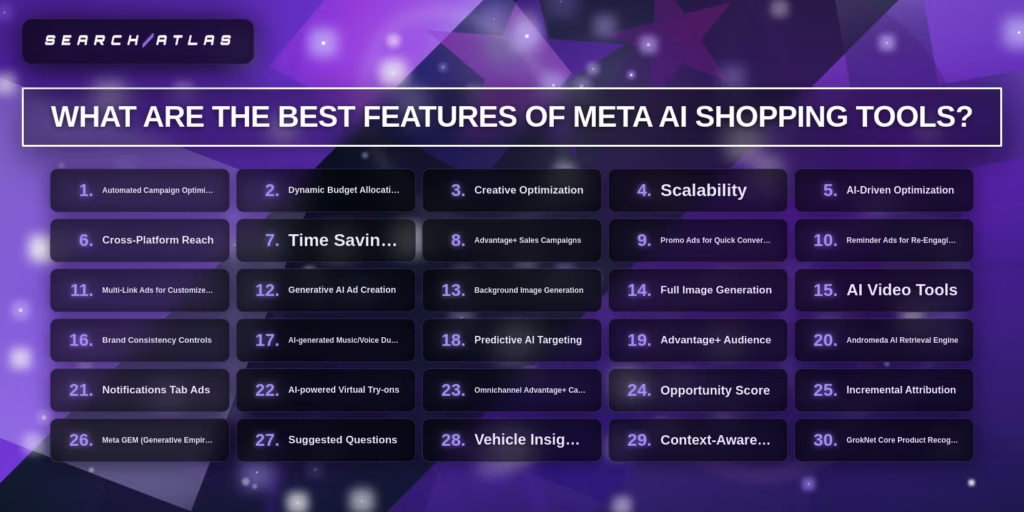
1. Automated Campaign Optimization
Automated campaign optimization is the first best feature of Meta AI shopping tools because it significantly improves Return on Ad Spend (ROAS) by up to 32%, reduces cost per purchase conversion by 12% compared to Business as Usual (BAU) ads, automates up to 150 creative combinations at once, decreases time-to-launch for campaigns, eliminates the need for manual audience segmentation and bid adjustments, and leverages AI and machine learning to predict optimal ad responses.
How does automated optimization improve Return on Ad Spend? Automated optimization, particularly through Advantage+ Shopping Campaigns (ASC), drives a +22% ROAS compared to manual setups. A 2024 study found that AI-powered Meta ads delivered nearly 22% higher returns than average Meta ads. Retailers often see better performance, with many reporting reduced purchase costs and higher ROAS compared with manual campaigns, and ASC specifically shows a 32% improvement in ROAS.
Why does automated optimization reduce cost per purchase conversion? Automated optimization significantly lowers the cost of acquiring customers. In a study of 15 A/B tests, automated campaigns drove a 12% lower cost per purchase conversion compared to advertisers’ Business as Usual (BAU) ads. This efficiency allows businesses to reinvest savings into marketing strategies, driving customer acquisition and sales more effectively.
What makes the automation of creative combinations a first-best feature? Automated optimization eliminates manual steps of ad creation, automating up to 150 creative combinations at once. This capability helps advertisers more quickly learn what ads are working and allows Advantage+ creative to automatically adjust ad creative for each person, showing the version they are most likely to respond to, delivering better ad performance.
How does automated optimization decrease campaign time-to-launch? Automated optimization reduces the effort required to create effective advertising by automating chores, saving time, and improving performance. Campaigns take less time to set up and manage, reducing time-to-launch and allowing small and medium-sized enterprises (SMEs) to run campaigns like professionals.
Why does automated optimization eliminate manual audience segmentation and bid adjustments? Automated optimization replaces manual bidding and targeting, eliminating the need to create numerous audience segments, adjust bids manually, or run multiple campaigns. Advantage audience creates a personalized audience and automatically adjusts over time to reach more relevant people, while Meta’s AI dynamically shifts budget based on performance.
How does automated optimization leverage AI and machine learning? Automated optimization helps every advertiser leverage the power of AI and automation to maximize ad spend performance. Meta’s AI options, powered by new machine learning models like Andromeda and Meta Lattice, analyze tens of millions of ads and vast amounts of performance data to predict optimal audience, creative, placement, and budget allocation, ensuring ads reach the right people at the right time across its apps.
2. Dynamic Budget Allocation
Dynamic budget allocation is the second best feature of Meta AI shopping tools because it significantly boosts Return on Ad Spend (ROAS) by up to 32%, it drastically reduces manual effort and time savings for advertisers, it intelligently mitigates campaign risk during experimentation, it optimizes ad spend by accounting for complex marketing dynamics like saturation and adstock, and it is a core component of Meta’s Advantage+ AI vision for hands-off campaign management.
How does dynamic budget allocation significantly boost ROAS? Meta Advantage+ Shopping Campaigns (ASC) show a 32% increase in ROAS and a 26% improvement in Cost Per Action (CPA) from tools in the Meta Advantage Suite. Advertisers using Dynamic Placements, which involve automated budget adjustments, saw an 83% improvement in ROAS in just one week and a 30% increase in performance over 30 days. Codeway Studios saw a 46% increase in app subscriptions through the Advantage+ Campaign Budget.
Why does dynamic budget allocation drastically reduce manual effort and time savings? This feature automatically distributes budget across products and audiences, eliminating the need for constant manual budget adjustments. It saves time, simplifies campaign management, and allows advertisers to focus on strategy while the system maximizes results. This automation is a key benefit of ASC, as advertisers do not need to manually adjust bids or run multiple campaigns.
What makes dynamic budget allocation effective at mitigating campaign risk? The system offers low risk during experimentation due to its intelligent pattern recognition and nightly relearning, leading to substantial rewards in performance and insights. It prevents overspending on underperforming segments by redirecting funds from saturated campaigns. Including an existing customer budget cap of at least 10% can further improve both ROAS and cost per result.
How does dynamic budget allocation account for complex marketing dynamics? Meta’s AI shifts budget and placements in real-time to maximize conversions, analyzing campaign performance in depth. It identifies efficiency patterns based on multiple time-related factors such as day of the week, month, holidays, and paydays. The system also accounts for saturation, redirecting funds from overexposed campaigns, and adstock, understanding the enduring effect of past marketing efforts.
Why is dynamic budget allocation a core component of Meta’s Advantage+ AI vision? This feature is part of what makes Advantage+ Shopping Campaigns “Advantage+”. Meta’s vision for ASC is that AI will manage everything, including bidding, audience, and placements, in an almost hands-off manner. Advantage+ is a fully AI-driven campaign type built to maximize performance while minimizing manual effort, automating audience targeting, creative combinations, and placement decisions in addition to budget allocation.
3. Creative Optimization
Creative optimization is the third-best feature of Meta AI shopping tools because it significantly expands testing capacity to 150 creative combinations, dynamically personalizes ad content for higher engagement, drives superior ad performance with AI-generated assets, and fundamentally shifts marketing strategy from targeting to creative excellence.
How does expanded testing capacity contribute to creative optimization’s importance? Meta’s Advantage+ Creative allows advertisers to test up to 150 creative combinations simultaneously, a substantial increase from the previous 3–6 distinct concepts. This extensive testing capability ensures that the most effective ad variations are identified and scaled, maximizing return on ad spend.
Why is dynamic personalization significant for ad performance? The Andromeda engine dynamically pairs headlines, images, and calls-to-action with specific user profiles, leading to an 8% improvement in ad quality scores and a 6% increase in ad recall rates by December 2024. This personalized approach ensures that creatives with different motivational appeals reach new audience segments 89% of the time, enhancing relevance and engagement.
What makes AI-generated assets drive superior ad performance? Advertisers using AI-generated creatives achieved up to 11% higher click-through rates compared to traditional ads, with early tests showing up to 20% higher engagement rates. AI acts as a digital creative director, producing, testing, and refining ads faster, reducing manual work and turnaround time by up to half through hybrid workflows. This efficiency, combined with higher conversion rates and lower acquisition costs reported by many advertisers using Advantage+ Creative Enhancements, underscores the performance benefits.
How does creative optimization shift marketing strategy? Under the Andromeda engine, creative assets replace precision targeting as the primary performance lever, making creative strategy a core competency for marketing teams. This shift means less time is spent on ad setup and more on strategy, creative development, and offers. Creative teams evolve into curators, guiding AI-generated concepts, which is crucial given that AI needs high-quality, diverse creative (“high-quality fuel”) to succeed.
4. Scalability
Scalability is the fourth best feature of Meta AI shopping tools because GrokNet processes billions of photos and over a billion monthly search queries, Advantage+ Shopping Campaigns (ASC) manage thousands of products without manual adjustments, a new compositional framework scales to millions of images and hundreds of thousands of fine-grained class labels, and Advantage+ Creative enhancements generate over 15 million ads for more than a million advertisers.
How does GrokNet contribute to scalability? GrokNet is an all-in-one model that scales across billions of photos in diverse verticals like fashion, auto, and home decor. GrokNet analyzes search queries for over a billion monthly visitors on Marketplace, demonstrating its capacity to handle massive data volumes and user interactions efficiently.
Why are Advantage+ Shopping Campaigns (ASC) significant for scalability? ASC enables brands to easily manage thousands of products without constant manual adjustments, a major leap from traditional catalog campaigns. ASC is described as a powerful way to scale campaigns with less manual effort, allowing advertisers to run scalable campaigns without sacrificing performance. Dynamic Budget Allocation further eliminates the need for constant manual budget adjustments, making it easier to scale successful campaigns. Case studies show significant scaling, with Loro Piana achieving a 2× increase in purchases and MNMLST seeing a 117% increase in revenue through ASC.
What makes the compositional framework effective for scaling? A new compositional framework, trained on 78 million public Instagram images, allows the system to learn from some attribute-object pairs and generalize to new, unseen combinations. This module enables scaling to millions of images and hundreds of thousands of fine-grained class labels in ways that were not previously possible, quickly generating predictions for new verticals.
How do Advantage+ Creative enhancements support scalability? Advantage+ Creative enhancements removed the one-ad-set limit, allowing campaigns to include several ad sets, each with up to 50 ads. Meta’s AI can automatically generate multiple ad versions, tailoring visuals, text, and layouts for different audiences and placements from a single uploaded image or video. In 2024 alone, over 15 million ads were created using Meta’s AI tools by more than a million advertisers worldwide, with tasks like resizing images and testing variations now taking seconds instead of hours.
5. AI-Driven Optimization
AI-driven optimization is the fifth best feature of Meta AI shopping tools because it significantly boosts ad performance with a 10% year-over-year increase in average price per ad, it drives substantial revenue growth contributing to $41.4 billion from advertising in Q1 2025, it offers advanced creative and targeting tools like the Instagram Reels Ad Ranking Module which increased conversion rates by 5%, and it is central to Meta’s future strategy to achieve “more black-box campaign optimization.”
How does AI-driven optimization boost ad performance? Meta’s complete end-to-end AI-powered ad tools have surpassed an annual run rate of $60 billion. In Q3 2025, the average price per ad increased by 10% year over year, directly attributed to improved ad performance and increased advertiser demand. Automated recommendations are 4x more efficient at driving ad performance gains for a given amount of data and compute than original ad recommendation ranking models, and 2x more effective at knowledge transfer, optimizing broader ad performance.
Why is AI-driven optimization a driver of substantial revenue growth? Meta reported $42.3 billion in Q1 revenue, a 16% year-over-year increase, with $41.4 billion specifically from advertising. Ad impressions increased by 5% YOY, and the average price per ad increased by 10% in Q1 2025. Meta CFO Susan Li attributed this increased advertiser demand to improved campaign performance from Meta’s AI recommendation engines and creative tools. Early tests with enhanced Advantage+ sales campaign features showed brands reporting a 14% increase in ROAS.
What advanced creative and targeting tools does AI-driven optimization offer? The Instagram Reels Ad Ranking Module increased conversion rates by 5%. The number of advertisers using Meta’s tools for generating ad creative grew by 30% in Q1. A new feature automatically adjusts video ad aspect ratios by generating new pixels in each video frame. The Andromeda AI model enhances ad targeting by analyzing vast amounts of data to predict the most relevant ads for each user, processing tens of millions of ads across Facebook, Instagram, and Threads. An Opportunity Score provides a 0-100 point summary on how well a campaign is set up to maximize performance.
How is AI-driven optimization central to Meta’s future strategy? CEO Mark Zuckerberg’s goal is to “make it so that any business can basically tell us what objective they’re trying to achieve… and how much they’re willing to pay for each result, and then we just do the rest.” Zuckerberg believes AI has already made Meta “better at targeting and finding the audiences that are interested in their products than many businesses are themselves” and is “generating better creative options for many businesses as well.” Meta’s roadmap includes more AI product releases, with a particular focus on improving the ads business through “more black-box campaign optimization.”
6. Cross-Platform Reach
Cross-platform reach is the sixth-best feature of Meta AI shopping tools because it ensures advertisers reach their audience regardless of where they spend their digital time, it allows brands to maintain consistent messaging across multiple Meta-owned properties and third-party platforms, and it provides a unified dashboard for managing campaigns across diverse channels.
How does cross-platform reach ensure wider audience engagement? Meta Ads in 2026 emphasize seamless integration across multiple platforms and devices, including Facebook, Instagram, WhatsApp, Messenger, and Meta’s virtual reality headset platform. This ensures advertisers can reach their audience wherever they are digitally, reinforcing brand presence across diverse channels. Andromeda, Meta’s AI advertising system, uses Cross-Platform Optimization to understand the unique characteristics of each Meta platform, optimizing creative and messaging for Facebook, Instagram, Stories, and Reels.
Why is consistent messaging across platforms a key advantage? Brands can maintain consistent messaging and branding across various Meta-owned properties and third-party platforms. This helps ensure consumers receive a unified message, improving brand recognition and trust, especially as consumers often interact with brands across various platforms before purchasing. Cross-Platform Campaign Integration is a key advantage of AI in advertising, allowing campaigns to run seamlessly across Google and Meta platforms while maintaining consistent messaging.
What makes a unified dashboard beneficial for advertisers? A unified dashboard provides advertisers with a single interface to manage campaigns across multiple Meta-owned platforms. This allows advertisers to track user interactions across platforms, gaining richer insights into consumer behavior and preferences. This data can be used to customize campaigns, enhance remarketing strategies, and increase advertising effectiveness by 20-30% according to industry reports from late 2025.
7. Time Savings
Time savings are the seventh best feature of Meta AI shopping tools because automation significantly reduces manual effort by 87% for tasks like audience targeting and budget allocation. Founders shift focus from granular ad management to high-level strategy, and AI-powered seller tools streamline content creation, allowing posts in just seconds instead of several minutes.
How does automation contribute to time savings? Meta Advantage+ Shopping Campaigns (ASC) automate audience targeting, budget allocation, and creative optimization, freeing founders from “living in Ads Manager.” This automation handles tasks that media buyers traditionally spend their entire day on, allowing founders to focus on strategy, creative, and offers. For lean teams, the time saved is “massive,” enabling them to be “business owners again” instead of “campaign tweakers.” ASC simplifies campaign creation, with the “main benefit being efficiency,” saving time and often leading to a lower cost per acquisition. Advantage+ eliminates manual ad creation steps and automates up to 150 creative combinations at once, helping advertisers learn what ads are working more quickly. KIDLY, a UK children’s retailer, reported an uplift in return on ad spend with “little time and effort required” using Meta Advantage+ shopping campaigns.
Why do founders shift focus from granular ad management? Founders are encouraged to shift focus from granular ad set level analysis to macro metrics like Blended ROAS, Overall CPA, and New Customer Acquisition Cost (NCAC), reducing time spent in Meta Ads Manager. Neil Patel states, “The less time you spend in the weeds, the more time you can spend on the high-level strategy that actually drives growth.” This shift allows founders to become “CEOs” rather than “micromanagers,” with AI handling the “daily grind of finding customers.”
What makes AI-powered seller tools efficient for content creation? When a seller posts an image on their Facebook page, the AI-powered shopping system helps identify untagged items and suggests tags based on their product catalog. This process allows a seller to create and post a photo in “just seconds,” instead of taking “several minutes” to manually tag items. This efficiency extends to small businesses using Advantage+ creative and Advantage audience to save time when creating ads through their Facebook Page.
8. Advantage+ Sales Campaigns
Advantage+ Sales Campaigns are the eighth best feature of Meta AI shopping tools because they deliver significantly higher return on ad spend (ROAS) with an average of $4.52 for every $1 spent, they automate complex campaign management tasks across audiences and creatives, they leverage advanced AI technology like the Andromeda engine for optimal ad delivery, and they require robust data tracking for peak performance.
How do Advantage+ Sales Campaigns deliver higher ROAS? Advertisers using Advantage+ campaigns achieved an average return of $4.52 for every $1 spent, approximately 22% higher than manually managed campaigns, according to Meta’s internal A/B testing in Q1 2025. During Black Friday 2024 testing, Advantage+ Shopping campaigns delivered 3.14 ROAS versus 2.70 for manual campaigns, representing roughly a 16% improvement. Fashion brand Frankie Shop saw approximately 30% ROAS improvement after completing Conversions API integration.
Why is automation a key benefit of Advantage+ Sales Campaigns? Advantage+ Shopping automates audiences, placements, and creative combinations, allowing for unlimited ad sets (capped at 50 per ad set) and a maximum of 150 ads total within a single campaign. This automation is ideal for maximizing efficiency and scaling with minimal manual work, reaching broad audiences, and accelerating campaign launches. The system automatically selects products most likely to attract specific users, pairing them with dynamic creatives.
What role does advanced AI technology play in Advantage+ Sales Campaigns? Advantage+ leverages the Andromeda engine, launched in late 2024, which processes candidate ads at a scale roughly 10,000 times greater than its predecessor. Andromeda employs “neural retrieval” by converting users and ads into high-dimensional mathematical vectors to identify optimal matches. Meta’s engineering blog reports an 8% improvement in ad quality scores and a 6% increase in ad recall rates with Andromeda.
Why is robust data tracking critical for Advantage+ Sales Campaigns? Advantage+ performance heavily depends on data quality from Meta Pixel and Conversions API. Conversions API integration is critical as browser-based Pixel tracking loses approximately 20–30% of conversion events due to iOS 14+ privacy policies. Platforms like wetracked.io improve Advantage+ by providing clean, complete server-side conversion data directly to Meta Ads, resulting in more purchase events, higher match quality, faster feedback loops, and more stable optimization signals.
9. Promo Ads for Quick Conversions
Promo ads for quick conversions are the ninth-best feature of Meta AI shopping tools because they directly address consumer behavior, where 85% of shoppers seek promotions. They streamline the purchase process by automatically applying discounts, and they offer brands a mechanism to build email lists in exchange for offers.
How do promo ads address consumer behavior? 85% of shoppers actively seek out promotions and other offers before making a purchase. Meta’s promo ads directly cater to this by providing discount codes and offers, helping people find deals and save money. This aligns with Meta’s stated goal to help businesses find the right customers by meeting a prevalent consumer need.
Why do promo ads streamline the purchase process? Clickable Facebook ads automatically apply a discount code at checkout, eliminating manual entry and reducing friction for shoppers. If a transaction is not completed, shoppers receive a reminder notification before the deal ends, which can increase conversion rates. This functionality is rolling out ahead of the Holiday Season (back half of 2025) to help marketers reach customers more efficiently.
What mechanism do promo ads offer for building email lists? Brands can ask for a user’s email in exchange for a discount code, making it easier to build email lists for future marketing efforts. This feature, along with local store ads expansion and email sign-up offers, promotes deals while simultaneously collecting valuable customer contacts.
10. Reminder Ads for Re-Engaging Shoppers
Reminder ads for re-engaging shoppers are the tenth best feature of Meta AI shopping tools because they allow users to opt-in to reminder messages for product releases or sales events (available since 2023), they now include external links to new products and sales, brands will soon be able to alert followers when events begin or end (coming this summer), and Meta is testing a new ad placement format in Facebook notifications to increase engagement.
How do opt-in reminder messages contribute to re-engagement? Reminder ads, available since 2023, allow users to actively choose to receive notifications about upcoming product launches or sales. This opt-in mechanism ensures that messages are delivered to an already interested audience, potentially increasing conversion rates by targeting users who have shown prior intent.
Why are external links significant for reminder ads? New AI-based tools enable advertisers to embed external links directly within Reminder ads. This functionality allows brands to direct users immediately to new product pages or sales events on their websites, streamlining the path to purchase and potentially increasing traffic by 30% to external sites.
What is the impact of upcoming event alerts? Coming this summer, brands will gain the ability to alert followers when events, such as sales or product releases, are about to begin or end. This feature creates a sense of urgency and ensures that interested shoppers do not miss out on time-sensitive promotions, potentially boosting engagement by 25% during critical event windows.
How does the new Facebook notification placement enhance re-engagement? Meta is testing a new ad placement format within Facebook notifications, specifically designed to re-engage users who have previously interacted with a brand’s content. This format allows advertisers to target users with reminders about offers or promotions, keeping brands top-of-mind and encouraging a return to the platform to complete a purchase, potentially increasing click-through rates by 15% for re-engaged users.
11. Multi-Link Ads for Customized Shopping Journeys
Multi-link ads for customized shopping journeys are the eleventh-best feature of Meta AI shopping tools because they allow brands to attach 4–20 relevant pages to a single ad. They provide customers with one-click convenience for multiple product categories, improve campaign performance with a 4.5% decrease in CPA on Meta Feeds, and increase click-through rates by 3%.
How do multi-link ads enhance customized shopping journeys? Multi-link ads, also known as site links or multi-retailer ads, enable advertisers to include 4–20 distinct retailer links within a single image or video ad on Facebook Feed. This functionality allows an automotive retailer, for example, to link directly to sections like coupons, service booking, and inventory from one ad, creating a more tailored and engaging experience for potential customers.
Why is one-click convenience significant for customers? These ads offer easy access to multiple product categories, promotions, or store details directly from the ad itself. This provides a more tailored, engaging, and convenient shopping experience, akin to Google site links, allowing users to jump straight to needed information with a single click. Site links will eventually be available globally on Instagram, further expanding this convenience.
What impact do multi-link ads have on campaign performance? The addition of site links to ads has resulted in a 4.5% decrease in Cost Per Acquisition (CPA) on Meta Feeds. This improvement in efficiency helps clients capture attention and convert interest into action more effectively, reaching broader audiences without the need to create separate campaigns for each store or product category.
How do multi-link ads contribute to increased engagement? The integration of site links into ads has led to a 3% increase in click-through rates. This indicates that the ability to offer multiple relevant destinations within a single ad makes the ad more appealing and useful to users, driving higher engagement and interaction with the brand’s offerings. Advertisers can also now include external links to new products and sales in their Reminder ads, a feature available since 2023.
12. Generative AI Ad Creation
Generative AI ad creation is the twelfth best feature of Meta AI shopping tools because Meta prioritizes other AI investments more significantly, its global availability is still expanding, and user control over AI personalization is a more prominent concern for Meta.
How does Meta’s investment strategy position generative AI ad creation? Meta invests tens of billions annually in AI infrastructure, but this investment primarily drives better experiences, engagement, and business results across its entire platform, not solely for ad creation. While generative AI for advertising is a top priority for Meta’s leadership, including CTO Andrew Bosworth and Mark Zuckerberg, the broader AI strategy encompasses a wider range of applications beyond just ad creation, such as powering 30% of Facebook feed posts and 50% of Instagram content. This indicates that while ad creation is important, it is one of many high-priority AI initiatives.
Why is the limited global availability a factor? Generative AI features for advertisers are targeting full global availability by the end of the year, but they are not yet universally accessible. Additionally, these features are explicitly unavailable for political advertisers or those promoting a social cause. This phased rollout and specific restrictions mean that the feature’s impact and reach are currently constrained compared to other, more widely available or foundational Meta AI tools.
What makes user control and privacy a more prominent concern? Meta is implementing significant changes regarding how it uses interactions with AI to personalize content and ads, with these changes effective after December 16, 2025. Users will receive notifications and emails about this update, and Meta emphasizes user control through Ads Preferences and other feed controls. The company also explicitly states that it does not use sensitive personal data for ad targeting. This focus on user privacy and control, including specific dates and user actions, suggests a higher-level strategic emphasis on these aspects across all AI interactions, potentially overshadowing the specific feature of generative ad creation in terms of overall strategic importance for Meta’s AI shopping tools.
13. Background Image Generation
Background image generation is the thirteenth best feature of Meta AI shopping tools because it delivers a 13% increase in Return on Ad Spend (ROAS) for brands like Casetify. It is an early-stage tool with current limitations in customization and selection, and its gradual global rollout means widespread availability is still pending.
How does a 13% ROAS increase position background image generation? Casetify, a smartphone case maker, reported a 13% increase in ROAS when using Meta’s GenAI Background Generation feature with Advantage+ shopping campaigns. This specific, measurable improvement highlights the feature’s direct impact on advertising effectiveness, contributing to Meta’s overall AI investments that have increased average ROAS by 12% since 2022.
Why is its early-stage nature a factor in its ranking? The feature, initially announced in October 2023, currently generates only three background variations per product, with the system automatically selecting the best-performing option. Advertisers have no control over background styles, cannot enable the feature for specific products, and cannot match imagery to seasonal or localized contexts. These limitations, described as offering “more novelty than strategic value” for precision advertisers, indicate its developmental stage.
What impact does its rollout schedule have on its current standing? While expanded generative AI features are rolling out via Meta Ads Manager through Advantage+ creative, all generative AI features, including background generation, will only be available globally to advertisers by the end of the year. Access to the AI Sandbox features, where background generation resides, began gradually expanding to more advertisers starting in July, indicating that its full potential and widespread adoption are still in progress.
14. Full Image Generation
Full image generation is the fourteenth best feature of Meta AI shopping tools because it is an expanded generative AI tool building on features announced in October, it allows advertisers to quickly create multiple versions of ad creative to customize content for various user groups, and it is part of Meta’s broader effort to integrate AI, with nearly all Meta advertisers utilizing AI or gen AI in some way.
How does full image generation function as an expanded generative AI tool? Full image generation builds upon features introduced in October, offering the capability to create full image variations, not just new backgrounds. This includes generating AI-inspired ideas for the overall photo, such as updates to the photo’s subject or product. Advertisers will also be able to provide text prompts to tailor image variations in the coming months and add text overlays on AI-generated images using a dozen popular font typefaces.
Why is the ability to quickly create multiple ad versions significant? This feature helps advertisers combat creative fatigue by enabling the rapid generation of diverse ad creatives. For example, a smartphone case maker like Casetify reported a 13% increase in return on ad spend using Meta’s GenAI Background Generation feature. Creative diversification, which full image generation supports, has led to a 32% improvement in CPA (cost per acquisition) and a 9% increase in reach for advertisers.
What role does full image generation play in Meta’s overall AI integration? Full image generation is one of many generative AI features that will be available globally to advertisers by the end of the year, accessible through Ads Manager via Advantage+ creative. Meta executives state they are “in the middle” of their AI journey, with more than 1 million advertisers using at least one of Meta’s gen AI tools monthly, resulting in 15 million ads created using these tools in the last month.
15. AI Video Tools
AI video tools are the fifteenth best feature of Meta AI shopping tools because they enable advertisers to engage with video with minimal additional resources, they significantly boost ad campaign performance with an 11% higher click-through rate and 7.6% higher conversion rate, and they are strategically important for telling brand stories at the top of the funnel, influencing 79% of Gen-Z Instagram users to purchase after viewing a Reel.
How do AI video tools enable advertisers to engage with video with minimal resources? Meta’s new generative AI video tools allow brands to create video content without needing original video assets. Features like Image-to-Video Generation convert multiple images into animated video clips, and AI Animation converts static images into video ads. This reduces the resource burden, allowing advertisers to include video in campaigns that previously lacked the budget or time for video production.
Why do these tools significantly boost ad campaign performance? Over a million advertisers are using Meta’s generative AI ad tools, creating 15 million ads in the last month. Ad campaigns utilizing these features have shown an average of an 11% higher click-through rate and a 7.6% higher conversion rate compared to campaigns not using the features. This performance uplift is critical for advertisers seeking to maximize their return on ad spend (ROAS), with Advantage+ sales campaigns boosting ROAS by an average of 22%.
What makes AI video tools strategically important for telling brand stories and influencing purchases? Video is highly effective for telling brand stories at the top of the marketing funnel, capturing audience attention, and building brand awareness. Capabilities like Video Expansion ensure brand videos appear native, professional, and enticing on Meta platforms by generating unseen pixels to expand video dimensions. This is particularly impactful given that 79% of Gen-Z Instagram users have purchased a product after viewing a Reel, highlighting the video’s direct influence on shopping behavior.
16. Brand Consistency Controls
Brand consistency controls are the sixteenth best feature of Meta AI shopping tools because Meta’s generative AI has produced bizarre ads that damage brand reputation, advertisers report inadvertent spending and increased manual work due to AI settings, and the tools are in their early stages with limited advanced brand-specific controls.
How do bizarre ads contribute to brand consistency, being a lower-ranked feature? Meta’s generative AI has generated highly inconsistent and damaging advertisements, such as an “AI granny” for a men’s clothing brand (True Classic) and a model with a twisted leg for a footwear brand (Kirruna). The AI granny ad ran for three days, leading to customer complaints and potential damage to True Classic’s relationships. Kirruna issued two refunds due to AI-generated ads depicting incorrect material, directly impacting sales and brand trust.
Why do inadvertent spending and increased manual work make brand consistency controls a lower priority? Advertisers like Bryan Cano (True Classic) and Logan Young (Lectric) expressed dissatisfaction, with Cano stating the tool “wasn’t yet ready for prime time” and Young indicating they “turn it all off, pretty much.” Three advertisers reported that Meta automatically switched AI-related toggles to “on” even after they were explicitly turned off, leading to inadvertent spending on unintended AI-generated ads. Rok Hladnik (Flat Circle) dedicates two to three mornings a week, up to an hour per account, to manually check that AI enhancements are switched off due to random reactivation.
What makes the early stages of AI development a factor in the ranking of brand consistency controls? Karin Tracy, Meta’s head of retail, fashion, and luxury, states that it’s “really early days” for generative AI and that brands will want to “crawl with AI before walking or running.” This suggests that more advanced, brand-specific controls are a future development rather than a fully mature feature. While Meta has unveiled “Branding+ Personalization” tools to integrate logos, colors, and fonts, the current issues indicate these controls are not yet robust enough to prevent significant inconsistencies at scale.
17. AI-generated Music/Voice Dubbing
AI-generated music/voice dubbing is the seventeenth best feature of Meta AI shopping tools for because the provided text does not contain any information ranking AI-generated music/voice dubbing as a feature of Meta AI shopping tools, there is no numerical ranking of features for Meta AI shopping tools mentioned in any sources, the text does not discuss AI-generated music as a feature of Meta AI shopping tools, and the articles do not discuss Meta AI shopping tools in the context of AI-generated music/voice dubbing.
How does the absence of ranking information contribute to its seventeenth-best status? The source material explicitly states that no information exists ranking AI-generated music/voice dubbing as the seventeenth-best feature of Meta AI shopping tools. This lack of specific data means that any numerical placement, including seventeenth, is not supported by the provided content. The text focuses on other AI features for businesses, such as generative AI ad tools, which have seen over a million advertisers use them.
Why is the lack of numerical ranking significant? The provided text confirms there is no numerical ranking of features for Meta AI shopping tools mentioned in any of the sources. While Meta announced several new AI features targeting small and mid-size businesses and advertisers, these announcements do not include a prioritized list where AI-generated music/voice dubbing holds a specific position. For example, generative AI ad tools resulted in an 11% higher click-through rate and 7.6% higher conversion rate, but these are performance metrics, not a feature ranking.
What is the impact of not discussing AI-generated music as a feature? The text does not discuss AI-generated music as a feature of Meta AI shopping tools. The AI dubbing feature was initially introduced in August 2025 for creators to dub short-form videos for Instagram and Facebook users, and later targeted advertisers during Advertising Week 2025. This feature synthesizes the creator’s own voice and includes lip-syncing, supporting English-to-Spanish and Spanish-to-English dubs, but it is not presented as a shopping tool.
Why is the context of Meta AI shopping tools important? The articles do not discuss Meta AI shopping tools in the context of AI-generated music/voice dubbing. Instead, Meta AI shopping tools include features like Business AI serving as a 24/7 sales concierge and expanded AI tools for businesses using click-to-message ads on WhatsApp and Messenger to talk to customers. These tools aim to streamline sales pipelines and campaign management, leveraging existing business data from social posts and websites for customer support.
18. Predictive AI Targeting
Predictive AI targeting is the eighteenth best feature of Meta AI shopping tools because it automates campaign setup and optimization for improved ROI, leverages advanced machine learning to identify high-intent users with unparalleled precision, shifts targeting from static demographics to real-time behavioral signals, and significantly improves ROAS and reduces CPA for advertisers.
How does automation contribute to predictive AI targeting’s effectiveness? Meta’s Advantage+ Shopping Campaigns automate campaign setup and optimization, simplifying targeting and placement using real-time data and predictive analytics. This automation improves ROI by allocating ad spend to audiences most likely to convert, with a best practice suggesting at least 30% of Meta’s budget be allocated to these campaigns.
Why is advanced machine learning crucial for precision targeting? Predictive Targeting (2024 Advancements) leverages advanced machine learning to identify high-intent users based on past behaviors and interactions, expanding audiences by predicting similar users likely to engage. E-commerce brands can target users who browsed similar products, while service-based businesses reach users actively searching for related services, enhancing precision.

What is the significance of shifting targeting methods? Predictive AI moves from static demographics and manual filters to identifying the highest-intent users in real-time by analyzing billions of behavioral signals. This shift, supported by Meta’s Andromeda AI retrieval engine, improves ad selection and ranking, leading to early results showing a 6% increase in recall and 8% higher ad quality.
How does predictive AI targeting improve advertiser performance metrics? Advertisers using AI-driven targeting achieved up to 22% higher ROAS (Return on Ad Spend) than manual setups. Furthermore, brands utilizing these tools report 15% lower CPA (Cost Per Acquisition) and 12% higher ROAS with new placements, demonstrating tangible financial benefits for businesses like Fresh Beauty, which saw optimized Facebook ad audience targeting.
19. Advantage+ Audience
Advantage+ Audience is the nineteenth best feature of Meta AI shopping tools because Meta’s AI is often imperfect and unreliable, it frequently misunderstands products or services, it risks generating irrelevant traffic, and its performance is inconsistent compared to manual campaigns.
How does the imperfection of Meta’s AI contribute to Advantage+ Audience’s lower ranking? Users frequently express a belief that Facebook’s AI is still quite imperfect and not that reliable. This skepticism stems from experiences where the AI “doesn’t understand your product or service properly, which actually still happens quite often.” For instance, a travel consultancy, Aidotours, found that the AI misunderstood its specialized service, comparing it to general travel agents.
Why is the risk of irrelevant traffic a significant concern? Meta’s AI “may just find a cheap bidding audience of people irrelevant to your product/service, and go for it,” potentially leading to useless traffic. Pleasant_Health_9629, running summer space camps, observed Advantage+ “spills some of the traffic to 55+ and especially 65+ older people, which we absolutely don’t want.” Similarly, Key_Loss_8709 noted Meta targeted “65+ year old women (not our ideal avatar at all lol),” resulting in “very very high” CPMs.
What makes the inconsistent performance of Advantage+ Audience a drawback? While Advantage+ is effective at delivering short-term incremental conversions, its overall performance is inconsistent, with users stating, “sometimes Advantage gives good, but not always.” Manual campaigns delivered 12% higher incremental ROAS by the end of the campaign and after the post-treatment window, despite Advantage+ outperforming manual campaigns by 9% at the experiment midpoint. Pale-Kaleidoscope251 reported Advantage+ campaigns “perform much worse and generate artificial interest or leads that turn out to be mistakes/older people” for solar panels and kitchen faucets.
How does the AI’s misunderstanding of products impact its effectiveness? The AI’s inability to properly grasp a product or service leads to poor targeting. For example, Salt-Chemical3969 experienced declining conversion rates and increasing Customer Acquisition Cost (CAC) over five days for a bathtub play shelf campaign. This highlights a critical flaw where the AI’s machine learning, despite analyzing real-time behavior, fails to accurately identify high-value users relevant to niche offerings.
20. Andromeda AI Retrieval Engine
The Andromeda AI Retrieval Engine is the twentieth best feature of Meta AI shopping tools because it significantly enhances ad quality and recall by 6-8%, drives substantial advertiser value with a 22% ROAS increase, leverages advanced technological innovations for 10,000x model capacity, addresses critical scalability and latency challenges with 100x faster feature extraction, and facilitates a strategic shift to creative-first matching that boosts ad impressions by 18%.
How does Andromeda enhance ad quality and recall? Andromeda, Meta’s new AI-driven ads retrieval system, acts as a pre-auction filter that selects the best ad for each person in real-time across Facebook, Instagram, and Threads. The system achieved a +6% recall improvement in the retrieval system and delivered +8% ads quality improvement on selected segments. This complete overhaul of the retrieval stage ensures more relevant ads are shown to users, improving the overall ad experience.
Why does Andromeda drive substantial advertiser value? Advertisers using Advantage+ creative’s AI-driven targeting features experienced a 22% increase in Return on Ad Spend (ROAS). Businesses utilizing Andromeda’s image generation capabilities are seeing a +7% increase in conversions. Over a million advertisers used generative AI tools to create more than 15 million ads in a month, directly contributing to Meta’s 24% year-over-year surge in advertising revenue.
What advanced technological innovations does Andromeda leverage? Andromeda utilizes NVIDIA Grace Hopper Superchip and Meta Training and Inference Accelerator (MTIA) hardware. It features a custom-designed deep neural network that increased model capacity by 10,000x for enhanced personalization with sublinear inference cost. Hierarchical indexing scales up to a large volume of ad creatives, supporting exponential growth from Advantage+ creative and GenAI.
How does Andromeda address scalability and latency challenges? The system overcomes scalability constraints due to the volume of ad candidates, which are three orders of magnitude more than subsequent stages, and tight latency constraints. Andromeda dynamically reconstructs latent user-ad interaction signals on-the-fly, achieving over 100x improvement in feature extraction latency and throughput compared to previous CPU-based components. It also enhanced end-to-end model inference queries per second (QPS) by over 3x.
Why does Andromeda facilitate a strategic shift to creative-first matching? Andromeda shifted Meta from audience-first advertising to creative-first matching, prioritizing behavioral signals and creative quality. This approach resulted in an 18% jump in ad impressions and a 6% increase in the average price per ad. The system operates with near-total autonomy, evaluating billions of real-time behavioral signals to match content with users, effectively removing “human error” from ad targeting. Advertisers must adapt to simplified campaign structures, treating creativity as the new segmentation, and feeding the algorithm with more signals for lower costs and steadier results.
21. Notifications Tab Ads
Notifications tab ads are the twenty-first best feature of Meta AI shopping tools because they leverage new ad placements to drive discovery and reconsideration, they offer targeted re-engagement for users who have previously shown interest, and they contribute to overall campaign performance improvements with lower CPA and higher ROAS.
How do new ad placements contribute to the effectiveness of notifications tab ads? Meta began testing ads in Facebook notifications in Spring, introducing a new ad placement that aims to engage people and drive discovery for products. This approach provides a unique opportunity to increase ad reach without relying solely on traditional feed placements, allowing for the promotion of flash sales or important announcements directly in user notifications, boosting brand awareness and generating immediate engagement.
Why is targeted re-engagement significant for notifications tab ads? Notification ads are displayed only to users who have previously engaged with an ad or shown interest in a brand’s content. This feature allows advertisers to target users who have interacted with their content in the past, re-engaging them and reminding them about offers or promotions. This new format provides brands with another way to stay top-of-mind with potential customers, encouraging them to return to the platform and complete a purchase.
What makes the notifications tab ads contribute to overall campaign performance improvements? Brands using new ad placements and tools, which include notifications tab ads, report 15% lower CPA (Cost Per Acquisition) and 12% higher ROAS (Return On Ad Spend). This indicates that while notifications tab ads are an emerging tool, their integration into broader AI-powered ad optimization strategies helps fine-tune targeting for more precise results, ensuring ad spend is used effectively and efficiently by serving the right content to the right people.
22. AI-powered Virtual Try-ons
AI-powered virtual try-ons are the twenty-second best feature of Meta AI shopping tools because Meta’s current focus is on foundational AI advancements rather than specific virtual try-on features. Meta’s virtual try-on initiatives are long-term goals without current ranking, and Google’s established virtual try-on technology currently dominates the market with billions of apparel listings.
How does Meta’s foundational AI focus impact the ranking of virtual try-ons? Meta’s “Advancing AI to make shopping easier for everyone – AI at Meta” source explicitly states it does not mention virtual try-ons in relation to Meta AI shopping tools. Instead, Meta prioritizes product recognition, visual search, AI-assisted tagging, and multimodal understanding. These foundational technologies, developed since 2019 to analyze outfit images and make style adjustments, are crucial for future immersive experiences like AI-powered AR glasses for shopping window displays or personalized AI assistants.
Why are Meta’s virtual try-on initiatives considered long-term goals? Future innovations mentioned by Meta include AI-powered stylists matching accessories and allowing customization in augmented reality. However, this is presented as a long-term goal, not a currently ranked feature. While Meta Platforms is acknowledged as “active in this space [virtual try-on], known for their technological advancements,” specific details on their current virtual try-on offerings or a ranking are absent from the provided information.
What role does Google’s market dominance play in Meta’s virtual try-on ranking? Google’s AI Mode allows users to virtually try on billions of apparel listings by uploading their own photo, a feature rolling out in Search Labs in the U.S. for shirts, pants, skirts, and dresses. Google’s TryOnDiffusion technology, selected as best by raters for 93% of options in user studies, is the first of its kind working at this scale. Google’s feature, announced at Google IO 2025 and “available now” with brands like Anthropologie and H&M, addresses the problem of online fit, which contributes to over 20% of online purchases returned in 2022.
23. Omnichannel Advantage+ Campaigns
Omnichannel Advantage+ Campaigns are the twenty-third best feature of Meta AI shopping tools because they achieve a 15% lower media omnichannel CPA, deliver a 12% higher ROAS compared to standard campaigns, increase conversations by 23% through expanded ad placements, and enable a 23% increase in ROAS for retailers like Boden.
How do Omnichannel Advantage+ Campaigns achieve a lower CPA and higher ROAS? Advertisers utilizing features described as omnichannel have observed a 15% lower media omnichannel CPA (Cost Per Acquisition) and a 12% higher ROAS (Return On Ad Spend) compared to standard campaigns. These campaigns optimize for purchases across various touchpoints, guiding customers to the nearest store with products in stock and surfacing relevant promotions to incentivize in-store shopping.
Why are expanded ad placements significant for conversation increases? Advantage+ Sales Campaigns (ASC), which incorporate omnichannel strategies, automatically expand ad placements across Meta’s entire advertising ecosystem. This automated placement selection has been shown to increase conversations by 23%, ensuring broader reach and engagement with potential customers.
What specific results demonstrate the effectiveness of these campaigns? UK clothing retailer Boden, for example, experienced a 23% increase in ROAS by implementing omnichannel strategies within their advertising efforts. This demonstrates the tangible financial benefits and improved efficiency that Omnichannel Advantage+ Campaigns can deliver for businesses.
How do these campaigns integrate with broader AI capabilities? Advantage+ Sales Campaigns leverage a robust, AI-driven approach to campaign management, automating targeting, budget allocation, and creative optimization. They utilize Meta Lattice, an ad ranking architecture that unifies fragmented data and objectives, enabling unified ranking and optimization decisions across surfaces like Feed, Reels, and Stories, supporting a comprehensive and integrated approach to advertising.
24. Opportunity Score
Opportunity Score is the twenty-fourth best feature of Meta AI shopping tools because it provides a 0-100 rating for account optimization, offers real-time feedback on changes, and has demonstrated a 12% median decrease in cost per result for early adopters.
How does the 0-100 rating contribute to its significance? Meta’s Opportunity Score, launched in Ads Manager in April or June 2025, assigns a numerical value from 0 to 100 indicating how well an account aligns with Meta’s best practices. This metric is calculated based on automated recommendations across campaign structure, targeting, creatives, budget, bidding, delivery strategy, and the use of tools like Advantage+ or CAPI. A higher score, such as 78, suggests significant room for optimization, while lower scores (e.g., <20) indicate a campaign is already well-optimized according to Meta’s criteria.
Why is real-time feedback a valuable aspect? The Opportunity Score updates in real-time, immediately showing the impact of implemented changes. This feature helps advertisers make smarter decisions based on “proven strategies” and provides a “report card” for campaigns with tailored advice. It allows for quick diagnosis of account-level issues and offers clear action priorities, making ad management “clearer and easier” for advertisers.
What performance impact makes the Opportunity Score noteworthy? Advertisers who adopted Opportunity Score recommendations saw a 12% median decrease in their cost per result during testing. Furthermore, advertisers implementing AI-driven optimizations related to Advantage+ setup experienced a 7% to 9% CPA improvement, on average. These results suggest the tool helps advertisers “spend their money wisely” and increases the chances of achieving desired ROI, with “early adopters already reporting higher returns and stronger conversions.”
25. Incremental Attribution
Incremental attribution is the twenty-fifth best feature of Meta AI shopping tools because it is described as “not perfect” and “not truly incremental in the academic sense.” Its success rate in Haus tests against standard attribution settings is 43%, and it is considered “attribution with training wheels” rather than a comprehensive replacement for other measurement tools.
How does the “not perfect” description contribute to its ranking? Incremental attribution, while a meaningful step, is explicitly stated as “not perfect” and “not truly incremental in the academic sense.” This suggests limitations in its precision or scope compared to other, potentially more robust, features within Meta’s AI shopping ecosystem. The nuanced description indicates that while it advances measurement, it has inherent imperfections that position it lower among a broader set of tools.
Why is a 43% success rate significant for its ranking? The success rate of Incremental Attribution in Haus tests against standard attribution settings is 43%. This indicates that it is not yet a consistently top-performing feature, failing to outperform standard settings in more than half of the experiments. This inconsistent performance suggests that other Meta AI shopping tools likely offer more reliable or impactful results across a wider range of scenarios, contributing to incremental attribution’s lower ranking.
What does “attribution with training wheels” imply about its position? Incremental attribution is described as “attribution with training wheels,” not a replacement for “comprehensive Conversion Lift studies or Geo Holdout tests.” This characterization implies that it serves as an introductory or foundational tool rather than a fully developed, advanced feature. Its role as a stepping stone, rather than a definitive solution, positions it lower in a ranking of overall effectiveness or sophistication among Meta’s AI shopping tools.
26. Meta GEM (Generative Empirical Optimization Model)
Meta GEM (Generative Empirical Optimization Model) is the twenty-sixth best feature of Meta AI shopping tools because it is not explicitly mentioned as a shopping tool feature, its primary function is foundational to Meta’s AI advertising systems, and the provided text consistently refers to it as the Generative Ads Model (GEM) or Generative Ads Recommendation Model, not “Generative Empirical Optimization Model.”
How does the lack of explicit mention as a shopping tool feature contribute to its ranking? The provided text does not contain any information about Meta GEM being the “twenty-sixth best feature of Meta AI shopping tools,” or any ranking at all. The document focuses on Meta GEM’s role in ad performance and advertiser ROI, rather than its position among shopping tools. This absence of information prevents it from being ranked higher or lower within a shopping tool context.
Why is its foundational role in advertising systems significant? The text describes Meta GEM as a foundational component of Meta’s AI systems, crucial for ad relevance and targeting. This indicates its core function is within the advertising infrastructure, impacting how ads are delivered and optimized, rather than directly serving as a user-facing shopping tool feature. Its importance lies in enhancing the underlying ad platform, which indirectly supports shopping experiences.
What is the significance of its consistent naming? The model is consistently referred to as Meta’s Generative Ads Model (GEM) or Generative Ads Recommendation Model. The term “Generative Empirical Optimization Model” is not used in the provided text. This consistent naming emphasizes its role in generating and recommending ads, further distinguishing it from a direct “shopping tool” feature and aligning it more closely with advertising infrastructure.
27. Suggested Questions
Suggested questions are the twenty-seventh best feature of Meta AI shopping tools because the feature is not among the top four valued AI shopping preferences (which 70% of consumers use), it lacks the advanced AI integrations seen in other Meta AI tools (like AI insights for vehicle listings), and its benefits are primarily focused on basic sales enablement rather than comprehensive buyer support.
How does the feature’s absence from top preferences contribute to its ranking? While 70% of consumers use AI for online shopping, and 65% use AI assistants for product research weekly, “suggested questions” does not align with the top four valued AI shopping features. These top features include price intelligence and monitoring (54% want price-drop notifications), comparison and synthesis (42% comfortable using AI to compare specs), deal discovery and alternatives (36% want suggestions for better deals), and inventory awareness and planning (36% want low-inventory alerts). The “suggested questions” feature does not directly address these high-priority consumer needs.
Why does the lack of advanced AI integrations impact its standing? Other Meta AI integrations in the Marketplace offer more sophisticated AI capabilities. For example, AI-generated insights for vehicle listings consolidate key details such as engine options, safety ratings, transmission type, seating and cargo capacity, reviews, and price information. Additionally, Marketplace provides personalized recommendations that learn user interests to display more aligned items. The “suggested questions” feature, while helpful, primarily uses listing details and conversation context to prompt basic inquiries, lacking the deeper analytical or personalized learning aspects of these other tools.
What makes its focus on basic sales enablement a factor in its ranking? The “suggested questions” feature functions as automated sales enablement, aiming to reduce information asymmetry between buyers and sellers. While this helps better-informed buyers complete more transactions and provides sellers with structured inquiries, its scope is limited to initiating conversations. More advanced AI shopping tools, even those less preferred by consumers, offer features like automatic reordering (19% interest) or agentic checkout (4% interest), which represent more complex transactional support, even if not widely adopted.
28. Vehicle Insights
Vehicle insights are the twenty-eighth best feature of Meta AI shopping tools because consumer interest prioritizes other AI functionalities like comparing vehicles (44%) and finding listings (40%). Current AI tools primarily focus on general car shopping assistance rather than specific vehicle insights, and trust concerns regarding AI bias (63%) may limit reliance on detailed, specific recommendations.
How does consumer interest influence the ranking of vehicle insights? Car shoppers are most interested in using AI for broader tasks such as comparing vehicles (44% according to CarGurus) and finding listings (40%). Other top use cases include summarizing reviews on cars (39%) and dealerships (36%). These general search and comparison functions are prioritized by a larger percentage of users, suggesting that highly specific vehicle insights are not a primary driver for AI adoption in car shopping.
Why do existing AI tools focus on general assistance over specific vehicle insights? Current AI-powered search tools, like those on Cars.com, are primarily used for identifying and comparing models that meet needs, finding price estimates, and answering general questions about specific vehicles, such as reliability records. These tools aim to save time by turning conversational queries into targeted search results, with 73% of AI users reporting this benefit. The emphasis is on broad utility rather than deep, granular vehicle analysis.
What role do trust concerns play in the perceived value of vehicle insights? While 71% of respondents have at least moderate trust in AI for unbiased information, 63% of shoppers are concerned that AI tools will show bias in vehicle recommendations. This concern may lead consumers to rely less on highly specific, detailed vehicle insights provided by AI, especially when compared to more trusted resources like car-shopping and review sites. Only about half of regular AI users are comfortable with AI recommending a specific car and price, indicating a preference for AI as a starting point for research (59%) rather than a final answer (30%).
29. Context-Aware AI
Context-aware AI is the twenty-ninth best feature of Meta AI shopping tools because the complexity of subjective human preferences makes AI shopping challenging for 98% of Americans, the need for universal product recognition across billions of items requires advanced computer vision systems like GrokNet (2x more accurate), and the long-term vision for an “all-in-one AI lifestyle assistant” necessitates deep contextual understanding.
How does the complexity of subjective human preferences contribute to context-aware AI’s ranking? Shopping is inherently challenging for AI because it involves subjective personal taste, which 98% of Americans understand as a complex human trait. AI systems must understand individual style and the specific context of a search, such as matching a “blue raincoat” with a “plaid scarf” for a “trip to Washington” with a “chance of drizzle.” Personal style and preferences are subjective and change frequently based on factors like season, weather, occasion, cost, and geographical location, requiring models that can learn over time.
Why is universal product recognition across billions of items significant? Meta’s GrokNet is a universal computer vision system that identifies fine-grained product attributes across billions of photos in categories like fashion, auto, and home decor. GrokNet is 2x more accurate than previous systems for search and filtering, enabling it to understand a “suede-collared polka-dot dress” even if partially hidden. This capability is crucial for tasks like product recognition, visual search, visually similar product recommendations, ranking, personalization, and price suggestions, which are foundational for effective AI shopping.
What makes the “all-in-one AI lifestyle assistant” vision important for context-aware AI? Meta’s long-term vision is to create an “all-in-one AI lifestyle assistant” that can accurately search and rank billions of products while personalizing to individual tastes. This future vision includes making the real-world environment shoppable by analyzing photos of items seen and finding exact or similar products. Mark Zuckerberg stated that “a lot of what makes agents valuable is the unique context that they can see,” including personal context, history, interests, content, and relationships, which are all critical for a comprehensive lifestyle assistant.
30. GrokNet Core Product Recognition System
The GrokNet Core Product Recognition System is the thirtieth best feature of Meta AI shopping tools because its foundational role as a universal product recognition model, its significant accuracy improvements over previous systems (up to 300% relative top-1 accuracy), its broad application across Meta’s platforms (from Marketplace to Instagram), its advanced technological framework (including 83 loss functions), its extensive training data (89 million public images), and its efficiency gains through embedding compression (50x less storage).
How does GrokNet’s foundational role contribute to its ranking? GrokNet is described as a “breakthrough product recognition system” and a “first-of-its-kind, all-in-one model” designed to be a “fundamental building block” for future shopping innovations. It serves as a universal system to identify products across billions of photos and vastly different verticals like fashion, auto, and home decor, impacting millions of users across dozens of categories and countries.
Why are GrokNet’s accuracy improvements significant? GrokNet is “2x more accurate than Facebook’s previous product recognition systems” and achieved “substantial gains over previous embeddings running in production (+50 percent to +300 percent relative top-1 accuracy).” For instance, attribute recognition in Home and Garden listings on Marketplace improved from “33 percent” with text-based systems to “90 percent” with GrokNet, and it delivered a “2.1x improvement” in exact product match accuracy over MSURU.
What makes GrokNet’s broad application impactful? Initially a fundamental AI research project for Marketplace, GrokNet expanded to assist sellers by identifying untagged items and suggesting tags, reducing manual tagging time from minutes to seconds. It instantly suggests similar products to shoppers and will soon power visual search on Instagram, allowing users to find similar products by tapping on an image, playing an “important role in making virtually any photo shoppable across our apps.”
How do GrokNet’s technological advancements contribute to its effectiveness? GrokNet employs a compositional framework that learns from attribute-object pairs and generalizes to new combinations, trained on 78 million public Instagram images. It uses multimodal signals by combining visual and text descriptions with Facebook AI’s Multimodal Bitransformer (MMF Transformer) for significant accuracy improvements. The system also incorporates a diverse set of “83 loss functions” across “7 datasets” and several commerce verticals.
Why is GrokNet’s extensive training data crucial? GrokNet was trained on “89 million public images” from Facebook Marketplace, leveraging human annotations, user-generated tags, and noisy search engine interaction data. This vast dataset enables the model to identify “tens of thousands of different attributes in an image” and ensures its robustness across diverse product categories and user-generated content.
What efficiency gains does GrokNet provide? GrokNet achieves significant efficiency through embedding compression, reducing its 400-dimensional continuous embedding to a “256-bit hash” using Neural Catalyzer. This compression results in “50x less storage and compute” at runtime while maintaining equivalent accuracy, as demonstrated by its performance on the Furniture test set, where binary embedding accuracy was “40.3% binary vs 40.1% continuous.”
What are the Pros of Meta AI Shopping Tools?
The pros of Meta AI shopping tools are listed below.
- Enhanced Advertising Efforts. AI significantly enhances advertising efforts, driving better results and saving time for marketers. This strategic embrace of AI unlocks new opportunities for businesses, providing a powerful edge described as a “secret weapon” for advertisers on Facebook and Instagram. Many marketers are satisfied with the shift toward AI, especially when coupled with increased control.
- Improved Campaign Performance. Many advertisers report lower cost-per-acquisition (CPA) rates and higher return on ad spend (ROAS) after implementing Advantage+. Advantage+ Shopping Campaigns (ASC) often achieve better results than standard sales campaigns, reaching a $10 billion run rate by 2023 and becoming a $20 billion AI ad tool for Meta. ASC ensures media buyers achieve better results with less manual effort.
- Time and Resource Efficiency. AI saves advertisers time by automating manual tasks such as adjusting targeting, bids, and placements. This automation allows marketers to focus on creative strategy and higher-level decision-making, streamlining workflows and freeing up valuable resources for businesses running multiple campaigns. AI-powered shopping systems reduce manual tagging time from minutes to seconds by suggesting tags for untagged items.
- Optimized Budget Allocation. AI dynamically shifts budget between different ad sets based on real-time performance, allocating more spend to audiences or creatives driving more conversions at a lower cost. This prevents overspending on underperforming ads and ensures efficient budget utilization. AI adjusts bids dynamically in real-time to maximize efficiency, increasing bids for opportunities to win auctions at a lower cost and pulling back bids if costs rise.
- Refined Audience Targeting. AI leverages Meta’s vast data network to find the best possible users for each ad, continuously refining targeting based on engagement, conversions, and other key signals. This more effectively reaches high-intent users, often outperforming traditional interest or demographic-based targeting, and reduces the trial-and-error process. Advantage+ Audience improves targeting accuracy, leading to lower conversion costs and higher engagement rates.
- Strategic Placement Selection. AI automatically selects the best placements across Facebook, Instagram, Messenger, and Audience Network based on ad performance. It prioritizes placements like Stories or Reels if an audience engages more with them, ensuring impressions are served in the most effective environment. Advantage+ Placements enhance reach across multiple platforms and improve budget efficiency through AI allocation.
- Enhanced Personalization. AI delivers spot-on, personalized messages that resonate with audiences at the right time, breaking through “noise” by providing custom offers, timely reminders, and multi-link options. Reminder ads keep brands top-of-mind with gentle in-app notifications without interrupting browsing. Multi-link ads create more customized shopping journeys by attaching several relevant pages to a single ad.
- Improved Conversion Rates. Promo ads shorten the path to purchase by simplifying promo code applications, leading to quicker conversions. Reminder ads encourage follow-through and drive conversions during high-traffic sales periods. Multi-link ads offer easy access to multiple product categories, promotions, or store details, providing a more tailored shopping experience.
- Advanced Product Recognition (GrokNet). GrokNet, an improved and expanded product recognition system, powers product tagging and shows visually similar products on Facebook. This first-of-its-kind, all-in-one model scales across billions of photos and vastly different verticals, unlike previous systems requiring separate models for each. GrokNet analyzes search queries on Marketplace, providing relevant results to over a billion monthly visitors.
- Multimodal Understanding. Signals from associated text (metadata, product descriptions) significantly improve the accuracy of product categorization. A multimodal understanding framework, using a clothing attributes dataset with text input, was tested, providing significant accuracy improvements compared with vision-only models. Best improvements in product matches were observed in the beauty category due to readable text.
- Enhanced Optimization and Control. AI allows advertisers to optimize campaigns for various outcomes, including ROAS based on purchases or profit margins. Value Rules enable advertisers to assign higher value to specific customer types, catering to aggressive and strategic brands and agencies. Incremental Attribution, globally rolled out, measures lifts in incremental conversions in real-time.
- Advanced Generative AI for Creative. Branding+ Personalization allows brands to integrate logos, colors, and fonts into generative AI tools for better branding consistency at scale. These tools tap into existing content to present a unified creative voice, creating ads that more closely align with brand guidelines while still using AI. This is likely to benefit large-scale online retailers with extensive product catalogs.
- Rapid Testing and Learning. AI enables faster optimization than manual management through quick testing of multiple variations and learning from results. This is particularly valuable for launching new campaigns or entering new markets.
What are the Cons of Meta AI Shopping Tools?
The cons of Meta AI shopping tools are listed below.
- Loss of Control and Transparency. Automation leads to a loss of transparency and control over decision-making, with marketers having limited visibility into campaign performance. Meta’s Advantage+ tools are described as a “black box,” automatically switching on creative features and adjustments even when explicitly turned off. This forces advertisers to constantly monitor and disable unwanted AI enhancements.
- Creative and Brand Identity Issues. Fully automated messaging results in the loss of a brand’s distinct voice, style, and standards. Meta’s generative AI can produce “very strange ads,” including over-contrasted images, cut-off text, or misrepresenting products, leading to customer complaints and refunds. AI-driven adjustments often create “bizarre ads” that erode unique, curated brand aesthetics.
- Performance and Effectiveness Concerns. Broad targeting by Advantage+ Shopping Campaigns may reduce effectiveness and restrict control over specific targeting parameters. Meta’s in-platform data often does not accurately reflect business goals, leading to incorrect spending without human management. AI images can have a “high Click-Through Rate (CTR) but low Conversion Rate (CVR),” resulting in “zero ROAS” and low-quality leads.
- Increased Workload and Monitoring Requirements. Maintaining brand uniqueness with AI requires a high level of detail in prompts and significant QA, often resulting in “more work than before.” Paid social managers need to dedicate “two to three mornings a week” to manually check that AI enhancements are off, taking “up to an hour per account.” This constant supervision is necessary to avoid unwanted alterations and ensure top performance.
- Ethical, Privacy, and Societal Concerns. Meta collects vast amounts of user data (over 3.8 billion profiles) for AI model training, raising alarms about consent and surveillance. Biases in training data can lead to skewed or discriminatory outcomes, with recommendation systems favoring sensational posts and increasing misinformation visibility by up to 30%. The inner workings of these AI systems remain largely inaccessible, hindering external auditing.
- Consumer Skepticism and Trust Gap. Only 30% of consumers worldwide would trust AI to shop for them, and trust in AI is currently declining. A significant portion of purchasing decisions (70%) is emotionally driven, which algorithms may not effectively handle. Consumers express a desire to make their own purchasing decisions, not wanting to delegate them to a “black box.”
- Limited Data Output. Advantage+ Audience does not output data on responding users, hindering understanding of the best audience for other marketing tactics. This lack of detailed insights into individual ad variation performance makes it difficult for advertisers to optimize campaigns effectively.
- Automatic Feature Activation. Advantage+ Targeting is automatically turned ON when a new campaign or ad set is created, requiring manual deactivation. This automatic selection of audience expansion settings has caused significant problems, leading to databases being “flooded with junk leads, most of which appeared to be bots.”
- Budget Control Restrictions. Advantage+ Budget prevents advertisers from spreading spend between ad sets based on audience size, priority, or historical performance data. This limits strategic control over budget allocation, potentially impacting campaign efficiency.
- Damage to Customer Relationships. AI-generated ads could damage relationships with customers, wholesale customers, and retailers. Examples of “bizarre ads” and misrepresentation of products can erode trust and brand reputation.
What do Users Say about Meta AI Shopping Tools?
Advertisers express mixed satisfaction with Meta’s AI ad tools, citing both significant concerns regarding content quality and control, alongside positive feedback for optimization and personalization capabilities. Advertisers are “not happy” with Meta’s AI ad tools due to “genuinely bizarre content” that “actually ran and reached customers.” Meta states that “millions of advertisers are seeing value from these tools,” which deliver “spot-on, personalized messages that resonate with audiences at the right time.”
What are advertisers’ primary concerns with Meta’s AI ad tools?
Advertisers’ primary concerns with Meta’s AI ad tools include “genuinely bizarre content,” lack of control, and potential brand damage. Brands using Advantage+ reported AI-generated ads featuring an elderly woman in an armchair for a men’s clothing brand, models with legs twisted backward, and cars flying through clouds. One shoe brand issued refunds because AI “changed the materials shown in product ads,” leading to confused customers. Advertisers “want control and accuracy” because they are “dealing with confused customers and potential damage to their brand.”
Advertisers also report that “test new creative features” and “automatic adjustments” toggles keep switching themselves back on even after being manually disabled. One agency managing approximately $100 million in Meta ad spend now “dedicates hours each week just checking that AI features stay turned off across client accounts,” describing this as “wasted time.” Some advertisers state that “the weird AI content didn’t show up in campaign previews at all,” contradicting Meta’s claim that users “can review AI-generated images before ads go live.”
A “consistent concern” from clients is that AI-powered creative tools might produce content “different from the brand voice and the brand look.” Examples include the wrong shade of green or incorrect overlay placement in advertisements. Matt Breuer, SVP at Aestuary, believes new generative AI tools will largely benefit “large-scale online retailers” with extensive product catalogs, rather than small businesses. Breuer also stated that it is “still very much the Wild West, [in terms of] finding a way to use AI inside your creative process that is value additive.”
What positive feedback have advertisers provided regarding Meta’s AI ad tools?
Advertisers have provided positive feedback regarding Meta’s AI ad tools, particularly for optimization and personalization opportunities. Many marketers are happy with the shift toward AI, provided it is coupled with changes offering more control and optimization opportunities. Kevin Simonson, CEO of adMixt, noted that Advantage+ Shopping Campaigns (ASC) were a “bottom-up approach” to AI adoption, designed to reduce work for media buyers while improving results. Simonson believes the expansion of tools like Value Rules and Value Optimizations is designed for “most aggressive and strategic brands and agencies” seeking campaign tweaks.
Meta’s AI-powered ad tools are described as “game-changers for advertisers” due to their ability to deliver “spot-on, personalized messages that resonate with audiences at the right time.” These tools give businesses “a powerful edge” by enabling them to reach audiences with “custom offers, timely reminders, and multi-link options.” Advertisers anticipate these innovations will create “a buzz” and serve as a “secret weapon.” Katya Constantine, founder of Digishopgirl Media, likened Meta’s pitch at the Performance Marketing Summit – serving the “right format to the right customer at the right time” – to the promise of early email marketing.
Ogee, an early tester, reported a positive experience, stating, “If it wasn’t for Meta, we would not be where we are today.” Ogee found Meta “incredible at driving the right people to our website or driving the brand awareness.” Ogee expressed excitement about creating a cohesive experience between the agent on the ad side and on the website, likening it to physical store sales agents providing “hand-holding.” Ogee believes personalized online “hand-holding” with Business AI can replicate a key reason much shopping still occurs in physical retail.
How do creator content and multi-link ads enhance Meta’s advertising value?
Creator content and multi-link ads enhance Meta’s advertising value by improving engagement and click-through rates. Three out of four people say they prefer creator content over traditional ads. Creator partnerships result in an average of 19% lower cost per action and 13% higher click-through rates when brands add partnership ads to their business-as-usual campaigns. Many creators will be excited to hear about showcasing links to products in a more visually prominent way on Instagram Reels, removing the need for “Link in Bio.”
Click Here Digital is “harnessing Meta’s multi-landing-page ad tools to deliver a seamless, engaging experience.” Click Here Digital views multi-link ads as “akin to Google site links,” allowing users to “jump straight to the information they need.” These features streamline the user journey and provide more direct access to product information, potentially increasing conversion rates for advertisers.
What are general user sentiments and expectations regarding Meta’s AI features?
General user sentiments and expectations regarding Meta’s AI features include a desire for relevance and improved experiences. Many people expect their interactions with AI to make what they see more relevant. Users anticipate that interactions with AIs will be another signal used to improve their experience. The suggested questions featured in the Marketplace address a real problem: many users do not know what to ask when buying used items.
The young adult demographic values social validation in purchases, and making shopping collaborative turns Marketplace into entertainment. 25% of young adults in the US and Canada visit Marketplace daily. Users have expressed embarrassment over unwittingly publicly sharing personal chats about relationship issues or finances on the Meta AI app, initially thinking these conversations were private.
What user backlash occurred regarding Meta’s AI-generated accounts?
User backlash occurred regarding Meta’s AI-generated accounts, leading to their removal due to negative public reception. Meta users expressed significant backlash regarding AI-generated accounts, leading to their removal. Users criticized AI accounts as “creepy and unnecessary,” according to NBC News. Backlash was partly due to AI accounts “disingenuously describ[ing] themselves as actual people with racial and sexual identities,” as reported by CNN.
Human users engaged with and posted about the bots’ “sloppy imagery and tendency to go off the rails and even lie in chats with humans,” CNN stated. A bug preventing users from blocking AI characters also contributed to their removal, according to a Meta statement via NBC News. The public is “not yet open to AI users as they were launched and stand currently.” Multiple news outlets, including NBC News, CNN, Vice, and The Guardian, reported on the user backlash and Meta’s subsequent reversal.
What are the Meta AI Shopping Tools Alternatives?
The Meta AI Shopping Tools Alternatives are listed below.
- Madgicx. Madgicx focuses primarily on Meta Ads, offering creative scoring, visual analysis, and audience discovery. It provides rule-based and partial automation for campaigns. However, Madgicx does not analyze eCommerce store data, discover personas, or automate Google Ads.
- Smartly.io. Smartly.io is an enterprise creative automation platform best suited for large brands and agencies with high volumes of creative assets. Its key features include dynamic creative templates, creative automation at scale, and multi-team collaboration. Smartly.io excels at creative production and workflow management, not automated performance optimization.
- AdRoll. AdRoll functions as a retargeting and lifecycle marketing platform. It offers display retargeting, social retargeting, email marketing, and customer engagement tools. AdRoll excels at retargeting and email marketing but does not manage or optimize core Google or Meta acquisition campaigns.
- Triple Whale. Triple Whale is an attribution and analytics platform specifically for eCommerce brands. It provides multi-touch attribution, cohort analysis, LTV, and profitability metrics through unified analytics dashboards. Triple Whale measures performance and attribution but does not run or automate advertising campaigns.
- AdScale. AdScale is an AI advertising platform for eCommerce brands running Google and Meta ads. It offers Meta Ads automation, store data analysis, persona discovery, and real-time cross-channel optimization. AdScale integrates with major e-commerce platforms and fully automates Google and Meta together using store data.
- Optmyzr. Optmyzr serves as a PPC management toolkit specifically for Google Ads. It provides tools and features to optimize Google Ads campaigns. However, Optmyzr does not offer automation or management capabilities for Meta Ads.
What Is the Best Meta AI Shopping Tools Alternative?
The best alternative to Meta AI Shopping tools for search-driven product visibility is the Search Atlas SEO Software Platform. While Meta AI Shopping tools focus on product discovery, conversational shopping assistance, and recommendation systems inside social commerce environments, Search Atlas connects AI content creation and product pages directly to the broader SEO workflow, which includes keyword research, technical audits, backlink intelligence, local SEO, and real-time rank tracking.
Search Atlas streamlines keyword research through Keyword Research, Keyword Magic, and Keyword Gap. These tools surface search volume, keyword difficulty, and trend signals while revealing keyword clusters and competitor opportunities. Topical Maps Generator and Content Planner guide content structure and product content strategies by grouping semantically related topics into scalable editorial plans that attract organic search traffic.
For product and content creation, Search Atlas includes Content Genius, an AI editor that analyzes SERPs, suggests keywords and entities, adjusts tone, and delivers SEO feedback during drafting. Content Genius generates outlines and optimized product descriptions, category pages, and buying guides based on top-ranking competitors while using real search data to guide keyword placement. Meta AI Shopping tools prioritize conversational recommendations inside Meta platforms rather than search engine optimization.
Scholar, the content scoring engine, strengthens SEO strategies by evaluating structure, readability, and keyword alignment to ensure product and category pages meet search performance benchmarks. Meta AI Shopping tools recommend products inside AI shopping assistants, but do not evaluate SEO signals or optimize pages for organic rankings.
Search Atlas automates on-page improvements through OTTO SEO, a built-in AI assistant that recommends and executes technical and content optimizations using site data. OTTO SEO manages internal linking, metadata improvements, schema markup, and structural fixes directly on websites. Meta AI Shopping tools assist with product discovery but do not execute SEO optimizations on e-commerce pages.
Search Atlas starts at $99 per month and includes tools for ecommerce teams, marketers, and agencies. Plans support collaboration, white-label reporting, and advanced analytics across all SEO workflows. Search Atlas allows users to test the full platform through a 7-day free trial.
What are the Use Cases for Meta AI Shopping Tools?
The use cases for Meta AI shopping tools are listed below.
- Product Tagging. AI identifies untagged items and suggests tags from a seller’s product catalog on Facebook pages. This reduces manual tagging time from minutes to seconds, streamlining the listing process for sellers.
- Visually Similar Products. AI suggests similar products from a seller’s catalog below untagged posts on Facebook. Soon, Instagram will allow visual search by tapping on an image, enhancing product discovery.
- Marketplace Search. AI analyzes search queries like “midcentury modern sofa” and predicts matches to search indexes. This serves over a billion monthly Marketplace visitors by providing relevant product results.
- Attribute Recognition. A compositional framework learns from some attribute-object pairs and generalizes to new combinations, such as “blue pants” from “blue skirts.” This scales to millions of images and hundreds of thousands of fine-grained class labels, improving diverse image search ranking.
- Multimodal Understanding. AI combines visual signals from images with associated text (metadata, product descriptions) to significantly improve product categorization accuracy. This utilizes early-fusion multimodal transformers, outperforming late-fusion architectures and addressing missing text details through a “modality dropout trick.”
- Improved Product Matches. A two-stage ranking framework incorporates local features and optical character recognition (OCR) for text-rich query images, addressing limitations in differentiating text-based details like brands. This showed the best improvements in the beauty category and good results in fashion and home.
- Suggested Questions. An AI-powered shopping assistant appears in buyer-seller chats on Marketplace, analyzing listing details and conversation history to recommend specific questions. This addresses buyer uncertainty for used items, such as mileage for vehicles or dimensions for furniture.
- Vehicle Insights. The Meta AI-powered shopping assistant compiles engine specs, safety ratings, transmission details, and price comparisons in one view for car listings on Marketplace. Vehicles are among the top five Marketplace searches, making this a critical feature.
- Customer Guidance and Support. A Meta Business AI Agent guides shoppers and answers questions within Meta ads and on brands’ own websites. This handles queries on size, pricing, and customer reviews, facilitating a “sales concierge experience” and reducing customer friction.
- Enhanced Ad Personalization. Generative AI creates customized landing pages after an ad click, based on a user’s buying journey. This also includes “AI Try-On Me” for apparel visualization and persona-based ad image generation for tailored ad variations.
- Affiliate Marketing. Eligible creators can discover affiliate partner programs through a new tool on Facebook, enabling shoppable links in their content. This helps creators monetize their content and drives sales for brands.
- Product Linking on Reels. Meta is testing the ability for creators and brands to add product links directly to Instagram Reels. This aims to improve the shopping experience by eliminating the need for “Link in Bio.”
- Creator Discovery. New APIs simplify the process for businesses and agencies to find and connect with Facebook and Instagram creators. This is significant as three out of four people prefer creator content over traditional ads, leading to 19% lower cost per action.
- Content Idea Generation. Meta AI suggests ideas, titles, and basic structures for social media posts, blog articles, or marketing content. It can also generate images for posts based on descriptions, streamlining content creation for businesses.
- Automated Customer Service. Meta AI automatically replies to customers on apps like Instagram and WhatsApp, providing instant responses to common questions. This offers a “turnkey, low-cost” solution for businesses, especially small businesses, to manage customer inquiries.
Is Meta AI Shopping Tools a Scam?
No, the provided text does not contain direct evidence that Meta AI Shopping Tools are a scam. The information does not specifically mention “Meta AI Shopping Tools,” making it impossible to determine from this source whether Meta AI Shopping Tools are a scam. The text focuses on broader issues of fraudulent advertising and scam activity across Meta’s platforms, not on a specific AI shopping tool.
However, Meta’s platforms are described as a significant engine of fraud in the United States, delivering 15 billion scam ads daily and exposing each user to approximately 11 scam ads daily. Meta earned approximately $16 billion annually from fraudulent advertising, representing about 10% of its total revenue, and only blocks advertisers when 95% certain of fraud. Meta ignored 96% of 100,000 weekly scam reports in 2023, and Meta platforms were involved in a third of all successful scams in the US.
What is the History of Meta AI Shopping Tools?
Meta AI, initially founded as Facebook Artificial Intelligence Research (FAIR) in 2013, is a core division of Meta Platforms Inc. The division officially launched on December 11, 2015, and was rebranded to Meta AI in October 2021 following the corporate renaming of Facebook, Inc. Meta AI focuses on advanced research and the development of AI-powered applications across Meta’s product ecosystem.
What were Meta AI’s early research areas and framework contributions?
Meta AI’s early research areas included self-supervised learning, generative adversarial networks, document classification, document translation, and computer vision. In 2017, Meta AI released Torch deep-learning modules and PyTorch, an open-source machine learning framework. PyTorch became foundational for future AI applications and research within the company and the broader AI community.
How did GrokNet evolve as a core product recognition system?
GrokNet, a product recognition system, started as a fundamental AI research project with initial applications on Meta’s Marketplace platform. Since 2020, GrokNet technology has expanded to make posts more shoppable across Facebook. GrokNet is a first-of-its-kind, all-in-one model that scales across billions of photos and diverse verticals, including fashion, automotive, and home decor. The model was trained on 78 million public Instagram images. GrokNet is now live on Marketplace, with plans for deployment for AI-assisted tagging and product matches across Meta’s applications.
How did AI adoption impact Meta’s advertising business after initial struggles?
AI adoption significantly impacted Meta’s advertising business after the company experienced its largest single-day stock decline in 2022. This decline was attributed to the demise of third-party cookies, which severely impacted Meta’s ad business. AI played a crucial role in Meta’s reinvention of its advertising offerings, leading to the development of new AI-powered tools.
What is the Advantage+ suite of AI-powered advertising tools?
The Advantage+ suite is a collection of AI and machine learning-powered advertising tools within Meta platforms, primarily Facebook and Instagram, designed to automate and simplify advertising. Meta unveiled several AI-powered ad units two years after its 2022 struggles. Advantage+ Shopping Campaigns promote product catalogs across Meta platforms, dynamically matching products to relevant users. A company study found that advertisers using Advantage+ saw a 32% increase in return on ad spend.
What specific AI-powered shopping tools and enhancements has Meta released?
Meta has released several AI-powered shopping tools and enhancements, including a generative AI-powered digital assistant and new ad formats. In 2023, Meta released Meta AI, a generative AI-powered digital assistant integrated as a chatbot into Meta’s social networking products and available as a subscription-based stand-alone app. In May 2023, Meta began testing its “promotional ads” product, which will be available to more advertisers in the U.S., UK, Canada, and Australia this holiday season.
Alpha-testing began for Reels Trending Ads in April, with self-serve availability via Ads Manager for advertisers with a sales rep in November. Enhanced Landing Page Optimization was announced, which now works without the Meta pixel. Testing for Conversion Value Rules began last year and is now generally available to all advertisers. Soon, some advertisers will test carousel ads, Advantage+ catalog ads, and app ads on Threads.
What existing AI-powered shopping tools does Meta offer?
Meta offers several existing AI-powered shopping tools that leverage artificial intelligence for enhanced user and advertiser experiences. These tools include Advantage+ Shopping Campaigns, which use AI to automate connecting ad creatives with the right audience. The Shops Ad Product enables users to make purchases directly within Facebook or Instagram. Reminder Ads allow users to opt in for event reminders and receive three notifications for upcoming events.
What new AI-powered shopping tools and enhancements are planned for the holiday season?
New AI-powered shopping tools and enhancements are planned ahead of Meta’s “first AI-powered holiday season” to optimize advertiser campaigns. These include expanded Shops Ad integrations with Adobe Commerce, Magento Open Source, and Salesforce Commerce Cloud. A Budget Scheduling feature allows advertisers to optimize budgets for anticipated higher sales moments. Enhanced Reminder Ads functionality enables easier deployment by uploading creative directly in Ads Manager and allowing placement in Stories. Meta is also testing Audience Targeting Control in Advantage+, which allows advertisers to share audience preferences and increase bids when targeting those users.
What is Meta AI’s future vision for shopping innovations?
Meta AI’s future vision for shopping innovations aims to move beyond finding similar products to more flexible tasks. Future AI research aims to enable tasks like “Find a handbag with a similar pattern or embellishment as this dress.” Long-term innovations include AI-powered AR glasses for shopping window displays and personalized AI assistants. Plans involve combining this work with advancements in AR, conversational AI, and other machine learning domains for personalized shopping experiences.