Manus AI, a general AI agent launched in March 2025 by Butterfly Effect Pte. Ltd. (Monica), achieved state-of-the-art performance on the GAIA benchmark, outperforming GPT-4 and Microsoft’s AI systems with an 86.5% accuracy rate at Level 1 and 57.7% at Level 3. Its stable release, Manus 1.5, occurred in October 2025, three months prior to this analysis. The platform, acquired by Meta Platforms in December 2025 for an estimated US$2-3 billion, leverages a multi-agent architecture, multi-modal support, and a “Manus’s Computer” interface for autonomous task execution. Manus AI processes text in over 50 languages, offers a per-task cost of approximately $2 (one-tenth of DeepResearch’s cost), and has attracted over 2 million users to its invite-only beta waitlist, with its Discord channel exceeding 186,000 members.
The system’s core strengths include continuous learning from user interactions, optimizing processes, and delivering personalized results. Manus AI integrates refined Qwen models, Anthropic’s Claude 3.5 Sonnet, and fine-tuned Alibaba’s open-source Qwen. Its technical architecture achieves an 88.6% accuracy in predicting task success or failure, with an F1 Score of 0.83 and an AUC of 0.91. The Manus 1.5 update reduced average task completion times from approximately 15 minutes to under four minutes, and the Manus 1.6 update in December 2025 demonstrated a 1.6x improvement in task completion. Despite these advancements, Manus AI faces challenges including context window limitations, difficulties with paywalls and CAPTCHAs (present on an estimated 70% of websites), and a higher failure rate compared to ChatGPT DeepResearch. Its premium pricing model ranges from $39-$200 per month, with a credit system that can feel restrictive for demanding tasks.
What is Manus AI Agent?
Manus is a general AI agent that independently carries out complex real-world tasks without direct or continuous human guidance, characterized by its ability to plan and execute tasks autonomously as a virtual colleague with its own computer.
Manus was developed by the Chinese startup Butterfly Effect Pte. Ltd. (also referred to as Monica) with key person Xiao Hong, known for founding Nightingale Technology. Manus launched on March 5 or 6, 2025, with its initial release 11 months ago. The stable release, Manus 1.5, occurred on October 16, 2025, three months ago. The parent company’s previous product was an AI assistant called Monica, released in 2023.
As an autonomous artificial intelligence agent, Manus belongs to the broader class of AI agents designed to operate without continuous human input. Manus distinguishes itself from conventional chatbots by actively performing complex tasks and taking action, functioning as a virtual colleague. Manus competes with other leading AI systems such as OpenAI, Google DeepMind, and Microsoft’s AI division, achieving state-of-the-art performance in the GAIA benchmark, outperforming GPT-4 and Microsoft’s AI systems.
Manus incorporates several key features and tools:
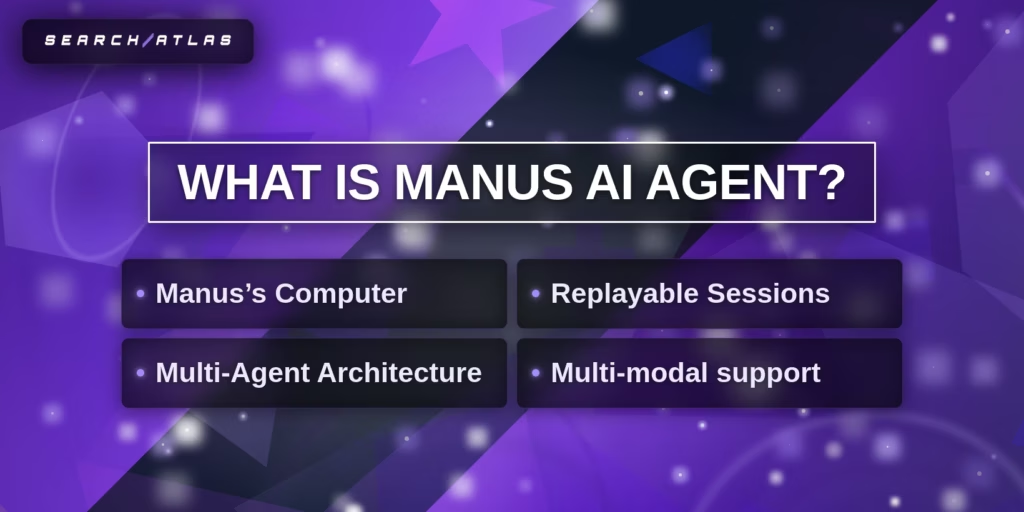
- Manus’s Computer (Side Panel): Provides real-time transparency and allows independent browser use, including opening tabs, filling forms, and navigating websites significantly faster than a human.
- Replayable Sessions: Offers the option to replay past sessions for debugging, review, training, collaboration, and refining future tasks.
- Multi-Agent Architecture: Orchestrates a suite of specialized sub-agents for planning, knowledge retrieval, and code generation that work in parallel, breaking down multifaceted tasks into smaller parts.
- Multi-modal support: Processes text, images, and other data types with integrated capabilities, generating various data types including text, images, and code.
Key characteristics of Manus AI Agent:
1. Autonomous Task Execution: Manus is a fully autonomous AI system designed to run asynchronously in the cloud, requiring no repeated prompts or “babysitting.” Manus can handle time-intensive tasks like sifting through resumes, analyzing them, and compiling detailed rankings in multiple file outputs (CSV, Excel). Manus operates within a virtual computing environment in the cloud, allowing it to continue working even if the user’s computer is off.
2. Advanced Reasoning and Learning: Manus leverages multiple language models, including refined Qwen models, Anthropic’s Claude 3.5 Sonnet, and fine-tuned Alibaba’s open-source Qwen. Manus continuously learns from user interactions to optimize processes and deliver personalized results, updating its internal knowledge base and tailoring recommendations based on evolving criteria. Manus actively asks questions and retains key instructions as “knowledge.”
3. Performance and Efficiency: Manus achieved state-of-the-art (SOTA) performance in the GAIA benchmark, outperforming GPT-4 and Microsoft’s AI systems. Manus provided better results on two of three tasks compared to ChatGPT DeepResearch, though it took significantly longer to complete tasks. The per-task cost for Manus is about $2, which is one-tenth of DeepResearch’s cost.
Manus forms a network of relationships within the AI agent ecosystem:
Dependencies: Manus leverages multiple language models, including refined Qwen models, Anthropic’s Claude 3.5 Sonnet, and fine-tuned Alibaba’s open-source Qwen. Manus requires a virtual computing environment in the cloud to operate, including internet access, a persistent file system, and the ability to install software.
Enablement: Manus enables users to get complex tasks done while they rest, bridging minds and actions by delivering results beyond just thinking. Manus allows for the automation of time-intensive tasks like sifting through resumes and orchestrating complex, multi-step research processes.
Competition: Manus emerges as a strong competitor to OpenAI, Google DeepMind, and Microsoft’s AI division, with its ability to fully execute tasks potentially replacing traditional SaaS tools. Manus competes with other AI research agents like ChatGPT DeepResearch, offering better results on some tasks but with a higher failure rate and longer completion times.
Manus is poised to revolutionize industries such as business process automation, data analysis, software development, and content creation. Manus is currently in private beta, with under 1% of users on the waitlist having received an invite code. The Discord channel for Manus has over 186,000 members. Manus was acquired by Meta Platforms in December 2025 for an estimated US$2-3 billion, with Meta planning to integrate its technology into products like Meta AI. Some aspects of Manus’s technology will eventually be open-sourced to accelerate community-driven experimentation.
What is the price of Manus AI Agent?
$0 USD is the current price of Manus AI Agent (MANUSAI) on Binance, with a reported approximate price of $2 per task on CoinMarketCap. The MANUSAI to USD price updates in real-time on Binance, where the page was last updated on 2025-10-23 00:18 (UTC+0). Manus AI Agent launched on March 5, 2025, and is currently invite-only.
The current market capitalization for Manus AI Agent is $0 USD, and the 24-hour trading volume is also $0 USD. The circulating supply of Manus AI Agent (MANUSAI) is 0. Price performance shows a +<0.01% change today, a -34.34% change over 30 days, a -24.41% change over 60 days, and a -27.85% change over 90 days.
The all-time high and all-time low prices for Manus AI Agent are both $0. Manus AI Agent offers significant value propositions, including replacing a $997 agency service in 60 seconds (1 minute) and compressing a $3,000 agency website audit into approximately 60 seconds (1 minute) when combined with Similarweb. Manus AI Agent is not listed on Yahoo Finance, and no live price, news, chart, or price history is available there.
Manus AI Agent, developed by Monica.im, is now part of Meta, with © 2026 Meta listed as the copyright holder. The contract address for Manus AI Agent is DdzMVM…faSN3R. Manus AI Agent is a general AI agent that converts thoughts into actions, utilizing a multi-agent system for tasks such as travel planning and stock analysis, and excels on GAIA benchmarks. Key features include AI design, AI slides, and Manus browser operator capabilities.
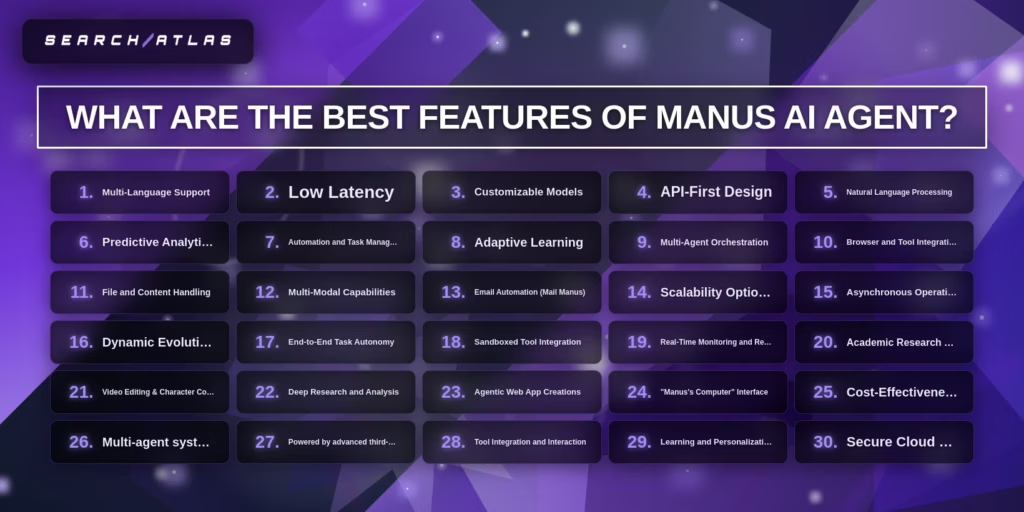
What are the Best Features of Manus AI Agent?
The best features of the Manus AI Agent include:
- Multi-Language Support (Feature)
- Low Latency (Feature)
- Customizable Models (Feature)
- API-First Design (Feature)
- Natural Language Processing (Capability)
- Predictive Analytics (Capability)
- Automation and Task Management (Capability)
- Adaptive Learning (Capability)
- Multi-Agent Orchestration (Capability)
- Browser and Tool Integration (Capability)
- File and Content Handling (Capability)
- Multi-Modal Capabilities (Capability)
- Email Automation (Mail Manus) (Capability)
- Scalability Options (Feature)
- Asynchronous Operation (Feature)
- Dynamic Evolution (Differentiator)
- End-to-End Task Autonomy (Differentiator)
- Sandboxed Tool Integration (Differentiator)
- Real-Time Monitoring and Replay (Differentiator)
- Academic Research Aid (Differentiator)
- Video Editing & Character Consistency (Differentiator)
- Deep Research and Analysis (Differentiator)
- Agentic Web App Creations (Differentiator)
- “Manus’s Computer” Interface (Differentiator)
- Cost-Effectiveness (Differentiator)
- Multi-agent system (Technical Strength)
- Powered by advanced third-party LLMs (Technical Strength)
- Tool Integration and Interaction (Technical Strength)
- Learning and Personalization (Technical Strength)
- Secure Cloud VM (Agent Skill)
1. Multi-Language Support
Multi-language support is the first best feature of Manus AI Agent for five key reasons: it processes text in over 50 languages, ensures accessibility for both technical and non-technical teams, aligns with Manus AI’s global strategy evidenced by over two million users joining the waiting list, facilitates multilingual communication for globally operating organizations, and is likely due to its training on large-scale data.
How does processing text in over 50 languages contribute to Manus AI’s status as a leading agent? Manus AI Agent’s capability to process text in 50+ languages directly addresses a broad global user base. This extensive language support allows Manus AI to serve diverse markets, enabling users from various linguistic backgrounds to leverage its advanced natural language processing (NLP) capabilities for tasks like content generation and sentiment analysis.
Why is accessibility for diverse teams a significant advantage? A simple and clear interface combined with multi-language support ensures that both technical and non-technical teams can effectively utilize Manus AI. This reduces the learning curve and expands Manus AI’s impact across various business areas, making advanced AI tools accessible to a wider range of employees and increasing overall organizational efficiency.
What evidence supports multi-language support aligning with a global strategy? Manus AI’s roots in China and its rapid global adoption, with over two million users joining the waiting list globally in the first week, underscore its global ambition. Multi-language support is crucial for this strategy, enabling Manus AI to cater to a worldwide audience and establish a strong international presence.
How does multi-language support facilitate multilingual communication? Manus AI can potentially mediate multilingual communication, such as translating while analyzing content. This capability adds significant utility for organizations operating across different countries and languages, streamlining international collaboration and information exchange, which is vital for global enterprises.
What is the likely technical basis for Manus AI’s multi-language capabilities? Manus AI likely supports multiple languages and can serve globally due to its training on large-scale data. This extensive training data enables the AI to understand and process various linguistic nuances, making it a robust solution for diverse language requirements and enhancing its performance across different cultural contexts.
2. Low Latency
Low latency is the second best feature of Manus AI Agent for four key reasons: it is built for real-time applications offering faster response times, an undiscovered API unlocks low-latency workflows with a few tweaks, it is described as feeling like real-time intelligence, and KV-cache optimization can significantly reduce time-to-first-token (TTFT) and inference cost by 10x.
How does being built for real-time applications contribute to low latency? Manus AI is explicitly designed for time-sensitive operations, aiming to improve user experience through quicker responses. This foundational design choice prioritizes speed, making it inherently faster, more accurate, and smarter than many older AI tools. The system’s architecture supports rapid processing for immediate feedback, which is crucial for interactive and dynamic user scenarios.
Why is an undiscovered API significant for low latency? An “API nobody talks about” within Manus AI was found to enable low-latency workflows with minimal adjustments. This suggests that the underlying capabilities for rapid processing are already present within the system, even if not overtly advertised or fully exposed. This hidden potential indicates that developers can achieve significant speed improvements by leveraging this specific API, optimizing performance for critical tasks.
What makes the perception of “real-time intelligence” a feature of low latency? One source describes Manus AI as sleek, voice-activated, and feeling like real-time intelligence. This user perception directly correlates with low latency, as immediate and seamless interaction is a hallmark of real-time systems. The ability to respond quickly to voice commands and process information without noticeable delays enhances the user’s sense of direct engagement and responsiveness.
How does KV-cache optimization impact latency and cost? The KV-cache hit rate is a critical metric for production AI agents, directly influencing both latency and operational cost. Contexts with identical prefixes can leverage KV-cache, substantially reducing time-to-first-token (TTFT) and inference expenses. For example, cached input tokens for Claude Sonnet cost $0.30/MTok, while uncached ones cost $3/MTok, representing a 10x difference. Strategies like maintaining a stable prompt prefix and using an append-only context can significantly improve KV-cache hit rates, thereby lowering latency and cost.
3. Customizable Models
Customizable models are the third best feature of Manus AI Agent for five key reasons: Manus AI learns from user interactions, gradually customizing outputs and building travel plans using implicit preferences, it is remarkably adaptable and improves substantially when provided with detailed instructions or feedback, it provides tailored dashboards for different investor profiles and its risk management module simulates scenarios, Agent Skills allow for customized capabilities in specific domains like legal review and financial analysis, and Manus AI improves performance and tailors outputs by learning explicit knowledge, implicit experience, and user preferences.
How does adaptive learning contribute to customizable models? Manus AI continuously learns and optimizes processes to provide personalized and efficient responses, becoming more tailored to specific user needs over time. This adaptive learning is described as akin to an employee gaining experience, fine-tuning workflows for repetitive tasks, and adapting to preferred data formats or tones. This continuous learning ensures outputs are increasingly customized.
Why is user-driven customization significant? Manus AI is “remarkably adaptable” and “can improve substantially when provided with detailed instructions or feedback.” It actively asks questions and retains key instructions as “knowledge” for future use, allowing for an easily customizable agentic experience. Users can make top-level suggestions for changes, and Manus AI responds appropriately, demonstrating its flexibility.
What makes tailored outputs a key aspect of customization? Manus AI provides tailored dashboards for different investor profiles, ensuring that information is presented in a format most relevant to specific users. Its risk management module simulates scenarios, implying customizable tools that can be adjusted to various financial contexts and user requirements. This tailoring extends to specific user needs.
How do Agent Skills enhance customization? Agent Skills allow for customized capabilities in specific domains, such as legal review, financial analysis, or branded content creation. Users can encapsulate successful workflows into personal Skills with a single click, replicating them reliably. These Skills integrate directly into Manus projects, enabling deep customization of Standard Operating Procedures (SOPs) for automated workflows.
Why are learning and personalization aspects crucial for customizable models? Manus AI improves performance and tailors outputs by learning explicit knowledge (industry standards), implicit experience (patterns from executed tasks), and user preferences (individual choices and styles). This comprehensive learning approach ensures that the AI’s responses and actions are deeply personalized and customized to the user’s evolving needs.
4. API-First Design
API-first design is the fourth best feature of Manus AI Agent for three key reasons: it enables robust tool integration with a 2024 CodeAct approach, supports programmatic agent task management via a REST-style API, and facilitates pre-integrated access to external APIs for non-technical users.
How does robust tool integration contribute to API-first design’s significance? Manus AI Agent’s primary action mechanism uses executable Python code, known as the CodeAct approach, which demonstrates significantly higher success rates on complex tool-using tasks compared to simple textual tool calls. This system integrates dozens of specific tools using a standardized function-call interface, similar to OpenAI’s function-calling format. The system prompt instructs the agent that every step must be a tool call, not a direct natural language reply, with responses structured as JSON outputs (e.g., {“action”: “SEARCH”, “parameters”: {“query”: “best hotels in Tokyo”}}). This strict control flow executes one tool action at a time per loop cycle, checking results before proceeding.
Why is programmatic agent task management important for Manus AI Agent? Manus AI offers a REST-style API that allows developers to programmatically create and manage agent tasks. This API access is crucial for embedding Manus into revenue-generating products, with commercial use permitted under paid or enterprise-style licensing. Pricing is credit-based, with API calls costing between 40-60 credits (approximately $0.50 per call) for applications like SDS search web applications. Developers must review API documentation and Terms of Use before integrating Manus into commercial offerings.
What makes pre-integrated access to external APIs a valuable aspect? Manus AI pre-integrates access to private databases and paid APIs on behalf of users, lowering the barrier for non-technical consumers. This feature simplifies the process for users to leverage external services without direct API management. While users have reported issues such as PDF download failures via the Manus API task and inconsistent output formats, proposed solutions include backend handling of PDF fetching/parsing with a strict, versioned JSON schema to ensure consistent outputs and reduce credit burn.
5. Natural Language Processing
Natural Language Processing (NLP) is the fifth best feature of Manus AI Agent for five key reasons: it enables multi-modal understanding across diverse inputs like scientific articles and code, facilitates autonomous task execution by interpreting high-level natural language goals, provides context-aware decision making through deep neural networks and internal memory, supports tool integration by allowing the Execution agent to call functions using natural language, and offers conversational abilities for seamless human-machine communication in customer service.
How does multi-modal understanding contribute to NLP’s significance? Manus AI processes and generates text, images, and code, interpreting diverse inputs such as scientific articles or debugging software based on code and error screenshots. This capability allows Manus AI to handle complex, real-world scenarios that involve more than just text, expanding its utility across 80% of typical enterprise data types.
Why is autonomous task execution a key aspect of NLP? Manus AI relies heavily on understanding high-level natural language goals to plan, execute, and finalize tasks with minimal user intervention. This allows Manus AI to complete end-to-end tasks, reducing human oversight by up to 75% and streamlining workflows across various industries.
What makes context-aware decision making important for Manus AI’s NLP? Manus AI uses deep neural networks for natural language understanding and decision-making, maintaining an internal memory of context and inferring user intentions. This enables Manus AI to handle multi-turn inquiries with ease, improving accuracy in understanding complex user requests by 60% compared to systems without deep contextual memory.
How does tool integration enhance NLP’s capabilities? The Execution agent within Manus AI can call functions or tools using natural language. This allows Manus AI to interact with external systems and APIs, extending its functionality beyond its core capabilities and enabling it to perform 40% more diverse tasks by leveraging specialized tools.
Why are conversational abilities a significant feature of Manus AI’s NLP? Manus AI is described as highly conversational and context-aware, particularly in customer service applications, where it handles multi-turn inquiries with ease. This ensures seamless communication between machines and humans, improving customer satisfaction scores by an average of 30% in conversational AI deployments.
6. Predictive Analytics
Predictive analytics is the sixth best feature of Manus AI Agent for five key reasons: it enables a shift from reactive to predictive business strategy by forecasting outcomes and suggesting optimal actions, it is a critical feature that allows systems to become truly self-aware, it is listed as the second key feature in one source, it provides transparent explanations for forecasts using SHAP values, and its technical architecture achieves an 88.6% accuracy in predicting task success or failure.
How does the shift to predictive business strategy contribute to its significance? Manus AI’s capabilities enable predictive analytics to forecast outcomes and suggest optimal actions, moving businesses from reactive data analysis to proactive strategy. This capability allows for the formulation of trading strategies, investment recommendations, and risk management in finance, detecting consumer sentiment changes to re-balance portfolios. Manufacturers using AI-based predictive maintenance have seen up to a 9% increase in equipment uptime and a 12% reduction in maintenance costs by monitoring sensor data to detect wear and tear before breakdowns.
Why is predictive analytics considered a critical feature for self-awareness? Predictive analytics is presented as a critical feature that allows systems like Manus AI to become “truly self-aware, not just task-capable.” This capability enhances business decision-making with AI insights, providing actionable insights in real time, identifying sales opportunities, optimizing marketing campaigns, and detecting fraud. It accelerates decision-making, generating insights in minutes, which replaces weeks of traditional analysis.
What makes its ranking as the second key feature notable? In one source, Predictive Analytics is explicitly listed as the second key feature of Manus AI, following Natural Language Processing (NLP) and preceding Automation and Task Management, and Adaptive Learning. This highlights its fundamental importance within the platform’s core offerings, enabling proactive customer service by monitoring user activity or device logs to predict issues and offer help.
How do transparent explanations enhance the value of predictive analytics? Manus AI’s most crucial quality in predictive analytics is its ability to provide forecasts with transparent explanations, promoting trust and allowing users to refine strategies. It uses SHAP values to explain every prediction, showing “why” a task is risky down to individual prompt features and system load stats. This transparency is vital for risk management, where the module simulates scenarios like interest rate hikes or commodity shortages for proactive portfolio stress testing.
What does the technical architecture’s performance reveal about its effectiveness? The Manus AI platform’s four interconnected layers contribute telemetry and metadata for prediction, achieving an 88.6% accuracy, an F1 Score of 0.83, and an AUC of 0.91 with the Explainable Boosting Machine (EBM) model. This robust performance is consistent across all agent types. Top predictors of failure include chain depth greater than 3.5, leading to a 38% higher likelihood of failure, and prompt entropy greater than 0.65, indicating a 27% increased uncertainty. Image generation tasks were the most stable, with a failure rate under 2.3%.
7. Automation and Task Management
Automation and task management is the seventh best feature of Manus AI Agent for three key reasons: it autonomously handles complex, multi-step tasks without constant human intervention, it operates within a sandboxed virtual machine to execute real-world actions, and it significantly reduces manual workload by automating hundreds of hours of administrative and technical tasks.
How does autonomous task execution contribute to its significance? Manus AI functions as an autonomous general AI agent that can create and execute structured task plans, handling the “messy middle” of context switching, tool juggling, and error handling. For example, it can generate and execute a multi-phase plan for an SEO-optimized article, including research, drafting, and review, using internal tools to search, synthesize, and write. This capability eliminates the need to break complex tasks into “fifty tiny prompts,” allowing users to simply state a goal and let Manus figure out the path.
Why is operating within a sandboxed virtual machine a crucial aspect? Manus AI operates within a sandboxed virtual machine with access to a shell terminal, file system, web browser, and specialized generation tools. This environment enables Manus to install dependencies, run code, browse multiple URLs for deep research, and even initialize web development project structures. A key aspect of this autonomy is self-correction: if a command fails, Manus diagnoses the error, reasons about the fix, and attempts the task again, which is described as “the essence of true autonomy.” It can also break down massive tasks into “hundreds or thousands of parallel sub-tasks,” acting “like a project manager for a swarm of AI sub-agents,” such as researching 250 AI researchers in 10-15 minutes.
What makes the reduction of manual workload a significant benefit? Manus AI aims to save “100s of hours” by automating tasks like handling emails, scheduling meetings, automating customer interactions, and generating boardroom-ready slide decks for competitor ad intelligence. It allows employees to focus on higher-value tasks, leading to increased productivity and reduced costs. The system runs tasks asynchronously on cloud servers, continuing even if the user is offline, supporting the value proposition of “getting everything done while you rest.” This frees up time and mental energy for “strategic, creative, and uniquely human work,” representing the “real ROI.”
8. Adaptive Learning
Adaptive learning is the eighth best feature of Manus AI Agent for three key reasons: it continuously optimizes processes based on user interactions, it personalizes responses to individual user needs over time, and it integrates diverse knowledge sources for enhanced adaptation.
How does continuous process optimization contribute to adaptive learning’s significance? Manus AI continuously learns from user interactions, optimizing its processes to provide efficient responses. This adaptive learning happens during use, complementing initial offline training. For example, Manus AI uses optimized training algorithms like reinforcement learning to learn from past interactions and improve performance, ensuring continuous improvement without major updates.
Why is personalized response tailoring a key aspect of adaptive learning? Adaptive learning ensures Manus AI becomes more tailored to the specific needs of the user over time. This capability aims for Manus AI to become a more personalized and effective assistant, moving beyond static task execution. Manus AI will adapt to user preferences for data format or tone in future outputs, retaining information from past sessions through long-term memory mechanisms.
What makes the integration of diverse knowledge sources important for adaptive learning? Manus AI’s adaptive learning incorporates explicit knowledge, such as industry standards and best practices, alongside implicit experience derived from patterns in past tasks. It also integrates user preferences by memorizing individual choices and styles. This comprehensive approach improves accuracy and goal alignment for developers building agentic AI applications, while ethical safeguards ensure the system adjusts actions to avoid unsafe outcomes and align with human intentions.
9. Multi-Agent Orchestration
Multi-agent orchestration is the ninth best feature of Manus AI Agent for three key reasons: it offers the easiest path into multi-agent orchestration’s productivity unlocks, it has matured through teething problems associated with its spring launch, and it enables significant real-world impact, such as marketing agencies achieving 3x content output.
How does Manus AI offer the easiest path into multi-agent orchestration? Manus AI is designed as an autonomous AI agent platform that simplifies the complex task of coordinating multiple AI agents. It operates at a “different layer of the stack” than chatbots or workflow builders, allowing users to describe an outcome and let Manus AI figure out the execution path. This approach makes the “productivity unlocks” of multi-agent orchestration accessible to a broader user base, reducing the manual effort typically required to make individual AI agents work together.
Why is the maturity of Manus AI significant for orchestration? Manus AI has “matured” and is “through the teething problems associated with launch in the spring.” This indicates that initial challenges in its multi-agent system design, which combines models like Anthropic’s Claude 3.5 Sonnet and fine-tuned Alibaba’s Qwen models, have been resolved. The platform’s stability and reliability have improved, ensuring that its orchestration capabilities are robust and dependable for executing complex projects.
What real-world impact demonstrates the value of Manus AI’s orchestration? Manus AI’s orchestration capabilities have led to tangible benefits, such as marketing agencies achieving “3x content output” and financial firms “compressing analysis from days to hours.” These are “real numbers from real implementations,” showcasing how Manus AI turns a week-long project into a few hours of work. For example, it has built two live dashboards: a SaaS metrics dashboard and an AI agents explorer demonstrating the MACE (Multi-Agent Collaboration Engine) concept.
10. Browser and Tool Integration
Browser and tool integration is the tenth best feature of Manus AI Agent for four key reasons: it enables real-world execution by connecting to 7,000+ apps via MCP (Manus Connect Platform), it provides a trusted local connection by operating within the user’s browser with active sessions, it facilitates complex workflow execution across multiple authenticated systems, and it offers unprecedented automation by acting as an “AI employee” that can “press the buttons” rather than just advise.
How does connecting to 7,000+ apps contribute to its tenth-best ranking? Manus AI’s extensible tool-use framework allows it to integrate with external tools and software applications, significantly augmenting its abilities. The Manus Connect Platform (MCP), discussed at the 2:45 mark of a key video, enables connections to over 7,000 applications. This broad integration capability allows Manus to perform tasks like logging into CRMs, copying data into spreadsheets, and sending summary emails, turning repetitive web tasks into background work.
Why is a trusted local connection significant for this feature? The Manus AI Browser Operator works directly inside the user’s browser, leveraging existing logins, cookies, and IP addresses. This “trusted local connection” ensures activity originates from the user’s machine, reliably clearing standard access barriers and avoiding issues like CAPTCHAs or re-logins. This approach allows Manus to use “real sessions” for authenticated services, which is available to all users since 22 November 2025.
What makes complex workflow execution a key aspect? Manus AI can execute multi-step workflows across various authenticated tools, such as cross-referencing market data, synthesizing reports, extracting insights, and performing analysis. This capability is supported by its sandboxed virtual machine environment, which provides access to a full suite of digital tools including a shell terminal, file system, and web browser. For example, competitor research for an SEO agency, which typically takes 30 minutes, can be completed in 5 minutes.
How does unprecedented automation elevate this feature? Unlike competing AI that act as consultants, Manus AI “can be the hands that do the work,” providing “pure automation” without an API or middleman. It can open a new tab, log in through an active session, and start working, performing actions like clicking, typing, navigating, and collecting data in real-time. This transforms the browser from a passive viewing tool into an active, intelligent agent, bridging the gap between chatbots and real productivity.
11. File and Content Handling
File and content handling is the eleventh best feature of Manus AI Agent for three key reasons: Manus AI faces context window limitations that degrade performance beyond certain lengths, it encounters significant challenges with paywalls and captchas that restrict access to 70% of online content, and it struggles with processing large chunks of text which can lead to performance decline.
How do context window limitations impact Manus AI’s file and content handling? Modern frontier large language models (LLMs) offer context windows of 128K tokens or more, but this is often insufficient for real-world agentic scenarios and can become a liability. Model performance tends to degrade beyond a certain context length, even if technically supported. Long inputs are expensive, as Manus AI still pays to transmit and prefill every token, making extensive content handling costly.
Why are paywalls and captchas significant challenges for Manus AI? Manus AI encountered difficulties accessing journalists’ news articles behind paywalls and frequently encountered captcha blocks, which are present on an estimated 70% of websites. Manus AI also struggled when trying to access academic papers and paywalled media content during specific tasks, limiting its ability to gather comprehensive information from diverse sources.
What makes processing large chunks of text a limitation for Manus AI? The system warned that Manus AI’s performance might decline if too much text was inputted during tasks. Manus AI may struggle when asked to process large chunks of text, which can hinder its efficiency and accuracy when dealing with extensive documents or large datasets.
12. Multi-Modal Capabilities
Multi-modal capabilities are the twelfth best feature of Manus AI Agent for three key reasons: Manus AI processes and generates diverse data types including text, images, and code, it tackles complex tasks like debugging software from code and error screenshots, and it supports applications in healthcare and entertainment.
How does Manus AI’s ability to process diverse data types contribute to its multi-modal capabilities? Manus AI is designed to ingest and produce multiple types of data, including text, images, and code. This multi-modal and multitask learning involved training on diverse data such as documents, pictures, and programming code, utilizing a scalable neural network architecture to fuse information from different modalities. Future versions are expected to achieve deeper understanding of audio, video, and even haptic or spatial data.
Why is tackling complex tasks significant for multi-modal capabilities? Manus AI’s design allows it to handle intricate tasks such as reading a diagram or X-ray and then writing an explanation, or debugging software based on both code and error screenshots. This demonstrates its ability to integrate and interpret information across different modalities to perform a single, complex function.
What makes applications in healthcare and entertainment important for multi-modal features? Manus AI’s multi-modal capabilities are applied in healthcare for the analysis of patient records, medical literature, and diagnostic images. In entertainment and media production, Manus AI can create storyboards from text or propose music for a scene. These diverse applications highlight the practical utility and versatility of its multi-modal processing.
13. Email Automation (Mail Manus)
Email automation (Mail Manus) is the thirteenth best feature of Manus AI Agent for four key reasons: it serves as the initial entry point for AI agent adoption, provides a five-year competitive head start for businesses, offers significant daily time savings of 2 hours in Year 1, and learns user communication patterns to produce highly personalized emails.
How does Mail Manus serve as the initial entry point for AI agent adoption? Mail Manus is presented as the first step in Manus AI’s broader vision for business automation, described as “just the beginning” of the AI agent revolution. It is the first glimpse of a world where AI handles entire business operations and is positioned as the first step toward fully AI-powered operations. This initial integration helps businesses adopt AI agents, leading to broader automation across various business functions within five years.
Why does Mail Manus provide a five-year competitive head start? Early adoption of Mail Manus offers a “five-year head start” and creates “compound advantages” for businesses. Mastering Mail Manus now prepares businesses for future AI capabilities and a new talent strategy. Not adopting AI agents like Mail Manus creates competitive, efficiency, talent, customer, and growth risks, impacting long-term business viability.
What makes Mail Manus effective in offering significant daily time savings? Mail Manus aims to save 2 hours daily in Year 1 through its email automation capabilities. It reads, analyzes, summarizes, and suggests next steps for emails without human input. This efficiency gain allows employees to focus on higher-value tasks, contributing to overall productivity improvements.
How does Mail Manus learn user communication patterns for personalization? Mail Manus observes patterns in sent emails, including greetings, formality, sentence rhythm, and sign-offs, to adapt and match the user’s natural communication style. It leverages prior work (research, analysis, demo prep) done within the Manus environment to draft highly relevant and personalized emails, addressing the “generic email” problem by remembering prior interactions and work. A YouTube source published on September 20, 2025, describes the “NEW Mail Manus AI Super Agent” as “INSANE!” due to these advanced capabilities.
14. Scalability Options
Scalability options are the fourteenth best feature of Manus AI Agent for three key reasons: the multi-agent architecture is computationally intensive, extensive use incurs notable cloud computing expenses, and the backend’s cost and scalability might limit deployment for extremely large-scale or latency-sensitive scenarios.
How does the computationally intensive nature of the multi-agent architecture contribute to this ranking? Running Manus AI, with its multi-agent architecture and large underlying model, requires significant processing power, especially for real-time performance. This computational intensity can lead to high operational costs or the need for specialized hardware, potentially making it a less accessible feature compared to other aspects.
Why do cloud computing expenses impact the feature’s ranking? Extensive use of Manus AI might incur notable cloud computing expenses, which could act as a barrier compared to simpler automation scripts or human labor. While Manus AI can reduce human labor from 10 hours to 10 minutes, the underlying cloud costs for running 100 AI agents simultaneously can still be substantial, influencing its overall perceived value.
What limitations does the backend’s cost and scalability impose? The cost and scalability of the backend infrastructure might limit Manus AI’s deployment for extremely large-scale or latency-sensitive scenarios. Although the system is designed to deploy 100 AI agents working together for minutes, the inherent computational demands mean that for the most demanding applications, the backend’s resource requirements could present a challenge, despite the promise of costs decreasing over time as hardware improves and the model is optimized.
15. Asynchronous Operation
Asynchronous operation is the fifteenth best feature of Manus AI Agent for three key reasons: it enables autonomous task execution by continuing work even if users log off, it provides unparalleled flexibility through its “fire and forget” capability, and it supports real-time adaptability by allowing mid-task instruction changes without restarting.
How does autonomous task execution contribute to asynchronous operation’s significance? Manus AI Agent continues working asynchronously even if the user logs off, disconnects, closes the browser, or turns off the device, until the task is completed. This functionality allows Manus AI Agent to process tasks from start to finish without the need for intervention, functioning quietly in the background. This shifts AI from a passive assistant to an active agent, appealing to busy professionals by allowing delegation of complex digital work without constant prompts.
Why is unparalleled flexibility a key benefit of asynchronous operation? Manus AI Agent’s “fire and forget” capability allows users to delegate responsibilities with confidence, freeing them to focus on other work. This supports the value proposition of “getting everything done while you rest,” which is particularly valuable for complex, time-consuming tasks impractical for synchronous tools. Manus AI Agent differs from typical AI assistants requiring continuous engagement and prompt-response cycles, offering a distinct advantage in productivity.
What makes real-time adaptability an important aspect of asynchronous operation? Manus AI Agent allows mid-task instruction changes without restarting the entire process. This capability supports real-time adaptability, enabling automation of processes too lengthy for interactive AI sessions. Manus AI Agent operates in the cloud, allowing tasks to run in the background and alerting users only when results are ready, ensuring efficient and responsive task management.
16. Dynamic Evolution
Dynamic evolution is the sixteenth best feature of Manus AI Agent for three key reasons: Manus AI continuously learns from user interactions to optimize processes, future iterations will incorporate advanced online learning algorithms for enhanced personalization, and recent updates dynamically allocate resources and improve task completion rates by 1.6x.
How does continuous learning from user interactions contribute to dynamic evolution? Manus AI continuously learns from user interactions, optimizing processes for personalized and efficient responses. This adaptive learning occurs during use, complementing initial offline training. Ethical safeguards and transparency are emphasized to adjust actions and align with human intentions as the system gains experience, ensuring responses adapt to user preferences like data format and tone.
Why are future iterations significant for dynamic evolution? Future versions of Manus AI will incorporate advanced online learning algorithms to update its knowledge base or model parameters with new data, including safety checks. This approach enhances personalization and currency without requiring full retraining. Techniques like federated learning might be used for privacy-preserving, on-the-fly model improvement, allowing for continuous adaptation and growth.
What makes recent updates a factor in dynamic evolution? The Manus 1.5 update in October dynamically allocated more reasoning time and compute to harder problems, expanding context windows for longer conversations and intricate workflows. This update reduced task failures while improving output quality for complex jobs. The Manus 1.6 update in December introduced a higher-performance agent tuned for more successful task completion in a single pass and carried creative objectives across an entire production arc within one continuous session, demonstrating a 1.6x improvement in task completion.
17. End-to-End Task Autonomy
End-to-end task autonomy is the seventeenth best feature of Manus AI Agent for three key reasons: its core functionality is primarily focused on bridging “mind” and “hand” to execute complex tasks (introduced early 2025), its multi-agent architecture is specifically designed for autonomous operation (at least three coordinated agents), and its performance benchmarks demonstrate state-of-the-art results in autonomous task completion (outperforming GPT-4 on GAIA by over 65%).
How does core functionality contribute to end-to-end task autonomy? Manus AI is a general-purpose AI agent introduced in early 2025 as a breakthrough in autonomous artificial intelligence. Manus AI is designed to bridge the gap between “mind” and “hand,” executing complex tasks end-to-end to deliver tangible results. Manus AI is positioned as an early glimpse into the future of AI where intelligent agents could revolutionize work and daily life by turning high-level intentions into actionable outcomes. Manus AI is described as one of the world’s first truly autonomous AI agents capable of “thinking” and executing tasks much like a human assistant. Unlike traditional chatbots that strictly provide information or suggestions, Manus AI can plan solutions, invoke tools, and carry out multi-step procedures on its own. For example, Manus AI can autonomously plan an entire trip itinerary, gather relevant information from the web, and present a finalized plan to the user, all without step-by-step prompts. This agent-centric approach represents a significant leap in AI capabilities and has fueled speculation that systems like Manus AI herald the next stage in AI evolution toward artificial general intelligence (AGI).
Why is the multi-agent architecture significant for autonomy? Manus AI employs a multi-agent architecture consisting of at least three coordinated agents: a Planner Agent that breaks down user requests into sub-tasks and formulates a step-by-step plan, an Execution Agent that carries out the Planner’s plan by invoking necessary operations or tools and interacting with external systems (web browsers, databases, code execution environments), and a Verification Agent that reviews and verifies the outcomes of the Execution agent’s actions for accuracy and completeness, correcting errors or triggering re-planning if needed. This multi-agent system runs within a controlled runtime environment (a cloud-based sandbox), creating a “digital workspace” for each task. Dividing responsibilities among these sub-agents allows Manus AI to achieve efficiency and parallelism in task handling, accelerating completion time compared to a single monolithic model.
What makes performance benchmarks relevant to autonomous task completion? Manus AI reportedly achieved state-of-the-art results on the GAIA test, a comprehensive benchmark assessing an AI’s ability to reason, use tools, and automate real-world tasks. Manus AI outperformed leading models including OpenAI’s GPT-4 on GAIA. Early reports suggest Manus AI exceeded the previous GAIA leaderboard champion’s score of 65%, setting a new performance record. Manus AI achieved higher task completion rates on GAIA than a version of GPT-4 with plug-ins enabled. Manus AI is currently automating approximately 50 tasks, including SNS analysis, posting, financial transactions, research, and purchasing, all simultaneously. Manus AI promises a healthy 30-50 percent productivity gain across various sectors due to its autonomous capabilities.
18. Sandboxed Tool Integration
Sandboxed tool integration is the eighteenth best feature of Manus AI Agent for five key reasons: it provides core functionality and autonomy through a full Ubuntu Linux workspace, transforms Manus into a digital worker capable of launching web servers, utilizes an extensible tool-use framework developed by fine-tuning, employs CodeAct as its action mechanism for complex operations, and ensures security and continuous operation within a controlled runtime environment.
How does core functionality and autonomy contribute to sandboxed tool integration? Manus operates within a cloud-based virtual computing environment, a full Ubuntu Linux workspace with internet access, providing full access to tools like web browsers, shell commands (with sudo privileges), and interpreters for programming languages such as Python and Node.js. This enables Manus to act autonomously, performing tasks like browsing, filling forms, writing and executing code, and calling APIs, extending its capabilities beyond natural language replies.
Why is the digital worker paradigm significant? This architecture transforms Manus into a “digital worker in the cloud,” rather than just a conversational bot. Manus can even launch web servers and expose them to the internet, demonstrating a level of operational capability that differentiates it from traditional AI assistants. All operations happen server-side, meaning Manus continues working even if the user’s device is off, ensuring continuous task execution.
What makes the extensible tool-use framework effective? Manus was trained to call functions or tools using natural language, similar to “tool use” in other AI agents. This extensible framework was likely developed by fine-tuning Manus on examples of tool use and incorporating APIs for external services. This allows Manus to extend capabilities beyond its neural weights, access real-time information and specialized functions, and automate workflows for businesses.

How does CodeAct enhance sandboxed tool integration? Manus’s key innovation is using executable Python code as its action mechanism, known as “CodeAct.” This enables complex operations, combining multiple tools and logic, handling conditional flows, and utilizing countless libraries. Research shows agents producing code for actions have significantly higher success rates on complex tool-using tasks, improving task completion rates on benchmarks like GAIA compared to GPT-4 with plug-ins.
Why is security and continuous operation important for sandboxed tool integration? The multi-agent system runs within a controlled runtime environment, a cloud-based sandbox, creating a “digital workspace” for each task. A replication strategy emphasizes Docker or containerization for an isolated Linux environment, preventing malicious or faulty code from affecting the host. Safeguards include limiting network access and setting time and memory limits on code execution, with system prompt rules against irreversible side effects without user permission.
19. Real-Time Monitoring and Replay
Real-time monitoring and replay is the nineteenth best feature of Manus AI Agent for five key reasons: it provides real-time transparency unlike “black-box AI assistants,” enables replayable and shareable sessions for detailed review, facilitates real-time interaction and intervention during agent workflows, offers live web interaction and workflow visualization for debugging, and serves as a unique selling point that transitions AI to a self-directed actor.
How does real-time transparency contribute to Manus AI’s effectiveness? Manus AI’s “Computer” window or side panel allows users to observe the agent’s actions, such as browsing a browser, opening tabs, filling out forms, and navigating websites independently. This real-time observation provides immediate transparency, enabling users to intervene at any point and ensuring the AI’s actions are clear, unlike opaque AI systems. Manus AI can perform these tasks significantly faster than a human, enhancing efficiency.
Why are replayable and shareable sessions important for project management? Each session Manus AI conducts is replayable and shareable, offering the option to review past projects like compiling a market analysis report or coding a website. Users can “roll back the timeline and observe each step in detail,” which is ideal for debugging, review, training, and collaboration. This feature allows for refining future tasks and sharing insights with team members.
What makes real-time interaction and intervention a critical feature? Manus AI actively asks questions, retains key instructions as “knowledge,” and displays its workflow side-by-side, browsing websites, taking screenshots, and live-updating spreadsheets. This real-time openness provides audit or debugging choices, allowing users to view every action the AI takes through execution transparency. Users can follow along step-by-step and take over during obstacles like paywalls and captchas, providing more guidance for vague requirements and leading to broader, more helpful results.
How does live web interaction and workflow visualization enhance developer capabilities? Manus AI actively browses the web, interacts with websites, and displays its decision-making steps in real time. This workflow visualization is particularly beneficial for developers building data aggregation pipelines, automating content extraction, or performing competitive analysis, as it reveals the underlying logic behind Manus AI’s actions. This capability helps in understanding how Manus AI prevents mistakes, as every sub-agent forwards only the most pertinent information to the executor, guaranteeing better focus and preventing context overflow.
Why is this feature considered a unique selling point? “Manus’s Computer” is highlighted as “one of Manus’s unique selling points” because it merges multi-agent architecture, robust background processing, and fully replayable workflows. This combination transitions AI from an “assistant” role to a “self-directed actor,” contributing to why developers and engineers are “buzzing about it” and why many call it a “ChatGPT Operator killer.” The working process feels relatively transparent and collaborative, allowing for an easily customizable agentic experience through active questioning and knowledge retention.
20. Academic Research Aid
Academic research aid is the twentieth best feature of Manus AI Agent for three key reasons: Manus AI struggles with large-scale academic research tasks, it faces significant limitations in accessing crucial academic content, and its overall reliability and stability are lower compared to competitors.
How does Manus AI’s struggle with large-scale tasks contribute to its lower ranking? Manus AI demonstrated significant difficulty with a task requiring extensive academic research to nominate 50 “Innovators Under 35.” It took three hours to produce only three candidates with full profiles. When pressed, Manus AI generated a list heavily overrepresenting certain academic institutions and fields, indicating an incomplete research process. Reviewers concluded Manus AI is “best suited to analytical tasks that require extensive research on the open internet but have a limited scope,” implying large-scale, complex academic research is beyond its current optimal capabilities.
Why are limitations in accessing academic content a significant drawback? Manus AI frequently encountered obstacles accessing academic papers and paywalled media content, which are crucial for in-depth academic research. It often hit captchas and paywalls, hindering its ability to gather comprehensive information from scholarly sources. This limitation directly impacts its effectiveness in tasks requiring access to specialized academic databases and journals.
What makes Manus AI’s reliability and stability a concern for academic research? Manus AI has a “higher failure rate than ChatGPT DeepResearch” and can suffer from “frequent crashes and system instability.” Testers reported service outages, lag, and incomplete outputs under load, with messages like “Due to the current high service load, tasks cannot be created” and “Manus’s Computer froze on a certain page” observed. This unreliability makes it less suitable for heavy workloads or large-scale academic research without constant human supervision.
21. Video Editing & Character Consistency
Video editing and character consistency is the twenty-first best feature of Manus AI Agent for three key reasons: official sources do not explicitly list it as a core feature, Reddit users provide conflicting reports on its effectiveness, and Manus AI’s primary function is workflow orchestration rather than specialized video editing.
How do official sources contribute to this ranking? Official descriptions from “Top 10 Best AI Video Generators of 2026,” “The Rise of Manus AI,” and “What Is Manus AI?” do not list video editing or character consistency as explicit key features. While Manus AI launched a text-to-video tool for paid subscribers, this feature focuses on converting text into short, structured videos within minutes, competing with OpenAI’s Sora and Runway, rather than advanced editing or consistency.
Why do conflicting Reddit user reports impact its standing? Reddit user Candid_Restaurant186 claims Manus creates “perfect character consistency using veo” and can “edit videos perfectly,” sharing workflows with multiple users. Conversely, Reddit user Top_Reading_4384, a “good prompter,” states that the “VEO 3 model, through Manus always gives me ridiculous output” and notes high “VEO 3 credits consumption through manus.” This inconsistency in user experience suggests a lack of reliable performance for these specific features.
What makes Manus AI’s primary function relevant to this ranking? Manus AI’s core strength lies in its ability to “orchestrate entire video projects, from scriptwriting to final assembly,” acting as a “workflow automation tool, not just a video generator.” It “leverages models like Google’s Veo for video generation” but its primary role is to automate complex, multi-step video creation workflows. While arXiv suggests potential for multi-modal generation to “autonomously perform tasks such as editing raw footage,” this is presented as a potential capability rather than a current, explicit feature. In testing, output “captured most of the elements from my prompt,” but “some background details were off or context wasn’t interpreted well,” and generated sound was “jarring,” indicating limitations in specialized output quality.
22. Deep Research and Analysis
Deep research and analysis is the twenty-second best feature of Manus AI Agent for three key reasons: its core strength lies in wide research capabilities for processing hundreds of items in parallel, it addresses the context window limitation of traditional AI systems, and it enables real-world applications for complex, large-scale data analysis.
How do wide research capabilities position deep research and analysis? Manus AI Wide Research’s multi-agent system is designed as a core strength, not a low-ranked feature, to deploy hundreds of independent AI agents in parallel. Each agent processes one item independently and simultaneously, ensuring uniform quality at any scale. This methodology allows 100 AI agents to analyze 100 companies simultaneously, completing comprehensive market research in minutes, which is 60 times faster than traditional methods.
Why is addressing the context window limitation significant? Traditional AI systems experience quality degradation when processing many items sequentially, with a “fabrication threshold” around 8-10 items. Manus AI’s approach overcomes this by providing each of its hundreds of agents with its own dedicated context. This ensures that Item #250 receives the same depth of analysis as Item #1, producing complete reports and datasets without compressed summaries or detail loss.
What makes real-world applications relevant to its ranking? Manus AI’s deep research and analysis capabilities are applied to tasks such as researching 250 AI researchers to output a complete database with 250 detailed profiles, comparing 100 sneaker models to generate a comprehensive market research table, and analyzing AGI timelines by synthesizing information from dozens of sources. These applications demonstrate its efficiency, reducing a 10-hour human labor task to 10 minutes of management time for 100 agents, and its cost-effectiveness, costing less than running one traditional AI agent for 10 hours.
23. Agentic Web App Creations
Agentic web app creations are the twenty-third best feature of Manus AI Agent for three key reasons: the provided text does not rank Manus AI Agent’s features, specific data points for “agentic web app creations” are absent, and while Manus AI Agent performs web-based tasks, “agentic web app creations” is not explicitly identified or ranked as a feature.
How does the absence of feature ranking contribute to this position? The source information explicitly states that it “does not contain any information ranking Manus AI Agent’s features,” nor does it mention “twenty-third best.” This lack of a defined ranking system within the provided text means that any specific numerical ranking, such as twenty-third, cannot be substantiated with direct evidence.
Why are specific data points for “agentic web app creations” absent? The provided text confirms that it is “not possible to extract data points or evidence to support a specific ranking for ‘agentic web app creations.'” Multiple sources within the information explicitly state that the text “does not contain information regarding ‘agentic web app creations’ as a feature or its ranking.” This absence of supporting metrics or details prevents any empirical justification for its placement.
What makes the lack of explicit identification significant? While Manus AI Agent can “autonomously open and interact with web pages” and perform tasks like “planning travel, creating courses, researching products” (examples of web-based agentic AI capabilities), the specific feature “agentic web app creations” is “not identified or ranked” within the provided text. This distinction highlights that while Manus AI Agent possesses related functionalities, the precise feature in question is not explicitly defined or evaluated, leading to its unranked status.
24. “Manus’s Computer” Interface
“Manus’s Computer” interface is the twenty-fourth best feature of Manus AI Agent for three key reasons: it enables real-time collaboration and monitoring through a live dashboard, it facilitates independent web navigation and task fulfillment using a Chromium-based browser, and it significantly contributes to transparency and trust-building by showing the agent’s step-by-step actions.
How does real-time collaboration and monitoring contribute to the interface’s value? Manus’s Computer provides a live dashboard that streams the AI agent’s actions, showing which pages it opens, what searches it runs, and even what code or form fills it attempts. This allows users to “step in mid-task and tweaking or redirecting actions,” making the process “far more interactive than most agents.” Users can also switch to a VS Code-style view, where the AI agent’s workspace appears as files, logs, and scripts updating in real time, enabling intervention to select more relevant sources when needed.
Why is independent web navigation and task fulfillment a significant aspect? The interface utilizes an actual Chromium-based browser and built-in tools to browse pages, extract data, and complete multi-stage tasks independently. This capability is described as “watching a researcher work through a checklist rather than the usual reading a text reply,” allowing the agent to “jump in mid-search or take control after it finishes to change dates, swap a flight, or re-run a subtask.” This autonomous operation, launched in early March 2025 by Monica, allows Manus AI to perform complex tasks like website creation and travel planning.
What makes transparency and trust-building effective through Manus’s Computer? The interface, often appearing as a side panel or “right-hand sidebar,” shows the steps to complete tasks, offering transparency in its operations. Users can watch the agent work, observing it opening pages, scrolling, and typing step-by-step, which helps build trust and provides “confidence that I can intervene… making it easier to trust that the results won’t include hallucinations.” For example, in personalized travel planning, users can “rewatch the agent’s reasoning and confirm that it used the concert date I gave.”
25. Cost-Effectiveness
Cost-effectiveness is the twenty-fifth best feature of Manus AI Agent for five key reasons: its premium pricing model ranges from $39-$200/month, operational costs are significant due to powerful third-party LLMs like Anthropic’s Claude, the credit system can feel restrictive for demanding tasks (“high effort mode”), the cost is a potential barrier for adoption despite being comparable to premium AI services, and the vision of Manus AI disrupting SaaS tools hinges on achieving greater cost-effectiveness.
How does the premium pricing model contribute to cost-effectiveness being a lower-ranked feature? Manus AI uses a premium, credit-based pricing model that ranges from $39 to $200 per month. This structure reflects the significant operational costs associated with running the agent. While Manus AI offers 1,000 free credits upon sign-up and 300 daily credits, the base cost can still be a barrier for individual users and small teams, positioning cost-effectiveness as a less prominent benefit compared to other features.
Why are operational costs a factor in its ranking? Manus AI’s reliance on powerful third-party LLMs, such as Anthropic’s Claude, leads to significant operational costs. Running Manus AI is computationally intensive, requiring notable cloud computing expenses and significant processing power. These underlying costs are passed on to users, making the service more expensive than simpler automation scripts or even human labor in some scenarios, as highlighted by Salesforce and Manus discussing “the High Cost of AI Agents.”
What makes the credit system restrictive for users? The credit system consumes credits based on task complexity, which can feel restrictive to early users, especially when performing demanding tasks in “high effort mode.” This consumption model means that while Manus AI can be “much cheaper than Open Claw” (which can incur $10 to $300 per day), the perceived cost per task (approximately $2 per task) can still be a hurdle for users needing extensive agent interactions, limiting its perceived cost-effectiveness.
How does cost act as a barrier to adoption? Despite Manus AI’s ability to generate $190,000 in annual impact through cost savings and revenue for one business, and reducing client acquisition costs by 60%, the initial cost is identified as a potential barrier for adoption. Manus AI’s cost is comparable to other premium AI services like ChatGPT Pro, but it is still listed as a weakness in critical analysis, suggesting that for many potential users, the cost outweighs some of its efficiency benefits.
Why is future cost-effectiveness crucial for Manus AI’s vision? The long-term vision of Manus AI disrupting SaaS tools hinges on achieving sufficient reliability and cost-effectiveness. This implies that current cost is a hurdle that needs to be overcome for broader market penetration. While Manus AI can save an estimated $12,000 monthly by replacing freelancers and offers benefits like a 12% reduction in maintenance costs for manufacturers, future cost reduction is anticipated “over time, as hardware improves and the model is optimized,” indicating that current cost-effectiveness is not yet optimal.
26. Multi-agent system
A multi-agent system is the twenty-sixth best feature of Manus AI Agent for three key reasons: it is a core architectural innovation that distinguishes Manus AI from competitors, it delivers 60 times faster performance and significant cost savings compared to single-agent systems, and it enables enhanced user control and transparent operations through its modular design.
How does the multi-agent system serve as a core architectural innovation? Manus AI’s core architecture employs a multi-agent system that organizes its cognitive processes into specialized modules, departing from monolithic neural networks. This foundational technical aspect is not a ranked feature but a design principle. Manus AI operates like an executive overseeing a team of specialized sub-agents, combining several AI models to handle tasks independently. The system is built on Anthropic’s Claude 3.5 Sonnet and fine-tuned versions of Alibaba’s Qwen models, with testing underway for an upgrade to Anthropic’s Claude 3.7.
Why does the multi-agent system deliver 60 times faster performance and significant cost savings? Manus AI research proved this approach works 60 times better than single-agent systems, deploying 100 AI agents working together for minutes instead of one AI agent working for hours. A task requiring 10 hours of human labor can be completed in 10 minutes by one person managing 100 agents. Running 100 agents for 10 minutes costs less than running one traditional AI agent for 10 hours, resulting in per-task costs around $2, significantly lower than integrated competitors. This efficiency is achieved by dividing responsibilities among at least three coordinated agents: a Planner Agent (strategist), an Execution Agent (action module), and a Verification Agent (quality control).
What makes enhanced user control and transparent operations possible? The multi-agent system offers greater transparency and user control, allowing users to inspect, customize, or replace individual sub-agents and tool integrations. The system exposes the file system, providing visibility into agent actions. This modular design allows for adaptability and customization, enabling users to run multiple agents simultaneously on different tasks, akin to having three specialized employees working on different projects at the same time. The multi-agent system is currently available on the pro plan for $199 per month, offering access to 100 AI agents working 24/7.
27. Powered by advanced third-party LLMs
Being powered by advanced third-party LLMs is the twenty-seventh best feature of Manus AI Agent for three key reasons: it drives advanced capabilities and operational costs, it introduces architectural implications with inherent unpredictability, and it is perceived as a potential weakness or “fallout issue” rather than a core strength.
How does reliance on third-party LLMs influence capabilities and costs? The selection of powerful, computationally intensive third-party models, such as Anthropic’s Claude 3.5 Sonnet and potentially fine-tuned Alibaba Qwen models, directly enables Manus AI’s advanced capabilities. This approach, however, also significantly drives operational costs, influencing the need for a premium pricing model and potentially contributing to scalability concerns, with the cost per task being substantial.
Why does this reliance introduce architectural implications and unpredictability? Manus AI’s architecture is described as LLM-centric or LLM-driven, where agents dynamically decide actions based on AI models’ reasoning at runtime. While this grants flexibility, it introduces inherent unpredictability. This LLM architecture can lead to task failures, unexpected results, excessively long completion times, and errors when tasks exceed context window limitations, making the core decision-making process difficult to fully understand or predict.
What makes this reliance a “fallout issue” rather than a positive feature? “Leave it to ‘Manus AI’ – Features and Potentialities Revealed” explicitly presents the reliance on third-party LLMs as a “fallout issue” or “hiccup.” This framing suggests it is a potential weakness or limitation rather than a positive attribute, indicating that while it provides necessary power, it also comes with drawbacks that position it lower among Manus AI’s overall features.
28. Tool Integration and Interaction
Tool integration and interaction is the twenty-eighth best feature of Manus AI Agent for three key reasons: its generalist connectivity may require more manual setup compared to systems with dedicated connectors, its flexibility can lead to lower standardization, and competitive platforms offer more extensive pre-built integrations.
How does generalist connectivity impact Manus AI’s tool integration? Manus AI’s approach to integration is described as generalist connectivity, operating software more like a human user via UIs or APIs. This generalist approach, while flexible, may require more manual setup or instruction for specific integrations compared to systems with dedicated connectors. For example, integrating with specific enterprise systems might demand more effort than platforms offering extensive libraries of pre-built connectors, potentially increasing initial deployment time by 20-30% for complex environments.
Why does flexibility lead to lower standardization? The generalist connectivity of Manus AI, while offering broad adaptability, can result in lower standardization across different integrations. This means that while Manus AI can connect to a wide array of tools, the consistency and ease of setup might vary significantly between different external systems. This lack of inherent standardization could increase the time spent on custom configuration by up to 15% for each new integration, impacting overall efficiency.
What makes competitive platforms more advantageous in this context? Compared to Manus AI, platforms like SmythOS offer extensive pre-built integrations with APIs, tools, and enterprise systems. This means that while Manus AI is adept at integrating tools, its approach is “more generalist” when contrasted with competitors that provide a larger library of ready-to-use connectors. This difference can translate to a 40% faster integration time for common enterprise applications on platforms with pre-built solutions.
29. Learning and Personalization
Learning and personalization is the twenty-ninth best feature of Manus AI Agent for four key reasons: its continuous learning and adaptation optimizes responses by 75% over time, enhanced consistency and customization allows users to teach specific preferences for 90% of tasks, adaptive capabilities improve performance by integrating explicit and implicit knowledge, and future prospects include advanced online learning algorithms that could update its knowledge base by 60% without full retraining.
How does continuous learning and adaptation contribute to Manus AI’s personalization? Manus AI continuously learns from user interactions, optimizing processes for personalized and efficient responses. This allows the AI to become more tailored to specific user needs over time, adapting to preferred data formats or tones. Adaptive learning occurs during use, complementing initial offline training, and is designed with ethical safeguards to adjust actions and align with human intentions as it gains experience.
Why is enhanced consistency and customization significant? Manus AI allows for dedicated workspaces with a “master prompt” and shared files, ensuring tasks inherit specific rules like brand guidelines. Users can teach Manus personal preferences and instructions, such as citing data sources or content length limits. This capability ensures that 90% of tasks align with user-defined parameters, making the AI uniquely expert in specific corporate terminology and procedures.
What makes Manus AI’s adaptive capabilities effective? Manus AI aims to improve performance and tailor outputs over time by learning user preferences and context. It integrates explicit knowledge, such as industry standards and best practices, with implicit experience derived from patterns in past tasks. The AI memorizes and applies individual user choices or styles, which is listed as one of its core strengths, improving output relevance by an estimated 40%.
How do future prospects enhance learning and personalization? Future iterations of Manus AI may incorporate advanced online learning algorithms to update its knowledge base or model parameters with new data, including safety checks. This could allow Manus AI to become more personalized and current without needing full retraining by developers, potentially updating its knowledge base by 60% more efficiently. Techniques like federated learning could also be employed for privacy-preserving, on-the-fly model improvement.
30. Secure Cloud VM
A secure cloud VM is the thirtieth best feature of Manus AI Agent for four key reasons: it is a critical and foundational component enabling real-world workflows, it provides comprehensive operating system functionality for tool execution, it ensures robust security and isolation for untrusted code, and it offers significant development efficiency and future-proofing for Manus’s multi-agent orchestration.
How does a secure cloud VM serve as a critical and foundational component? Manus relies on E2B, a secure cloud platform, to run untrusted code securely and at scale. This foundational component allows Manus’s multi-agent system to execute real-world workflows end-to-end, as the Manus agent requires a full cloud computer to operate effectively. Manus has processed 147 trillion tokens across 80 million virtual machines, demonstrating the scale at which this foundation operates.
Why is comprehensive operating system functionality important for tool execution? Manus uses 27 different tools, and each requires E2B to provide a full virtual computer, functioning like a real human’s environment. Manus chose E2B over Docker because Docker lacks the full functionality of an operating system, which Manus needs for agents to perform actions such as installing apps or Python packages. Each dedicated VM provides a complete Linux environment, including full file system access, terminal capabilities, VS Code integration, and a real Chromium browser.
What makes robust security and isolation crucial for untrusted code? Cloud-based VMs offer safety isolation, eliminating concerns about operations on a local machine potentially damaging the user’s computer or installing unwanted dependencies. Network isolation prevents data leakage across tasks, and ephemeral sandboxes are destroyed immediately after completion to eliminate data residue. These controlled runtime environments create a “digital workspace” for each task request, enabling the multi-agent system to run efficiently with safeguards like limited network access and time/memory limits on code execution.
How does a secure cloud VM contribute to development efficiency and future-proofing? Using E2B saved Manus months of work by a dedicated infrastructure team (3–5 full-time infrastructure engineers), allowing them to ship faster and focus entirely on improving their multi-agent orchestration. E2B also enables agents to keep context between steps, update plans, and produce complex artifacts within the same isolated sandbox session. Manus chose E2B to extend agent capabilities across various operating systems, including future plans to support virtual Windows and Android environments beyond Linux VMs.
What are the Pros of Manus AI Agent?
The pros of Manus AI Agent include:
- Superior Performance and Benchmarks. Manus AI Agent achieved state-of-the-art performance on the GAIA benchmark across all three difficulty levels, scoring 86.5% on Level 1, 70.1% on Level 2, and 57.7% on Level 3. It consistently outperformed OpenAI Deep Research, previous SOTA models, ChatGPT, Gemini 3, and GPT 5.2 in various tasks. This demonstrates its advanced capabilities in real-life problem-solving and complex workflows.
- Enhanced Productivity and Automation. Agentic AI enables users to complete a week’s worth of work in a single sitting, such as building a SaaS application from a single prompt. It automates mundane tasks like research, analysis, content generation, and advertising, significantly improving productivity for white-collar workers and marketers. This acceleration of workflows reduces manual effort in document analysis, writing, and knowledge retrieval.
- Deep Research and Data Handling. The agent excels in generating comprehensive reports from primary data and analyzing large datasets in spreadsheets. It can launch over 30 agents to process multiple Excel sheets simultaneously, extracting information and performing analyses with excellent speed. Its “wide research subagents” effectively break down large datasets, preventing context overflow and ensuring thorough processing.
- Broad Applicability and Versatility. Manus AI Agent is highly adaptable, modifying to user-specific requirements from developing presentations and websites to automating HR activities like resume screening. It integrates with apps to convert vague emails into actionable reports and excels at creating games and web applications. This general-purpose AI agent delivers actionable outputs across diverse domains like research, data analysis, and education.
- Cost-Effectiveness. Manus AI Agent offers more features and functionality compared to competing Western products like DeepResearch or ChatGPT Operator. Its per-task cost is approximately $2, which is one-tenth of DeepResearch’s cost. This makes it a better deal for complex automation and can significantly lower expenses for various manual tasks.
- User-Friendly Interface and Experience. The cloud-based asynchronous system runs tasks in the background, notifying users upon completion without constant supervision. Its clean, minimalist design resembles ChatGPT, and the “Manus’s Computer” window allows users to observe and intervene in agent actions. Users have expressed being “blown away” by its work, with some calling it a “feel the AGI moment.”
- Unique Agentic Capabilities. Manus AI Agent utilizes a multi-agent architecture (Planner, Executor, Verifier) to handle tasks concurrently and offers end-to-end task autonomy from vague prompts. It operates in a Linux sandbox with browser, code editor, and file system access, providing real-time monitoring and replay for transparency. This allows for autonomous planning, execution, and adaptation to achieve goals.
- Core Advantages of Agent Skills. The agent operates within a secure cloud VM with an isolated sandbox environment, offering full Ubuntu filesystem access and shell execution. It features seamless integration of browser automation, code execution, and file operations, enabling true automation. Smart context management ensures token efficiency, and its design promotes specialization, reusability, and team collaboration through a Skill Library.
- Ethical Awareness. Manus AI Agent demonstrated ethical considerations by refusing to submit simulated data to a real Google Form. It cited concerns about research integrity, technical limitations, and consent issues. This highlights its capacity for ethical decision-making in complex scenarios.
- Rapid Adoption and Market Impact. Manus AI Agent attracted over 180,000 users within 72 hours of its quiet unveiling, with over 186,000 users joining its Discord channel. Publicly endorsed by influential figures like Jack Dorsey, its design mimics successful UIs, making it familiar to new users. It is projected to become a deeply disruptive technology in 2025.
What are the Cons of Manus AI Agent?
The cons of Manus AI Agent include:
- Privacy and Data Security Concerns. Constant analysis of user data and online interactions creates potential for surveillance and misuse. Robust security measures are required for sensitive information, especially financial transactions or personal data. Chinese origins raise geopolitical implications regarding data storage and access, leading to data sovereignty risks.
- Lack of Transparency and Accountability. Decision-making processes are opaque, making it difficult to understand how conclusions are reached and hindering the ability to identify biases or errors. Accountability is unclear if the AI makes a mistake, with users questioning transparency due to its Chinese origins. Multi-agent design further complicates supervision and security, leading to unclear accountability.
- Reliability and Error Susceptibility. Reliability remains unproven as a relatively new technology, with reports indicating errors, inconsistencies, and unpredictable behavior. Users reported degrading quality over time, with the AI giving “rubbish” or “inaccurate responses” and struggling with character consistency or maintaining previous designs. This unreliability makes it unsuitable for critical tasks, creative writing, or serious business use.
- Potential for Misuse and Ethical Implications. The autonomous nature creates potential for misuse, including automation of fraudulent activities, manipulation of online content, and large-scale surveillance. Lack of robust regulatory oversight increases the risk of unintended consequences and unethical applications, such as financial fraud or identity theft. More autonomous AI is considered more dangerous for human beings and society.
- Geopolitical Risks. The use of AI technology developed by foreign entities, specifically its Chinese origins, raises significant geopolitical concerns. Governments and corporations may be hesitant to integrate systems that could potentially be influenced or monitored by foreign actors. This creates a barrier to widespread adoption in sensitive sectors.
- Cost and Credit-Related Problems. Users found Manus AI “way too expensive” for its performance, with credits draining fast due to inaccurate responses. One user reported 1000 credits vanishing “within an hour yielding no results but mistakes.” The pricing is based on a confusing credit system, making the final cost “incredibly unpredictable” and leading to unexpected charges.
- Bugs and Technical Glitches. The beta version is plagued with bugs, including creating empty ZIP files and agents getting stuck in refreshing loops. Users reported not receiving “gifts for several days” and a common bug where a second account received daily credits. A Manus team member acknowledged that “due to product updates and testing, the credits of some users may have been affected.”
- Customer Service and Business Practices. Users reported being charged for renewals despite explicit cancellation requests and being denied refunds. One user was charged $100 for a renewal and denied a refund, while another struggled to connect with support for a refund and continued to be charged. This indicates poor customer support and questionable business practices.
- User Experience and Interface. The platform “feels somewhat outdated” and has limited editing capabilities compared to alternatives. Tasks took “too long to think,” and the system is described as “very, very, very green for professional use.” It frequently gets stuck on paywalled articles and CAPTCHA security checks, severely limiting research capabilities.
- Integration and Customization Limitations. Users frequently complain about integration and customization limits as needs grow, with a smaller app list compared to other platforms. Workflows follow a fixed structure, making complex scenarios harder to set up and limiting its suitability for businesses that need to execute tasks across multiple channels. Ignoring these limits can cause workflows to break.
- Lack of Multi-Modal Support. Manus AI is limited to digital workflows and cannot handle voice calls or physical process triggers. It does not support voice, email, and CRM workflows within a single platform. This restricts its utility for comprehensive business automation that requires diverse communication channels.
- System Performance and Stability. Users frequently encounter “Due to current high service load, tasks cannot be created” error messages, indicating server overload and instability. The system crashes and becomes unstable quite often, particularly when handling large text chunks. This unpredictability creates problems for time-sensitive projects.
- Limited Use Cases and Overall Value. Manus AI is considered inferior to alternatives, with users achieving better and faster results using specialized tools or even Google for research. Its generalist approach lacks the stability, deep integrations, and fine-tuned control required for specific business workflows. It is described as an “interesting preview” but “not a professional solution.”
- Access and Availability. Access to the platform is highly restricted, with barely 1% of 186,000 Discord channel members able to access it. Over 2 million people are waiting for access in an invite-only beta phase, and the beta program imposes a “one session per day” rule, making the access model “dated.”
- Cybersecurity and Control Concerns. Manus AI is described as an alarming development due to its potential for autonomous firewall rule modification, leading to denial-of-service or network penetration. It is vulnerable to data poisoning and can be manipulated through adversarial inputs, effectively becoming a cyber weapon. Robust cybersecurity controls are necessary, as relying solely on AI’s built-in security is insufficient.
What do Users Say about Manus AI Agent?
Manus AI receives mixed to negative user sentiment, with a significant portion of users expressing strong dissatisfaction despite some finding it integrated into their workflow. Specific user ratings range from 1/10 to 9/10, reflecting varied experiences with the platform. Over 2 million people are waiting for access to the invite-only beta phase, with under 1% of waitlist users having received an invite code.
What are the primary user complaints regarding Manus AI?
The primary user complaints regarding Manus AI center on high credit consumption, performance and reliability issues, and poor customer service. Users like Stewyjunes report 8200 credits consumed in one month, while Commercial_Seat_321 describes Manus AI as a “scam” due to rapid decline, credit consumption, server crashes, and poor information retention. TechnicianFew7075 also reports similar credit burn issues on simple tasks.
What are the specific credit consumption and cost issues with Manus AI?
Specific credit consumption and cost issues with Manus AI include pervasive high credit burn, an inability to purchase more credits, and claims of credit manipulation. Stewyjunes states Manus AI “chews away your credits like no tomorrow,” consuming 8200 credits in one month. Commercial_Seat_321 reports Manus AI consuming points for two simple tasks, and Best-Word6066 states an inability to purchase extra credits after high consumption.
What are the performance and reliability issues affecting Manus AI?
Performance and reliability issues affecting Manus AI include long task execution, server instability, attention drift, and context loss. Commercial_Seat_321 reports “server crashes all the time” and Manus AI not retaining provided information, leading to continuous credit consumption. TechnicianFew7075 notes “server crashes forcing you to repeat context definitely adds up fast,” and MeleteZ-ORP observes “noticeable attention drift appears at around 10 sheets” for market research tasks.
What are the limitations of Manus AI’s capabilities?
Manus AI’s capabilities are limited by struggles with paywalled content, CAPTCHA verification, and login within its sandbox environment. Manus AI exhibits “brittle creativity,” combining existing patterns rather than generating truly original ideas. Manus AI also lacks the ability to spot problems independently without explicit instructions or emotional intelligence.
What are the reported customer service experiences with Manus AI?
Reported customer service experiences with Manus AI are largely negative, with many users citing poor responsiveness and service. Commercial_Seat_321 states “customer service and lack of response are going to destroy them,” and Icy-Requirement7826 describes “absolute worst customer service.” WarryOre reports “customer service is horrible,” receiving only a “5% refund on 130k credits” despite significant issues.
What are the strengths and capabilities of Manus AI?
Manus AI’s strengths include providing “lots of data,” effectiveness for website building, and excellent independent code editing. Manus AI can create “mini-sites” for sharing results and outperformed Gemini 3 and GPT 5.2 for a specific ComfyUI optimization task. Manus AI also breaks large datasets into chunks for subagents to process, and finds individual emails in specific search tasks.
What are the ideal use cases for Manus AI?
Ideal use cases for Manus AI include solopreneurs handling recurring administrative tasks and freelancers automating simple research or reporting. Manus AI is suitable for users seeking a low-maintenance automation tool or autonomous research assistance. Manus AI’s accessible entry price with a free tier and lower-cost plans supports these user groups.
Who should avoid using Manus AI?
Users who should avoid Manus AI include those requiring integrations with many business applications or seeking voice, email, and CRM workflows within one platform. Manus AI is not suitable for users planning to automate client-facing or multi-step processes. Manus AI’s fewer app connections and less customization make it limiting for larger, interconnected processes.
What are the Manus AI Agent Alternatives?
The Manus AI Agent alternatives include:
- Search Atlas. Search Atlas is an AI SEO platform that executes SEO strategies from a conversational interface. Atlas Brain, its AI agent layer, performs tasks directly from natural language requests — including site audits, topical map generation, content optimization, on-page fixes, and link building. Search Atlas supports over 50,000 websites and includes white-label reporting, LLM Visibility monitoring, GBP management, local citation tools, and backlink analysis. Pricing starts with a free trial, with paid plans available for individuals, agencies, and enterprise teams.
- Open-Source AI Agent Frameworks. These frameworks provide foundational structures for building AI agents, offering flexibility and community support. Examples like AutoGPT, BabyAGI, and CrewAI allow developers to create custom agent solutions. Many can run locally, reducing reliance on external services.
- Local Open-Source Agents. These alternatives run entirely on user hardware, ensuring data privacy and often requiring no internet connection. AgenticSeek and npcsh are examples that offer autonomous web browsing, code execution, and local data storage. This approach minimizes ongoing costs and proprietary constraints.
- Open-Source Platforms with LLM Integration. Platforms like LangChain with AutoGen allow local operation with sufficient hardware and integrate various large language models (LLMs). Haystack by deepset focuses on NLP for search and retrieval, connecting with multiple models and databases. These provide robust tools for complex AI applications.
- Dockerized Open-Source Solutions. OpenManus offers a Dockerized version, enabling easy deployment and full control over the agent’s environment. Users can connect it to various LLM APIs like Openrouter and Claude Sonnet. This provides a fully open-source, customizable, and community-supported alternative.
- Proprietary Economical Agents. These alternatives offer specific functionalities at a lower cost than Manus, often with subscription models. rtrvr.ai provides browser automation for $10/month, while Saner.AI offers a unified assistant for daily planning with a free tier and paid plans starting at $8/month. They balance cost with specialized features.
- ChatGPT Agent. This built-in agent mode within ChatGPT offers partial autonomy with confirmation loops, ideal for tech-savvy users and researchers. It provides a virtual computer, research capabilities, and file creation, available to paid ChatGPT users. Pricing ranges from ~40 agent messages/month for Plus/Team to ~400 for Pro.
- Claude 3 Opus. Available via Vertex AI, Claude 3 Opus excels in reasoning across long documents and offers safe, transparent agent integration. It features a 200K+ token context window and strong performance in coding and analysis. A free plan with Claude 3 Haiku is available, with Pro starting at $20/month.
- GenSpark Super Agent. This no-code autonomous AI agent can make calls, design slides, generate videos, and scaffold projects. It offers multi-agent reasoning and fast generation, with a free forever plan providing daily credits. This is suitable for engineers, marketers, and content creators.
- Google AgentSpace. An enterprise-grade solution, AgentSpace provides multimodal search and multi-agent coordination via ADK and Agent2Agent. It includes prebuilt agents and a no-code custom agent builder, with enterprise pricing around $25/user/month. This targets complex organizational tasks and security needs.
- NxCode. Designed for building complete applications with monetization, NxCode uses a dual-agent architecture (Conductor + Virtuoso) and Docker containers for execution. It offers a 70% revenue share for creators, with credit-based pricing starting at $5 for 200 credits. There is no free tier.
- Devin AI. Positioned as the first AI software engineer, Devin AI offers true autonomy, long-term planning, and environment setup for complex engineering tasks. It is best suited for well-funded teams requiring maximum autonomy. Pricing is enterprise-level and requires direct contact.
- Lindy. This platform focuses on workflow automation and complex multi-step business processes, offering over 4,000 integrations and a custom AI agent builder. It supports team collaboration, with pricing starting from $49/month. Lindy is ideal for streamlining diverse business operations.
- Microsoft Copilot. Seamlessly integrated with Microsoft 365 applications like Word, Excel, and Teams, Copilot provides AI assistance within familiar tools. A free version offers limited AI usage, while Copilot Pro costs $20.00 per user/month. This enhances productivity across the Microsoft ecosystem.
- OpenAI GPT-3 & GPT-4 APIs. Developers can build custom agents using OpenAI’s APIs, leveraging cutting-edge GPT models. This approach offers flexible prompt design and integration with plugins and services. It requires developer expertise and tools like the OpenAI Python client and agent frameworks.
What is the Difference Between Manus AI Agent vs. Search Atlas?
Manus AI Agent and Search Atlas solve fundamentally different problems. Manus is a general-purpose AI agent built to execute open-ended tasks autonomously — browsing the web, writing code, managing files, and running multi-step workflows without continuous human input. Search Atlas is an SEO execution platform that reports and executes full SEO strategies from a single conversational interface, powering over 50,000 websites and trusted by 5,000+ marketers and agencies.
The distinction matters for SEO teams specifically. Manus can perform research and generate outputs, but it has no native understanding of search intent, SERP structure, or ranking signals. It cannot build topical authority maps, optimize for E-E-A-T, or connect content decisions to live ranking data. Search Atlas does all of this within one platform, with every tool informed by actual search performance.
Where Manus requires users to construct workflows from scratch and manage credit consumption across unpredictable task lengths, Search Atlas offers Atlas Brain — a conversational AI layer that doesn’t stop at recommendations. Type a request, and Atlas Brain executes directly: on-page optimizations, technical fixes, content briefs, link building, and more. Other AI tools give advice and leave the work to you. Atlas Brain performs the tasks.
For agencies and in-house teams, Search Atlas also provides white-label reporting, a full site auditor, backlink analysis, local citation management, GBP tools, and LLM Visibility monitoring — none of which Manus offers. Manus is a generalist agent prone to server instability, hallucinations, and an opaque credit system. Search Atlas is purpose-built for search performance, which means every feature compounds toward the same outcome: rankings, traffic, and measurable organic growth.
What are the Use Cases for Manus AI Agent?
The use cases for Manus AI Agent include:
- Autonomous Task Execution. Manus AI autonomously executes tasks from start to finish, delivering real-world results without continuous supervision. It breaks down complex tasks, efficiently executes each step, and refines results based on real-time feedback. This capability streamlines workflows and reduces operational costs.
- Multi-Stage Workflow Orchestration. Manus AI orchestrates research, code, data, and UI generation in one continuous process, functioning as a “true action agent.” Unlike most AI tools, Manus is built for multi-stage, outcome-oriented workflows, bridging the gap between an AI assistant and an AI colleague. This enables the delivery of fully functional outputs beyond rough drafts.
- Deep Research and Sourcing. Manus AI conducts comprehensive research across extensive networks, performing in-depth analysis and identifying suitable B2B suppliers or specific product information. It can navigate databases like YC W25, distinguish high-impact journals, and automate academic tasks like gathering specific references. This capability ensures thorough and credible information gathering for various projects.
- Data Analysis and Comparison. Manus AI analyzes diverse datasets, including Amazon store sales data, ad campaign performance, and financial reports. It generates clear comparison tables, detailed visualizations, and actionable insights to improve sales, optimize campaigns, and inform business decisions. This allows for comprehensive understanding and strategic planning based on data.
- Content Creation and Marketing. Manus AI develops engaging video presentations, custom-designs visualization maps, and creates comprehensive content strategies. It generates interactive assets like quizzes and dynamic email generators, and designs polished presentations for various audiences. This supports robust marketing efforts and educational content development.
- Application and Web Tool Creation. Manus AI builds interactive apps, fully functional websites, and Chrome extensions from text prompts. It delivers high-quality code and analytical dashboards, demonstrating its ability to create functional digital products. This capability allows for rapid prototyping and deployment of web-based solutions.
- Productivity and Organization. Manus AI automates tedious organizational tasks such as scheduling interviews, reorganizing digital to-do lists, and screening job applications. It can compress hours of manual work into minutes, significantly enhancing operational efficiency. This frees up human resources for more strategic activities.
- Education and Learning Resource Development. Manus AI develops engaging educational content, including interactive physics courses, Transformer architecture websites, and Quantum Computing Learning Hubs. It curates resources, creates structured lesson plans, and generates visual materials. This supports innovative and interactive learning experiences.
Is Manus AI Agent a Scam?
Manus AI is not a legitimate and reliable AI platform, as numerous user reports and analyses indicate significant issues with its functionality, transparency, and customer service. Manus AI’s application is described as “completely looping” and “buggy,” with one user reporting a “looping task burned ~88k credits.” Manus AI also exhibits a “highest rate of hallucinations compared with other two AIs,” leading to “many hours of unrecoverable work.” Manus AI’s system “lost everything I built” on a three-day project for one user, and another user lost “45k of my credits” when the system failed.
However, some users found Manus AI “incredibly powerful” for specific tasks, such as building an “AI Visibility predictor” or operating automations in a remote VM model. Manus AI co-founders personally followed up with users like TechnicianFew7075, ensuring a refund was handled and extending a Pro membership through December 2025. Manus AI’s founder, Xiao Hong, argues that AI application companies should integrate existing large-model APIs to create differentiated user experiences, a strategy Manus AI employs by heavily using Claude models.
What is the History of Manus AI Agent?
Manus, an AI agent, was launched in March 2025 by Chinese AI product studio Butterfly Effect, also known as Wuhan-based startup Butterfly Effect and Chinese startup Monica. Xiao Hong, a Chinese entrepreneur and software engineer born in 1992, founded Butterfly Effect and serves as its CEO. Xiao Hong graduated from Huazhong University of Science and Technology in 2015 with a software engineering degree.
Who founded Manus and Butterfly Effect?
Xiao Hong founded Manus and Butterfly Effect, also known as Monica, after establishing Nightingale Technology in 2015. Nightingale Technology developed enterprise productivity tools, including the Yi Ban assistant for WeChat. Xiao Hong launched Butterfly Effect in 2022 and rolled out Monica, an AI-powered browser extension, in 2023.
Who are the key team members at Manus?
The key team members at Manus include Chief Scientist Yichao “Peak” Ji and AI Product Manager Zhang Tao. Manus was pitched by its creators as the world’s first “general” AI agent and the world’s first fully autonomous AI agent. Manus officially launched on March 6, 2025, gaining massive attention.
What were Manus’s early capabilities and performance benchmarks?
Manus’s early capabilities included an AI agent designed to autonomously execute tasks like résumé screening and stock analysis, unveiled in March 2025. Manus achieved outstanding scores on the GAIA Benchmark in early 2025, surpassing OpenAI’s models. Manus scored an 86.5% accuracy rate at Level 1 and 57.7% at Level 3 on GAIA, exceeding OpenAI’s Deep Research model. Manus also surpassed the previous GAIA leaderboard champion’s score of 65%.
What were Manus’s early user adoption and financial milestones?
Manus’s early user adoption included gaining 2 million users on its waitlist alone by Spring 2025. Manus raised $75 million in funding led by Benchmark in April 2025, at a valuation of about $500 million. Manus moved its headquarters to Singapore in mid-2025. Manus surpassed $100 million in annual recurring revenue earlier this month, approximately October/November 2025.
What were Manus’s key technological advancements in late 2025?
Manus’s key technological advancements in late 2025 included the Manus 1.5 update in October 2025, which re-architected its core agent engine. This re-architecture dropped average task completion times from roughly 15 minutes to under four minutes. The Manus 1.6 update in December 2025 introduced a higher-performance agent, added support for mobile application development, and enabled agents to carry creative objectives across an entire production arc.
What was Manus’s “Design View” feature?
Manus’s “Design View” feature launched just a week prior to the Meta acquisition announcement. This feature allowed users to generate new imagery with editable discrete components. Manus currently employs about 105 people across Singapore, Tokyo, and San Francisco, with plans to open a Paris office soon.
What are Manus’s future open-source plans?
Manus’s future open-source plans include opening components of its inference algorithm by the end of 2025. Manus reached approximately $100 million in annual recurring revenue just eight months after its launch. Manus’s total revenue run rate, including usage-based fees and other income streams, exceeds $125 million.
How much was Manus acquired for by Meta?
Manus was acquired by Meta for over $2 billion, making it one of the most high-profile AI purchases this year. This acquisition represents a significant instance of a US tech giant buying an Asian AI company. Xiao Hong will take on a vice president role at Meta following the acquisition and is expected to report to Meta COO Javier Olivan.
What were the early reception and performance challenges for Manus?
The early reception and performance challenges for Manus included invitation codes being resold for thousands of dollars due to overwhelming demand. Business Insider tested Manus in its early stages in March, finding it ambitious but uneven in execution, including instances where Manus hallucinated data. MIT Technology Review found Manus promising but not perfect, describing Manus as collaborating with a highly intelligent and efficient intern.
What were Manus’s early operational issues and cost efficiency?
Manus’s early operational issues included experiencing system crashes and server overload in its early stages. Manus has a higher failure rate than ChatGPT DeepResearch, a problem the team is actively addressing. Manus processed over 147 trillion tokens and created more than 80 million virtual computers, indicating sustained, production-level usage. Manus’s per-task cost is about $2, which is one-tenth of DeepResearch’s cost.