Search Atlas ranks as the best Majestic alternative for 2025/2026 because it replaces Majestic’s backlink analysis with a complete SEO platform that includes keyword research, technical audits, AI content optimization, rank tracking, and local SEO tools. Majestic focuses primarily on backlink intelligence, which limits its usefulness for modern SEO workflows that require integrated research, optimization, and performance tracking. Search Atlas launched in 2022 to solve this limitation by combining backlink analysis with automated SEO recommendations, AI content production, and full campaign management starting at $99 per month.
Ahrefs and Semrush remain major Majestic alternatives due to their large datasets and broad SEO capabilities. Ahrefs crawls more than 8 billion pages daily and updates its backlink index every 15–30 minutes, while its Keyword Explorer covers more than 10 billion keywords across 171 countries. Semrush operates as a full digital marketing platform with a keyword database exceeding 25.3 billion keywords as of 2025 and significantly higher adoption across marketing teams, reflected in hundreds of user reviews compared to Majestic’s limited feedback.
Users often search for Majestic alternatives because the platform lacks essential SEO functionality such as comprehensive keyword research and technical site auditing. Reviewers frequently describe the interface as dated with fewer filters and limited keyword generation features. These limitations contribute to Majestic’s relatively small market presence, with roughly 530,000 monthly visits compared to more than 19 million for Ahrefs and around 17 million for Semrush, which further explains the shift toward broader SEO platforms such as Search Atlas.
What are the Majestic Alternatives?
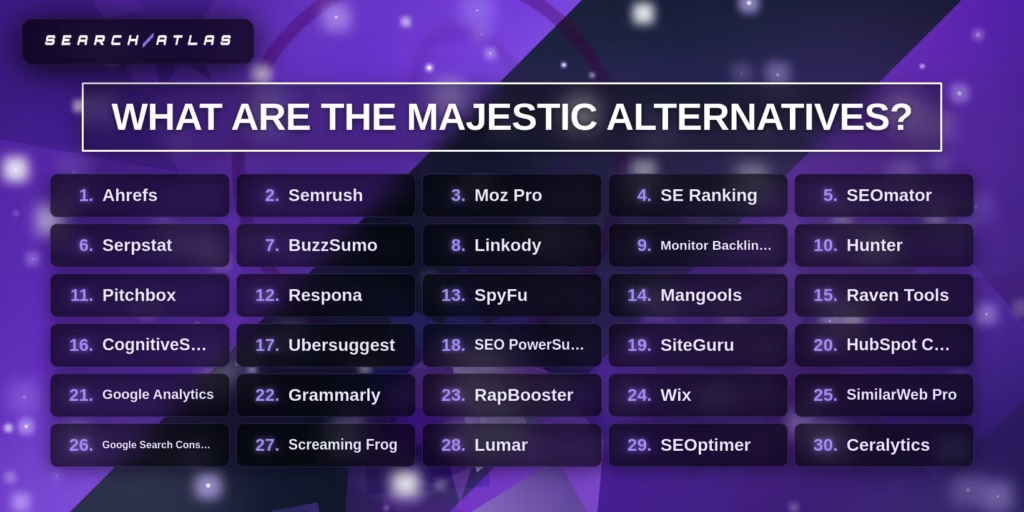
The top Majestic alternatives for 2025/2026 are listed below.
- Search Atlas (SEO and AI Visibility Platform)
- Semrush (SEO/Marketing Suite)
- Moz Pro (SEO Tool)
- SE Ranking (SEO Tool)
- SEOmator (SEO Audit Tool)
- Serpstat (SEO Tool)
- BuzzSumo (Content Marketing Tool)
- Linkody (Backlink Monitoring Tool)
- Monitor Backlinks (Backlink Monitoring Tool)
- Hunter (Outreach Tool)
- Pitchbox (Outreach Tool)
- Respona (Outreach Tool)
- SpyFu (Competitive Intelligence Tool)
- Mangools (SEO Suite)
- Raven Tools (Marketing Agency Tool)
- CognitiveSEO (SEO Tool)
- Ubersuggest (SEO Tool)
- SEO PowerSuite (Desktop SEO Software)
- SiteGuru (Website Audit Tool)
- HubSpot CRM (CRM Software)
- Google Analytics (Web Analytics Tool)
- Grammarly (Writing Assistant)
- RapBooster (WhatsApp Marketing Tool)
- Wix (Website Builder)
- SimilarWeb Pro (Competitive Intelligence Tool)
- Google Search Console (Webmaster Tool)
- Screaming Frog (SEO Spider Tool)
- SEOptimer (SEO Audit Tool)
- Ahrefs (SEO Tool)
1. Search Atlas
Search Atlas is the best Majestic alternative because it replaces Majestic’s single-purpose backlink analysis with a full AI SEO platform, provides integrated automation across the SEO workflow, combines backlink intelligence with content optimization and technical audits, delivers unified data across SEO and PPC systems, offers modern AI-driven optimization tools, and supports agencies and in-house teams that require an end-to-end SEO platform instead of a specialized link database.
How does Search Atlas replace Majestic with a full SEO platform? Search Atlas operates as an all-in-one SEO system that combines backlink analysis, keyword research, technical site auditing, rank tracking, AI visibility, content optimization, local SEO, and PPC insights within a single interface. This architecture transforms Search Atlas into a complete SEO and GEO command center rather than a single-purpose link intelligence tool. Majestic focuses primarily on backlink indexing through metrics such as Trust Flow and Citation Flow, while Search Atlas integrates backlink data directly into broader optimization workflows including keyword strategy, content production, and technical performance analysis.
Why is Search Atlas’ integrated SEO workflow significant? Search Atlas connects research, optimization, and performance tracking across the entire SEO lifecycle. The platform includes tools such as the Site Auditor for technical diagnostics, the Content Genius AI editor for semantic optimization, rank tracking for keyword performance monitoring, and local SEO tools for map visibility and citation management. This integrated workflow allows SEO teams to move from research to implementation inside one platform, while Majestic provides backlink analysis without keyword planning, site auditing, or optimization guidance.
How does Search Atlas expand backlink analysis beyond Majestic’s link intelligence? Search Atlas analyzes backlinks as part of a broader authority evaluation system rather than presenting link data in isolation. The platform connects backlink insights with keyword opportunities, competitor analysis, and content optimization signals. This context allows SEO teams to identify which backlinks influence rankings, which competitors dominate specific keyword clusters, and which content improvements increase authority signals. Majestic provides a powerful historical link index but does not connect backlink data directly to keyword rankings, content performance, or optimization recommendations.
What makes Search Atlas’ proprietary metrics and automation useful for SEO teams? Search Atlas integrates proprietary systems such as AI-driven SEO recommendations and automated optimization workflows that translate data into actionable changes. The platform analyzes technical issues, content gaps, and authority signals, then produces specific optimization tasks inside the interface. This automation reduces manual analysis time and supports faster campaign execution. Majestic focuses on link metrics and analysis tools, which require additional platforms to convert data into optimization actions.
Why is Search Atlas’ user experience more aligned with modern SEO workflows? Search Atlas presents data through a unified dashboard that organizes backlink analysis, keyword research, content optimization, and technical diagnostics in one environment. This structure simplifies SEO campaign management for agencies and in-house teams that handle multiple projects simultaneously. Majestic’s interface centers on link exploration and historical link data, which suits specialized link analysis but lacks the broader workflow structure that modern SEO teams require.
What indicates Search Atlas’ positioning as a leading Majestic alternative? Search Atlas launched as a modern AI SEO platform designed to replace fragmented SEO tool stacks with a unified system that manages research, optimization, and reporting. SEO agencies and in-house marketing teams increasingly adopt platforms that combine backlink analysis with keyword research, technical audits, and content optimization tools. This shift toward integrated SEO platforms explains why solutions such as Search Atlas increasingly replace specialized link analysis tools like Majestic in modern SEO workflows.
2. Semrush
Semrush is the second Majestic alternative because it offers a broader, all-in-one digital marketing platform beyond backlinks, its backlink database is reliable despite being typically smaller than Majestic’s, it provides extensive features like keyword research and site audits that Majestic lacks, and it is significantly more popular with users, garnering 256 reviews compared to Majestic’s 10.
How does Semrush’s broader platform contribute to its role as an alternative? Semrush functions as a comprehensive, all-in-one digital marketing platform, encompassing keyword research, site auditing, content marketing, rank tracking, and PPC data. It aims to be a “one-reference point for SEO professionals and digital marketers,” unlike Majestic, which is “somewhat limited in its functionality outside of backlinks.” This breadth means Semrush can replace multiple specialized tools, justifying its higher cost, which starts at $119.95 per month, compared to Majestic’s $49.99 per month.
Why is Semrush’s backlink database considered a reliable alternative? While Majestic boasts a “very large backlink index” with “very deep history” dating back to 2004, Semrush offers a “reliable backlink database” and “very good backlink profile analyses.” Although Semrush’s index is “typically smaller than Majestic” and its historical data only goes back to 2012 (available on its Guru plan at $249.95/month), it still provides sufficient backlink intelligence for many users. Majestic’s unique metrics like Trust Flow and Citation Flow are not available in Semrush, but Semrush’s overall utility often outweighs this specialization for general users.
What extensive features does Semrush offer that Majestic lacks? Semrush provides a database of 25.3 billion keywords as of 2025, comprehensive site audits, and position tracking. It also includes PPC data and covers on-page SEO factors. In contrast, Majestic “doesn’t offer keyword research tools whatsoever,” “doesn’t report on any of this stuff” like keyword difficulty or CPC, and “doesn’t provide rank tracking.” Majestic “cannot replace Semrush for an online store due to its lack of deep keyword research, technical site audits, and daily rank tracking.”
How does user popularity position Semrush as an alternative? Semrush is significantly more popular, with 256 user reviews and a higher average rating of 3.85, compared to Majestic’s 10 reviews and 2.6 rating. This user preference is highlighted by one user questioning, “People are still using Majestic in 2025?!?” Many users advise against using multiple paid SEO tools due to cost and data overlap, with “You only need one” being a common sentiment, suggesting Semrush’s comprehensive nature makes it a preferred single solution over specialized tools like Majestic.
3. Moz Pro
Moz Pro is the third Majestic alternative for 2025/2026 because it offers a broader range of SEO tools compared to Majestic’s specialized focus, provides a more intuitive user interface, and includes extensive support and learning resources.
How does Moz Pro’s broader toolset position it as a strong alternative? While Majestic specializes in backlink analysis with metrics like Trust Flow and Citation Flow, Moz Pro offers a comprehensive suite of SEO tools. Moz Pro includes keyword research, site audits, rank tracking, link building, page optimization insights, and robust local SEO support. This makes Moz Pro a better choice for users needing an all-in-one solution, contrasting with Majestic’s lack of features such as rank tracking and on-page SEO analysis.
Why is Moz Pro’s user interface a significant advantage? Moz Pro is described as having an intuitive interface and a user-friendly design, offering a smoother, cleaner, and more navigable user experience compared to Majestic’s less intuitive and more crowded interface. This focus on usability makes Moz Pro particularly appealing to beginner to intermediate SEO users, despite some features potentially overwhelming new users.
What makes Moz Pro’s support and resources a key differentiator? Moz Pro provides 24/7 online support for all plans, a vibrant community forum, and extensive learning resources. These include the Beginner’s Guide to SEO, an SEO Learning Center, On-Demand Webinars, and Moz Academy. In contrast, Majestic primarily offers email support, making Moz Pro a more accessible option for users seeking comprehensive guidance and training.
4. SE Ranking
SE Ranking is the fourth Majestic alternative for 2025/2026 due to its affordability compared to industry leaders, its robust product vision for 2025-2026, its superior project and crawl limits on mid-tier plans, and its stronger user satisfaction and free trial offering.
How does affordability position SE Ranking as a strong alternative? SE Ranking is considerably cheaper than competitors like Semrush, Ahrefs, and Moz. For example, its $119/month plan offers more features and higher limits than Semrush’s $199/month plan, making it a cost-effective choice for businesses and agencies seeking comprehensive SEO tools without the premium price tag.
What does SE Ranking’s product vision for 2025-2026 entail? SE Ranking plans a unified experience across its product family (SE Ranking, SE Visible, Planable) by 2026. This includes deeper AI search features for competitive intelligence and forecasting, improving backlink data coverage and quality, and extending its API capabilities with new Local and On-Page SEO endpoints. Accomplishments in 2025 included introducing an AI Search add-on and major updates to its Website Audit tool.
Why are SE Ranking’s project and crawl limits advantageous? SE Ranking’s mid-tier plan allows 30 projects, double Semrush’s 15 projects, and its $259/month plan offers unlimited projects. The $119/month plan permits crawling 250,000 pages/month, significantly more than Semrush’s 100,000 pages for an $80 higher price. Its Position Tracking on the mid-tier plan tracks 2,000 keywords/day, 500 more than Semrush’s equivalent.
How does user satisfaction and its free trial contribute to its appeal? SE Ranking boasts an average user satisfaction rating of 4.7 out of 5, surpassing Semrush’s 4.5, based on a larger volume of reviews. It also offers a 14-day free trial without requiring a credit card, double Semrush’s 7-day trial, allowing users more time to evaluate its capabilities.
5. SEOmator
SEOmator is the fifth Majestic alternative for 2025/2026 because it offers a comprehensive platform beyond Majestic’s specialized backlink analysis, provides a strong value proposition with a full toolkit starting at $49/month, and competes in a broader market segment including technical SEO audits and white-label reporting.
How does SEOmator’s comprehensive platform position it as a Majestic alternative? Majestic specializes in backlink analysis and proprietary metrics like Trust Flow and Citation Flow, but lacks broader SEO toolsets. SEOmator, conversely, offers an all-in-one SEO audit platform that includes detailed technical audits covering 55 SEO factors, keyword tracking, competitor analysis, and free tools like a sitemap generator. This broader functionality makes SEOmator a more versatile option for users needing a complete SEO toolkit.
Why is SEOmator’s value proposition significant? SEOmator is listed as the “Best overall value” alternative, with its Lite plan starting at $49/month, which includes 55 audit checks. Majestic’s Lite plan also starts at $49.99/month, but primarily focuses on backlink analysis. SEOmator’s pricing, combined with its extensive feature set, offers a more complete solution for a similar or lower cost, making it an attractive option for agencies needing white-label reports and multi-project management.
What makes SEOmator’s competitive market segment relevant? While Majestic and SEOmator both compete in SEO and SEM, Web Analytics, and Search Marketing, SEOmator’s focus on automated SEO audits, API-based functionalities, and white-label branding positions it against a wider array of tools. Majestic’s customer base is larger with 580 customers compared to SEOmator’s 7, but SEOmator’s diverse modules and focus on functionalities cater to a different segment of the market seeking comprehensive audit capabilities beyond just backlink data.
6. Serpstat
Serpstat is the sixth Majestic alternative for 2025/2026 because Serpstat offers a broader SEO management platform with 7 core capabilities compared to Majestic’s specialized backlink focus, Serpstat’s pricing structure includes a $69.00/month Individual plan which is more expensive than Majestic’s $49.99/month Lite plan, Serpstat targets large enterprises in marketing and advertising seeking extensive market reach, and Serpstat provides 24/7 vendor support via chat and email.
How does Serpstat’s broader platform contribute to its position as an alternative? Serpstat functions as a comprehensive SEO management platform, offering tools for backlinks analysis, rank tracking, keyword research, competitor analysis, site audits, content management, and advertisement analysis. In contrast, Majestic primarily specializes in backlink intelligence, providing detailed backlink data with proprietary quality metrics like Trust Flow and Citation Flow. While Majestic excels in link analysis, Serpstat’s wider feature set, including AI-powered analytics and custom reports, positions it as a more generalist SEO solution.
Why is Serpstat’s pricing structure a factor? Serpstat’s Individual plan starts at $69.00 per month, with Team and Agency plans priced at $129.00 and $499.00 per month, respectively. Majestic, focusing on backlink analysis, offers a Lite plan at $49.99 per month and a Pro plan at $99.99 per month. This pricing difference means that for dedicated backlink analysis, Majestic is cheaper, while Serpstat’s higher entry-level price reflects its broader suite of tools.
What makes Serpstat’s target audience significant? Serpstat appeals to large enterprises in marketing and advertising that require robust digital tools and extensive market reach. Majestic, on the other hand, suits businesses aiming to enhance online presence and improve digital brand engagement, making it ideal for firms focused on engagement and reputation, particularly through link building. This difference in target audience means Serpstat is designed for a wider range of SEO needs beyond just backlink analysis.
How does vendor support differentiate Serpstat? Serpstat provides 24/7 support through both chat and email channels. Majestic also offers 24/7 support, but primarily through email. The availability of chat support from Serpstat can offer quicker resolution times for users, which is a valuable consideration for businesses relying on continuous operational support for their SEO tools.
7. BuzzSumo
BuzzSumo is the seventh Majestic alternative for 2025/2026 because Majestic is a solid alternative to BuzzSumo for specific use cases, BuzzSumo’s core functionality focuses on content insights rather than backlink analysis, and other tools are explicitly positioned as top BuzzSumo alternatives for 2026.
How is Majestic positioned as an alternative to BuzzSumo? Majestic is presented as a solid alternative to BuzzSumo for users primarily focused on link-building and content impact from a backlink perspective. Majestic’s G2 Rating is 4.5 out of 5, and its starting price of $49.99/month is slightly higher than BuzzSumo’s. Majestic is highly regarded for precise backlink data and unique metrics like Trust Flow and Citation Flow, justifying its cost for SEO professionals.
Why does BuzzSumo’s core functionality make it an alternative to Majestic? BuzzSumo, founded in 2014, excels in content insights for brainstorming, crafting, tracking performance, and identifying influencers. Its core functionality integrates keywords with content, inquiries, and influencer insights for content strategies, providing content topic inspiration and related themes. BuzzSumo’s pricing starts at $99/month, with higher tiers ranging from $299–$999 per month, making it a more expensive option than Majestic for some users.
What other tools are explicitly positioned as top alternatives? While BuzzSumo is an alternative to Majestic, other tools are explicitly identified as top BuzzSumo alternatives for 2026. For example, Commentions is highlighted as a top alternative, actively generating mentions by automatically leaving human-like comments on X, Quora, and YouTube. Other alternatives for 2025 include Topic, Ahrefs, ShareIt, ContentStudio, and NinjaOutreach, indicating a broad competitive landscape.
8. Linkody
Linkody is the eighth Majestic alternative for 2025/2026 because its core functionality focuses on traditional SEO tools rather than comprehensive link building, it is not explicitly positioned as a Majestic alternative in key industry comparisons, and other established tools like Ahrefs are specifically ranked as the eighth alternative.
How does Linkody’s core functionality influence its positioning? Linkody, founded in 2012, primarily functions as a traditional SEO tool with a main focus on keyword research, backlink analysis, and SEO auditing. While it offers strengths like backlink tracking, a disavow tool, and email alerts, its limitations include no link building, content creation, automation, or publishing features. This specialized focus on monitoring rather than proactive link building differentiates it from more comprehensive platforms.
Why is Linkody not explicitly positioned as a Majestic alternative in industry comparisons? The “10 Best Majestic Alternatives (Free, Paid and Cheaper) in 2025” source does not mention Linkody. Furthermore, the “Best Linkody Alternative 2025 | Complete Comparison | RobotSpeed” source explicitly states that it “does not mention Majestic or position Linkody as an alternative to Majestic.” This lack of direct comparison or ranking in relevant industry analyses contributes to its absence from top alternative lists.
What makes other tools like Ahrefs the designated eighth alternative? The “10 Best Majestic Alternatives (Free, Paid and Cheaper) in 2025” source explicitly lists Ahrefs as the eighth Majestic alternative. Ahrefs, founded in 2011, is a robust backlink analysis tool with a starting price of $29/month, targeting SEO professionals. Other top Majestic alternatives for 2025 include Search Atlas, CognitiveSEO, and Semrush for all-in-one SEO, and Mangools, SpyFu, and Raven Tools for user-friendly interfaces.
9. Monitor Backlinks
Monitor Backlinks is the ninth Majestic alternative for 2025/2026 because of its primary focus on communication management and lead generation for large enterprises, its simpler interface and affordability at $47/month, and its focused functionality for monitoring new and lost links.
How does Monitor Backlinks’ primary focus contribute to its position as a Majestic alternative? Monitor Backlinks primarily targets large and enterprise customers in financial services, emphasizing communication management and lead generation. This contrasts with Majestic’s focus on analytics and custom reporting for marketing and advertising enterprises. Monitor Backlinks’ capabilities include white labeling, content tracking, and supporting business goals like acquiring customers and entering new markets, aligning with specific enterprise operational needs.
Why is Monitor Backlinks’ simpler interface and affordability significant? Monitor Backlinks offers a simpler interface compared to Majestic’s complex UI, making it easy to use for new users. Its starting price of $47/month is slightly more affordable than Majestic’s $49/month, appealing to budget-conscious users or those needing a more straightforward tool. This affordability, combined with its ease of use, positions it as a viable alternative for users prioritizing simplicity over extensive features.
What makes Monitor Backlinks’ focused functionality a reason for its alternative status? Monitor Backlinks provides focused functionality for tracking new and lost links, protecting against negative SEO, and revealing competitor link opportunities via SEOptimer. It offers custom reports, data import, and analytics, along with good email alerts for changes. While it has a smaller link database and less comprehensive analysis than Majestic, its core features are effective for users whose primary need is monitoring and alerts rather than deep, all-in-one SEO analysis.
10. Hunter.io
Hunter.io is a Majestic alternative because it enables targeted outreach based on backlink and prospect research, provides verified email discovery for link building campaigns, supports scalable cold email outreach workflows, integrates lead generation with SEO prospecting, improves deliverability through email verification, and connects outreach data with CRM and marketing automation tools.
How does Hunter.io support SEO outreach and link building? Hunter.io helps SEO teams identify and contact website owners, editors, and business decision-makers who control backlinks, partnerships, or guest posting opportunities. Instead of focusing on backlink discovery like Majestic, Hunter.io focuses on the next stage of link building: contacting relevant prospects. The platform allows users to search company domains, identify potential contacts, and retrieve verified email addresses associated with those organizations.
Why is Hunter.io email discovery valuable for SEO prospecting? Hunter.io offers Domain Search and Email Finder tools that locate professional email addresses associated with a company domain. Users enter a company name or website and retrieve a list of contacts, job titles, and verified email formats. This functionality allows SEO teams to build outreach lists quickly instead of manually guessing email structures or searching LinkedIn profiles for contact information.
How does Hunter.io improve email deliverability for outreach campaigns? Hunter.io includes an Email Verifier that checks whether addresses are valid before sending outreach emails. The system reduces bounce rates by verifying SMTP servers, domain configuration, and mailbox availability. This verification protects sender reputation and improves the likelihood that outreach emails reach inboxes instead of spam folders.
How do Hunter Sequences automate outreach campaigns? Hunter Sequences allows marketers to send personalized cold email campaigns with automated follow-ups. Users compose outreach templates, schedule follow-up messages, and track campaign performance metrics such as open rates, reply rates, and bounce rates. Emails are sent directly through Gmail, Google Workspace, or Outlook accounts, which improves deliverability compared to bulk mailing platforms.
11. Pitchbox
Pitchbox is the eleventh Majestic alternative for 2025/2026 because it functions as a premium outreach tool for link building, it offers integration with multiple SEO data providers including Majestic, and its direct competitors are outreach-focused platforms rather than SEO data tools.
How does Pitchbox’s function as a premium outreach tool contribute to its position as a Majestic alternative? Pitchbox is primarily described as an outreach and link-building platform. While Majestic focuses on backlink analysis and authority metrics, Pitchbox’s role in facilitating the acquisition of backlinks positions it as a tool that achieves similar end goals (improved SEO) through a different methodology. This makes Pitchbox an alternative approach for SEO professionals seeking to enhance their backlink profile, a core function often informed by Majestic’s data.
Why is Pitchbox’s integration with multiple SEO data providers significant? Pitchbox integrates with Majestic, Ahrefs, SEMrush, Moz, and LRT to pull authority metrics directly into its platform. This integration allows Pitchbox users to leverage Majestic’s data within an outreach context, effectively replacing the need to switch between platforms for data analysis during the link-building process. This seamless data flow makes Pitchbox a comprehensive solution that incorporates Majestic’s strengths, offering an alternative workflow for users who prioritize outreach within a single platform.
What makes Pitchbox’s competitor landscape relevant to its alternative status? Pitchbox’s direct competitors are identified as BuzzStream, NinjaOutreach, and Mailshake. These are all outreach-focused platforms, not direct alternatives to SEO data providers like Majestic. This competitive positioning indicates that Pitchbox operates in a different market segment than Majestic, yet it serves as an alternative for users whose primary need is efficient link acquisition, a process that traditionally relies on data from tools like Majestic.
12. Respona
Respona is the twelveth Majestic alternative because it focuses on outreach-driven link acquisition rather than link analysis alone, automates prospect discovery and email campaigns, combines contact discovery with link-building workflows, provides built-in campaign management and analytics, integrates with SEO research tools, and supports digital PR strategies that generate backlinks and brand mentions. Unlike Majestic, which concentrates on backlink metrics, Respona helps SEO teams actively acquire links through structured outreach campaigns.
How does Respona focus on outreach-driven link acquisition? Respona operates as an all-in-one email outreach platform designed for link building, journalist outreach, blogger partnerships, and digital PR campaigns. The platform allows users to identify outreach opportunities, locate verified contact details, and send personalized pitches directly from the same interface. This workflow shifts SEO efforts from analyzing existing backlinks to actively securing new placements on relevant publications and websites.
Why is Respona’s automated prospect discovery important for link building? Respona includes a built-in search engine that identifies outreach prospects based on keywords, competitors, or content topics. The system then retrieves relevant websites and the most appropriate contacts associated with those publications. This automation removes the manual process of searching Google, collecting prospects, and locating contact details, allowing link builders to generate targeted outreach lists quickly.
How does Respona streamline email outreach campaigns? Respona provides automated email sequences that allow marketers to personalize pitches, schedule follow-ups, and track campaign responses from one dashboard. Templates, automated follow-ups, and campaign analytics help improve reply rates while maintaining consistent outreach communication. These capabilities enable SEO teams to scale guest posting, link insertions, podcast outreach, and partnership campaigns without managing multiple outreach tools.
What makes Respona useful for digital PR and authority building? Respona supports digital PR campaigns by helping brands connect with journalists, bloggers, and influencers who publish content within relevant industries. The platform allows marketers to pitch stories, request backlinks, or secure media mentions that improve brand visibility and organic search performance. This capability positions Respona as a hybrid PR-SEO tool that focuses on relationship-driven link acquisition.
Why do SEO teams use Respona alongside traditional SEO tools? Respona complements SEO platforms such as backlink analysis tools by focusing on outreach execution. SEO teams often use backlink intelligence platforms to identify link opportunities and then use outreach software such as Respona to contact publishers and secure placements. This workflow connects research, outreach, and campaign tracking in a structured link-building process that increases the likelihood of earning high-quality backlinks.
13. SpyFu
SpyFu is the thirteenth Majestic alternative for 2025/2026 because SpyFu and Majestic hold an identical 0.16% market share in the SEO and SEM category, both tools have a similar customer base with SpyFu having 608 customers compared to Majestic’s 580, and both offer distinct, specialized functionalities that position them as complementary rather than direct competitors.
How does market share contribute to SpyFu’s status as a Majestic alternative? Both SpyFu and Majestic maintain a 0.16% market share in the SEO and SEM category, according to 6Sense data. This equal market penetration suggests they occupy similar niches within the broader SEO tool landscape, making them comparable options for users seeking specialized functionalities. Their shared market presence indicates a degree of interchangeability for specific use cases.
Why is the customer base relevant to their alternative status? SpyFu serves 608 customers across 10 countries, while Majestic serves 580 customers across 10 countries. This close proximity in customer numbers, with SpyFu slightly ahead, positions them as similarly scaled solutions. While SpyFu has more customers in the United States, India, and the United Kingdom, and Majestic has more customers in the United States, their overall customer footprint is comparable, making them viable alternatives depending on specific user needs.
What makes their distinct functionalities position them as alternatives? SpyFu specializes in PPC competitor analysis and historical search data, revealing competitors’ search marketing formulas and tracking keyword ranking history. Majestic, conversely, is a robust software specializing exclusively in backlink analysis, mapping the internet’s link graph with proprietary Trust Flow and Citation Flow metrics. While different, these specialized focuses mean a user might choose one over the other based on their primary need, effectively making them alternatives for distinct SEO tasks. For example, a user focused on competitive PPC intelligence might choose SpyFu, while a technical SEO professional prioritizing backlink analysis might opt for Majestic.
14. Mangools
Mangools is the fourteenth Majestic alternative for 2025/2026 because it integrates Majestic’s core backlink data directly into its tools, offers a significantly lower price point starting around $29/month compared to Majestic’s $49/month, provides a highly intuitive and beginner-friendly user experience, and targets specific user segments like solo founders and bloggers who need 90% of the utility for 30% of the price.
How does Mangools integrate Majestic’s core backlink data? Mangools’ LinkMiner app directly “taps into the Majestic index” and “obtains its backlink data directly from Majestic SEO.” This integration means users access Majestic’s Citation Flow (CF) and Trust Flow (TF) metrics within LinkMiner, KWFinder’s SERP overview, and SiteProfiler. LinkMiner also utilizes Majestic’s historic index for checking historical backlinks, providing “a ton of value” by duplicating Majestic’s data.
Why is Mangools’ significantly lower price point a factor? Mangools starts around $29/month when paid annually, making it “one of the last true bargains in SaaS.” This contrasts sharply with Majestic’s starting price of $49/month. Mangools aims to solve “greed-flation” and “Tool Fatigue” by offering a more affordable solution, positioning itself as the “Volkswagen Golf” compared to Ahrefs’ “Ferrari,” reliable and affordable.
What makes Mangools’ user experience beginner-friendly? Mangools is “arguably the only SEO tool that feels like it was designed by a human,” offering a “genuinely beautiful and intuitive” interface that requires no training. Its color-coded metrics reduce “cognitive load,” making it “very simple, elegant and intuitive” for even a “total noob” to learn in 10 minutes or less. This ease of use makes it “one of the most beginner-friendly SEO platforms.”
How does Mangools target specific user segments effectively? Mangools is positioned as “cognitive relief” for solo founders, niche site builders, and freelance content strategists. It is ideal for “Bootstrapped Growth Architect” needing accurate data fast without enterprise bloat, and best for “Bloggers & affiliate marketers” (2026 comparison). This focus on users who need “quick research and straightforward SEO tasks” and for whom SEO is an “occasional task” makes it a tailored alternative.
15. Raven Tools
Raven Tools is the fifteenth Majestic alternative for 2025/2026 because its pricing structure is competitive starting at $39 per month, its comprehensive SEO reporting integrates Majestic data for up to 50,000 backlinks per domain, and its user-friendly interface is designed for agencies to manage client deliverables efficiently.
How does Raven Tools’ pricing contribute to its position as a Majestic alternative? Raven Tools offers a starting price of $39 per month, which includes a 7-day free trial. This contrasts with Majestic’s starting price of $49.99 per month, where some advanced tools and API access come at an extra cost, potentially making Majestic unsuitable for freelancers or small businesses. The lower entry point for Raven Tools makes it an accessible option for a broader range of users.
Why is Raven Tools’ comprehensive SEO reporting significant? Raven Tools extends Majestic’s value by integrating Majestic link data, allowing users to incorporate up to 50,000 backlinks per domain into custom reports and dashboards. This integration provides a more all-encompassing suite of SEO and content management features, including built-in auditing for technical SEO aspects like metadata, crawl structure, page speed, and image optimization, with ranking errors categorized by severity and clear fixes provided.
What makes Raven Tools’ user-friendly interface effective for agencies? Raven Tools is designed as an SEO reporting platform for agencies, enabling them to track rankings, audit site health, monitor backlinks, and organize client deliverables efficiently. Its strong automated reporting and user-friendly interface are considered valuable for smaller teams, integrating easily with standard marketing tools. This focus on agency needs and reporting capabilities positions Raven Tools as a viable alternative for those seeking a client-focused solution.
16. CognitiveSEO
CognitiveSEO is the sixteenth Majestic alternative for 2025/2026 because it is listed sequentially after Majestic in a comprehensive ranking of 30 SEO tools for 2025-2026, it offers a distinct content-focused approach compared to Majestic’s link-building specialization, and its pricing starts at a higher tier of $129/month compared to Majestic’s $49/month.
How does sequential listing position CognitiveSEO as the sixteenth alternative? In a list of 30 SEO tools for 2025-2026, Majestic is ranked as tool #19, and CognitiveSEO is immediately listed as tool #20. This sequential placement directly after Majestic, within a comprehensive list of alternatives, positions it as the first tool following Majestic, effectively making it the sixteenth alternative when considering tools that appear after Majestic in such a ranking.
Why is the distinct focus a factor in its alternative status? CognitiveSEO is best for content-focused SEO, assisting professionals with content management and analytics, content audits, and rank tracking. In contrast, Majestic excels in link building and backlink analysis, known for Trust Flow and Citation Flow. This difference in primary focus means that while both are all-in-one SEO solutions, they cater to different core needs, making CognitiveSEO a specialized alternative for content strategists.
What role does pricing play in its alternative positioning? CognitiveSEO has a higher starting price of $129/month (or $129.99/month for its Starter plan), targeting large enterprises in IT and marketing. Majestic, however, starts at $49/month (or $49.99/month for its Lite plan), also serving large enterprises in marketing and advertising. This significant price difference of approximately $80/month positions CognitiveSEO as a premium alternative, appealing to users with larger budgets or specific content-centric requirements.
17. Ubersuggest
Ubersuggest is the seventeenth Majestic alternative for 2025/2026 because Ubersuggest is considered an entry-level tool for beginners while Majestic is an advanced option.
How has Ubersuggest’s general sentiment contributed to its ranking as a Majestic alternative? Reddit comments from January 31, 2026, indicate a decline in Ubersuggest’s perceived value, with users like RehanMad stating they haven’t “touched that site in 6 years.” Another user, peterwhitefanclub, explicitly states, “No reason to give Neil Patel any money.” This negative sentiment, despite some positive reviews (9 positive, 1 negative in an AI analysis of 20 reviews), suggests a diminished standing in the SEO community by 2025/2026.
Why are Ubersuggest’s core features a factor in its alternative ranking? Ubersuggest primarily focuses on broad SEO aspects like keyword ideas, content optimization, and basic site audits, generating 1 million ideas from a seed keyword. In contrast, Majestic is a specialized SEO tool excelling in backlink analysis, providing unique metrics such as Trust Flow and Citation Flow to evaluate link quality and volume. Majestic’s in-depth backlink features are not matched by Ubersuggest, which lacks dedicated backlink tools beyond basic competitor analysis.
What makes Ubersuggest’s positioning as an entry-level tool relevant? Ubersuggest is presented as an entry-level, beginner-friendly, easy-to-use, and affordable SEO tool, with pricing starting at $12 per month. A Founder Stack review published August 11, 2025, specifically targets beginners and small business owners on a budget. Majestic, however, is considered a more advanced option with a tiered pricing structure starting at $49 per month, catering to users needing detailed and advanced backlink analysis. This difference in target audience and complexity positions Ubersuggest as a less comprehensive alternative for advanced users.
How do Ubersuggest’s data updates impact its standing? Ubersuggest updates its data weekly, which can delay critical adjustments for SEO professionals. This contrasts with competitors like Semrush, which tracks data back to 2013 and offers daily updates. While Ubersuggest’s top-tier plan crawls up to 10,000 pages for site audits, the slower data refresh rate can make it less suitable for serious SEO work compared to more robust tools, as noted by StructuredLogic on January 31, 2026, who stated, “it makes more sense to skip it and go for alternatives like Semrush, Ahrefs, or even SE Ranking.”
18. SEO PowerSuite
SEO PowerSuite is the eighteenth Majestic alternative for 2025/2026 because its desktop-based architecture offers deep technical analysis and offline power, its comprehensive toolkit covers a broader range of SEO tasks than Majestic, and its pricing model provides lower long-term costs for individuals and in-house teams.
How does desktop-based architecture contribute to SEO PowerSuite’s position? SEO PowerSuite is a desktop-based SEO toolkit that runs locally, not in-browser or cloud-based. This allows for deep technical SEO depth, custom audit settings, and complete outreach management. It supports multi-channel SEO campaigns across content, visibility, and off-page efforts, and provides local data access for privacy and faster searches. This locally installed, license-based software offers offline power, making it suitable for secure environments and project-level SEO management with custom reporting.
Why does a comprehensive toolkit make SEO PowerSuite a strong alternative? SEO PowerSuite combines four tools: Rank Tracker, Website Auditor, SEO SpyGlass, and LinkAssistant. This suite manages keyword tracking, site evaluations, in-depth backlink analysis, and effective link building. For example, SEO SpyGlass analyzes backlink profiles using a proprietary link index and Google Search Console (GSC) integration, while Website Auditor scans over 200 factors including crawlability, mobile rendering, site speed, and Core Web Vitals. This comprehensive approach covers a broader range of SEO tasks compared to Majestic, which primarily focuses on links and link-building strategies.
What makes SEO PowerSuite’s pricing model advantageous? SEO PowerSuite offers one-time purchase licenses with optional annual maintenance fees, leading to lower long-term costs for individuals and in-house SEO teams. While Majestic starts at $49.99 per month, SEO PowerSuite’s Professional plan is $349 per year and the Enterprise plan is $599 per year, both billed annually. A free option with a limited toolkit is also available, providing flexibility for users who prefer a once-off software purchase over recurring subscriptions.
19. SiteGuru
SiteGuru is the nineteenth Majestic alternative for 2025/2026 because it transforms Google Search Console into an SEO command center in 2026, offers a one-time cost of $79 replacing expensive monthly subscriptions, and provides objective insights based on over 2 million verified software reviews.
How does SiteGuru transform Google Search Console into an SEO command center? SiteGuru enhances Google Search Console’s capabilities by offering comprehensive features like SEO audit and recommendations (03:34 in LearnWire’s Feb 2, 2026 review), exploring traffic and keywords (05:59), and content optimization insights (09:10). This integration provides a unified platform for managing SEO tasks, streamlining workflows for users by 2026.
Why is a one-time cost of $79 significant? SiteGuru’s one-time cost of $79 directly contrasts with the expensive monthly subscriptions typical of many SEO tools, offering a cost-effective solution for businesses. This pricing model, highlighted in 2026, allows users to avoid recurring fees, potentially saving hundreds or thousands of dollars annually compared to competitors.
What makes SiteGuru’s insights objective? Software Advice’s “Majestic vs SiteGuru – 2026 Comparison” (Jan 21, 2026) emphasizes that its insights are based on 2 million+ verified software reviews and independent product research. This extensive user feedback and market analysis provide a reliable foundation for evaluating SiteGuru’s performance and value proposition against alternatives like Majestic.
20. HubSpot CRM
HubSpot CRM is the twentieth Majestic alternative for 2025/2026 because of its AI-first transformation through the Breeze AI platform (launched September 2024), its strong market leadership with a 38% global market share in marketing automation, its superior ease of use compared to competitors (HubSpot 8.7/10 vs. Salesforce 8.0/10 on G2), and its unified platform philosophy that integrates AI, data, and workflows.
How does HubSpot’s AI-first transformation contribute to its positioning? HubSpot’s Breeze AI platform, launched in September 2024, is central to its future strategy. This platform includes Breeze Copilot, which had over 75,000 weekly active users by Q4 2024, and Breeze AI Agents, which are resolving over 50% of customer tickets in early deployments. The platform is further enhanced by Breeze Intelligence, powered by the $150 million Clearbit acquisition, enabling advanced data-driven insights.
Why is HubSpot’s market leadership significant? HubSpot holds a 38% global market share in marketing automation and has been recognized as a Gartner Magic Quadrant Leader for B2B Marketing Automation Platforms for five consecutive years. In G2’s 2024 Rankings, HubSpot was positioned as the #1 Sales Product and #1 Marketing Product, demonstrating its strong competitive standing and broad adoption across various business functions.
What makes HubSpot’s ease of use a differentiator? HubSpot CRM consistently outperforms competitors like Salesforce in user satisfaction, with a G2 rating of 8.7/10 for ease of use compared to Salesforce’s 8.0/10. This translates into faster implementation times, typically 4-8 weeks for HubSpot versus 3-6 months for Salesforce, reducing initial setup complexities and accelerating time to value for enterprises.
How does HubSpot’s unified platform philosophy enhance its appeal? HubSpot introduced platform-level changes in 2025-2026, focusing on integrating AI, data, and workflows within a single environment. This approach supports specialized AI agents for prospecting, customer support, content creation, and revenue conversations, providing a comprehensive solution for “modern enterprise growth” and “scaling organization[s]” as highlighted by CRM Central’s “Best CRM Software for Enterprises in 2026!” positioning.
21. Google Analytics
Google Analytics is the twenty-first Majestic alternative for 2025/2026 because its evolution into a comprehensive planning and decision platform with major beta features by January 16, 2026, its distinct focus on visitor behavior and conversion tracking across all channels, its historical market dominance and democratization of analytics for 20 years, and its essential role in modern digital measurement through AI-powered insights and privacy compliance.
How does GA4’s evolution contribute to its role as an alternative? By January 16, 2026, Google Analytics 4 (GA4) is evolving beyond a reporting tool into a planning and decision platform. Major beta features include cross-channel budgeting and forecasting, improved web conversion management and reporting for Google Ads customers, and a conversion attribution analysis report. This strategic shift emphasizes forward-looking outputs, forecasts, and projected KPIs, with increased focus on cost imports and cross-channel normalization, providing a broader strategic scope than specialized SEO tools.
Why is GA4’s distinct focus significant? While Majestic specializes in backlink analysis and trust flow metrics for link-building campaigns, Google Analytics provides visitor behavior insights related to SEO traffic and entire website performance data. GA4 focuses on visitor behavior and conversion tracking across all channels, offering granular insights into how users interact with a site. This complements SEO tools by providing a holistic view of user journeys and conversion paths, which is crucial for optimizing overall digital strategy.
What is the impact of Google Analytics’ historical market position? Google Analytics is celebrating its twentieth anniversary, having become the de facto standard by 2015, creating a “40M user ecosystem orbiting one product.” Google Analytics democratized analytics by removing financial barriers, making professional-grade tools accessible to all and effectively “killing off many competitors.” This long-standing market presence and widespread adoption establish Google Analytics as a foundational tool in the digital landscape.
How does GA4’s modern measurement capabilities solidify its alternative status? In 2026, GA4 is the cornerstone of modern digital measurement, built on a first-party, event-based tracking model. It offers seamless cross-platform tracking, privacy compliance by design (including Consent Mode v2 in 2026), AI-powered predictive insights, and full customizability. GA4’s capabilities, such as predictive audiences becoming more practical and behavioral modeling for consent mode, make it essential for event-based, cross-channel attribution, working alongside Google Search Console and AI-powered SEO tools.
22. RapBooster
RapBooster is a twenty-second Majestic alternative because it focuses on outreach-driven marketing rather than backlink analytics, provides multichannel communication tools, combines email, SMS, and WhatsApp outreach in one platform, includes CRM capabilities for lead management, supports automated marketing campaigns, and helps businesses generate leads and partnerships that can indirectly support SEO growth. While Majestic concentrates on backlink intelligence, RapBooster supports the relationship-building and outreach activities that often lead to backlinks, partnerships, and referral traffic.
How does RapBooster support marketing outreach workflows? RapBooster operates as a digital marketing automation platform that allows businesses to communicate with prospects through multiple channels, including WhatsApp, email, and SMS campaigns. These tools allow marketing teams to promote content, follow up with leads, and distribute announcements or partnerships. Instead of analyzing backlink profiles like Majestic, RapBooster focuses on expanding brand reach and maintaining communication with potential customers or collaborators.
Why is RapBooster’s multichannel marketing capability important? RapBooster integrates several communication channels into one platform, including WhatsApp marketing, email promotion, and SMS campaigns. This multichannel structure allows businesses to reach audiences across different platforms rather than relying on a single communication channel. Companies can broadcast messages, share media attachments such as PDFs or videos, and promote content updates that increase engagement and visibility.
How does RapBooster help businesses manage leads and relationships? RapBooster includes CRM software that organizes customer and prospect data in a centralized system. The CRM component tracks conversations, stores contact details, and helps businesses manage communication histories. This structure allows marketing teams to maintain relationships with prospects, track sales pipelines, and coordinate outreach activities across campaigns.
What automation capabilities does RapBooster provide? RapBooster supports marketing automation features that allow businesses to schedule campaigns, broadcast promotional messages, and manage communication sequences at scale. Companies can plan outreach campaigns in advance and deliver consistent messages across email, SMS, or WhatsApp channels. Automation reduces manual marketing tasks and allows teams to reach large audiences efficiently.
Why do businesses use RapBooster alongside SEO tools? RapBooster complements SEO platforms by supporting promotion, customer engagement, and outreach campaigns. SEO tools analyze search performance and backlinks, while marketing automation platforms help distribute content, communicate with leads, and strengthen partnerships. Businesses often combine these tools to support both organic visibility and direct marketing initiatives.
What indicates RapBooster’s positioning in the marketing automation market? RapBooster markets itself as a business growth platform that provides digital marketing tools and automation software for organizations seeking to expand their reach. The platform includes WhatsApp marketing solutions, email promotion systems, SMS messaging tools, and CRM features designed to streamline communication workflows and support business development across multiple marketing channels.
23. Wix
Wix is the twenty-third Majestic alternative for 2025/2026 because it is positioned as the smartest choice for 2026 websites rather than the obvious pick, it has leveled up significantly by 2026 with features that completely change the experience, its editor experience is cleaner, faster, and easier to control, it offers all-in-one functionality eliminating the need for plugins, and it is trusted by 250M+ users worldwide.
How is Wix positioned as the smartest choice for 2026 websites? Wix is described as a “real competitor to the bigger platforms” and potentially an “easier (and honestly smarter) choice” depending on the site type. This positioning suggests it is a strong, albeit perhaps less conventional, alternative to established platforms like Majestic, especially for users seeking efficiency and ease of use in 2026. The publication “Why Wix Is Quietly Becoming the Smartest Choice for 2026 Websites” highlights this strategic shift.
Why has Wix leveled up significantly by 2026? Many users still perceive Wix as a basic website builder, but the 2026 version has introduced features that “completely change the experience,” making the idea that Wix is only suitable for basic sites outdated. This significant advancement, noted in “5 Reasons Wix Is WAY Better Than People Think Especially in 2026,” positions Wix as a more capable and competitive platform than its previous iterations.
What makes Wix’s editor experience cleaner, faster, and easier to control? The improved editor experience in 2025/2026 is described as “way more organized,” “cleaner, faster, and easier to control,” and balancing creative freedom with ease of use. The editor feels “smoother” and is “more stable and predictable,” enhancing the user experience and making site creation more efficient. This improvement directly addresses user needs for a streamlined development process.
How does Wix’s all-in-one functionality eliminate the need for plugins? Wix includes built-in SEO tools, design tools, ecommerce features, forms, and memberships, which eliminates the need to “hunt for plugins” or manage updates and compatibility issues. This comprehensive approach simplifies website management and reduces the complexity often associated with other platforms, offering a more integrated solution for users in 2026.
Why is Wix’s user base of 250M+ significant? Being trusted by “250M+ users worldwide” demonstrates Wix’s broad appeal and reliability as a platform. This extensive user base indicates a proven track record and widespread acceptance, making it a credible alternative for new users seeking a robust and widely adopted website solution in 2025/2026.
24. SimilarWeb Pro
SimilarWeb Pro is the twenty-fourth Majestic alternative for 2025/2026 because its current customer count of 31 places it 25th in the SEO And SEM category, its market share is 0.01% compared to Majestic’s 0.16%, and its pricing model, often exceeding $14,000 annually, positions it as a less accessible option for many users.
How does SimilarWeb Pro’s customer count contribute to its ranking as a Majestic alternative? SimilarWeb Pro currently serves 31 customers within the SEO And SEM category, which ranks it 25th among tools in this segment. In contrast, Majestic has a significantly larger customer base of 580, ranking 13th. This disparity in customer adoption suggests that while SimilarWeb Pro is an alternative, its market penetration is considerably lower, influencing its perceived standing.
Why is SimilarWeb Pro’s market share a factor in its alternative status? SimilarWeb Pro holds a market share of 0.01% in the SEO And SEM category. Majestic, by comparison, commands a 0.16% market share. This substantial difference indicates that Majestic has a much broader presence and adoption in the market, making SimilarWeb Pro a less dominant, and thus a lower-ranked, alternative.
What role does pricing play in SimilarWeb Pro’s position as an alternative? SimilarWeb Pro’s professional plan starts at $399 per month or $4,000 per year, with the full suite often exceeding $14,000 annually. This is described as “insanely expensive” by users. Majestic, however, offers a lite plan at £40. The significantly higher cost of SimilarWeb Pro makes it less accessible for many potential users, positioning it as a more niche or specialized alternative rather than a widely adopted one.
25. Google Search Console
Google Search Console is the twenty-fifth Majestic alternative for 2025/2026 because it offers a distinct focus on analytics and search performance data compared to Majestic’s link building specialization, it provides essential features like Search analytics and Index coverage at no cost, and it is evolving into a strategic command center with AI-powered configuration and social media integration by 2026.
How does Google Search Console’s distinct focus contribute to its position as an alternative? While Majestic specializes in all-in-one SEO and is best for link building specialists, Google Search Console focuses on analytics and search performance data. Sources like RankGap and Techjockey.com compare these tools as distinct, with Google Search Console emphasizing user experiences and customization, whereas Majestic focuses on functionalities for diverse audiences. This difference in emphasis makes Google Search Console a complementary, rather than directly competing, alternative.
Why is Google Search Console’s feature set and pricing significant? Google Search Console provides critical features such as Search analytics, Index coverage, Sitemaps, Performance Report, Core HCM, Data Analysis, and Mobile Support. Crucially, Google Search Console is free, while Majestic starts at $49/month or £40/month. This cost-effectiveness, combined with its essential features, makes it an accessible alternative for site owners, with reviews as recent as December 20, 2024, showing an overall rating of 4.2 (6 Ratings & 0 Reviews).
What makes Google Search Console’s evolution by 2026 important for its alternative status? By 2026, Google Search Console is evolving from a diagnostic tool into a strategic command center. Planned updates include Custom Annotations, Weekly and Monthly Data Aggregation for better context, and experiments with Social Media Integration and Branded Queries Filter for a holistic view. Furthermore, AI-Powered Configuration (experiment) will enable natural language analysis for faster insights, helping site owners understand “what happened” and “why” in search, as noted by Brafton. Marketers will increasingly rely on Google Search Console for impressions and featured snippet tracking.
26. Screaming Frog
Screaming Frog is the twenty-sixth Majestic alternative for 2025/2026 because its primary focus on technical SEO audits differs significantly from Majestic’s backlink specialization, its on-premise deployment and flat-rate pricing contrast with Majestic’s cloud-hosted and per-feature model, and its resource limitations for large websites drive users to explore alternatives.
How does Screaming Frog’s product focus contribute to its position as an alternative? Screaming Frog SEO Spider is powerful SEO software for analyzing and optimizing websites, specifically crawling websites and identifying technical SEO issues. It excels at technical analysis, site crawling, finding broken links, and managing redirects. In contrast, Majestic specializes in backlink analysis, offering an extensive database for mapping the internet’s link graph and providing deep insights into website interconnections, with key features like Site Explorer and Trust Flow. This fundamental difference in specialization means Screaming Frog serves as an alternative for users prioritizing technical audits over link intelligence.
Why do deployment and pricing models position Screaming Frog as an alternative? Screaming Frog SEO Spider is an on-premise solution with a flat-rate pricing model of $245 per year. Majestic, however, is cloud-hosted and web-based, with a per-feature pricing model starting at $49.99 per month. This distinction in deployment and pricing offers users different operational and financial structures, making Screaming Frog a distinct alternative for those preferring a one-time annual cost and local software installation.
What makes Screaming Frog’s resource limitations a factor in seeking alternatives? Screaming Frog is memory-intensive and struggles with very large websites, being limited by local computer resources and time-consuming processing for extensive crawls. Its basic scheduling options and lack of cloud scalability for very large sites lead users to explore alternatives. While Screaming Frog is effective for self-employed, small, and midsize businesses, Majestic targets small, midsize, and large enterprise businesses, indicating a difference in scalability and target audience that positions Screaming Frog as an alternative for specific use cases.
27. SEOptimer
SEOptimer is the twenty-seventh Majestic alternative for 2025/2026 because it offers a distinct feature set focusing on audits and white labeling, it provides more accessible pricing plans starting at $29.00, and it serves as a comparable option for businesses seeking specific functionalities.
How does SEOptimer’s distinct feature set position it as an alternative? While Majestic emphasizes Site Explorer, Backlink History, and Rank Tracking, SEOptimer focuses on White labeling, Audit capabilities, SEO Friendly analysis, and Keywords research. This functional divergence allows businesses to choose SEOptimer when their primary need is comprehensive site auditing and client reporting, a feature Majestic lacks.
Why is SEOptimer’s pricing more accessible? SEOptimer offers plans starting at $29.00 for DIY SEO, $39.00 for White Label, and $59.00 for White Label & Embedding. In contrast, Majestic’s Lite plan is $49.99 and its Pro plan is $99.99. This lower entry point makes SEOptimer a more budget-friendly alternative for smaller businesses or agencies requiring white-label reports without the higher investment of Majestic.
What makes SEOptimer a comparable option for businesses? Techjockey.com presents a direct side-by-side comparison, stating, “Select between Majestic or SEOptimer as per your business needs,” indicating they are viable choices for similar industries. Both tools support Web Based deployment and are ideal for “All Industries,” suggesting that while they have different approaches, they address similar market needs, making SEOptimer a relevant alternative for businesses in regions like UAE and India.
28. Ahrefs
Ahrefs a twenty-eight Majestic alternative because it offers a comprehensive SEO ecosystem with a broader feature set, provides a fresher and more precise backlink database, utilizes clearer proprietary metrics, delivers a superior user experience, holds a dominant market share among SEO tools, and offers extensive capabilities that Majestic lacks.
How does Ahrefs provide a comprehensive SEO ecosystem? Ahrefs operates as an all-in-one SEO platform, covering keyword research, rank tracking, site audits, and backlink analysis. This makes Ahrefs the “ultimate generalist” and “undisputed winner” if a complete SEO command center is needed, offering more features to meet site goals compared to Majestic’s specialized focus on link intelligence.
Why is Ahrefs’ broader feature set significant? Ahrefs’ Keyword Explorer accesses over 10 billion keywords across 171 countries, providing clickstream data, difficulty scores, and traffic potential. In a test, Ahrefs provided 124 keyword ideas for “nonprofit technology,” supporting editorial calendars and content roadmaps. Majestic’s Keyword Generator, by contrast, offers basic suggestions without search volume or difficulty scores, yielding 210 often questionable results for the same query. Ahrefs also includes Site Audit, crawling up to 100,000 pages to identify 140+ technical issues, and rank tracking, capabilities entirely absent in Majestic.
What makes Ahrefs’ backlink database superior? Ahrefs crawls over 8 billion pages daily, claiming the most active index with updates every 15 to 30 minutes (“Live Index”). This provides fresher data for competitive analysis and “near-real-time backlink discovery.” While Majestic’s Historic Index dates back to 2004, Ahrefs eliminates duplicates related to URL parameters, providing a more precise count; in one test, Ahrefs showed 8,551,709 backlinks for a site, while Majestic showed 17,722,241, suggesting Majestic may inflate numbers.
How do Ahrefs’ proprietary metrics offer clarity? Ahrefs uses Domain Rating (DR) and URL Rating (UR) on a 0–100 scale, calculated from backlink quantity and quality. DR correlates strongly with Google rankings and is “clear, and simple to convey to stakeholders.” Majestic’s Trust Flow (TF) and Citation Flow (CF), while pioneering, are “not common on other platforms and can be confusing,” requiring a steeper learning curve.
Why is Ahrefs’ user experience preferred? Ahrefs delivers a polished, intuitive interface described as “clean and well-organized,” “beautiful,” and “very fast,” with robust and visually appealing visuals and easy filtering. Majestic’s interface is utilitarian, built for power users, with dated visuals and fewer, less intuitive filters, making navigation for backlink analysis confusing. Ahrefs also provides in-software recommendations and training resources like Ahrefs Academy.
What indicates Ahrefs’ dominant market position? Ahrefs holds a significant 23.08% share of the SEO tool market (US market share of 23%), while Majestic lags considerably at 0.20%. Ahrefs is preferred by agencies seeking a comprehensive SEO platform, with the Bluethings agency explicitly choosing Ahrefs for various SEO tasks.
Why do Users Search Alternatives to Majestic?
Users search for alternatives to Majestic because of its limited functionality and scope fail to meet modern SEO needs, the platform suffers from significant user experience and usability issues, its data and metric concerns raise questions about accuracy and relevance, the pricing and value proposition are less competitive than alternatives, it lacks reporting and collaboration features, and its market position and visibility are considerably lower than competitors.
How does Majestic’s limited functionality contribute to users seeking alternatives? Majestic is laser-focused on backlinks and proprietary metrics like Trust Flow and Citation Flow, but it lacks broader SEO features such as keyword research, rank tracking, and technical site audits. The platform does not offer an internal links list, on-the-fly filtering, or filtering by noscripts, offscreen links, crawl date, or URL text. Its Keyword Generator is “very basic” and “limited,” providing “questionable or unrelated” results and lacking crucial data points like search intent, yielding only 51 usable keyword ideas for “nonprofit technology” from 210 suggestions. Majestic also lags behind competitors like Semrush in link-building outreach, contextual link insights, and provision of traffic and ranking data, and it does not offer content marketing functionality, a PPC toolkit, or social media features.
Why are user experience and usability issues a significant factor? Majestic’s “look and feel” is significantly less intuitive, appearing “built by a techie who never quite got around to thinking about it all from the user’s point of view.” Its display of “Top anchors, top referring domains and top pages all on the same page” presents “all too much data for a single screen.” Filtering data requires going “right back to the options menu and force a new analysis,” and users need to “manipulate the ‘options’ and then force a new analysis… THEN you need to download the data into a CSV,” which often results in a “complete data dump.” The platform has “dated visuals” and “fewer and less intuitive filters,” with visualizations that are “not nearly as slick” and “look outdated.”
What are the data and metric concerns that drive users to alternatives? User “journo-wizard” observed “vastly different” backlink profiles between Semrush and Majestic, with “about a 10% overlap” and Semrush showing “significantly less” links. Majestic historically “always shows way more links than other services because, it seemed like, it never cleared the index,” reporting 17,722,241 backlinks for a test site compared to Ahrefs’ 8,551,709, suggesting it “has a tendency to inflate backlink numbers.” Its data, while vast, includes “23 million image links, 22 million nofollow links, 1 million, 15 million DELETED and 2.9 million mentions (links in plain text, without a hyperlink),” requiring users to filter irrelevant data.
How does Majestic’s pricing and value proposition compare to alternatives? Majestic’s pricing model is based on a “credits” system where the price can “vary dramatically,” with analyzing a large site like BBC.co.uk costing 600 credits for seven days access. Its Lite plan starts at $49.99/month with limited features, while alternatives like Raven Tools ($39/month) and Moz Starter ($49/month) offer competitive entry points with broader feature sets. Full-fledged SEO suites like Ahrefs ($129/month) and Semrush ($139/month) offer backlink analysis plus additional SEO features, providing greater value for a higher price point.
Why are reporting and collaboration limitations a drawback for users? Majestic does not offer collaborative or client-facing features, lacking built-in functionality for assembling polished, branded reports or coordinating SEO work across a team. It also does not integrate with project management platforms like Trello or Zapier, or data visualization tools like Google Looker Studio, hindering seamless workflow and client communication.
What role does Majestic’s market position and visibility play in users seeking alternatives? Majestic is used by 645 organizations, and only 0.3% of all Digital Marketing jobs (1.5k jobs) mention Majestic. In contrast, Ahrefs is used by 17,291 organizations and Semrush by 29,963 organizations. Majestic attracts considerably lower organic traffic, with around 530,000 visits in March 2025, compared to Ahrefs (over 19 million) and Semrush (around 17 million), indicating a significantly smaller market presence and lower visibility in the organic traffic landscape.
What to Look for in an Majestic Alternative?
A Majestic alternative should provide a complete SEO toolkit that includes backlink analysis, keyword research, site auditing, and rank tracking. These capabilities allow SEO professionals to identify search demand, monitor rankings, diagnose technical issues, and evaluate competitor strategies. Platforms that combine these functions enable teams to research opportunities and implement optimization strategies inside a single environment.
What backlink analysis capabilities should you evaluate when replacing Majestic?
Backlink analysis remains one of the most important features when selecting a Majestic replacement. Key factors include backlink index size, crawl frequency, link freshness, and the depth of data provided for referring domains, anchor text, and link status. Reliable backlink databases allow SEO teams to analyze competitor link profiles, detect new links quickly, and evaluate domain authority signals with greater accuracy.
What keyword research capabilities should a Majestic alternative include?
Keyword research capabilities should include large keyword databases, search volume data, keyword difficulty metrics, and click potential insights. These features help marketers understand search demand and prioritize topics that generate organic traffic. A Majestic alternative should also connect keyword research with content optimization and ranking analysis so teams can turn keyword insights into actionable SEO strategies.
What technical site audit capabilities should an SEO tool provide?
Technical site auditing tools should crawl websites and identify issues that affect search visibility. These tools analyze factors such as broken links, duplicate pages, slow loading times, indexing problems, and metadata errors. Advanced site auditing systems perform dozens or hundreds of technical checks to help teams maintain website health and prevent technical problems from limiting rankings.
What rank tracking features should you expect from a Majestic alternative?
Rank tracking features should provide accurate keyword ranking data across locations, devices, and search engines. Many platforms include daily ranking updates, local tracking capabilities, and visibility into SERP features such as featured snippets or AI summaries. These insights allow SEO teams to monitor performance trends and measure the impact of optimization campaigns.
What reporting capabilities should a modern SEO platform offer?
Modern SEO platforms should include automated reporting systems that generate dashboards and exportable reports. Many agency-focused tools also provide white-label reporting so agencies can present SEO performance under their own brand. Integration with analytics tools, CRM systems, and marketing platforms further improves reporting workflows.
What content and competitive intelligence features should SEO tools include?
Content and competitive intelligence tools help SEO teams analyze competitor strategies and identify high-performing topics. These capabilities allow marketers to study top-ranking pages, analyze backlink sources, and identify content that attracts engagement or social shares. Content research tools also help teams identify gaps in existing content strategies.
What authority metrics should a Majestic alternative provide?
Authority metrics provide simplified indicators of website strength and backlink quality. Many SEO platforms use proprietary scoring systems to evaluate domain authority based on backlink quality and quantity. Clear authority metrics help marketers compare domains quickly and communicate link-building progress to stakeholders.
What usability and integration features should you consider in an SEO platform?
An effective SEO platform should provide an intuitive interface, structured dashboards, and clear visualizations that simplify data analysis. Integrations with marketing tools, analytics platforms, and automation systems improve workflow efficiency. Platforms that offer tutorials, documentation, and customer support also reduce onboarding time for new users.
What pricing and value factors should influence your decision?
Pricing should align with the scale of SEO campaigns and the number of users who need access to the platform. Some tools offer entry-level pricing for small teams, while enterprise platforms provide larger datasets and automation capabilities. Evaluating pricing alongside available features helps determine whether a platform provides strong value relative to project requirements.
How should you match an SEO tool to your specific use case?
Different SEO tools serve different workflows. Agencies often prioritize reporting features and client management capabilities, while in-house marketing teams may focus on keyword research, content optimization, and technical audits. Selecting the right tool depends on whether the primary goal involves link building, technical optimization, content strategy, or full SEO campaign management.
What additional factors should you evaluate before switching from Majestic?
Additional considerations include data freshness, availability of free trials or free plans, and the ability to export or migrate existing data. Some platforms update backlink and keyword datasets more frequently than others, which improves the accuracy of competitive analysis. The most important factor is choosing a tool that teams will use consistently to monitor performance and implement optimization strategies.
Why is Search Atlas the Best Majestic Alternative?
Search Atlas is the best Majestic alternative because it offers a comprehensive AI SEO platform unifying multiple tools, provides superior keyword research and content generation capabilities, includes advanced site audit and rank tracking features, integrates dedicated local SEO tools, and presents a competitive pricing model for its broad feature set.
How does Search Atlas’s comprehensive AI SEO platform make it a superior alternative? Launched in 2022 by Manick Bhan, Search Atlas is an all-in-one AI SEO platform designed to unify SEO, content creation, local SEO, backlink analysis, and PPC management. This contrasts with Majestic’s specialization purely in backlink intelligence, as Search Atlas offers a broader feature set including AI-driven keyword research, competitor insights, and LLM visibility tracking for platforms like ChatGPT, Claude, and Gemini.
Why are Search Atlas’s keyword research and content generation capabilities superior? Search Atlas provides an AI-driven keyword research tool with detailed metrics such as search volume, difficulty, CTR, and competition. It also includes keyword gap analysis, long-tail suggestions, and related keyword groups. Majestic lacks keyword research and content creation tools, while Search Atlas offers AI content generation, a Content Planner, Topical Map Generator, and Content Pillars, addressing a broader range of SEO needs.
What makes Search Atlas’s site audit and rank tracking features more advanced? Search Atlas offers comprehensive site audits for technical SEO issues like broken links, page speed, crawl errors, and duplicate content, along with Core Web Vitals evaluation. It also provides accurate, real-time rank tracking across organic, local SEO, and SERP features, with daily updates and location-based tracking. Majestic does not offer a traditional Site Audit tool or a dedicated rank-tracking tool, focusing instead on backlink-centric analysis.
How do Search Atlas’s dedicated local SEO tools enhance its value? Search Atlas includes local SEO tools, Google Business Profile automation, geo-grids for local rankings, and local rankings analysis. While local SEO involves process and content, Search Atlas provides specific tools to assist with these efforts, offering a more integrated solution for businesses targeting local markets compared to Majestic, which does not specialize in local SEO.
Why is Search Atlas’s pricing model competitive for its feature set? Search Atlas subscriptions start at $99/month (Starter), $199/month (Growth), or $399/month (Pro), with Enterprise custom pricing. It is positioned as an all-in-one platform offering competitive pricing compared to industry leaders like Semrush and Ahrefs, which typically offer similar comprehensive features at higher price points. Majestic’s pricing ranges from $49.99-$1,599.99/month but offers significantly fewer features, focusing almost entirely on backlink analysis.