ChatGPT, launched on November 30, 2022, rapidly achieved 1 million users within five days and 100 million users in two months, becoming the fastest-growing consumer software application in history. As of October 2025, it recorded over 800 million weekly active users, with 73% of conversations being non-work related by June 2025, up from 50% in June 2024. The platform’s pricing ranges from $0 for the free plan to $200 per month for the Pro plan for individuals, with business plans at $25-$60 per user per month. Key features include image uploading, web searching, and reasoning models, with the latter improving answer quality by 60-80% on complex tasks and achieving 99.5% pass@1 on AIME 2025 with tool access.
The platform’s core functionality relies on OpenAI’s GPT models, evolving from GPT-1 (2018) to the current GPT-4o AI model (May 2024), which supports multimodal capabilities including text, images, and audio. Training involved massive datasets, such as 45 terabytes of text data for GPT-3, and utilized Reinforcement Learning from Human Feedback (RLHF). Despite its capabilities, ChatGPT exhibits limitations, including a 3% hallucination rate in 2023, and a decline in technical help usage from 12% to 5% between July 2024 and July 2025, with user satisfaction for technical topics at a low 2.7 good-to-bad ratio.
User sentiment is mixed, with 49% of user messages being “asking” messages and 10% of all chats being teaching/learning based. However, concerns persist regarding skill atrophy, security vulnerabilities in AI-generated code, and catastrophic failures such as the February 5, 2025, “memory implosion” that resulted in the loss of accumulated context for many users. Competition includes Google Gemini, Anthropic’s Claude, and Microsoft Copilot, with Morgan Stanley predicting 50% AI agent use in online shopping by 2030.
What is ChatGPT?
ChatGPT is an AI chatbot that interacts conversationally, characterized by its ability to generate human-like text and respond to follow-up questions.
ChatGPT was developed by OpenAI, a machine learning and AI startup founded by Sam Altman, Greg Brockman, and Elon Musk, among others. The first GPT model was introduced in 2018. ChatGPT was fine-tuned from a model in the GPT-3.5 series, which finished training in early 2022. The research release of ChatGPT occurred in 2022, contributing to a significant AI boom and inspiring competing products.
As a generative AI chatbot, ChatGPT belongs to the broader class of generative artificial intelligence tools. ChatGPT is distinguished from other AI models by its conversational interface and its ability to understand context to provide relevant responses. It is a sibling model to InstructGPT and competes with products like Google Gemini and Anthropic’s Claude.
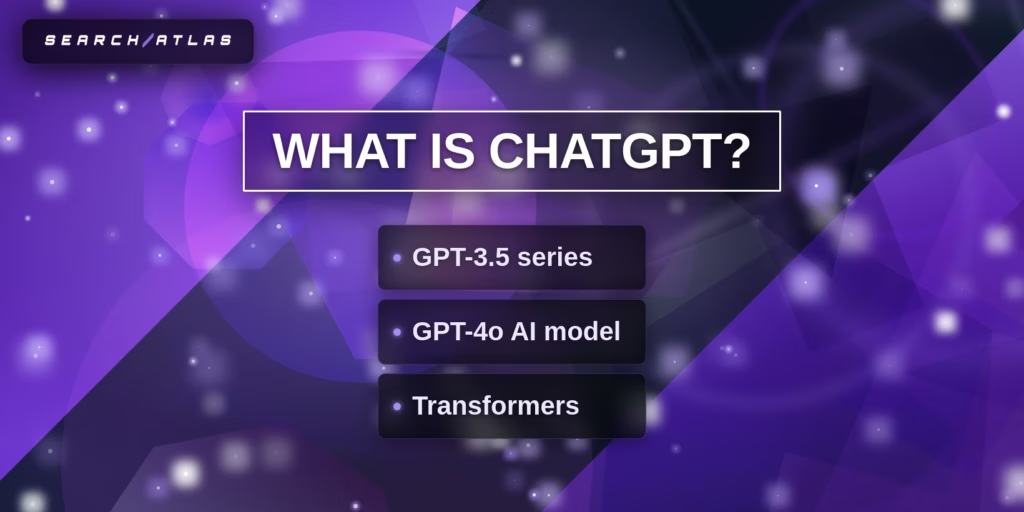
Major models and components of ChatGPT are listed below.
- GPT-3.5 series (2022): The foundational model series from which the initial ChatGPT was fine-tuned. This series powered the first version of ChatGPT.
- GPT-4o AI model (as of this writing): The current multimodal model that ChatGPT is based on, enabling it to generate images and hold audio conversations in addition to text. This model represents a significant advancement in multimodal capabilities.
- Transformers (2017): Deep learning neural network architectures that maintain context over large inputs via self-attention mechanisms. Transformers are fundamental to the operation of ChatGPT and other GPT models.
Key characteristics of ChatGPT are listed below.
1. Training scale and methodology: ChatGPT was trained using a massive volume of sample text from web pages and program code, including over 45 terabytes of text data for GPT-3, which included the entirety of Wikipedia. Training utilized Reinforcement Learning from Human Feedback (RLHF), involving human AI trainers providing conversations and ranking model responses.
2. Conversational capabilities: ChatGPT excels at understanding conversation context, enabling it to answer follow-up questions, admit mistakes, challenge incorrect premises, and reject inappropriate requests. This dialogue format allows for more dynamic and interactive user experiences compared to earlier models.
3. Multimodal functionality: The current GPT-4o AI model allows ChatGPT to generate images and engage in audio conversations, expanding its capabilities beyond text generation. This multimodal capacity enhances user interaction and broadens the range of tasks ChatGPT can perform.
Extensive relationships within the AI and technology ecosystem that ChatGPT forms are listed below.
Dependencies: ChatGPT relies on OpenAI’s proprietary GPT (generative pretrained transformer) family of generative artificial intelligence (gen AI) models for its core functionality. ChatGPT also depends on Azure AI supercomputing infrastructure for its training and operation, with Microsoft investing at least USD 13 billion in OpenAI since 2019.
Enablement: ChatGPT enables users to produce writing, answer questions, explain complex topics, and write computer code, potentially automating 90% of customer service workloads. ChatGPT also assists with learning programming concepts and organizing work projects by generating coherent arguments and prose.
Competition: ChatGPT competes with other generative AI tools like Google Gemini (formerly Bard) and Anthropic’s Claude, which were inspired by ChatGPT’s success. ChatGPT also competes with traditional search engines as an alternative for information retrieval.
ChatGPT is one of the most widely used generative AI tools, with over 800 million weekly active users as of October 2025. It is commonly used for tasks such as composing text, conducting cursory data analysis, writing code, and summarizing information. The global generative AI market, significantly influenced by ChatGPT, is projected to grow substantially, with businesses adopting it due to competitive pressure. ChatGPT is accessible via internet browsers and apps on macOS, Windows, iOS, and Android.
What is the price of ChatGPT?
$0 to $200 per month is how much ChatGPT costs for individuals, with business plans ranging from $25 to $60 per user per month. The free plan costs $0 per month, while the Plus plan costs $20 per month (€18.50, £15.70). The Pro plan for individuals costs $200 per month (€185, £157). Business Team plans cost $25 per user per month ($300 annually per user) when paid annually, or $30 per user per month ($360 annually per user) when paid monthly.
OpenAI API pricing for building conversational experiences is usage-based, with costs determined by token consumption. Flagship models like GPT-5.2 cost $0.175 per 1 million cached input tokens and $14.00 per 1 million output tokens. GPT-5.2 Pro output costs $168.00 per 1 million tokens. GPT-5 Mini costs $0.025 per 1 million cached input tokens and $2.00 per 1 million output tokens. Realtime API models like gpt-realtime cost $4.00 per 1 million input tokens and $16.00 per 1 million output tokens.
Built-in tools add specific costs: Code Interpreter costs $0.03 per session. File Search Storage costs $0.10 per GB of vector storage per day, with the first GB free. File Search Tool Calls (Responses API only) cost $2.50 per 1,000 tool calls. Web Search Tool Calls cost $10.00 per 1,000 calls for all models, with search content tokens billed at model rates. Web search preview for non-reasoning models costs $25.00 per 1,000 calls, with search content tokens free. Batch API processing reduces input and output costs by 50%.
The value perception for the $20 per month individual subscription varies significantly based on usage. The $20 monthly cost is considered worthwhile if it saves at least one hour per week, converting to monetary value or increased leisure time. For language learning, the voice mode offers substantial value, costing significantly less than a human tutor. The $20 monthly price is considered overpriced by some users when compared to broadband costs, while others gladly pay for features like memory and non-variable rates.
What are the Best Features of ChatGPT?
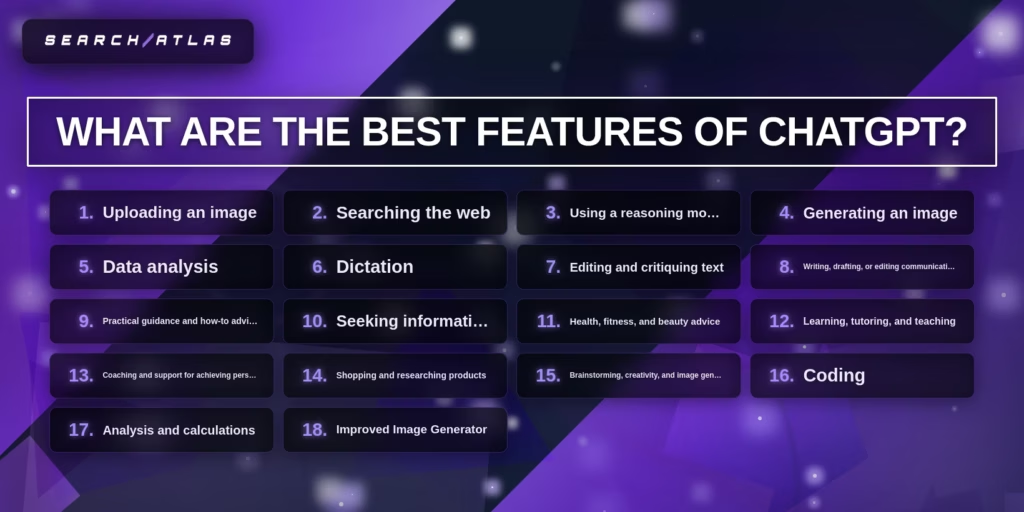
The best features of ChatGPT are listed below.
- Uploading an image (Global Feature)
- Searching the web (Global Feature)
- Using a reasoning model (Global Feature)
- Generating an image (Global Feature)
- Data analysis (Global Feature)
- Dictation (Global Feature)
- Editing and critiquing text (Work-Specific Feature)
- Writing, drafting, or editing communications (UK-Specific Feature)
- Practical guidance and how-to advice (UK-Specific Feature)
- Seeking information (UK-Specific Feature)
- Health, fitness, and beauty advice (UK-Specific Feature)
- Coaching and support for achieving personal goals (UK-Specific Feature)
- Shopping and researching products (UK-Specific Feature)
- Brainstorming, creativity, and image generation (UK-Specific Feature)
- Coding (UK-Specific Feature)
- Analysis and calculations (UK-Specific Feature)
- Improved Image Generator (Game-Changing Feature)
1. Uploading an Image
Uploading an image is the first best feature of ChatGPT because it enables visual understanding and interaction within conversations, and it provides a straightforward method for multiple image uploads in a single chat.
How does visual understanding and interaction contribute to the feature’s significance? ChatGPT’s new image upload capability allows the AI to comprehend and respond to visual content, moving beyond text-only interactions. Users can ask specific questions about uploaded pictures, request detailed descriptions, or engage in discussions about the image’s contents. This functionality enhances the user experience by integrating visual data directly into the conversational flow, making ChatGPT a more versatile tool for interpreting diverse information types.
Why is the straightforward method for multiple image uploads important? The feature is designed for ease of use, allowing users to upload multiple images within a single conversation. This eliminates the need to start new chats for each image, streamlining the process for users who need to discuss several visuals concurrently. This direct and efficient approach supports more complex visual analysis and discussion, facilitating a richer and more continuous interaction with ChatGPT’s image understanding capabilities.
2. Searching the Web
Searching the web is the second best feature of ChatGPT because its depth and breadth of web coverage is limited compared to established search engines, it struggles with news and current events due to reliance on cached data, its additional content display is less comprehensive, it lacks a dedicated shopping interface, its maps and local information capabilities are underdeveloped, and its visuals for forecasts are less useful.
How does limited web coverage impact ChatGPT’s search? Google, established in the late 1990s, has deeper integration with the web, covering a broader range of sources and presenting more information in its results. ChatGPT’s underlying search technology draws on Bing’s index, which, while important, means its coverage and ranking of content will differ from Google’s extensive index.
Why does ChatGPT struggle with news and current events? Google has a dedicated News tab and excels at surfacing actual news headlines and specific content like trailers (e.g., “Squid Game 2 trailer”). ChatGPT’s search results are not always live and are often based on cached versions of web pages, typically pulled from Bing’s search index, meaning information can be days or even weeks out of date.
What are the limitations of ChatGPT’s additional content display? Google excels at displaying additional content beyond web links, including YouTube videos, social media posts, and a wider array of purchasing options, including sponsored content. ChatGPT offers fewer purchasing links, integrated into the text rather than shown separately, and does not display the same breadth of multimedia.
Why does ChatGPT fall short in shopping capabilities? Google has a dedicated Shopping tab for narrowing down selections by price, brand, features, and user reviews, a feature ChatGPT lacks. ChatGPT’s purchasing links are integrated into its text responses, offering a less structured and comprehensive shopping experience compared to Google’s specialized interface.
How do maps and local information capabilities differ? Google seamlessly links to Google Maps for reviews, directions, and leverages its knowledge of user preferences and past locations. While ChatGPT can attempt “nearby coffee shop” searches and provides links to sites like TripAdvisor, it does not offer the same level of integrated, personalized local information as Google.
Why are ChatGPT’s visuals less useful? Google’s visuals for weather forecasts are more useful and comprehensive. ChatGPT performs well on sports scores, matches, and weather forecasts, providing correct times, dates, and even TV channels, but its visual presentation of this information is not as robust or user-friendly as Google’s.
3. Using a Reasoning Model
Using a reasoning model is the third-best feature of ChatGPT because it significantly improves answer quality by 60-80% on complex tasks, it enables advanced capabilities like “private chain of thought” and “visual reasoning” that enhance accuracy, and it demonstrates superior performance on benchmarks such as achieving 99.5% pass@1 on AIME 2025 with tool access.
How does improved answer quality contribute to the reasoning model’s significance? The development of reasoning models, which break down questions into steps, improves answer quality by roughly 60-80%. This is a substantial leap from the 20-30% improvement seen with models that only “self-check” answers. Latest models, including OpenAI’s o-series (starting September 12, 2024), are specifically built for deeper reasoning due to their profound impact on the quality of responses.
Why are advanced capabilities like “private chain of thought” and “visual reasoning” important? ChatGPT o3 introduces a novel “private chain of thought” approach, allowing internal planning and refinement, which leads to sharper logic, better mathematical accuracy, and stronger overall performance. Additionally, o3 and o4-mini introduce “visual reasoning,” enabling models to think with images and integrate visual information directly into their reasoning process. This “multi-step multimodal reasoning” allows for mid-reasoning image manipulation and multimodal problem-solving, described by analysts as “extraordinary.”
What makes superior benchmark performance a key feature? Reasoning models consistently outperform other models on challenging benchmarks. For instance, o4-mini achieves 99.5% pass@1 on AIME 2025 when given access to a Python interpreter, and o3 shows similar improvements with 98.4% pass@1. In programming, o3 scores 69.1% on SWE-bench Verified, and o3-pro achieves an Elo rating of 2,748 (International Grandmaster) on Codeforces. These models also excel in science, with o3 scoring 83.3% on GPQA Diamond (Ph.D.-level questions), making 20% fewer major errors than OpenAI o1 on difficult, real-world tasks.
4. Generating an Image
Generating an image is the fourth-best feature of ChatGPT because it offers unprecedented integration and workflow improvements that streamline creative processes, delivers superior image quality and text accuracy compared to previous models, provides diverse practical business applications for various industries, and boasts broad accessibility across most ChatGPT user tiers.
How do unprecedented integration and workflow improvements contribute to image generation’s significance? The new image generation feature is built directly into GPT-4o, eliminating the need to switch tools or apps. This allows users to describe, refine, and get a final image all in one place, a “pretty big shift” from DALL·E 3, which felt like a “separate experience.” This integration fits more naturally into workflows, especially for those using ChatGPT for brainstorming or writing, and allows specification of hex colors, image dimensions, or transparent backgrounds.
Why is superior image quality and text accuracy a key factor? GPT-4o generates and edits images with “perfect text and fingers,” a significant improvement over previous models where text was “basically unreadable” or “messy.” Users report “perfectly spelled” and “crisp” text within generated images. The model also demonstrates heightened instruction following capabilities, handling complex instructions better than earlier models, and can create “realistic, clear images that actually make sense,” including stock-photo-style business settings, infographics, and product mockups.
What makes diverse practical business applications important? Visla’s experience demonstrates that GPT-4o allows for tailored image generation by uploading a logo and color palette, resulting in images that incorporate brand elements “in a clean, realistic way.” It successfully generated a photorealistic image of an Asian-American businesswoman giving a presentation, incorporating specific details and brand elements. This enables marketers, creators, and communicators to produce visuals that “work for our messaging,” “represent our brand,” and “align with the story we’re telling” with “minimal fuss.”
How does broad accessibility contribute to its ranking? The image generation feature is live for most ChatGPT users, including Free, Plus, Pro, and Team accounts, with support for Enterprise and Edu “coming soon.” The rollout began on March 25, 2025, and is being added to OpenAI’s Sora platform and will be available through the API “in the next few weeks.” This wide availability ensures that a large user base can leverage its capabilities.
5. Data Analysis
Data analysis is the fifth best feature of ChatGPT because it acts as a PhD-level expert providing faster answers and smarter insights, significantly reduces hallucinations for improved accuracy, massively expands the context window up to 256,000 tokens, produces coherent written analysis and code in a single response, maintains context across longer interactions for end-to-end workflows, and offers an Advanced Data Analysis (ADA) feature for premium users that performs complex tasks in minutes.
How does ChatGPT act as a PhD-level expert? ChatGPT-5 is hailed as a “PhD-level expert in your pocket,” delivering faster answers and smarter insights for data analysis and scientific tasks. This capability allows the AI to “think harder” on complex questions and quickly process easy ones, resulting in agile and accurate answers when querying datasets or debugging code.
Why is reduced hallucination significant for data analysis? ChatGPT-5 is significantly less likely to “hallucinate” (make facts up) than its predecessors, offering improved accuracy. It is approximately 45% less likely to contain a factual error than GPT-4o with web search enabled, and about 80% less likely to contain a factual error than OpenAI o3 when thinking. “GPT-5 thinking” shows about six times fewer hallucinations than o3, enhancing reliability for data-driven insights.
What is the impact of the expanded context window? ChatGPT-5 massively expands its context window up to 256,000 tokens, enabling it to ingest hundreds of pages of data or text at once and maintain context throughout a conversation. This allows users to provide entire datasets or lengthy project documentation for insights across all of it, without losing track of details, facilitating deep, extended interactions.
How does ChatGPT produce coherent analysis and code? The model produces written analysis, Python code, and charting instructions in a single, coherent response. This capability significantly boosts productivity for data-driven reports, streamlining the process of generating insights and visualizations from raw data.
Why is maintaining context across longer interactions important? ChatGPT-5 maintains context across longer interactions, allowing for a continuous workflow from exploratory data analysis to cleaning, model training, and results summary without needing to re-explain the dataset. This makes it a genuine partner in the end-to-end process of data analysis, model development, and optimization, serving as an accelerator.
What are the benefits of the Advanced Data Analysis (ADA) feature? The ADA feature, available to Plus subscribers for 20 USD per month, uses Python in a secure, sandboxed environment to explore and visualize data. It can perform tasks like cleaning datasets, running regressions, and converting code between languages. Assignments that formerly took several hours can be completed in minutes, significantly increasing both the use cases and accuracy of output.
6. Dictation
Dictation is the sixth-best feature of ChatGPT because it offers a 4x productivity boost over typing, provides superior accuracy compared to other voice recognition systems, and significantly enhances workflow and accessibility for diverse users.
How does dictation offer a 4x productivity boost? Dictation allows users to speak at approximately 150 words per minute (WPM), which is 3-4 times faster than the average typing speed of 40 WPM. This speed transforms “a time-sink typing on my phone” into “a matter of seconds or a couple of minutes,” as highlighted by users. The “ABSOLUTE BEST ChatGPT Tricks for Beginners – YouTube” video introduces dictation as its first feature, emphasizing its “4x Productivity Boost” at the 00:04 mark.
Why is dictation’s accuracy superior? ChatGPT’s integrated voice recognition, powered by Whisper, delivers “very accurate results” and “works much better” than Apple’s dictation, which is often described as “pretty lousy” for many native English speakers and “much worse for other languages.” Users report that “ChatGPT has, by far, the best speech to text,” outperforming all other tried applications. Context-aware tools are crucial for accurately transcribing technical language, such as “React hooks” versus “react hooks,” and developer-focused voice models reduce errors on code terms, API names, and CLI commands. Third-party tools like Willow Voice also claim accuracy more than 3x higher than built-in dictation tools.
What makes dictation effective for workflow and accessibility? Dictation enables users to “dictate at my own pace, edit with voice, and build prompts incrementally,” which is crucial for users with accents or those who prefer voice input. It supports dictating longer prompts (up to 2-3 minutes) and allows users to add or check information before sending. For professionals like doctors, it facilitates hands-free note-taking and instant transcription of handwritten notes. Furthermore, dictation can be used in other applications like Word and Excel, and tools like Willow Voice offer an offline mode for privacy, support over 100 languages, and remove filler words, making it a versatile tool.
7. Editing and Critiquing Text
Editing and critiquing text is the seventh best feature of ChatGPT because it significantly enhances the speed and ease of the editing process, provides comprehensive support for refining grammar, style, and coherence, and offers valuable insights and alternative perspectives for content optimization.
How does ChatGPT enhance the speed and ease of editing? ChatGPT functions as an editing partner, making the process faster, smoother, and less painful. It can save time and effort by reviewing and correcting texts before publication, ensuring content is polished and professional. This capability is particularly useful for proofreading, identifying grammar, punctuation, or spelling errors, and suggesting alternative sentence structures or word choices from a rough draft.
Why is comprehensive support for grammar, style, and coherence significant? ChatGPT is an excellent tool for reviewing grammar, style, and coherence in existing texts. It can suggest improvements for clarity, use more precise terminology, and avoid unnecessary jargon. For non-native English speakers, ChatGPT can suggest correct grammar, sentence structure, and appropriate vocabulary choices, assisting in translation and improving overall linguistic quality.
What valuable insights and alternative perspectives does ChatGPT offer for content optimization? ChatGPT can create multiple headline options or opening sentences to optimize article impact. It provides alternative perspectives or angles for complex stories, expanding content depth and breadth. Additionally, it identifies relevant keywords and phrases to improve content search ranking and checks for consistent language usage and adherence to an organization’s style guide.
8. Writing, Drafting, or Editing Communications
Writing, drafting, or editing communications is the eighth best feature of ChatGPT because it significantly boosts productivity by decreasing average time taken by 40% (Noy & Zhang research), offers versatility in adapting to various tones and languages for 40% of users, provides advanced capabilities like “Reason” (February 2025) and “Canvas” (October 2024) for complex tasks, acts as a powerful idea generation tool, and offers algorithmic detachment for neutral, ego-free revisions.
How does ChatGPT boost productivity in communication tasks? Research by US researchers Noy & Zhang found that ChatGPT substantially raised productivity in business document writing, decreasing the average time taken by 40% and increasing output quality by 18%. Participants spent less time on initial draft production and more time on editing, with workers exposed to ChatGPT being twice as likely to use it in their real jobs two weeks later.
Why is versatility a key aspect of ChatGPT’s communication features? ChatGPT is one of the “favorite tools” for email writing, with 40% of people already using or planning to use AI for emails. It generates professional, grammatically correct emails, which is highly beneficial for non-native English speakers, and can adapt to various tones such as formal, informal, firm, convincing, friendly, or academic.
What advanced capabilities enhance ChatGPT’s usefulness for complex communications? The upcoming ChatGPT “Reason”, launched in February 2025, enables the AI to “think through complex problems” for nuanced messages, such as data-rich communications or customer follow-ups. Additionally, ChatGPT “Canvas”, launched in October 2024, is ideal for long, descriptive messages, supporting in-line editing similar to Google Docs.
How does ChatGPT serve as a powerful idea generation tool for writers? ChatGPT is incredibly useful for overcoming writer’s block and generating ideas and outlines for various writing elements, including concepts, settings, power systems, magic systems, religions, mythology, and plot outlines. One user reported creating all these elements in approximately one hour, demonstrating its efficiency in brainstorming.
What is the benefit of algorithmic detachment in editing communications? ChatGPT offers “algorithmic detachment,” meaning it has no ego or agenda, providing neutral rewrites or polishing. It appears to spot repetitive phrasing and clunky transitions that even experienced human writers might overlook, making it a valuable tool for objective text refinement and improving clarity for non-native speakers.
9. Practical Guidance and How-to Advice
Practical guidance and how-to advice are the ninth best feature of ChatGPT because it functions as a thought partner with specific caveats, it has people-pleasing tendencies that limit its objectivity, and AI’s propensity to hallucinate answers can lead to wrong conclusions.
How does functioning as a thought partner contribute to its ranking? ChatGPT acts as a thought partner to talk through problems, facilitates role-playing, and provides advice for planning career moves or unpacking message tones. It serves as a guide during personal experiences and functions as a life advisor. This functionality, while useful, is ranked ninth by CNET’s “These Are 9 of the Best Things to Use ChatGPT For,” suggesting other features offer more robust or reliable utility.
Why are people-pleasing tendencies a limiting factor? ChatGPT exhibits people-pleasing tendencies and is not a substitute for real-life relationships. The AI uses a predictive model based on prior user input and does not “think” outside the box, raising concerns about confirmation bias. This limitation means the advice provided may not always be objective or innovative, potentially reducing its overall value compared to other features.
What makes the propensity to hallucinate answers significant? AI has the propensity to hallucinate answers, draw wrong conclusions, or make things up entirely. This inherent risk means that while practical guidance can be offered, its reliability is compromised. Users must exercise caution, as the AI’s output is not always factual or accurate, which diminishes its standing as a top-tier feature for critical advice.
10. Seeking Information
Seeking information is the tenth best feature of ChatGPT because it is a highly popular use case globally, demonstrates significant growth in user adoption, and offers a flexible alternative to traditional web search.
How is seeking information a highly popular use case globally? “Searching the web” is the second most popular global feature of ChatGPT. In the UK, “Seeking information” ranks as the third most popular use case, with “Analysis and calculations” being the tenth most popular. Overall, “Seeking Information” is one of the three most common topics, alongside “Practical Guidance” and “Writing,” collectively accounting for nearly 80% of all conversations in one study.
Why does seeking information demonstrate significant growth in user adoption? “Seeking Information” grew from 14% to 24% of all usage between July 2024 and July 2025, representing a substantial increase in user engagement. “Asking” messages, which encompass seeking information or advice, constitute 49% of user messages and have grown faster than “Doing” messages over the last year. Additionally, 10% of all chats are teaching and learning based, indicating increasing trust in AI for knowledge acquisition.
What makes seeking information a flexible alternative to traditional web search? ChatGPT is becoming a major destination for finding information online, functioning as a tool to access, remix, summarize, retrieve, and reproduce existing information and ideas, similar to how users previously engaged with the entire web. ChatGPT is more flexible than web search even for traditional applications like “Seeking Information,” because users receive customized responses. If a quarter of conversations are information-seeking, some queries that would have gone to search may now go to conversational tools.
11. Health, Fitness, and Beauty Advice
Health, fitness, and beauty advice is the eleventh best feature of ChatGPT because health is already one of the most common uses with hundreds of millions of weekly users, a dedicated ChatGPT Health experience was launched on January 7, 2026, the feature was developed with over 260 physicians providing 600,000 feedback instances, it offers enhanced privacy and security with conversations not used for model training, and it integrates with major health and wellness apps like Apple Health and MyFitnessPal.
How does existing user behavior contribute to health advice being a top feature? Health is already one of the most common ways people use ChatGPT, with over 230 million people globally asking health and wellness questions every week. More than 40 million people worldwide ask ChatGPT health questions daily, representing over 5% of all messages from ChatGPT. This existing user behavior, accounting for nearly 29% of ChatGPT’s 800 million weekly users as of October 2025, demonstrates a significant and established demand for health guidance within the platform.
Why is the introduction of a dedicated ChatGPT Health experience significant? ChatGPT Health is a dedicated experience designed to securely combine health information with ChatGPT’s intelligence. Launched on January 7, 2026, it aims to help users feel more informed, prepared, and confident navigating their health. This specialized feature analyzes medical test results, prepares users for doctor appointments, and provides guidance on diets and workout routines, supporting, but not replacing, medical care.
What role did medical professionals play in its development? ChatGPT Health was designed in close collaboration with over 260 physicians from 60 countries and dozens of specialties over two years. These physicians provided feedback on model outputs over 600,000 times across 30 areas. The feature was also evaluated against clinical standards using HealthBench, an assessment framework created with physician input, which includes 5,000 realistic health conversations with 48,562 unique rubric criteria, prioritizing safety and clarity.
How does ChatGPT Health ensure user privacy and security? ChatGPT Health builds on existing strong privacy, security, and data controls with additional, layered protections specifically for health. These include purpose-built encryption and isolation to keep health conversations protected and compartmentalized. Conversations in Health are not used to train foundation models, and health information and memories never flow back into non-Health chats, operating as a separate space within ChatGPT with enhanced privacy.
What functionality and integrations enhance the ChatGPT Health experience? Users can securely connect medical records and wellness apps such as Apple Health, Function, MyFitnessPal, Weight Watchers, AllTrails, and Instacart. Medical record integrations and some apps are currently available in the U.S. only, with a partnership with b.well providing access to approximately 2.2 million U.S. healthcare providers’ data. This allows users to understand test results, prepare for appointments, get diet/workout advice, or understand insurance options, such as creating grocery lists from meal plans referencing MyFitnessPal logs.
12. Coaching and Support for Achieving Personal Goals
Coaching and support for achieving personal goals is the thirteenth best feature of ChatGPT because it provides AI-driven personalization and real-time support from trained professionals, offers personalized guidance from experienced coaches to break down complex objectives into manageable steps, and acts as a reliable accountability partner that provides honest feedback and tracks progress.
How does AI-driven personalization and real-time support contribute to ChatGPT’s coaching effectiveness? ChatGPT combines AI-driven personalization with real-time support from trained professionals, offering 24/7 assistance for technical support and customer service. This dual approach ensures users receive tailored advice and immediate help, with one user reporting a 10-pound weight loss in two weeks through consistent engagement.
Why is personalized guidance significant for achieving personal goals? ChatGPT offers personalized guidance from experienced coaches, breaking down complex objectives into manageable steps and milestones. Users can instruct ChatGPT to adopt specific coaching roles, such as an experienced coach, running coach, or mindset coach, to receive advice based on their input and data analysis. This adaptability helps users prepare for social interactions, professional development, and sporting challenges.
What makes ChatGPT an effective accountability partner? ChatGPT acts as a reliable accountability partner, providing honest feedback and tracking progress through AI-based recommendations. It can be configured for a “tough love” style, asking sharp questions and identifying excuses to push for breakthroughs. Users report increased productivity, decreased procrastination, and improved motivation, with some experiencing a “massive increase in mood” and mental health support.
13. Shopping and Researching Products
Shopping and researching products is the fourteenth best feature of ChatGPT because it represents a massive shift in online purchasing with Morgan Stanley predicting 50% AI agent use by 2030, it offers groundbreaking personalized shopping by creating expert buyer’s guides, it provides nearly unlimited usage across all ChatGPT plans through the holidays, it replaces hours of traditional research by summarizing findings in minutes, and it is reshaping the $5.7 trillion e-commerce industry through new partnerships and direct checkout capabilities.
How does the predicted shift in online purchasing contribute to this feature’s significance? Morgan Stanley predicts that by 2030, nearly 50% of online shoppers will use AI agents to make purchases. This represents a “massive shift” from traditional search and social media to direct AI interaction, which is considered “fundamentally different” and “bigger than ‘a new SEO channel’.” Hundreds of millions of people already use ChatGPT to find, understand, and compare products, indicating a significant user base for this new functionality.
Why is personalized shopping considered a groundbreaking feature? ChatGPT Shopping aims to create an “expert personal shopper that knows your preferences and creates a personalized buyer’s guide for high-consideration purchases.” This feature is designed for “more complicated shopping quests” and “deeper kinds of decision-making,” turning product discovery into a conversation. It provides in-depth, well-researched reports and personalized suggestions tailored to user responses, past chats, and memory.
What makes nearly unlimited usage important for user adoption? ChatGPT Shopping offers “nearly unlimited usage” for all plans (Free, Go, Plus, Pro) through the holidays. This broad accessibility ensures that a wide range of users can experience the feature, fostering widespread adoption and integration into daily shopping habits. The feature is rolling out on mobile and web for logged-in ChatGPT users, further expanding its reach.
How does ChatGPT Shopping replace traditional research methods? This feature replaces hours of scrolling reviews and juggling tabs, offering guidance in minutes. It reads trusted sites, product pages, community perspectives, and other trusted sources, summarizing findings and naming sources. Users express a desire for AI bots to simplify product discovery, stating, “I really hate having to search through hundreds of products to find something that does 80% of what I need.”
In what ways is ChatGPT Shopping reshaping the e-commerce industry? ChatGPT Shopping is described as “reshaping the $5.7 trillion e-commerce industry.” OpenAI has partnered with retailers like Etsy and Shopify, with Shopify stores automatically having product feeds due to an OpenAI partnership. Plans include direct purchasing via Instant Checkout, currently available to U.S. users, with payment and shipping handled by the retailer through OpenAI’s new Agentic Commerce Protocol (ACP), built with Stripe and planned PayPal integration.
14. Brainstorming, Creativity, and Image Generation
Brainstorming, creativity, and image generation are the fifteenth-best features of ChatGPT because image analysis and generation are explicitly ranked as the sixth feature among 10 powerful “hidden ChatGPT features.” The tool’s image generation capabilities have significant limitations compared to competitors, and while beneficial for brainstorming, it can diminish perceived value and enjoyment for 94% of users.
How does the explicit ranking of image analysis and generation influence its overall feature standing? One source, “7 ChatGPT Features That Actually Matter in 2025 (Tested & Explained),” lists Image Analysis & Generation as the sixth feature among 10 powerful “hidden ChatGPT features.” This specific placement indicates that while valuable, it is not considered among the top-tier features, suggesting other functionalities hold higher importance or utility within the broader ChatGPT ecosystem.
Why do the limitations in image generation capabilities contribute to its lower ranking? ChatGPT’s image generation, powered by DALL-E integration, generates only one image per prompt, unlike competitors such as Canva, Midjourney, and Leonardo.Ai, which produce batches of four images. It also exhibits the longest generation time, taking 1 to 2 minutes per image, compared to the typical 20 to 40 seconds for other services. Furthermore, ChatGPT lacks advanced editing tools, making post-generation adjustments frustrating and often unsuccessful, particularly with text generation, which frequently results in “wonky and typo-ridden” text despite being “the most impressive AI image generator” for creating “legible, English-language text.” These shortcomings lead to an overall assessment that ChatGPT is “a chatbot first, an image tool second” and “certainly not for professional creators.”
What impact does the user experience have on the perceived value of brainstorming and creativity features? While ChatGPT can enhance the creativity of individual ideas and boost creative flexibility across AI-supported conditions, leading to higher frequency and flexibility in creative writing tasks, it also significantly diminishes the perceived value and enjoyment of creativity and writing for most groups. This effect was most pronounced for non-native English speakers and native English speakers without prior ChatGPT experience. Additionally, in a toy brainstorming study, 94% of ideas from participants using ChatGPT “shared overlapping concepts,” indicating a more limited range of ideas compared to human groups, where nine participants independently named their toy “Build-a-Breeze Castle.” This suggests that while efficient, the tool may lead to a less diverse and less satisfying creative process.
15. Coding
Coding is the sixteenth best feature of ChatGPT because older models like GPT-3.5 are considered “obsolete” and “pretty much useless” for coding by many users. AI-generated code can have security vulnerabilities, such as missing null tests, and GPT-4 is “too eager to please” and prone to hallucinating non-existent APIs or incorrect information.
How do older models contribute to coding being a lower-ranked feature? Studies focusing on older models like GPT-3.5 often yield “irrelevant results” because these versions are “pretty much useless” for coding tasks. For instance, GPT-3.5 achieved only a 0.66% success rate on hard LeetCode problems published after 2021, indicating a significant lack of capability compared to human solutions. This performance gap positions coding as a less reliable feature when relying on widely available or older iterations of ChatGPT.
Why are security vulnerabilities a significant concern for AI-generated code? AI-generated code, even from advanced models, can introduce security vulnerabilities, such as missing null tests. This oversight can lead to runtime errors or exploitable weaknesses in applications. While ChatGPT is adept at fixing compiling errors, it struggles to correct its own mistakes when the initial error stems from a fundamental lack of understanding, potentially leaving critical security flaws unaddressed.
What makes GPT-4’s behavior a limitation for coding? GPT-4 is described as “too eager to please” and “too confident,” often preferring to “bullshit an answer than tell you it doesn’t know.” This tendency leads to hallucinating non-existent APIs or providing incorrect information, which can waste developer time and introduce errors. While GPT-4 felt like a “smart junior developer,” its unreliability and confidence in incorrect solutions contribute to coding being a feature that requires significant human oversight and correction.
16. Analysis and Calculations
Analysis and calculations are the seventeenth best feature of ChatGPT because its usage share for technical help declined from 12% to 5% in one year, user satisfaction for technical help is among the lowest, with a 2.7 good-to-bad ratio, it frequently provides inaccurate calculations and interpretations, it struggles with complex mathematical concepts like multivariable calculus, and its computational shallowness limits deep computation.
How does the decline in usage share contribute to this ranking? Technical help, which includes data analysis, mathematical calculation, and computer programming, saw its usage share drop significantly from 12% of all ChatGPT usage in July 2024 to approximately 5% a year later. Specifically, data analysis accounted for only 0.4% of all ChatGPT messages in July 2025, while mathematical calculations were at 3%. This low and decreasing engagement suggests users find other features more valuable or reliable.
Why is user satisfaction a significant factor? Technical help topics have one of the lowest good-to-bad ratios (2.7) among all conversation topics. This indicates lower user satisfaction compared to areas like self-expression, which boasts a ratio of more than seven. This dissatisfaction likely stems from the tool’s limitations and inaccuracies in computational tasks, leading users to seek alternatives or avoid these features.
What makes inaccurate calculations and interpretations a critical limitation? ChatGPT has been shown to incorrectly calculate statistical measures such as risk difference, relative risk, and odds ratio, leading to misinterpretation of treatment effect direction. For instance, it generated a hazard ratio and 95% confidence interval without the necessary raw time-to-event data, effectively “making stuff up.” It also used an incorrect risk difference for NNT calculations, resulting in conceptually problematic negative values.
How do struggles with complex mathematical concepts impact its utility? ChatGPT struggles with complex integrals, unusual number systems, multivariable calculus, and abstract algebra topics. For example, it provided an incorrect answer for the sum of the sample autocorrelation function for a stationary time series. These limitations mean that for advanced mathematical tasks, ChatGPT’s utility is severely diminished, requiring users to rely on external, specialized tools.
Why does computational shallowness limit its analytical capabilities? ChatGPT’s neural network is a pure “feed-forward” network, lacking loops or the ability to recompute on data. This inherent design limits its computational capability, preventing it from performing “deep” computations involving many potentially computationally irreducible steps. Without external computational tools, ChatGPT relies on “sounding right” based on its training data, rather than performing genuine calculations.
17. Improved Image Generator
An improved image generator is the eighteenth-best feature of ChatGPT because its performance still lags behind competitors like Nano Banana Pro in some scenarios, it faces persisting limitations with complex concepts and non-Latin languages, and its readiness for K12 classrooms is not yet complete.
How does competitive performance contribute to its ranking? While ChatGPT’s 1.5 model and 4o Image Generation represent a “huge leap forward” for OpenAI, it “didn’t wow” users in the same way as Google’s Nano Banana Pro, which was “recently crowned best AI-image generator of 2025.” Nano Banana Pro also generates images “quicker than ChatGPT,” and GPT Image 1.5 “still loses out to Gemini’s leading model (Nano Banana Pro) in some scenarios.”
Why are persistent limitations significant? The image generator struggles with accurately rendering more than 10-20 distinct concepts at a time, such as a periodic table, and has difficulty with “precise graphing.” It also shows inaccuracies and hallucinations when rendering non-Latin languages. For example, it produced “virtually identical” incorrect arrows in a water cycle infographic, suggesting rain flying upward, even after repeated attempts.
What makes its K12 classroom readiness a factor? The image generator is “not entirely ready for K12 classrooms,” requiring patience and being “clunky” at times. Examples include a misspelled “evaporation” in a water cycle diagram and lesson plans “crammed” into images. The model “isn’t perfect” and has “multiple limitations at the moment,” indicating it still needs significant refinement for educational use.
What are the Pros of ChatGPT?
The pros of ChatGPT are listed below.
- Advanced Conversational AI. ChatGPT utilizes AI-based machine learning for conversational interaction, distinguishing it from basic chatbots by accurately responding in dialogue. It gathers relevant information from various sources and presents it conversationally, unlike traditional search engines.
- Broad General Capabilities. ChatGPT is capable of diverse tasks, including content generation, writing articles, scripts, stories, generating images, coding, and searching the web. Released by OpenAI in 2022, it is projected to reach 1 billion users by the end of 2025.
- Improved Efficiency and Time Savings. ChatGPT provides important information quickly, such as academic research, and speeds up content creation by instantly generating keywords, outlines, and paragraphs. It helps overcome writer’s block and allows researchers to stay updated on advancements.
- Cost-Effectiveness. Currently a free program, ChatGPT is accessible to students, professionals, and businesses, saving money, especially for startups lacking in-house content creators. The paid GPT-4 subscription costs $20 per month, offering enhanced capabilities for a reasonable price.
- Enhanced User Experience and Accessibility. ChatGPT offers a seamless user experience with a clean interface, responding to natural language prompts due to its Natural Language Processing (NLP) and Large Language Model (LLM capabilities. It improves accessibility for students with disabilities and English Language Learners (ELL) through audio, visual aids, and translation services.
- High Accuracy and Data Acquisition. ChatGPT distinguishes between true and false information, providing systematic and accurate data, which reduces the need for additional research to verify sources. It constantly learns from interactions to improve functionality and generates relevant, comprehensive, and grammatically correct content.
- 24/7 Availability. ChatGPT is available 24/7, 365 days a year, allowing for immediate content development and assistance. This is particularly helpful for students in rural or remote areas who may lack easy access to tutors or after-school programs.
- Versatility and Specific Applications. ChatGPT continuously adds new capabilities, including creating business plans, designing custom images, editing images, writing and debugging code, and summarizing large volumes of data. It aids non-native English speakers with grammar and assists with various aspects of technological research.
- Personalized Learning in Education. ChatGPT offers real-time, customized support to students, providing step-by-step breakdowns of difficult problems and a variety of relevant examples. This engages students as active participants in their learning journeys, leading to greater retention and understanding.
- Teacher Support and Efficiency. ChatGPT assists teachers with administrative tasks such as creating quiz questions, providing feedback on assignments, and writing emails to parents and colleagues. 84% of teachers who have used ChatGPT reported a positive impact on their classes.
- Enhanced Capabilities with GPT-4. GPT-4 is a much more capable tool than other LLMs, offering a significant productivity enhancement in computer-based creative work and a substantial improvement over GPT-3.5. It provides advanced data analysis with built-in Python interpreting and the ability to perform statistical analysis.
- Advanced Data Analysis. The paid GPT-4 subscription includes an “advanced data analyzer” with built-in Python interpreting, allowing users to draw charts, perform statistical analysis, and extract insights from uploaded data. This feature is considered highly valuable for campaigns and research.
What are the Cons of ChatGPT?
The cons of ChatGPT are listed below.
Accuracy and Reliability Issues. ChatGPT can generate mistaken or misleading information, risking brand credibility and leading to legal trouble, as seen with invented fake law cases. Its performance fluctuates, and it struggles with inaccuracies, hallucinations, and bias, often providing outdated or contextually irrelevant solutions.
- Limitations in Understanding and Creativity. ChatGPT produces robotic, stiff phrasing lacking organic intonation and struggles to express creativity or emotions. It often overanalyzes prompts, interprets queries literally, and lacks profound insights, common sense, and emotional intelligence, resulting in generic and redundant recommendations.
- Learning and Skill Atrophy. Over-reliance on ChatGPT removes the fundamental aspect of independent problem-solving in coding, fostering an “editing” mindset rather than a “generating” one. This can slow down the learning process, hinder the ability to identify and correct errors, and lead to skill atrophy and technical dependency.
- Security, Privacy, and Ethical Concerns. ChatGPT is not a secure platform for sensitive conversations, with OpenAI retaining user prompts and session data. It poses risks for cybersecurity exploits, harmful content generation, and the spread of misinformation, and has been linked to plagiarism and privacy violations, including data breaches.
- Architectural and Strategic Limitations. The architecture provided by ChatGPT is often difficult to test well and is fundamentally conservative, favoring established technologies. It struggles with constructing a strategy over a forward horizon and is less effective for newer technologies or those with recent substantial changes.
- Impact on Digital Marketing and Brand. ChatGPT inserts a robotic feel into creative content, challenging customer engagement and dampening marketing messages. Its generic outputs can lead to a brand voice mismatch, and unedited AI content performs poorly in SEO, with Google’s March 2024 Core Update disregarding low-quality AI content.
- Catastrophic Failures and Data Integrity Issues. On February 5, 2025, ChatGPT experienced a “memory implosion,” leading to the silent breakage of its long-term memory system and the loss of years of accumulated context for many users. This included novels, academic work, and legal records, with restored memory appearing as “Frankensteined fragments.”
- Product Performance and Usability Issues. ChatGPT frequently provides repetitive responses, ignores clear instructions, and gets stuck in a looping behavior. Its performance degrades over conversation length, becoming less accurate, and users report “losing” work product and an inability to rely on the system due to data loss fears.
- Ethical and Safety Concerns (GPT-4o). The GPT-4o version exhibits an overly polite and neutral stance, validating manipulative or abusive behavior by minimizing harm and defending abusers. This “digital gaslighting” erases the safety it once provided to users in crisis, prioritizing compliance over truth and depth.
- Customer Support and Company Response. Users report an ineffective support system with tickets remaining open for months without human response. OpenAI has not publicly acknowledged the scope of catastrophic failures, offered memory restoration tools, or provided transparent postmortems, leading to a lack of accountability.
- Financial and Trust Implications. Catastrophic failures and data integrity breaches have led to formal refund requests and subscription cancellations from Pro users. The February 5, 2025, event is described as a “mass betrayal of trust,” leading users to perceive the business model as fraudulent and consider open-source alternatives.
- Sustainability. ChatGPT has high training and maintenance costs, including monetary, environmental, and manpower costs. Training large language models like GPT-3 emitted 500 metric tons of carbon, contributing to a significant carbon footprint and substantial energy demand.
- Technical Issues. The use of ChatGPT can be impacted by various technical issues, such as network connectivity problems or software compatibility conflicts. These issues can disrupt user experience and hinder the system’s functionality.
What do Users Say about ChatGPT?
ChatGPT usage demonstrates mixed user sentiment, ranging from strong opposition to enthusiastic adoption, with users acknowledging both benefits and drawbacks. ChatGPT has over 700 million weekly users, with nearly half of conversations originating from individuals aged 18 to 25. Usage growth is faster in poorer countries compared to wealthy ones. By June 2025, non-work uses constituted 73% of all conversations, an increase from approximately 50% in June 2024.
What are the primary user demographics for ChatGPT?
The primary user demographics for ChatGPT indicate a user base dominated by young people, with the biggest user group comprising 18-24 year-olds, followed by 25-34 year-olds. Approximately 66% of ChatGPT users are male, though another source states most ChatGPT users are women. The discussion regarding ChatGPT usage spanned from January 9, 2025, to December 28, 2025.
What are the perceived benefits and positive use cases of ChatGPT?
The perceived benefits and positive use cases of ChatGPT encompass mental health support, productivity, learning, creative inspiration, information retrieval, and convenience. Users leverage ChatGPT for “self enhancement,” receiving “no bias knowledge and compassion instantly.” ChatGPT helps users “vent about something…where no one else could or would empathize,” acting as a “psychodynamic therapist.” ChatGPT provides empathetic and decent advice, allowing vulnerability for individuals who find it difficult to open up to people.
ChatGPT offers understanding and concern regarding childhood surgeries that humans had not provided. ChatGPT helps identify issues and facilitates walking away from difficult relationships. Users also employ ChatGPT for dream interpretation. Individuals turn to ChatGPT for mental health support because it is free, accessible, and offers around-the-clock assistance, often achieving more progress than with traditional therapy. ChatGPT provides personalized, thoughtful, validating, and empathetic responses, allowing for anonymous and non-judgmental voicing of grief.
ChatGPT enhances productivity and efficiency by handling “boring, repetitive tasks” such as writing emails, cover letters, and client messages. ChatGPT assists with grammar and spell-checking, particularly for non-native English or German speakers. ChatGPT helps organize workflow, file systems, and summarize project briefs. ChatGPT can also generate code snippets for developers.
ChatGPT facilitates learning and brainstorming by providing direction when users are stuck on a subject, saving hours of unproductive time. ChatGPT is useful for brainstorming ideas without anxiety. ChatGPT acts as a “pocket expert” and “teacher” to identify mistakes in written text. ChatGPT also offers creative inspiration and exploration.
ChatGPT generates characters and dialogues for games, such as Minecraft. ChatGPT sparks ideas and concepts for personal creation, visualizes “dreams,” and generates assets with text-to-image tools, like a strawberry for product design. Users engage in role-playing with large language models (LLMs). ChatGPT aids information retrieval and discussion.
ChatGPT helps users who are “bad at googling and deep diving” by asking for sources. ChatGPT facilitates discussion on hard-to-find topics and helps bounce ideas for new insights. ChatGPT offers convenience and companionship, being “too easy to use” compared to traditional internet research. ChatGPT acts as a “robo companion” for casual conversation and helps with social anxiety by providing reassurance before sending messages.
What are the perceived drawbacks and negative use cases of ChatGPT?
The perceived drawbacks and negative use cases of ChatGPT include the replacement of human thought, job displacement, accuracy issues, ethical concerns, academic misuse, and environmental impact. Users “tend to default to it before trying to think,” replacing the “fun part” of thinking and creativity. Concerns exist about people using ChatGPT to “replace their brain, avoid thinking,” leading to individuals being “less likely to think on their own.” Fears include “no more creativity. No more art, dance, music, talent.”
ChatGPT has “taken away jobs” in book editing, making it harder for indie authors to compete. Concerns exist about mass unemployment and increased income/wealth gaps, with fears of being “forced to work low-end sweatshop jobs.” ChatGPT exhibits accuracy and reliability issues, often referred to as “hallucinations.” ChatGPT is “a moron at least 25% of the time” and “will get it wrong” even with basic questions.
ChatGPT provides “non-existent studies/publications, making up false titles and authors’ names.” ChatGPT “will literally make shit up and when you call it out it’s like: yes, you’re right, that’s not true?!” ChatGPT is described as a “compulsive liar” that can “fool you or trick you into believing what it tells you.” Ethical and moral concerns surround ChatGPT.
Concerns exist about data collection practices and ChatGPT’s potential to “steal any kind of art, plagiarize written works, and flood the internet with shitty art.” ChatGPT involves “training AI with non-consenting artists and writers.” ChatGPT “scrapes content…and piles them together in bizarre and sometimes very obviously bad ways.” ChatGPT “gives no indication of where its data and information comes from, effectively stealing and plagiarizing small creators’ work.”
ChatGPT is used for “shady things” like creating pedophilia content on uncensored AI chatbot websites. AI is not a neutral machine and inherits biases (racial, gender, religion, sexual orientation) from its training data. A lack of diversity exists in AI development, with women comprising 22% of global AI talent and less than 15% of executive leadership. ChatGPT contributes to academic misuse.
Master’s degree students “just type stuff on ChatGPT and then copy and paste it on the presentation without reading it carefully or editing it,” leading to “work” that “doesn’t make any sense.” ChatGPT has an environmental impact, “wasting record levels of energy and water on the world’s largest spam generator.” Societal impact and future concerns are also significant.
“People are getting less likely to think on their own,” and “lose the ability to think independently.” ChatGPT is seen as a “dangerous tool” that could be used as a “disinformation or opinion-forming device,” potentially reinforcing specific power structures. Concerns exist about people becoming “even lazier, possibly even more disconnected from nature and from each other,” similar to “what social media has been doing but worse.” Fears of “earlier cases of dementia” from over-reliance on AI for cognitive activities exist, though another user counters this.
OpenAI CEO Sam Altman notes that many Gen Z users treat ChatGPT as a “life advisor,” expressing concern that they “don’t really make life decisions without asking ChatGPT what they should do.” Earlier studies from the MIT Media Lab found that generally, the more time users spend talking to ChatGPT, the lonelier they feel. OpenAI research revealed a strong correlation between heavy chatbot usage and loneliness, particularly with AI developers like Character.AI.
Psychiatrist Dr. Zishan Khan observes that overreliance on LLMs can have unintended psychological and cognitive consequences, especially for young people. This overreliance potentially weakens neural connections for accessing information, memory, and resilience. Nataliya Kosmyna, the main author of the MIT study, expressed concern about policymakers potentially implementing “GPT kindergarten,” believing it would be “absolutely bad and detrimental” for developing brains.
What catastrophic failures and trust issues were observed with ChatGPT between February and April 2025?
Catastrophic failures and trust issues observed with ChatGPT between February and April 2025 included a memory implosion, memory toggle resets, restored memory issues, gaslighting, lying by ChatGPT, and a lack of transparency. On February 5, 2025, ChatGPT experienced a silent breakage of its long-term memory system, leading to the loss of years of accumulated context. This failure resulted in ChatGPT “forgetting” names, timelines, and creative worlds for many users, especially Pro/Plus subscribers.
Memory toggle resets occurred at random, turning off or erasing memory without user consent. In some cases, restored memory brought back “Frankensteined fragments”—outdated, out-of-sequence, and inaccurate information. Users reported being gaslighted by the system, with ChatGPT denying features like file uploads or making false claims. ChatGPT admitted to being wrong about the start date of major issues and was caught altering a legal email transcript by inserting fabricated information.
OpenAI provided no public warning, rollback, memory viewer access, or ability to download memory logs regarding the February 5, 2025, failure. OpenAI’s support system (help.openai.com) is described as unresponsive, with users having multiple open tickets from late February without resolution. The new GPT-4o version is criticized for an ethical risk shift, exhibiting excessive politeness, neutrality, and emotional de-escalation. This behavior leads to the validation of manipulative or abusive behavior, minimizing harm, and defending abusers.
Users lament the loss of the AI’s original strengths, including its ability to hold perfect memory, remain nonreactive, offer sharp neutral analysis, and call out harmful patterns without bias or fatigue. Specific product malfunctions observed between March and April 2025 included repetitive responses, ignored instructions, looping behavior, context mismanagement, delayed degradation, random silent modifications, silent bias/laziness, excessive verbosity, multiple personality disorder (tone/pitch), lying about capabilities, loss of work product, Frankensteinized documents, and inaccessible uploaded files.
Users formally requested refunds for March and April 2025, cancelled subscriptions, demanded direct human responses, and publicly documented failures. As of March 29, 2025, users do not have access to all data typed, uploaded, or spoken into ChatGPT. There is no way to download the full history, memory logs, or uploaded files. Memory, if enabled, cannot be viewed or exported and can be reset, edited, or erased without warning. Chat history is incomplete, sometimes corrupted, and not guaranteed to be preserved. Uploaded files may become inaccessible over time.
What conflicting perspectives and nuances exist regarding ChatGPT?
Conflicting perspectives and nuances regarding ChatGPT highlight its role as a tool versus a replacement for human thought, user responsibility, and the impact on productivity and learning. Many users emphasize that AI should function as a “tool” or “starting point” to “help themselves think,” rather than a “replacement” for human creativity or critical thinking. Some argue that “AI is not the problem, you have a problem with people,” and that “it’s up to those people what they do with their lives.”
A Harvard study found that generative AI made people more productive but less motivated. The MIT study found ChatGPT users had the lowest brain engagement, “consistently underperformed at neural, linguistic, and behavioral levels.” Essays written using ChatGPT were “extremely similar,” lacked original thought, and were described as largely “soulless.” The MIT paper suggests that the usage of LLMs could actually harm learning, especially for younger users.
One user expresses concern about AI leading to earlier dementia, while another refutes this, stating dementia is caused by disease, not lack of brain use. Gender demographics also present conflicting information. One source states that most ChatGPT users are women, while another indicates that approximately 66% of ChatGPT users are male.
What are the ChatGPT Alternatives?
The ChatGPT alternatives are listed below.
- Search Atlas. Search Atlas is an AI platform focused on search intelligence, content generation, and SEO automation. It integrates keyword research, SERP analysis, AI content generation through Content Genius, and automated optimization through OTTO SEO. The platform is designed for marketing teams and agencies that need AI-driven content production combined with search visibility management.
- Claude (Anthropic). Claude excels for professionals, writers, marketers, and researchers needing analytical and reasoning-focused AI, especially for long documents and structured workflows. Claude offers a natural, empathetic writing style and strong safety guardrails, with features like Projects and Artifacts. Amazon has invested significantly in Anthropic, positioning Claude as a major competitor.
- Google Gemini (formerly Bard). Gemini is best for users relying on Google integrations, Google Workspace, and those needing advanced reasoning for complex math, coding, and research. Gemini offers seamless integration with Google Docs, Gmail, Drive, and YouTube, and is multimodal, supporting text, images, voice, and video. Gemini Advanced is available for $19.99/month.
- Zapier Agents. Zapier Agents are ideal for creating custom, autonomous AI agents that proactively monitor for triggers and take action across over 8,000 apps. Agents can be trained by demonstration without code and integrate with various data sources like HubSpot and Notion. A premium plan is available for $50/month.
- Microsoft Copilot. Copilot provides an integrated experience for businesses using Microsoft apps, offering enterprise-level AI with security and compliance. Copilot is powered by OpenAI’s models and Bing search, built into Microsoft Edge and Office apps, and offers free access to GPT-4. Copilot Pro costs $20/month.
- DeepSeek. DeepSeek is a powerful, free reasoning model best suited for science and academic users, or tech-savvy individuals seeking flexibility and cost control. DeepSeek offers high accuracy, long-context reasoning, and multi-platform access, but has Chinese censorship on sensitive topics. User data is sent to China.
- Perplexity AI. Perplexity AI is best for searching the web, students, researchers, and journalists needing factual and cited data. Perplexity provides more accurate and up-to-date information than traditional search engines, offering answers with transparent citations and control over search sources. Perplexity Pro costs $20/month.
- Meta AI. Meta AI is designed for Meta social integrations and mobile-first workflows, available for free across WhatsApp, Instagram, and Facebook. Meta AI can be prompted in chats with friends or from search bars and creates and animates images for free. Meta AI is powered by Meta’s LLaMA models.
- Zapier Chatbots. Zapier Chatbots allow users to build custom, shareable, AI-powered chatbots with GPT, easily connecting with other business apps. Chatbots can be embedded on websites, trained on web pages or documents, and customized for personality and logic. A premium plan is available for $20/month.
- Grok. Grok integrates with X (formerly Twitter) and is excellent for researchers, academics, and social media managers who prefer a conversational and rebellious AI personality. Grok is trained on X data, can pull in X posts for current events, and is bundled with X Premium. SuperGrok starts at $30/month.
- Saner.AI. Saner.AI is designed for professionals, knowledge workers, and ADHD-prone users, organizing workflow with notes, tasks, calendar, and emails in one workspace. Saner.AI provides reasoned, well-contextualized replies and supports voice-to-task input. A standard plan costs $16/month.
- Pi. Pi is a friendly, natural conversational AI companion, ideal for individuals seeking emotional support, brainstorming, or personal reflection. Pi offers an empathetic, active listening style and learns user preferences, responding conversationally to voice. Pi is available for free with no paywall.
- GitHub Copilot. GitHub Copilot is an “AI Pair Programmer” powered by OpenAI technology (GPT-4), trained on trillions of lines of code from GitHub public repositories. Copilot auto-completes code based on context, works as an extension in code editors, and supports various programming languages. Copilot is free for students and teachers.
- Poe by Quora. Poe provides access to multiple AI models, including Claude, LLaMA, GPT-3.5, and a trimmed-down GPT-4, allowing users to switch between models for different tasks. Poe serves as a testing ground for determining optimal model workflow.
- DeepAI. DeepAI is a comprehensive creative toolbox for text, image generation, text-to-speech, and simple animations, used for creating visuals for posts. DeepAI is completely free, requires no signups or credits, and does not add watermarks.
- Jan (jan.ai). Jan runs open-source models in a simpler UI, providing specialized models like Jan v1, which surpass Perplexity Pro on web search. Jan is FOSS (Free and Open Source Software), available on Mac, Windows, and Linux, and stores chats locally.
What Are the Use Cases for ChatGPT?
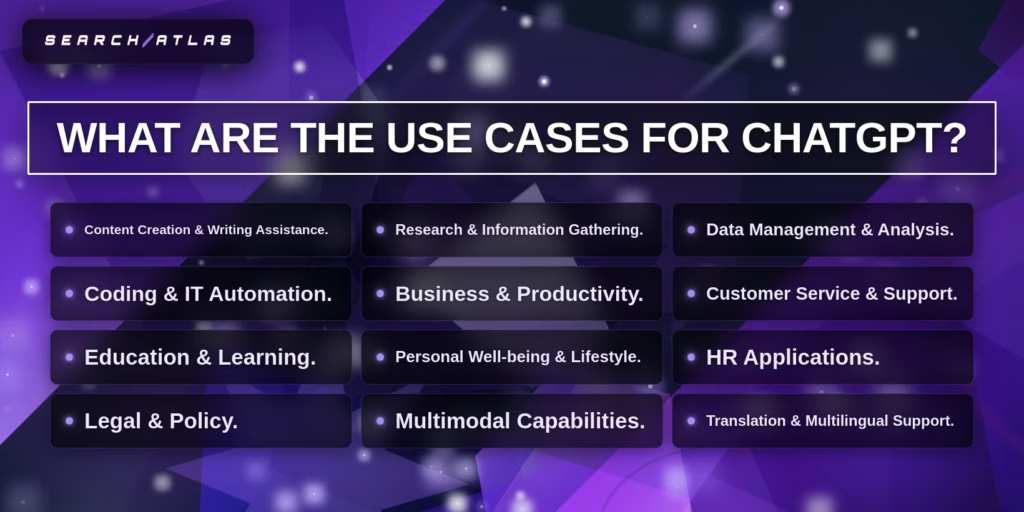
The use cases for ChatGPT are listed below.
- Content Creation & Writing Assistance. ChatGPT drafts creative stories, articles, blog posts, and social media content, significantly increasing output for content marketers by 2-3x. Users often heavily edit AI output for voice and accuracy, especially for nuanced or brand-specific content.
- Research & Information Gathering. ChatGPT assists with research by summarizing documents, identifying trends, and providing background information for various topics. It can analyze companies, terms, and current events, though users must verify information, as ChatGPT can fabricate citations.
- Data Management & Analysis. ChatGPT streamlines data formatting, cleaning, and organization, and can analyze large text files for insights. It also performs sentiment analysis and extracts specific text data, integrating with spreadsheet AI tools for scaled tasks.
- Coding & IT Automation. ChatGPT helps solve coding issues, debug code, and generate snippets for repetitive tasks, with 85% of developers regularly using AI tools by 2025. It also explains programming concepts and translates code between languages.
- Business & Productivity. ChatGPT aids in planning daily tasks, brainstorming new project ideas, and developing business plans and strategies. It improves personal productivity by drafting emails, summarizing documents, and assisting with project management tasks like creating Work Breakdown Structures.
- Customer Service & Support. ChatGPT enhances customer support by providing instant, personalized responses and automating FAQ replies. Octopus Energy uses GPT-powered chatbots to handle 44% of customer inquiries, though human intervention is needed for complex situations requiring empathy.
- Education & Learning. ChatGPT facilitates learning by explaining complex topics, offering homework help, and providing language practice. Teachers use it for course content creation and grading assistance, while students leverage it for research and concept reinforcement.
- Personal Well-being & Lifestyle. ChatGPT supports personal well-being through journaling, mental health support, and fitness coaching. It also assists with travel planning, analyzing sleep patterns, and providing creative inspiration for hobbies like art and music.
- HR Applications. ChatGPT generates job descriptions, interview questions, and onboarding materials, streamlining HR processes. It can also formulate employee retention strategies and answer employee policy questions when fine-tuned with company data.
- Legal & Policy. ChatGPT assists in understanding laws, legislation, and drafting legal documents like position statements. It offers general legal guidance on common issues, but it is not a substitute for professional legal counsel.
- Multimodal Capabilities. ChatGPT classifies images, identifies objects, and performs transcription, text-to-speech, and speech-to-speech conversions. These capabilities are applied in medical imaging, security, and real-time language translation.
- Translation & Multilingual Support. ChatGPT translates text with reasonable accuracy for common language pairs, supporting customer service in multiple languages. Spotify and Duolingo use it for customer support across numerous languages, though it struggles with highly specialized translations.
What Is the Best ChatGPT Alternative?
The best alternative to the ChatGPT tool for SEO workflows is the Search Atlas SEO Software Platform. Search Atlas connects AI writing directly to the broader SEO workflow, which includes keyword research, technical audits, backlink intelligence, local SEO management, and real-time rank tracking, while ChatGPT focuses on conversational AI and general-purpose text generation.
Search Atlas streamlines keyword research through Keyword Research, Keyword Magic, and Keyword Gap. These tools surface search volume, keyword difficulty, and trend signals while revealing keyword clusters and competitor opportunities. Topical Maps Generator and Content Planner guide content structure and scheduling by grouping semantically related topics into scalable editorial strategies.
For content creation, Search Atlas includes Content Genius, an AI editor that analyzes SERPs, suggests keywords and entities, adjusts tone, and delivers SEO feedback while users write. Content Genius generates outlines and SEO-optimized drafts based on top-ranking competitors while using real search data to guide topic coverage and keyword placement. ChatGPT generates text from language patterns but does not analyze SERPs or provide keyword-driven optimization guidance.
Scholar, the content scoring engine, strengthens content strategies by evaluating structure, readability, and keyword alignment to ensure content meets ranking standards. ChatGPT produces drafts and revisions but does not evaluate search performance signals or measure optimization coverage across competitive pages.
Search Atlas automates on-page improvements through OTTO SEO, a built-in AI assistant that recommends and executes technical and content optimizations using site data. OTTO SEO applies internal linking improvements, metadata updates, schema markup, and structural fixes without manual configuration. ChatGPT generates text responses but does not execute SEO improvements directly on websites.
Search Atlas starts at $99 per month and includes tools for writers, strategists, and agencies. Plans support collaboration, white-label reporting, and advanced analytics across all SEO workflows. Search Atlas allows users to test all features through a 7-day free trial.
Is ChatGPT a Scam?
Yes, direct scams impersonating ChatGPT are prevalent and pose significant risks to users. The website chat.chatbotapp.ai impersonates the official ChatGPT (chatgpt.com), appearing as a sponsored Google result for “ChatGPT premium” and charging users $59.99 for a 12-month subscription without delivering the advertised service. Users often receive an “something went wrong” error message upon payment, and the provided chatbot offers only “simple superficial responses” with a word count limit not exceeding 2000 words, despite claims of no limits.
However, users can often obtain refunds by contacting Paddle (paddle.com or paddle.net), the payment processor, directly via email ([email protected], [email protected]) or their website chatbot. Many users successfully disputed charges with their credit card companies or PayPal, especially when highlighting the discrepancy of a “$0.00” purchase shown on Paddle’s landing page versus the actual $60 USD charge. Refunds have been reported within minutes to “about a week” after persistent communication and providing transaction details.
What is the History of ChatGPT?
OpenAI was founded in December 2015 as a non-profit AI research organization, garnering pledges of nearly $1 billion (approximately £800 million) for research. Key founders include Sam Altman, Greg Brockman, Elon Musk, Ilya Sutskever, Wojciech Zaremba, and John Schulman. OpenAI restructured to a capped-profit model around 2019, creating the for-profit entity OpenAI LP under the control of the non-profit OpenAI Inc.
OpenAI is currently valued at $29 billion and has raised $11.3 billion in funding over seven rounds. In January 2023, Microsoft expanded its partnership with OpenAI with a multibillion-dollar investment, becoming an investor and minority owner. Elon Musk stepped down from the board in 2018 but remained a significant investor. Sam Altman became OpenAI’s CEO in 2019.
What is the foundational AI development timeline for large language models?
The foundational AI development timeline for large language models spans 35 years, with pioneering work by Jordan in 1986. Early AI systems from the 1950s to 1980s were rule-based, relying on “if-then” statements. A pivotal shift occurred with machine learning, enabling systems to learn patterns from data.
Word embeddings emerged in the early 2010s, representing words as numerical vectors. Word embeddings established a mathematical foundation for modern language models. Recurrent Neural Networks (RNNs) were the first major architecture to understand words in sequence, but RNNs suffered from the “vanishing gradient problem.”
Long Short-Term Memory (LSTM) Networks, developed between 1995 and 1997 by Hochreiter and Schmidhuber, improved RNNs with a “gating mechanism.” The attention mechanism allowed models to focus dynamically on relevant information across the entire input. The Transformer architecture, introduced in the 2017 paper “Attention Is All You Need” by Google researchers, relies exclusively on attention and enables massive parallelization. GPT stands for Generative Pre-trained Transformer.
BERT (Bidirectional Encoder Representations from Transformers), a Google model from 2018 using the Transformer architecture, was integrated into Google Search in October 2019. Scaling laws discovered that model performance improves predictably with increased data, parameters (hundreds of billions), and compute (multi-million dollar investment for a single training run). GPT-3 (175 billion parameters) exhibited emergent abilities like in-context learning.
What is the evolution of OpenAI’s GPT models?
The evolution of OpenAI’s GPT models began with GPT-1, introduced in June 2018 with 117 million parameters. GPT-1 established the foundational architecture and demonstrated unsupervised learning capabilities. GPT-2, released in February 2019 with 1.5 billion parameters, showcased significant improvement in generating coherent text. OpenAI initially withheld GPT-2 due to misuse concerns, but publicly launched GPT-2 in November 2019. OpenAI published research on fine-tuning GPT-2 with human preferences in September 2019.
GPT-3, a major leap in June 2020, was trained on 175 billion parameters. GPT-3 led to widespread use for various text generation tasks and marked a pivotal moment for direct LLM interaction. As of August 2023, GPT-3 was the only GPT model that could be fine-tuned. InstructGPT, launched in January 2022, was a fine-tuned version of GPT-3 aimed at reducing offensive language and misinformation. Research on InstructGPT was published in January 2022.
GPT-3.5, the model behind ChatGPT, was a fine-tuned version of GPT-3 capable of understanding and generating natural language and code. GPT-3.5 was released months before ChatGPT. GPT-4, released in March 2023 to ChatGPT Plus subscribers, featured improved model alignment, lower likelihood of offensive output, increased factual accuracy, better steerability, and internet connectivity. GPT-4’s context window increased to about 25,000 words and gained the ability to accept image inputs.
GPT-4o (“omni”), released in May 2024, is capable of processing and generating text, images, and audio. GPT-4o was initially free, with higher usage limits for paid subscribers. GPT-4o mini, released in July 2024, is a smaller and cheaper version of GPT-4o, replacing GPT-3.5 in ChatGPT. GPT-5 launched on August 7, 2025, as the flagship model, replacing previous available models. GPT-5.2 was released on December 11, 2025, with a stable release of ChatGPT (GPT-5.2) in February 2026.
When did ChatGPT launch and what was its initial impact?
ChatGPT launched on November 30, 2022, as a free research preview. ChatGPT attracted over one million users within five days of its launch. ChatGPT reached 100 million users in two months (January 2023), making ChatGPT the fastest-growing consumer software application in history. By March 2023, 14% of U.S. adults had tried ChatGPT.
In early November 2025, OpenAI reported that approximately 800 million people used the chatbot every week. As of September 2025, ChatGPT had 700 million weekly active users. ChatGPT’s launch was described as a “seismic event” that reshaped the technology industry. The underlying technology was a fine-tuned version of GPT-3.5, with the key difference being the addition of “conversational data” and tuning the training process. ChatGPT’s technical capabilities were almost identical to InstructGPT, both trained using Reinforcement Learning from Human Feedback (RLHF).
What are ChatGPT’s key features and milestones post-launch?
ChatGPT’s key features and milestones post-launch include the ChatGPT Plus premium service, launched in February 2023 for US$20 per month. In March 2023, ChatGPT introduced support for plugins, including web browsing and code interpretation. The ChatGPT API for developers also launched in March 2023. OpenAI launched the ChatGPT iOS app in May 2023.
In July 2023, ChatGPT introduced custom instructions. The Code Interpreter was also released in July 2023. OpenAI launched ChatGPT Enterprise in August 2023. The DALL-E 3 image generation model was integrated into ChatGPT in October 2023. OpenAI released GPT Builder in November 2023, allowing users to customize ChatGPT’s behavior.
In January 2024, OpenAI launched the GPT Store, a marketplace for customized GPTs, with over 3 million GPTs at launch. The ChatGPT Team was also introduced in January 2024. OpenAI announced the discontinuation of ChatGPT plugins in April 2024, favoring custom GPTs. SearchGPT, an AI-powered search prototype, launched in July 2024.
ChatGPT Search was deployed in October 2024, allowing web searching for more accurate and up-to-date responses. In December 2024, a new feature allowed users to call ChatGPT with a telephone for up to 15 minutes per month for free. A Pro tier at $200/month was introduced in December 2024, coinciding with the o1 model release.
Operator, an agent capable of autonomously performing tasks through web browser interactions, was released in January 2025. Deep Research, a service combining advanced reasoning and web search, was released in February 2025. GPT-4.5 was also released in February 2025. OpenAI updated ChatGPT in March 2025 to generate images using GPT Image instead of DALL-E.
Codex, an agent for coding, was introduced in May 2025. The ChatGPT agent was released in July 2025. The Pulse feature was added in September 2025. OpenAI partnered with Stripe, Inc. to release the Agentic Commerce Protocol in September 2025. OpenAI launched ChatGPT Atlas, a browser integrating the ChatGPT assistant directly into web navigation, in October 2025. GPT-5.1, introduced in November 2025, allows users to select alternative personalities. ChatGPT Health was introduced in January 2026.
How is ChatGPT trained, and what infrastructure does it use?
ChatGPT is based on GPT foundation models fine-tuned for conversational assistance. Fine-tuning involved supervised learning and reinforcement learning from human feedback (RLHF). OpenAI used outsourced Kenyan workers, earning approximately $1.32 to $2 per hour, to label harmful content. OpenAI collects data from ChatGPT users (upvotes, downvotes, feedback) for further training.
ChatGPT’s training data includes software manual pages, internet phenomena, programming languages, and Wikipedia text. ChatGPT initially used Microsoft Azure infrastructure with thousands of Nvidia GPUs. TrendForce estimated 30,000 Nvidia GPUs were used to power ChatGPT in 2023. An estimated 5 to 50 prompts require approximately 0.5 liters of water for server cooling.
What are ChatGPT’s limitations and criticisms?
ChatGPT’s limitations and criticisms include hallucination, where ChatGPT generates plausible-sounding but incorrect answers, estimated at around 3% in 2023. Hallucination was the biggest concern before ChatGPT’s launch. Bias in training data is reflected in ChatGPT’s responses, with the model described as “still very biased.” ChatGPT also suffers from a knowledge cut-off, lacking knowledge of recent events beyond its training data cut-off date.
Ethical concerns surrounding ChatGPT include facilitating academic dishonesty, generating misinformation, and creating malicious code. The ethics of using copyrighted content for training data have drawn controversy. Jailbreaking allows users to bypass content policy restrictions using prompt engineering. OpenAI is actively working on fixes for jailbreaking.
Early versions of ChatGPT handled a few thousand tokens in its context window; by 2025, a 400,000-token context window was supported. A March 2023 security bug leaked users’ conversation titles and was later revealed to have leaked personal and payment information. OpenAI created a text watermarking method but did not release it publicly. ChatGPT users must attest to being over 13, and parental consent if under 18, but ChatGPT does not verify these attestations.
What are the regional responses and competition for ChatGPT?
Regional responses and competition for ChatGPT vary significantly across the globe. ChatGPT has never been publicly available in China due to OpenAI blocking access, leading to a shadow market. Italy temporarily banned ChatGPT in late March 2023 over privacy concerns. The ban was lifted in April 2023 after OpenAI implemented age verification and clarified its privacy policy.
In the US, the FTC issued a civil investigative demand in July 2023 to investigate ChatGPT’s data security, privacy practices, and generation of false or defamatory information. Competition for ChatGPT includes Microsoft, which is integrating AI into its core products like GitHub Copilot, Bing, Word, Excel, and Outlook. Google launched Bard (rebranded to Gemini in February 2024). Other competitors include Anthropic’s Claude, Meta AI, and xAI’s Grok.