Ahrefs alternatives are sought primarily due to its high cost (Lite plan starting at $129/month), a restrictive credit system that rapidly depletes 100 Starter plan credits, and significant data accuracy concerns, with Ahrefs overestimating organic traffic by as much as 949% (66.2k vs. 6.3k Google Analytics sessions in January 2026). Key alternatives to Ahrefs offer more affordable pricing, with solutions like Ubersuggest starting at $12/month and Mangools at $19.90/month (billed annually). Several alternatives provide free trials (e.g., Search Atlas’s 7-day trial with free 1 on 1 onboarding) or free tiers (e.g., Google Search Console, Bing Webmaster Tools), contrasting with Ahrefs’ lack of a free trial for its paid plans.
Comprehensive alternatives to Ahrefs like Search Atlas and Semrush offer broader toolkits, with Semrush boasting 27.9 billion keywords across 142 locations and Search Atlas providing a 100 trillion backlink database, significantly exceeding Ahrefs’ 35 trillion. Specialized tools like Surfer SEO, with an 8-year lead in content optimization, demonstrate a 0.28 Spearman correlation with higher Google rankings, outperforming Ahrefs’ backlink correlation of 0.17. AI visibility tools are increasingly integrated, with Search Atlas, SE Ranking, MozPro, and Mangools including them in all plans, while Ahrefs requires a $199/month Brand Radar add-on. Rank tracking capabilities vary, with Mangools offering daily updates for the top 30 positions and ProRankTracker providing daily updates on every plan, whereas Ahrefs’ basic plans update weekly.
What are the Ahrefs Alternatives?
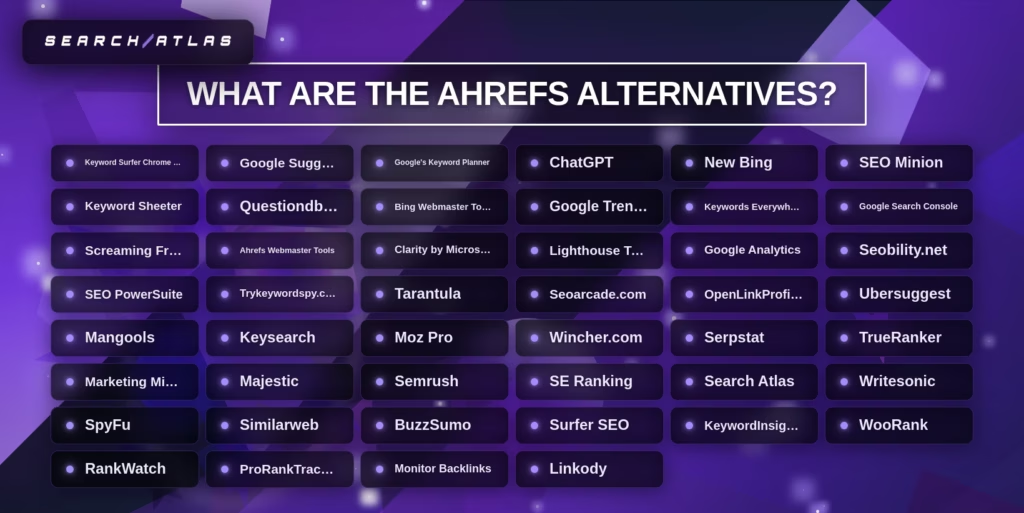
Ahrefs alternatives include various free, low-cost, mid-range, and comprehensive paid tools. The 46 best Ahrefs alternatives are listed below.
- Search Atlas (Comprehensive SEO and LLM Visibility Platform)
- Keyword Surfer Chrome plugin (Keyword Research Tool)
- Google Suggest (Keyword Research Tool)
- Google’s Keyword Planner (Keyword Research Tool)
- ChatGPT (AI Tool)
- Copilot (AI Tool)
- SEO Minion (Keyword Research Tool)
- Keyword Sheeter (Keyword Research Tool)
- Questiondb.io (Keyword Research Tool)
- Bing Webmaster Tools (SEO Tool)
- Google Trends (Keyword Research Tool)
- Keywords Everywhere (Keyword Research Tool)
- Google Search Console (SEO Tool)
- Screaming Frog (Site Audit Tool)
- Ahrefs Webmaster Tools (Free SEO Tool)
- Clarity by Microsoft (User Behavior Tracking Tool)
- Lighthouse Tool (On-Page SEO Tool)
- Google Analytics (Web Analytics Tool)
- Seobility.net (SEO Platform)
- SEO PowerSuite (SEO Toolkit)
- Trykeywordspy.com (On-Page SEO Tool)
- Tarantula (SEO Tool)
- Seoarcade.com (SEO Tool)
- OpenLinkProfiler (Backlink Analysis Tool)
- Ubersuggest (SEO Platform)
- Mangools (SEO Platform)
- Keysearch (SEO Platform)
- Moz Pro (SEO Platform)
- Wincher.com (Rank Tracking Tool)
- Serpstat (All-in-One SEO Platform)
- TrueRanker (Rank Tracking Tool)
- Marketing Miner (SEO Platform)
- Majestic (Backlink Analysis Tool)
- Semrush (Comprehensive SEO Platform)
- SE Ranking (Comprehensive SEO Platform)
- Writesonic (AI Content Creation Tool)
- SpyFu (Competitor Analysis Tool)
- Similarweb (Digital Intelligence Platform)
- BuzzSumo (Content Analysis Tool)
- Surfer SEO (Content Optimization Tool)
- KeywordInsights (Keyword Clustering Tool)
- WooRank (Website Analysis Tool)
- RankWatch (SEO Management Platform)
- ProRankTracker (Rank Tracking Tool)
- Monitor Backlinks (Backlink Tracking Tool)
- Linkody (Backlink Monitoring Tool)
1. Search Atlas
Search Atlas is the best Ahrefs alternative because it offers a comprehensive toolset with feature parity, provides advanced AI capabilities including LLM visibility tracking, streamlines content and link building workflows with integrated tools, delivers data accuracy closer to Google Search Console for organic traffic estimates, presents superior pricing and value compared to Ahrefs’ credit system, and features a cleaner, user-friendly interface for many users.
How does Search Atlas offer a comprehensive toolset comparable to Ahrefs? Search Atlas is an all-inclusive SEO tool with over 40 features. Its site audit and backlink tools are considered on par with Ahrefs and offer a cleaner UI. Search Atlas combines local SEO, content optimization, technical audits, and link building in one system, areas where Ahrefs’ Standard plan often lacks depth.
Why are Search Atlas’s AI capabilities a strong alternative? Search Atlas provides AI Placement Data without additional costs or restrictive limitations, unlike Ahrefs and SEMRush which price this data “astronomically” (Reviewer). It features the QUEST Tool, which analyzes how LLMs generate answers by reverse-engineering responses, and offers LLM visibility tracking across ChatGPT, Claude, and Gemini (SE Ranking; Alli AI). While Ahrefs offers Brand Radar for AI visibility, it is a paid add-on ($199/month) or a free beta moving to $99/month, matching Search Atlas’s features (SE Ranking; Alli AI).
What makes Search Atlas’s content and link building workflows superior? Search Atlas’s Content Genius offers a more integrated workflow from keyword to optimization, including AI-powered briefs and bulk writing, practical on-page guidance, and extras like meta generation and image creation. Its link building and research are described as “on a completely different level,” integrating contact capabilities (like Justreachout and Hunter.io) and a link exchange service (“Link Laboratory”) directly within the software, whereas Ahrefs only shows potential opportunities (Reviewer).
How does Search Atlas provide more accurate data and keyword tracking? Search Atlas’s organic traffic estimate for a reviewer’s website in October 2025 was 6.1k organic visits, “pretty close to the actual numbers” from Google Search Console (6.3k), and its data is generally closer to GSC than Ahrefs’ estimates. Search Atlas offers GSC Insights for keyword tracking, as Ahrefs only sees 30-40% of a website’s keywords (Why You Should Stop Using Ahrefs for Keyword Tracking, June 16, 2022).
Why does Search Atlas offer superior pricing and value? Search Atlas is described as the “most value packed SEO tool,” with its functionality requiring an Ahrefs plan in the “$1,000+/month range” (Reviewer). Search Atlas’s Growth plan is $199/month, while Ahrefs’ comparable Standard plan is $249/month and uses a controversial credit-based system that depletes quickly, leading to unpredictable monthly costs (Reviewer; Alli AI). All Search Atlas features are included in the base price, unlike SEMRush which charges for each (Reviewer).
In what ways does Search Atlas offer a cleaner, user-friendly interface? User comments such as Spiritual_Reserve907 (5/7/2025) specifically note Search Atlas has a “cleaner UI” compared to Ahrefs for its site audit and backlink tools. The reviewer describes Search Atlas as “extremely user friendly” considering its robustness, with a “gorgeous,” fast, and glitch-free dashboard (Reviewer). While Ahrefs’ interface is dense and can be overwhelming for new users, Search Atlas aims for a more intuitive experience, according to the Search Atlas review.
2. Keyword Surfer Chrome plugin
Keyword Surfer Chrome plugin is an Ahrefs alternative because it offers cost-effectiveness as a free tool compared to Ahrefs’ $129/month plans, provides direct keyword data within Google search results for quick insights, boasts ease of use and accessibility as a Chrome extension, covers specific keyword research functionality for immediate demand signals, and includes additional features like content analysis and ChatGPT integration.
How does cost-effectiveness make Keyword Surfer an alternative? Keyword Surfer is a free Chrome extension, making it a highly cost-effective alternative to Ahrefs, which starts at $129/month (or $108/month billed annually) and offers no free trial. While Ahrefs has a limited free Keyword Generator, Keyword Surfer provides its core functionality at no cost, appealing to users seeking tools without hundreds of dollars in monthly fees.
Why is direct keyword data in search results a significant advantage? Keyword Surfer displays search volume, related keywords, and estimated traffic directly within Google search results. This provides immediate insights without navigating a separate platform, streamlining keyword research by surfacing data inside the SERP. This direct integration offers quick data access for any search query.
What contributes to Keyword Surfer’s ease of use and accessibility? As a Chrome extension, Keyword Surfer offers immediate access to data during browsing, making it highly accessible for keyword research. Its integration into the browser workflow means users do not need to switch between different tools, enhancing the user experience for quick analysis.
How does specific functionality position Keyword Surfer as an alternative? Keyword Surfer covers a specific aspect of SEO: keyword research. It is mentioned alongside tools like “inpages for site explorer” and “screaming frog for technical SEO,” indicating its focused utility. It provides demand signals for keywords, serving as a useful tool for quick keyword research and analysis, particularly for initial exploration.
What additional features enhance Keyword Surfer’s appeal as an alternative? Keyword Surfer includes keyword suggestions, content analysis, and the ability to save keyword collections and export them as CSV files. It also integrates with ChatGPT for content refinement and humanization scoring, adding value beyond basic keyword data. User “hankorrrrr” suggested Keyword Surfer on 2/13/2025 as an alternative achieving “at least 80% of the Ahrefs quality” without high costs.
3. Google Suggest (Autocomplete)
Google Suggest is an Ahrefs alternative since it provides valuable keyword insights by focusing on native Google features like Autocomplete and SERP inserts, and Google Keyword Planner (GKP), a related Google tool, is directly compared to Ahrefs in a 2021 YouTube video by The Social Guide.
How does Google Suggest provide valuable keyword insights? Google’s recent search result changes emphasize the importance of understanding what appears in Autocomplete and SERP inserts. These native Google features offer direct insights into user search behavior and popular queries, effectively serving a similar function to third-party tools for specific aspects of keyword research. By analyzing these elements, users can uncover relevant keywords that Google itself highlights.
Why is Google Keyword Planner’s comparison to Ahrefs significant? The YouTube video “Best Keyword Research Tool: Ahrefs vs UberSuggest vs GKP vs SemRush,” published on October 5, 2021, by The Social Guide, directly compares Google Keyword Planner (GKP) with Ahrefs. This comparison aims to help users determine the best keyword research tool for their needs, positioning GKP, a Google-native tool, as a direct competitor and alternative to Ahrefs in the market.
4. Google’s Keyword Planner
Google’s Keyword Planner is an Ahrefs alternative because it is free to use with an active Google Ads account, its primary purpose is to plan paid search campaigns, it offers unique keyword ideas that Ahrefs may not have, it provides accurate search volumes directly from Google’s search engine, and it features a simple, user-friendly interface that is easy for beginners to navigate.
How does cost contribute to GKP being an alternative? Google Keyword Planner (GKP) is free to use for anyone with an active Google Ads account, making it a highly accessible tool. In contrast, Ahrefs operates on a paid subscription model, with plans ranging from $29/month (Starter) to $449/month (Advanced). This significant cost difference positions GKP as a viable, budget-friendly alternative for users who do not require Ahrefs’ extensive feature set.
Why is GKP’s primary purpose significant? GKP is specifically designed to help advertisers plan paid search (PPC) campaigns, providing insights into ad competition and bid ranges. While Ahrefs focuses on organic SEO research, GKP’s data is crucial for understanding commercial intent and real demand for keywords before building organic content. GKP is also required for running PPC campaigns, offering bid estimates and impression data directly from the auction environment.
What makes GKP’s keyword ideas unique? GKP excels at finding extra keywords that Ahrefs may not have in its database. It generates keyword ideas based on broader topics and can target specific locations or search by website/webpage. This capability allows GKP to discover hyperlocal data (city-level) by pulling directly from Google Ads, providing valuable insights for niche or geographically targeted SEO projects.
How does GKP’s data accuracy compare? GKP provides accurate search volumes directly from Google’s search engine, making its data reliable for understanding search trends and for advertisers. While it often shows search volume ranges (e.g., “100k – 1000k”) without an active Google Ads campaign, maintaining minimal ad spend can unlock exact numbers. GKP also offers geographic and demographic insights for ad campaigns, which are directly sourced from Google’s own data.
Why is ease of use an important factor? GKP features a simple, user-friendly interface that is easy for beginners to navigate. It is considered beginner-friendly and does not require extensive technical knowledge to operate. This accessibility contrasts with the potentially steeper learning curve of more comprehensive tools like Ahrefs, making GKP a practical choice for users seeking straightforward keyword research.
5. ChatGPT
ChatGPT is an Ahrefs alternative since it serves as an affordable AI assistant for diverse writing tasks at $20/month, functions as a creative partner for brainstorming and drafting content, acts as a new traffic channel driving 0.23% of total web traffic (January 2026), provides keyword suggestions that some users find valuable for general overviews, and offers a freemium model making AI capabilities accessible to individuals and small teams.
How does ChatGPT’s affordability make it an alternative? ChatGPT Plus costs $20/month, making it significantly more accessible than Ahrefs, which starts at $129/month. This pricing model positions ChatGPT as an affordable AI assistant for individuals and teams needing a wide variety of writing tasks. One Reddit user noted that using ChatGPT for this purpose involves “a whole lot of effort for a limited financial advantage” compared to Ahrefs, implying it can serve as a budget-conscious alternative.
Why is ChatGPT considered a creative partner? ChatGPT is an LLM built to understand questions and write human-like text, described as a “writer, not a data analyst.” It functions as a “super-versatile intern” or “creative partner” for tasks like drafting emails, brainstorming ideas, or generating first drafts. It helps “get words on the page quickly” and is a “probabilistic word generator” (Reddit, Nov 22, 2023), making it a valuable tool for content creation support.
What makes ChatGPT a new traffic channel? ChatGPT is an “answer engine” that now drives measurable referral traffic to websites, representing a new channel that did not exist two years ago. In January 2026, ChatGPT accounted for 0.23% of total traffic share, growing 9.2% in visitors sent month-over-month (Ahrefs AI vs Search Traffic Analysis 2025, Feb 2, 2026). When ChatGPT cites a website, it sends highly qualified visitors, with AI search traffic responsible for approximately 12.1% of Ahrefs’ sign-ups despite being only about 0.5% of total visits.
How do ChatGPT’s keyword suggestions serve as an alternative? While Ahrefs provides “concrete SEO metrics” and “actual data,” some users utilize ChatGPT for keyword suggestions to “get a general overview of the keywords” (Poll, July 21, 2025). This indicates that for initial exploration or less data-intensive needs, ChatGPT can offer a preliminary alternative for keyword ideation, even if its suggestions are “not backed by any real data.”
Why is the freemium model a key aspect of its alternative status? ChatGPT’s freemium model, with a free tier and ChatGPT Plus at $20/month, makes advanced AI assistance widely available. This contrasts with Ahrefs’ enterprise-focused pricing, starting at $129/month. The accessibility of ChatGPT’s model allows individuals and smaller teams to leverage AI for various writing and content generation tasks without the significant investment required for a full SEO toolkit.
6. Microsoft Copilot (New Bing)
Microsoft Copilot is an Ahrefs alternative because it offers competitor backlink analysis for free, provides faster indexing of new content compared to Google and Ahrefs, and is useful for discovery and spot checks in conjunction with other tools.
How does Copilot offer competitor backlink analysis? Bing Webmaster Tools allows users to view and export competitor backlinks without cost, unlike paid alternatives. While it does not provide an “Ahrefs-level competitor backlink profile,” it is effective for initial “discovery and spot checks” of backlink opportunities. This functionality can be integrated with tools like SE Ranking for a more efficient setup, particularly for solo link builders.
Why is faster indexing of new content a significant advantage? Bing surfaces fresh articles and new URLs faster than Google in some niches, often within hours. This enables quicker detection of new brand mentions and competitor content. In contrast, Google often hides or delays fresh articles, and its search results have become less “fresh” due to AI updates, making filters like date range almost impossible to use effectively. Ahrefs Content Explorer and Brand Radar are also perceived to lag behind Google in tracking new content.
What makes Copilot useful for discovery and spot checks? Bing Webmaster Tools is primarily recommended for “discovery and spot checks” rather than “full exports” of data. Its ability to quickly index new content, combined with advanced search operators and monitoring tools, helps users detect new brand mentions and competitor content efficiently. Manual checks in Bing are also used in conjunction with Ahrefs Content Explorer for comprehensive content tracking.
7. SEO Minion
SEO Minion is an Ahrefs alternative since it offers specific keyword research functionality for free (initially), provides a range of on-page SEO analysis tools, and serves as a cost-effective option compared to Ahrefs’ $990 annual subscription.
How does SEO Minion’s specific functionality contribute to it being an alternative? SEO Minion is a free tool (initially) for keyword research, specifically designed to scrape PAA (People Also Ask) data and efficiently organize PAAs. One user noted that Ahrefs provides PAA data directly, implying SEO Minion offers a scraping alternative for this specific data point. This targeted functionality can reduce the immediate need for Ahrefs for this particular task.
Why are SEO Minion’s on-page analysis tools significant? SEO Minion offers various on-page SEO analysis features, including meta tag analysis, heading structure analysis, structured data review, broken link checking, SERP preview, Hreflang tag validation, Google search location simulation, and HTML vs DOM comparison tools. These tools provide a comprehensive suite for on-page optimization, addressing needs that might otherwise require a broader tool.
What makes SEO Minion a cost-effective alternative? Ahrefs costs $990 annually, making it a significant investment. While SEO Minion’s pricing has become conflicting (initially free, then requiring a Keywords Everywhere subscription, or a one-time purchase of “$48?”), it generally presents a much lower financial barrier. For infrequent audits or keyword research, the cost of SEO Minion, even with associated subscriptions, is considerably less than Ahrefs, aligning with the demand for cheaper options.
8. Keyword Sheeter
Keyword Sheeter is an Ahrefs alternative because it offers a lower-cost or free option compared to Ahrefs’ $990 annual cost, provides simple bulk keyword generation with unlimited pulls even on its free plan, focuses on fresh, accurate keyword data without bundled non-value adding features, and is specifically designed for brainstorming and raw keyword ideas rather than a comprehensive SEO suite.
How does Keyword Sheeter offer a lower-cost or free option? Ahrefs has an annual cost of $990, making it inaccessible for many users. Keyword Sheeter, in contrast, provides unlimited keyword pulls on its free plan, generating hundreds of raw keyword ideas in seconds. While additional data like search volume and keyword difficulty require payment, these paid features start at a significantly lower cost, such as “Sheet coins” at $0.0012 per keyword or paid plans from $9/month, making it a budget-friendly alternative.
Why is simple bulk keyword generation a key differentiator? Keyword Sheeter excels at generating up to 1000 keyword ideas per minute from Google autocomplete. This functionality is described as “Best for Bulk Keyword Dumps” and brainstorming, providing a straightforward way to gather a large volume of potential keywords quickly. This contrasts with Ahrefs’ broader scope, which includes a vast keyword database but is not solely focused on rapid, raw idea generation.
What makes Keyword Sheeter’s focus on fresh, accurate data significant? Keyword Sheeter functions as a keyword planner using fresh data and does not require monthly payments for bundled features that may not add value, a criticism sometimes leveled at comprehensive tools like Ahrefs. It also claims to offer “the only accurate keyword difficulty in the industry”, addressing concerns about data quality in existing tools where data can be “spam and noise”.
How does Keyword Sheeter’s design for brainstorming and raw ideas position it as an alternative? Keyword Sheeter is primarily a tool for generating raw keyword ideas, serving a specific need for brainstorming. Ahrefs, while “awesome,” is considered “not suitable for everyone” due to its nature as a comprehensive SEO suite with industry-leading backlink and competitor data, accurate keyword volumes, and click metrics. Keyword Sheeter fills a niche for users who need a focused tool for initial keyword discovery without the full suite of advanced SEO features.
9. Questiondb.io
Questiondb.io is an Ahrefs alternative because it offers core keyword research functionality similar to premium tools like Semrush, it provides free access for beginners and low-budget users with paid plans starting at $9.99 a month, it features a clean and intuitive user experience, and it includes AI-powered tools for content and keyword extraction.
How does Questiondb.io offer core keyword research functionality? Questiondb.io focuses on real questions from Reddit and Quora, providing keyword ideas with metrics such as volume, difficulty scores, and CPC. The platform offers filtering by source and suggests related terms, much like premium tools. It also provides visual reports for keyword trends, search intent, estimated CPC, and Google SERP features, along with a Keyword Checker to refine keyword lists based on volume and difficulty.
Why is free access a significant factor for Questiondb.io as an alternative? Questiondb.io is presented as a free tool for keyword research, not requiring sign-in for quick searches. Free sign-up increases the free limit to 5 searches, making it accessible for users with a low SEO budget or beginners. While Ahrefs offers limited free tools like a Keyword Generator, Questiondb.io provides more comprehensive keyword research at zero cost, with paid plans starting at $9.99 a month.
What makes Questiondb.io’s user experience noteworthy? The platform features a clean, intuitive, and easy-to-use interface. This accessibility ensures that users, particularly those new to SEO, can quickly leverage its capabilities without a steep learning curve.
How do AI-powered tools enhance Questiondb.io’s capabilities? Questiondb.io includes an AI Keyword Extractor that identifies keywords, themes, and sub-topics from content or URLs, which is useful for competitor analysis. The platform also offers AI-powered content and keyword research tools specifically designed for brand and entity SEO, expanding its utility beyond basic keyword generation.
10. Bing Webmaster Tools
Bing Webmaster Tools is an Ahrefs alternative because it is directly positioned as a competitor in industry comparisons, it offers a budget-friendly or free option for basic SEO needs, and it provides core webmaster audit functionalities.
How is Bing Webmaster Tools positioned as a direct competitor? TrustRadius’s “Ahrefs vs Bing Webmaster Tools 2026” and Software Advice’s “Ahrefs vs Bing Webmaster – 2025 Comparison” directly compare the two platforms. A YouTube video from July 9, 2021, titled “Google Search Console vs Bing Webmaster vs Ahrefs Audit,” also positions Bing Webmaster Tools as a direct competitor or alternative for webmaster audit functions. TrustRadius’s “Alternatives Considered” section explicitly lists “Ahrefs” and “Microsoft” (referring to Bing Webmaster Tools) as alternatives.
Why is Bing Webmaster Tools considered a budget-friendly option? Bing Webmaster Tools is suggested as a tool to “scrape by in a pinch” for users who are “reallllly broke” or whose budget “doesn’t allow me to continue with Ahrefs.” This implies it is a free or very low-cost option, making it a viable alternative when financial constraints prevent the use of paid tools like Ahrefs. It is also recommended as part of a “budget SEO stack” when combined with other free tools like Google Search Console and Screaming Frog.
What core functionalities does Bing Webmaster Tools offer as an alternative? Bing Webmaster Tools provides basic SEO functionality, grouping it with tools like Google Search Console, Yoast, and the free version of Screaming Frog. Software Advice rates Bing Webmaster Tools as “easy to use” and navigable. While it is implied to be less comprehensive than Ahrefs, described as “Not as shiny as Ahrefs,” it still offers essential webmaster audit capabilities that directly compete with Ahrefs’ audit functions. Both tools also have “Pricing available upon request” and “Screenshots and Demo” available as of February 9, 2026.
11. Google Trends
Google Trends is an Ahrefs alternative since it is directly classified as an alternative on TrustRadius, both tools share significant purpose and application overlap, they target similar large enterprise audiences, both offer free versions with distinct functionalities, and they provide complementary data for comprehensive SEO strategies.
How is Google Trends directly classified as an alternative? TrustRadius explicitly lists Google Trends under “Alternatives Considered” for Ahrefs, confirming its status as a comparable tool. Users evaluate both tools based on metrics such as “Likelihood to Recommend,” “Likelihood to Renew,” “Usability,” and “Support Rating,” indicating they are considered alongside each other in decision-making processes.
Why do Google Trends and Ahrefs share purpose and application overlap? Both tools are categorized as SEO solutions that support content management and customer acquisition. Google Trends aims to acquire customers and grow market share, while Ahrefs SEO Toolbar focuses on acquiring customers and enhancing social presence. Both offer robust analytics and custom reporting capabilities, serving similar strategic goals for businesses.
What makes their target audience and industry preference similar? Google Trends is preferred by large enterprises in marketing and advertising sectors. Similarly, Ahrefs SEO Toolbar is favored by large enterprises and marketing sectors. This overlap in target demographic suggests that businesses in these industries consider both tools for their respective needs.
How do both tools offer free versions with distinct functionalities? Google Trends is a free tool providing real-time data on search popularity, including keyword volumes and geographical information, and helps explore trending searches and seasonal patterns. Ahrefs SEO Toolbar also offers free functionalities such as instant on-page SEO reports, broken link checks, redirect tracing, and a local search simulator, contrasting with Ahrefs’ main paid plans starting at $129/month.
How do Google Trends and Ahrefs provide complementary data for comprehensive SEO strategies? Google Trends visualizes popularity using normalized scores (0–100) and identifies “Breakout” keywords, showing real-time and daily shifts. Ahrefs aggregates demand into monthly averages and longer-term trends, anchoring trend lines to estimated monthly search volume, including a forecasting layer and a “Growth Metric” for demand increase over 3, 6, or 12 months (e.g., +20–50% for early momentum, +100%+ for breakout topics). While Google Trends is suitable for exploring ideas or checking seasonality, Ahrefs is designed for SEO execution, offering practical layers like click potential, ranking difficulty, and SERP analysis.
12. Keywords Everywhere
Keywords Everywhere is an Ahrefs alternative because it offers core functionality overlap in keyword research, provides significant cost-effectiveness with pricing starting at $10/10k credits, enables quick access to real-time data directly on search engines, and includes unique features like bulk keyword upload for analyzing large datasets.
How does core functionality overlap contribute to Keywords Everywhere being an Ahrefs alternative? Both Keywords Everywhere and Ahrefs are identified as “excellent tools for SEO and keyword research.” Keywords Everywhere provides essential keyword data, including monthly search volume, CPC data, and competition metrics, which are also core components of Ahrefs’ keyword research capabilities. Keywords Everywhere specializes in showing this data directly on search engines, offering a focused approach to keyword insights.
Why is cost-effectiveness a significant factor? Keywords Everywhere offers low-cost annual pricing, starting at $10 for 10,000 credits, making it significantly more affordable than Ahrefs, which starts at $99/month (or $129/month for its Lite plan). This price difference, with Ahrefs plans ranging up to $1,499/month, positions Keywords Everywhere as an inexpensive option, particularly for bloggers, small businesses, and creators who may find Ahrefs’ pricing prohibitive.
What makes quick access to real-time data valuable? Keywords Everywhere provides essential data like monthly search volume, related terms, and competitor insights quickly and efficiently through its browser extension. This allows users to see real-time data directly on Google, YouTube, and Amazon, saving time and enabling quick decision-making while browsing without switching between tools. For casual keyword checks, Keywords Everywhere is considered simpler and more accessible than Ahrefs.
How do unique features enhance Keywords Everywhere alternative status? Keywords Everywhere offers additional features such as “bulk keyword upload,” which is highlighted as a unique and time-saving capability for analyzing large sets of keywords. It also provides on-page keyword data and on-page keyword density checks, offering specific functionalities that cater to immediate keyword insights and on-page optimization tasks.
13. Google Search Console
Google Search Console (GSC) is an Ahrefs alternative because GSC provides more accurate position data directly from Google’s index. It is a completely free tool compared to Ahrefs’ premium pricing starting at $99 per month. GSC’s ranking methodology averages performance over time versus Ahrefs’ single-moment checks. GSC offers superior insights into page indexing and site health. It reveals significant discrepancies in organic traffic and keyword positions, and provides unique core functionality for website owners.
How does GSC’s data accuracy contribute to its role as an alternative? Google Search Console is considered more accurate for position data, providing direct data from the source. Keyword tools like Ahrefs are “usually slower to get updated position data”. Ahrefs is “just a guide and not accurate,” with observed discrepancies where “keyword tools are barely ever anywhere near the actual number” of traffic. GSC provides data directly from Google’s search index, offering more accurate insights into website performance. GSC data is considered authentic and real-time, with multiple users believing in the GSC results and considering GSC’s search performance metrics more reliable. Ahrefs primarily relies on its own web crawler and scrapes SERPs, which is “never 100% accurate,” though “pretty good.”
Why is GSC’s cost and accessibility a key differentiating factor? GSC is a completely free tool, with all functionality available at no cost. Ahrefs is a premium tool with pricing tiers ranging from $99 per month (Lite Plan) to $999 per month (Enterprise Plan). GSC is accessible to anyone with a website, regardless of budget or technical expertise, making it an invaluable resource for small business owners, bloggers, and those new to SEO. GSC is a “no-brainer” for those starting out with SEO and limited budgets.
What makes GSC’s methodology for ranking data distinct? GSC reports “average performance over a given time period” by considering “every time that query happened and you showed up in the search results” from “whatever location they are located in.” Ahrefs checks position “one time from one location,” representing “ranking at one random moment.” For example, for the keyword “personal trainer columbus ohio,” GSC reported an average search position of 43, while Ahrefs reported an average search position of greater than 100.
How does GSC offer superior insights into page indexing and site health? GSC “sees most of my pages” and “tells you what pages are/aren’t indexed.” In contrast, Ahrefs reported only “2 visible pages” despite “dozens of crawls” for one user. GSC monitors website health, alerting users to crawl errors, broken links, or other technical issues. It provides a Mobile Usability report and acts as the “first line of defense,” constantly checking site health. GSC offers a “Direct Line from Google” and “Direct Feedback Loop,” flagging problems like slow loading times or mobile-friendliness.
Why are there significant discrepancies in organic traffic and keyword positions between the tools? Ahrefs often shows much higher organic traffic numbers than what is seen in GSC or Google Analytics. For example, in January 2026, Ahrefs estimated 66.2k organic visits for one author’s site, while Google Analytics showed 6.3k organic sessions. Tools like Semrush, SE Ranking, and Search Atlas provide more accurate organic traffic estimates, closer to GSC data. GSC tells you “exactly what keywords people are using to find you” and shows “Real Clicks and Impressions.”
What unique core functionality does GSC provide? GSC provides unique and unparalleled insights into how Google crawls, indexes, and serves a website’s pages. It offers detailed reports on search performance, indexing status, and crawl errors. GSC alerts users to any penalties or manual actions taken by Google and provides “any major technical issues.” GSC shows “clicks/impressions and so much more,” with GSC data being the primary concern for website owners. GSC is ideal for website owners and webmasters for monitoring site performance, submitting sitemaps, and identifying indexing/security issues, as well as for SEO professionals of all levels due to its user-friendly interface and actionable insights.
14. Screaming Frog
Screaming Frog is an Ahrefs alternative because it offers a more in-depth technical SEO audit with custom crawls, provides a significantly more affordable annual license starting at $279, excels in detailed on-page and content analysis including Flesch reading ease scores, and is the go-to technical crawler for experienced SEOs who need raw data.
How does Screaming Frog offer a more in-depth technical SEO audit? Screaming Frog is primarily a website crawler that provides detailed information on webpage structure, metadata, links, and XML sitemap accessibility. It allows for faster and easier updates through custom crawls, identifying issues like non-responsive pages and redirects. Ahrefs’ crawl tool, while easier to interpret for beginners, provides less upfront data in website audits. Screaming Frog’s technical SEO capabilities can sometimes be the “20% that causes 80% of results.”
Why is Screaming Frog’s cost a significant alternative factor? Screaming Frog’s paid version starts at $279 per license, per year, with volume discounts for 5+ licenses, making its annual license range from approximately $180 to $500+. In contrast, Ahrefs’ paid plans start at $29 per month for basic features, with subscription plans starting at $129 per month, translating to approximately $1188 per year for the Lite plan. This makes Screaming Frog significantly less expensive annually and “more affordable” in pricing comparison.
What makes Screaming Frog excel in detailed on-page and content analysis? Screaming Frog provides comprehensive on-page SEO and content analysis. It identifies missing/duplicate H1s, meta descriptions, and total page word counts. The tool also offers a content readability assessment, including the Flesch reading ease score and average words per sentence by page. It can even assess semantic similarity with an LLM API connection, offering a different view of content duplication.
How is Screaming Frog the go-to technical crawler for experienced SEOs? Screaming Frog is considered “more in-depth on the technical side” and is the “go-to technical crawler” with “tremendous support and on-going engineering.” While Ahrefs is better for beginner SEOs with suggested fixes, Screaming Frog is better for experienced SEOs who require customizable crawls and raw data to “get into the weeds” of technical and on-site SEO. Its interface, though described as “clunky” with a “steep learning curve,” provides a sheer volume of data that experienced users leverage daily.
15. Ahrefs Webmaster Tools
Ahrefs Webmaster Tools (AWT) is an Ahrefs alternative because it offers free unlimited access to core SEO tools for verified websites, provides privacy-focused web analytics as an alternative to Google Analytics, includes robust technical SEO auditing for up to 5,000 URLs, and delivers advanced Site Explorer insights that fill gaps in Google Search Console.
How does free unlimited access make AWT an alternative? AWT provides free unlimited access to Ahrefs’ Site Audit and Site Explorer tools for verified website owners. Unlike Ahrefs’ paid plans, which often cost “$99+” monthly and require a free trial for the full platform, AWT offers a free entry point without such requirements. This makes professional-grade SEO tools accessible to website owners who cannot justify investing in a paid subscription.
Why is privacy-focused web analytics a significant alternative? AWT’s Web Analytics tool offers real-time insights into website traffic, visitors, and sources. It functions as a privacy-focused alternative to Google Analytics by collecting no cookies or personal data by default. This tool displays essential metrics such as top traffic sources, pages, locations, and browser clients, along with historical performance graphs, without the data privacy concerns associated with other analytics platforms.
What makes robust technical SEO auditing a strong alternative? The Site Audit tool scans for over 170 common technical and on-page SEO issues, assisting with fixes and monitoring a website’s Health Score over time. It allows running technical SEO audits for up to 5,000 URLs per project per month, significantly more than Screaming Frog’s free version (500 URLs), and includes JavaScript crawling for free. This extensive auditing capability provides a powerful, free resource for maintaining website health.
How do advanced Site Explorer insights serve as an alternative? AWT’s Site Explorer reveals top organic traffic pages and keywords, identifies backlinks, and shows ranking keywords. It aims to fill gaps in Google Search Console by offering advanced insights, SEO health advice, domain/page-level SEO metrics, and detailed broken link data (internal/external), including link types like nofollow, UGC, and sponsored. This provides a more comprehensive view of a website’s organic performance than GSC alone.
16. Clarity by Microsoft
Clarity by Microsoft is an Ahrefs alternative due to the fact that both tools compete in the Web Analytics, SEO, and SEM categories. Clarity offers free user behavior tracking that complements SEO efforts, both platforms are actively researching and integrating AI-related capabilities into their analytics, and Clarity provides visual analytics that offer insights into user experience.
How do both tools compete in the same categories? Ahrefs and Microsoft Clarity are both positioned within the Web Analytics, SEO And SEM, and Social Media categories. While Ahrefs is an “essential SEO platform” for site health and keyword research, Clarity focuses on user behavior. This overlap in the competitive landscape means both tools address different facets of website performance and optimization, making Clarity a viable alternative for specific analytical needs.
Why is Clarity’s free user behavior tracking a key alternative? Microsoft Clarity is a free website analytics tool that focuses on tracking user behavior through heatmaps, click insights, and session recordings. This free access, built on open source and promising to always be free, contrasts with Ahrefs’ pricing, which starts at $99 per month. Clarity’s ability to provide conversion funnel analysis and “Session Insights” text descriptions offers valuable data for SEO tasks, particularly for understanding user engagement without a subscription cost.
What makes AI-related capabilities a shared alternative factor? Both Microsoft Clarity and Ahrefs are actively engaged in AI research and integration. Clarity published research on December 18, 2025, on how AI assistants are reshaping website analytics, introducing the “Agentic Web,” and introduced AI traffic filters in August 2025 to separate visits from known AI referrer URLs. Ahrefs also studied AI search visitors on June 16, 2025, finding AI search visitors convert 23x higher than organic traffic, accounting for 0.5% of total website visits yet generating 12.1% of all signups. This shared focus on AI-driven insights positions both as forward-thinking alternatives in the evolving analytics landscape.
How do visual analytics contribute to Clarity being an alternative? Steph Andrusjak, a Freelance SEO Consultant, calls Microsoft Clarity “by far my favorite of these types of visual analytics tools,” highlighting its video recordings, heatmaps, and AI element for Session Insights. While Ahrefs provides comprehensive SEO data, Clarity’s visual approach to user experience data, accessible through Bing Webmaster Tools, offers a different but complementary perspective. This focus on visual user behavior analysis provides insights into conversion and user experience data that can inform SEO strategies, making it an alternative for understanding the “why” behind website performance.
17. Lighthouse Tool
Lighthouse Tool is an Ahrefs alternative because it addresses user cost concerns by being a free, readily available option, it provides similar core technical SEO audit functionality, and it offers a better value proposition for users new to SEO tools.
How does Lighthouse address user cost concerns? Lighthouse is already available in Chrome dev tools and Google search console, making it a free and accessible option. This directly contrasts with the significant monthly subscription cost of Ahrefs, providing a viable solution for users with budget constraints.
Why does Lighthouse offer similar core technical SEO audit functionality? User Teodor noted, “From what i see this tool isn’t providing more info,” implying Lighthouse offers comparable core features to Ahrefs’ Site Audit Tool. Lighthouse guides users to fix SEO issues, checks on-page SEO issues like missing alt tags, and performs a technical audit of a website. It also provides a score from 0 to 100 for loading speed, interaction time, element visibility, and image size, identifying technical improvement points for a website.
What makes Lighthouse a better value for new users? Lighthouse’s integration into Chrome dev tools and Google Search Console makes it easily discoverable and usable for individuals exploring SEO without needing to invest in expensive, comprehensive platforms like Ahrefs.
18. Google Analytics
Google Analytics is an Ahrefs alternative because it offers a privacy-friendly and cookie-free approach, it provides zero complexity with just the right metrics, it features lightning-fast data reporting within 1 minute, and it is free for verified websites up to 1 million events per month.
How is Ahrefs Web Analytics positioned as an alternative? Ahrefs itself markets its Web Analytics tool as a “Simple, free Google Analytics alternative” and a “better way to track website traffic.” Travis Wilkie’s video, published March 13, 2024, directly compares both tools to assist users in decision-making “before committing to one over the other,” implying they serve similar functions.
Why is a privacy-friendly approach a key differentiator? Ahrefs Web Analytics emphasizes being “Privacy-friendly. No personal data collected. Period.” It operates as a “cookie-free” solution, directly addressing concerns about Google Analytics’ “disillusioning” level of data collection and the difficulties in complying with regulations like CCPA and GDPR. This contrasts with Google Analytics, which collects identifiable user data.
What makes Ahrefs Web Analytics’ simplicity an advantage? Ahrefs Web Analytics promises “Zero complexity. Get just the right metrics you need.” This directly counters the perception that Google Analytics’ complexity “can often get in the way of its usefulness,” a weakness noted by some users. Google Analytics’ perceived complexity and the “mess” of the GA4 rollout have led some, like an SEO writer, to remove it due to infrequent use.
How does speed contribute to Ahrefs Web Analytics’ appeal? Ahrefs Web Analytics is described as “Lightning-fast. Instantly see website visitors within 1 minute of an event.” This rapid data reporting provides immediate insights into website activity, a feature that enhances its utility as a real-time tracking alternative.
Why is the cost structure of Ahrefs Web Analytics significant? Ahrefs Web Analytics is “free for websites with verified ownership” and “free for up to 1 million events per project each month.” This cost-free model for substantial usage makes it an attractive alternative, especially when compared to the perceived value and complexity of Google Analytics.
19. Seobility.net
Seobility.net is an Ahrefs alternative because it offers comparable core SEO functionality for a significantly lower cost, provides a broader free tier ideal for beginners, targets a wider range of users from hobbyists to agencies, offers superior white-label reporting, and provides real-time monitoring with email alerts.
How does comparable core SEO functionality contribute to Seobility’s status as an Ahrefs alternative? Seobility performs “a lot of stuff that Semrush and Ahrefs can do,” including backlink analysis, keyword research, and site auditing capabilities. Both platforms offer Artificial Intelligence (AI), Google Analytics Integration, and Website Optimization Tools Features. Seobility crawls up to 100,000 pages, identifying on-page optimization problems, duplicate content issues, and technical errors, evaluating over 300 factors.
Why is Seobility’s lower cost a significant factor? Seobility’s Premium plan starts at €49.90/month, which is approximately 50% below Ahrefs’ entry cost of $99.00 per user per month. Seobility also offers annual discounts of 20%, making it a more affordable option for individuals and small to mid-size businesses.
What makes Seobility’s broader free tier advantageous? Seobility provides a more extensive free Basic plan compared to Ahrefs, making it ideal for beginners and hobbyists. This accessibility allows new users to explore SEO tools without an initial financial commitment.
How does Seobility’s target audience differentiate it? Seobility is suitable for beginners, hobbyists (Basic plan), small to mid-size businesses (Premium plan), and agencies/large websites (Agency plan). Ahrefs’ features can be more advanced and costly than necessary for smaller websites, positioning Seobility as a more accessible alternative. Seobility was also awarded G2 Easiest Setup, praised for its quick setup and intuitive dashboard.
Why is Seobility’s reporting superior? Seobility offers White-Label Reporting, allowing customization with brand logos and colors, and scheduled automatic delivery. Ahrefs has “limited white-label reporting options,” making Seobility a better choice for agencies or consultants who need branded reports for clients.
How do real-time monitoring and alerts enhance Seobility’s value? Seobility provides real-time crawls and email alerts for server errors and major problems, ensuring ongoing site health. This proactive monitoring service notifies users via email about critical issues, allowing for prompt resolution and maintaining website performance.
20. SEO PowerSuite
SEO PowerSuite is an Ahrefs alternative because it offers significantly lower pricing with perpetual licenses, provides robust website auditing capabilities that delve deeper into technical issues, delivers highly customizable and geo-specific rank tracking, includes a comprehensive outreach tool for link building, and offers users full data ownership and local control.
How does SEO PowerSuite’s pricing model make it an alternative? SEO PowerSuite offers a Professional License for $299/year and an Enterprise License for $499/year, which includes white-label reports and client automation. This contrasts sharply with Ahrefs’ Lite Plan at $99/month ($108/month billed annually) and Standard Plan at $199/month ($208/month billed annually), making PowerSuite a more budget-friendly option. SEO PowerSuite licenses are also perpetual, with renewal after the first year covering updates and support, unlike Ahrefs’ monthly subscription model.
Why are SEO PowerSuite’s website auditing capabilities a strong alternative? SEO PowerSuite’s Website Auditor provides in-depth auditing, catching technical issues Ahrefs missed, and delves into crawlability, on-page elements, broken links, Core Web Vitals, and TF-IDF analysis. While Ahrefs’ Site Audit is excellent for quickly spotting common technical issues, it is “not as granular as PowerSuite’s auditor” and “doesn’t delve as deeply into on-page structure or content.”
What makes SEO PowerSuite’s rank tracking a viable alternative? According to the SEO PowerSuite review, the tool offers unlimited keywords, multiple locations, custom search engines, competitor rank tracking, and daily updates. It allows tracking rankings for specific locations, including street addresses, providing more accurate geo-specific data than Ahrefs, which narrows by city. Ahrefs rank tracking is limited by plan and updates daily, but requires a $2,000/year add-on (Project Boost Max) for daily updates.
How does SEO PowerSuite’s outreach tool serve as an alternative? SEO PowerSuite’s LinkAssistant streamlines the link-building process, offering a comprehensive solution for identifying prospects and managing outreach campaigns, a feature not as prominently highlighted or integrated within Ahrefs’ core offerings.
Why is data ownership and local control a distinguishing factor for SEO PowerSuite? SEO PowerSuite operates as a desktop application, allowing users more control over data storage and customization, ensuring full data ownership and privacy. This contrasts with Ahrefs’ cloud-based SaaS model, which lacks deep customization for data ownership or local control, making PowerSuite appealing to users who prioritize local data management.
21. Trykeywordspy.com
Trykeywordspy.com is an Ahrefs alternative because it is directly compared against Ahrefs in TrustRadius’s 2026 analysis, and both tools are subject to the inherent estimation limitations of SEO metrics, as noted by industry experts in January 2026.
How does direct comparison establish Trykeywordspy.com as an alternative? TrustRadius directly compares Ahrefs and KeywordSpy for 2026 across multiple categories, including Likelihood to Recommend, Pros, Cons, Likelihood to Renew, Usability, Support Rating, Alternatives Considered, and Return on Investment. This comprehensive comparison implies that KeywordSpy is a recognized competitor and alternative to Ahrefs in the SEO tool market.
Why are inherent estimation limitations relevant to Trykeywordspy.com being an alternative? SEO tools like Ahrefs, Semrush, and SpyFu rely on estimates and guesses, not direct scans of site code, as stated by JakeHundley and WebLinkr in January 2026. There is “no such thing as accurate SEO metrics no matter what tool you use,” according to JakeHundley. Tools pull data from search results and estimates, which can be “pretty close or wide of the mark,” meaning users “wont ever know” the exact accuracy. This shared characteristic of estimation means that any SEO tool, including Trykeywordspy.com, operates within the same fundamental data limitations as Ahrefs, making it a viable alternative for users seeking similar estimated insights. For example, a user observed Semrush and SpyFu showing a competitor ranking for a trademarked keyword even when the keyword was not present in the competitor’s page source, demonstrating that tools estimate rankings based on factors like relevance or user behavior, not just explicit keyword usage.
22. Tarantula
Tarantula is an Ahrefs alternative because it is a cheaper option recommended on January 19, 2024, it offers AI SEO capabilities including the AI-enabled crawler, and it provides comprehensive SEO functionality for competitive analysis and site optimization.
How does cost contribute to Tarantula being an Ahrefs alternative? Tarantula is explicitly recommended as a “way more cheaper” alternative to Ahrefs, making it an accessible option for users seeking cost-effective SEO tools. While Ahrefs typically involves higher recurring costs, Tarantula offered a launch promotion with lifetime access and free future monthly updates, providing significant long-term savings compared to Ahrefs’ standard monthly subscription model.
Why are Tarantulas AI SEO capabilities significant? Tarantula is described as an “Impressive AI SEO tool” and the “First AI Enabled Crawler in the industry,” a feature not commonly highlighted by Ahrefs. Its AI capabilities allow it to reveal “the best ranking secrets of your competitors,” identify authentic keywords, and rewrite any page with a single click using its AI Rewriter. This advanced AI functionality, published on December 13, 2023, provides a distinct competitive edge.
What comprehensive SEO functionality does Tarantula offer? Tarantula provides a broad range of SEO features that directly compete with Ahrefs’ offerings. It identifies site issues, broken links, redirects, and duplicate content, analyzes meta descriptions, titles, and keywords, and views Robots.txt and sitemaps. The tool also uncovers and extracts valuable insights to help improve ranking, offering all essential information to boost website performance, similar to the core objectives of Ahrefs.
23. Seoarcade.com
Seoarcade.com is an Ahrefs alternative because it provides revenue and lead forecasting that Ahrefs does not, it offers customizable and iterative forecasting with up to 30 re-runs, it delivers comprehensive data and deliverables including up to 1,000 keywords, it streamlines keyword research workflows saving hours of manual effort, and it serves as a business intelligence tool to communicate SEO value to C-Suite executives.
How does revenue and lead forecasting differentiate Seoarcade.com? Ahrefs and Semrush primarily provide search volume data and overall traffic estimates for keywords. Seoarcade.com, however, estimates potential traffic, conversions, sales, and revenue for specific keywords at specific ranking positions (1-10). This allows businesses to understand market potential by translating keyword volume into potential leads, sales, and revenue, a piece often ignored by other tools.
Why is customizable and iterative forecasting a key feature? Seoarcade.com’s estimates are based on a user’s specific conversion rate, sales conversion rate, and revenue per sale. Users can re-run any individual SEO Forecast Report up to 30 times with different conversion, sale, or revenue values to understand various ROI projections. An unlimited subscription offers no cap on the number of various seed keywords explored.
What comprehensive data and deliverables does Seoarcade.com provide? Seoarcade.com delivers up to 1,000 relevant keyword phrases from 1-5 initial keywords. It gathers the top 100 keywords for the top 10 URLs ranking for a target keyword. The output is a Google Sheet (Excel format) loaded with formulas and data projecting potential revenue, organic traffic, and relevant keyword data, including search volume and CPC data. Forecasts are provided for each keyword in each specific position (1-10) and generic numbers for ranking in the “top” (1-3) or “bottom” (4-10) of the front page, complete with visualizations, tables, charts, and graphs. It also offers International & Multi-language Organic Search Volumes by specific languages, locations, or devices.
How does Seoarcade.com streamline keyword research workflows? Seoarcade.com simplifies keyword research workflows, meaning agencies and users spend less time using tools and more time implementing data. It saves hours downloading CSVs and building keyword reports in Google Sheets, acting as an Excel (Google Sheets) template alternative to a lengthy keyword research process.
Why is Seoarcade.com considered a business intelligence tool? Seoarcade.com helps remove doubt from the C-Suite regarding the value of SEO. It is described as the “Ultimate business intelligence tool” to communicate market reach and value to CFOs and CEOs, emphasizing that “SEO is pointless, unless it actually generates revenue!” It aims to untie the knots in uncovering the true value of SEO, which is often underestimated. John Doherty of Editor Ninja stated, “I used to sell these for $499,” and Jonas Sickler of Terakeet endorsed it as “Solving SEO.”
24. OpenLinkProfiler
OpenLinkProfiler is an Ahrefs alternative because it offers cost-effectiveness as a completely free tool, provides core backlink analysis functionality for any domain without restrictions, includes key features and metrics like a Link Influence Score, offers robust export capabilities for up to 200,000 links, targets specific user needs for beginners and quick audits, and supports strategic pairing with other free SEO tools.
How does cost-effectiveness position OpenLinkProfiler as an alternative? OpenLinkProfiler is entirely free to use, making it a suitable Ahrefs alternative for bloggers and SEO beginners seeking to avoid high recurring costs. It specializes in comprehensive backlink analysis at zero cost, providing link intelligence without the complexity or expense of all-in-one platforms. This focus on backlinks at no charge makes it a “cheaper alternative to Ahrefs.”
Why is core backlink analysis functionality a significant factor? OpenLinkProfiler specializes in comprehensive backlink analysis, providing data on backlinks, anchor text, and link context. It offers detailed reports on a website’s backlink profile and allows analysis of any domain without restrictions, daily limits, or search caps, enabling unlimited domain scans. The tool provides information on referring domains, broken backlinks, domain rank, and crawled pages, effectively covering most core functions related to backlink analysis.
What key features and metrics contribute to its alternative status? OpenLinkProfiler includes a Link Influence Score, a proprietary metric evaluating link quality based on multiple factors. It offers detailed filtering by link type, industry category, anchor text, or specific metrics. Users can view total links, referring domains, link types (dofollow vs. nofollow), anchor text distribution, and categorization by industry. The platform also features a fresh index with new backlinks added every 5 minutes, basic authority metrics, and link age data, all presented in a clean, ad-free interface.
How do export capabilities enhance its utility as an alternative? OpenLinkProfiler allows users to download comprehensive reports for deeper analysis or client presentations. It supports exporting up to 200,000 links without requiring an account, providing data in CSV format. This extensive export functionality enables users to conduct thorough offline analysis or integrate data into other workflows.
For what target users and use cases is OpenLinkProfiler best suited? OpenLinkProfiler is best for beginners and students, useful for basic competitive research, educational purposes, and quick competitive checks. It serves a crucial function for businesses looking to clean up their link profile or plan outreach without an Ahrefs subscription. The tool is also suitable for quick audits and small sites, supplementing paid tools rather than fully replacing them.
How does strategic pairing enhance OpenLinkProfiler’s role as an alternative? OpenLinkProfiler can be paired with Google Search Console and a keyword tool like Ubersuggest to build a powerful SEO toolkit entirely from free resources. It can also be combined with other tools like Mangools and Google Search Console for extra backlink checks in a mixed setup, offering core capabilities at a lower monthly cost than a single enterprise plan. This strategic integration is recommended for a high-impact SEO setup focused on checking backlink data.
25. Ubersuggest
Ubersuggest is an Ahrefs alternative because it offers significantly more affordable pricing starting at $12/month compared to Ahrefs’ $129/month, provides a more intuitive and user-friendly interface with a gentler learning curve, targets beginners and small businesses with 1 to 2 projects, covers essential SEO features like keyword research and backlink analysis, offers a unique one-time payment option for lifetime access, and provides actionable SEO insights for budget-conscious users.
How does Ubersuggest’s pricing make it an alternative? Ubersuggest is considerably more affordable, with paid versions starting at $12/month for one website, $20 for 2-7 websites, and $40 for 8-15 websites. It also offers lifetime access options ranging from $120 to $400. In contrast, Ahrefs’ Lite plan starts at $129/month, with Enterprise plans reaching $14,990/month, making Ubersuggest a viable option for users with budget constraints.
Why is Ubersuggest’s user-friendliness a key differentiator? Ubersuggest features a simple-to-navigate Keyword Research dashboard and a clean, intuitive interface. Its gentler learning curve allows users to find useful data within minutes, making it accessible for those who prefer simplicity over the complex interface and steeper learning curve associated with Ahrefs’ extensive features and data points.
What target audience does Ubersuggest serve as an alternative for? Ubersuggest is designed for beginners, small businesses, freelancers, bloggers, local businesses, or individuals managing 1-2 projects. It caters to those needing a general overview of SEO performance or focusing on content research and improving SEO skills, whereas Ahrefs is an enterprise-grade platform for larger businesses with dedicated SEO teams.
How does Ubersuggest’s feature set position it as an alternative? Ubersuggest covers essential SEO features such as keyword research, competitive analysis, content ideas, and backlink analysis. Its Keyword Research dashboard provides search volume, difficulty, CPC, and content ideas, offering sufficient data for most small- to medium-sized business needs, even if Ahrefs has a larger database of 7 billion keywords.
What unique payment model does Ubersuggest offer? Ubersuggest provides a one-time payment option for lifetime access, a feature not offered by Ahrefs. This payment model can be particularly appealing to users seeking to avoid recurring monthly subscriptions, offering long-term cost savings compared to Ahrefs, which offers 2 months free with annual payment.
Why does Ubersuggest offer overall value as an alternative? Ubersuggest provides actionable SEO insights for users who prioritize simplicity over deep, complex data analysis. It offers excellent value for budget-conscious users or those needing affordable, straightforward SEO tools that cover the essentials without overwhelming them with the advanced insights and comprehensive data typically found in Ahrefs.
26. Mangools
Mangools is an Ahrefs alternative because it offers significantly more affordable pricing with plans starting at $19.90/month (billed annually), targets beginners and small businesses with a user-friendly interface, provides daily rank tracking updates compared to Ahrefs’ weekly updates, focuses on long-tail keyword research with local search volume accuracy, bundles five focused SEO tools for essential tasks, and can complement Ahrefs by filling specific data gaps.
How does affordability contribute to Mangools being an alternative? Mangools is significantly more affordable, with annual plans starting at $19.90/month, while Ahrefs plans begin at $83/month (billed annually). Mangools Premium costs $30/month (paid annually) during a Cyber Monday sale, offering 25% off for a lifetime, whereas Ahrefs Lite is $82/month (paid annually). Users can save approximately $1,200 per year by choosing Mangools Premium over Ahrefs Standard.
Why is the target audience a key differentiator? According to the Mangools review, the platform is recommended for beginners, solopreneurs, small businesses, bloggers, and individual marketers with limited budgets or less SEO expertise. It suits users with a single personal website focused on increasing discoverability for relevant keywords. In contrast, Ahrefs targets “pros,” larger organizations, and advanced marketers needing comprehensive analysis.
What makes Mangools’ rank tracking a strong alternative feature? Mangools’ SERPWatcher tool offers daily rank tracking updates, a significant advantage over Ahrefs’ standard weekly updates (Ahrefs updates every 7 days for its $99 plan). This provides more current data on keyword performance, which is crucial for rapidly adapting SEO strategies.
How does keyword research position Mangools as an alternative? Mangools’ KWFinder is “long-tail keyword-focused” and “pretty accurate” for local search volume, quickly highlighting viable opportunities with low SEO difficulty. While Ahrefs offers broader keyword data, Mangools provides month-by-month keyword volumes, which some users prefer over Ahrefs’ historical averages, especially for rapidly growing search terms. For example, Mangools showed “blue face rolex” with 8,700 global searches compared to Ahrefs’ 500.
Why is the focused toolset an alternative approach? Mangools bundles five focused tools: KWFinder (keyword research), SERPChecker (SERP analysis), SERPWatcher (rank tracking), LinkMiner (backlink analysis), and SiteProfiler (SEO metrics). This “scrappy, lean” approach with “fewer features” makes it less overwhelming and more accessible for new users, as its tools are “readily available with a single click.”
How can Mangools complement Ahrefs? Mangools is considered optimal when used in conjunction with Ahrefs, filling Ahrefs’ weaknesses in KWFinder and SERPWatcher. For instance, Mangools provides daily rank tracking updates and specific keyword volume data that Ahrefs may lack. The combined price of Mangools Premium + SurferSEO Basic ($79/month) is similar to Ahrefs Lite ($82/month), offering a strong complement for on-page SEO.
27. Keysearch
Keysearch is an Ahrefs alternative because it offers a significantly lower cost, targets a distinct user base with a simpler interface, provides a more precise keyword difficulty algorithm, includes unique features like YouTube SEO, offers flexible free trial options, and has evolved into an all-encompassing SEO toolkit since its 2015 launch.
How does cost-effectiveness position Keysearch as an alternative? Keysearch is described as a “fraction of the cost” of Ahrefs, with its Starter plan at $13.60 per month or up to $24 per month, and its Pro plan at $40 or $48 per month. In contrast, Ahrefs costs around $99 to $200 per month for basic marketing plans, making Keysearch a “very affordable” option for users with smaller budgets.
Why is target audience and usability a critical differentiator? Keysearch is tailored for everyday users, bloggers, small enterprises, and content creators, offering an “intuitive and easy to use” interface suitable for novices. Ahrefs, conversely, is designed for seasoned marketers and large corporations, known for its intricate dashboards and steep learning curve. Keysearch’s streamlined interface reduces learning time, appealing to 99% of customers who need a simpler tool.
What makes Keysearch’s keyword difficulty algorithm more precise? Keysearch’s algorithm factors in over a dozen data points, including backlinks, on-page factors, and Google results count, providing a more accurate difficulty score. Ahrefs primarily relies on a single metric (linking domains). Keysearch also offers more suggestion options, pulling data from Google Keyword Planner, its own database (over 1 billion keywords), Google Suggest, Amazon Suggest, and YouTube Suggest, with included search volume and CPC data.
How do unique features enhance Keysearch’s alternative status? Keysearch includes an entire section dedicated to YouTube Research and YouTube SEO, offering keyword difficulty scores specifically for YouTube videos. Its Brainstorm Niche Ideas module displays current Twitter Trends, Google Trends, and Amazon Movers, and generates keyword suggestions for Yahoo, Google, Bing, Amazon, YouTube, and eBay, features not explicitly highlighted in Ahrefs’ core offerings.
Why are free trial options important for an alternative? Keysearch offers free trial options, allowing potential users to test its capabilities without an initial financial commitment. Ahrefs, while offering a 7-day trial, charges $7 for access, making Keysearch’s free access more appealing for those exploring alternatives.
How has Keysearch’s evolution contributed to its positioning? Launched in 2015 by Dan Pfeffer, Keysearch initially focused on niche keyword research but has evolved into an all-encompassing SEO toolkit over almost a decade. This expansion includes essential features like competitor analysis reports, content optimization suggestions, backlink checkers, and site audits, providing a comprehensive suite of tools that directly compete with Ahrefs’ offerings.
28. Moz Pro
Moz Pro is an Ahrefs alternative because it offers a more affordable pricing structure starting at $49 per month, provides a user-friendly interface ideal for small businesses and beginners, includes a robust set of core SEO features like keyword research and backlink analysis, offers strong Google AI Overview monitoring with SERP integration, and is considered a comprehensive SEO suite for site optimization.
How does Moz Pro’s pricing structure make it an alternative? Moz Pro’s Starter plan begins at $49 per month, significantly lower than Ahrefs’ Lite plan at $129 per month. This makes Moz the most affordable option for teams focused on cost predictability, offering broader functionality at a lower price point. All Moz tiers bundle core SEO features without requiring additional paid modules, providing better value for money, especially for small businesses.
Why is a user-friendly interface important for an Ahrefs alternative? Moz Pro is identified as the better option for small businesses and solo entrepreneurs, recommended for “in-house marketers with a single website to track” and “one-person marketing hero[es] with a limited budget” (Oneupweb). Its interface is easy for beginners to navigate, providing clearer insights and making interpretation simpler. This all-in-one suite avoids overwhelming complex analytics, making it ideal for new users.
What core SEO features position Moz Pro as a viable alternative? Moz offers a robust keyword research tool “on par with Ahrefs,” providing data on search volume, difficulty, and potential traffic. Its Link Explorer tool offers insights into backlink profiles, including Domain Authority (DA) and Spam Score, and identifies new opportunities. Moz also provides rank tracking to monitor keyword rankings over time and site audit tools to identify SEO issues, integrating traditional SEO coverage.
How does Moz Pro’s AI visibility monitoring compare? Moz Pro offers solid Google AI Overview monitoring with strong SERP integration, notifying users when their brand appears in Google’s AI Overview results. This AI Overview tracking exists as a flag within keyword SERP features, indicating if a query triggers an AI Overview box. Moz is considered a “stronger option for conventional SERP and Google AI Overview monitoring” compared to other tools.
Why is Moz Pro considered a comprehensive SEO suite? Moz is positioned as “a good choice for those looking for a comprehensive SEO suite with a focus on site optimization.” It integrates Domain Authority (DA) as a widely recognized link metric, offers comprehensive link indexing, and provides real-time monitoring of mentions and backlinks. While some users consider it “just a step below Ahrefs and Semrush” (Oneupweb), its all-in-one nature makes it a strong contender for overall SEO management.
29. Wincher.com
Wincher.com is an Ahrefs alternative because it offers a cost-effective solution at $29 monthly compared to Ahrefs’ “expensive” pricing, its Keyword Rank Tracking feature is rated 4.7/5 as the “Highest performing feature” (Software Advice, Feb 11, 2026), it provides robust integration capabilities with platforms like Google Search Console and WordPress, users express strong positive sentiment and endorsement, and it addresses Ahrefs’ limitations regarding misleading traffic estimates.
How does Wincher provide a cost-effective solution? Users choose Wincher specifically because cost is a factor, seeking a better tool than free options without the significant investment required for “well-established tools” like Ahrefs. Wincher is priced at $29 monthly, making it an affordable “starter” keyword tool. This contrasts with Ahrefs, which users describe as “expensive,” positioning Wincher as a budget-friendly alternative for SEO professionals.
Why is Wincher’s Keyword Rank Tracking feature highly regarded? Wincher’s Keyword Rank Tracking feature is rated 4.7/5, making it the “Highest performing feature in the comparison” by Software Advice as of February 11, 2026. A user review highlights that the tool provides “insightful and accurate keyword tracking,” enabling effective SEO strategy refinement. Wincher allows tracking of all important keywords with daily position updates, offers SERP tracking up to the top 30 positions, and includes local rank tracking capabilities. In contrast, Ahrefs offers “decent” rank-tracking but is primarily valued as a “link finder/analysis tool.”
What robust integration capabilities does Wincher offer? Wincher integrates seamlessly with essential SEO and analytics platforms, including Google Search Console, WordPress, and Google Data Studio. A key partnership with Yoast enables keyphrase tracking directly within Yoast SEO. Furthermore, Wincher provides advanced reporting features through its integration with Google Looker Studio, enhancing data visualization and analysis for users.
How do users express strong positive sentiment for Wincher? Users like “Kid_you__not” on Reddit (Nov 9, 2024) endorse Wincher, stating, “Been with them for 3 years now and I live it!” Many users are actively exploring Wincher as a cheaper alternative to Ahrefs or Semrush. Phil Rozek suggests that for basic rank tracking and keyword suggestions, tools are “pretty similar,” advising users to choose what is “affordable and sustainable,” aligning with Wincher’s value proposition.
How does Wincher address Ahrefs’ limitations? While Ahrefs provides “invaluable insights into keywords, search volume and other metrics,” a significant criticism from users is that “the traffic estimates Ahrefs show are extremely misleading.” One user explicitly states that “marketing agencies should no longer use this tool as a point of reference about traffic levels on a website.” Wincher’s focus on accurate rank tracking and its comprehensive SEO offerings provide a reliable alternative, mitigating concerns about potentially inaccurate data from competitors.
30. Serpstat
Serpstat is an Ahrefs alternative because it offers a significantly lower price point (up to 50% less), caters to a broader target audience from SMBs to enterprises, provides a comprehensive suite of over 55 SEO tools, demonstrates strong PPC analysis capabilities with a slight edge over Ahrefs, features a user-friendly interface, and boasts responsive customer support with responses within 5 minutes.
How does Serpstat offer a significantly lower price point? Serpstat’s starter plans begin at $69/month, which is nearly 50% less than Ahrefs’ $129/month. Comparable plans to SEMrush also show a price advantage of roughly 50%. Past AppSumo deals offered Serpstat for as low as $39 or a lifetime subscription for $20, noted as “less than half a month of Ahrefs.” User reviews from 2025 rate Serpstat 4.5/5 for value, praising its affordability, and additional user seats are cheaper, making it cost-effective for teams.
Why does Serpstat cater to a broader target audience? While Ahrefs primarily targets agencies, link builders, and enterprise-level users, Serpstat is best for SMBs, local SEO, freelancers, individuals, smaller teams, and budget-conscious marketers with simple needs or those just starting out. Serpstat’s easy-to-use interface supports users at all levels, from small businesses to large enterprises.
What makes Serpstat’s suite of SEO tools comprehensive? Serpstat offers a complete toolbox for SEO, with more than 55 tools available across 230 Google regions. Key functionalities mentioned in the Serpstat review include keyword analysis (over 7.16 billion keywords), competitor analysis, rank tracking (daily updates, 20% better local SEO accuracy), site audit (detecting up to 60 critical issues), page audit, clustering, and backlink analysis (increasing its index by 2 billion links daily).
How do Serpstat’s PPC analysis capabilities compare to Ahrefs? Serpstat has strong PPC analysis capabilities, providing insights into paid search strategies and revealing keywords and ad performance for competitors. It excels in keyword overlap analysis and PPC tracking, giving it a slight edge over Ahrefs in this category. Serpstat is the most precise option for PPC comparison of competitor domains and allows detecting competitors by keywords in search results from both paid and organic campaigns, whereas Ahrefs has limited PPC analysis features.
Why is Serpstat’s user interface considered user-friendly? Serpstat is described as having a “very clean UI and easy to use” and “a lot more clean and easy to use” compared to Ahrefs by some users. Serpstat has an intuitive user interface, making it accessible for various user levels.
What makes Serpstat’s customer support responsive? Serpstat offers “freakishly amazing” and responsive chat support, consistently responding within 5 minutes. This responsive and helpful customer support enhances the user experience.
31. TrueRanker
TrueRanker is an Ahrefs alternative because its significantly lower starting price of $9.99 per month compared to Ahrefs’ $129 per month, its provision of a 14-day free trial which Ahrefs lacks, its core functionality overlap in keyword tracking and competitive analysis, and its explicit positioning as a “cheaper alternative” in industry discussions and reviews.
How does TrueRanker’s pricing contribute to its status as an alternative? TrueRanker offers plans starting at $9.99 per month, with other tiers at $12, $30, $39, and $69 per month. This contrasts sharply with Ahrefs’ starting price of $129 per month, making TrueRanker a “Very economic google rank tracker” and a more accessible option for businesses with budget constraints.
Why is the free trial significant for an alternative? TrueRanker provides a 14-day free trial, allowing users to test its features before committing. Ahrefs does not offer a free trial, which can be a barrier for potential users evaluating tools. This accessibility makes TrueRanker a more appealing entry point for those seeking a cost-effective solution.
What core functionalities overlap between TrueRanker and Ahrefs? Both platforms offer robust keyword tracking and competitive analysis. TrueRanker’s keyword tracker monitors rankings over time, tracks competitor keyword rankings in Google search, and provides daily ranking position updates. Ahrefs’ Keyword Explorer helps discover valuable keywords and assess competitiveness. For competitive analysis, TrueRanker helps find and track competitors, while Ahrefs’ Site Explorer provides insights into organic search traffic. TrueRanker also offers on-page SEO comparisons for headings, keyword density, and visibility metrics.
32. Marketing Miner
Marketing Miner is an Ahrefs alternative because both tools offer core SEO functionality for enhancing website visibility, they target a similar audience of data-driven marketers, they provide overlapping key features like keyword research and backlink analysis, Marketing Miner offers a user-friendly interface and bulk data analysis for up to 100,000 keywords, and it presents a potentially more cost-effective solution compared to Ahrefs’ starting price of $129/month.
How do both tools offer core SEO functionality for enhancing website visibility? Both Marketing Miner and Ahrefs are designed to improve website visibility and search engine rankings. Marketing Miner offers “over 40 features to skyrocket your website rankings,” while Ahrefs is an “All-in-one SEO toolset” aimed at helping users “rank higher and get more traffic.” The core purpose of comparison guides between them is to help users decide which tool best enhances these aspects.
Why do both tools target a similar audience of data-driven marketers? Marketing Miner positions itself as an SEO tool for “all data-driven marketers.” Ahrefs targets marketers from “the world’s biggest brands,” catering to both “Junior marketer or SEO expert.” This broad appeal across different experience levels and business sizes indicates a shared target demographic focused on leveraging data for SEO outcomes.
What makes their key features overlap? Both Marketing Miner and Ahrefs provide essential SEO features. Marketing Miner explicitly lists Keyword Research, SEO Audit, Link Building, Competitor Analysis, and Rank Tracking as popular features. Ahrefs also offers keyword research, website audits, link building idea generation, SEO competitor monitoring, and tools to track SEO performance, demonstrating significant feature parity.
How does Marketing Miner’s user-friendly interface and bulk data analysis contribute to its alternative status? Marketing Miner features a “User-friendly interface” and robust “bulk data analysis features,” allowing users to “analyze up to 100,000 keywords or URLs in a single click.” While Ahrefs is described as “powerful yet easy to master,” Marketing Miner’s explicit mention of large-scale bulk analysis and ease of use positions it as a strong contender for users needing efficient data processing.
Why is Marketing Miner a potentially more cost-effective solution? Ahrefs pricing starts at $129/month, which some sources suggest can “drain budgets.” The framing of Marketing Miner as an alternative that offers “professional-level data for less” implies it provides a more budget-friendly option for users seeking comprehensive SEO tools without the higher investment associated with Ahrefs.
33. Majestic
Majestic is an Ahrefs alternative its specialized focus on backlink analysis makes it a powerful tool, it offers unique proprietary metrics like Trust Flow and Citation Flow, its backlink index is extensive dating back to 2006, it provides more affordable entry-level pricing starting at $41.67/month annually, it offers a 7-day free trial on Lite and Pro plans, and it excels at identifying spammy link practices more effectively than competitors.
How does Majestic’s specialized focus contribute to its role as an Ahrefs alternative? Majestic is “laser-focused on backlinks,” excelling as a specialized tool for deep backlink research. Its core value proposition centers on backlink profiles and organic keyword rankings, making it ideal for users prioritizing content strategy and link-building efforts. While Ahrefs has more features for overall site goals, Majestic is most useful for dedicated link building.
Why are Majestic’s unique proprietary metrics significant? Majestic offers unique link metrics: Trust Flow (TF) and Citation Flow (CF), which evaluate link quality and authority. These proprietary metrics are considered more reliable than SEMrush’s authority metrics for measuring link quality. Majestic’s TF/CF ratio is a valuable tool for identifying sites with numerous low-quality backlinks, suggesting a healthy ratio should be no greater than 2:1 or 1:2. An example showed a spammy site with a 1:6 TF/CF ratio.
What makes Majestic’s backlink index extensive? Majestic reported 17,722,241 backlinks for a test site, while Ahrefs reported 8,551,709 for the same site, suggesting Majestic has a greater backlink index. This index is considered one of the best available, “blowing most SEO competition out of the water.”
How does Majestic offer more affordable entry-level pricing? Majestic provides more affordable entry-level pricing plans compared to Ahrefs. For example, Majestic Lite costs $41.67/month (annually) or $49.99/month (monthly), while Ahrefs Starter is $29/month (though another source states Ahrefs Lite is $99/month). Majestic Pro is $99/month versus Ahrefs Standard at $179/month. Annual subscriptions offer two months free, such as Lite at $490 annually.
Why is a 7-day free trial a key differentiator? Majestic offers a 7-day free trial on its Lite and Pro plans, which contrasts with Ahrefs, which offers no free trial. This allows users to test Majestic’s specialized backlink analysis capabilities before committing to a subscription. Majestic also provides a free backlink checker service, though its free plan is “extremely restricted” with limits requiring a full 24 hours to reset.
What makes Majestic effective at identifying spammy link practices? According to the Majestic review, the tool has a greater backlink index with the ability to detect spammy sites, filtering reliable backlinks from less helpful data. It is more effective than Ahrefs, SEMrush, or Moz at identifying sites engaged in comment spamming and other spammy methods. Majestic’s “neighborhood checker” feature uniquely identifies other websites sharing the same IP address, helping to spot potential “bad neighbors.”
34. Semrush
SEMrush is an Ahrefs alternative because it offers a broader digital marketing toolkit beyond SEO, boasts a larger keyword database with 27.9 billion keywords, provides more granular and frequent keyword tracking updates daily, simplifies backlink opportunity identification with quality scores, offers a more accurate competitive analysis and organic traffic estimates, and integrates advanced AI tools like Semrush One for AI visibility tracking.
How does SEMrush’s broader toolkit make it an alternative? SEMrush functions as an “all-in-one toolkit” covering SEO, PPC, content marketing, social media management, and competitive intelligence, potentially replacing 3-4 separate subscriptions for agencies. This comprehensive platform is ideal for agencies, SaaS companies, and e-commerce businesses needing to combine SEO with broader marketing campaigns, helping execute full campaigns, audit sites, create topic clusters, and track performance across multiple channels.
Why is SEMrush’s keyword database significant? SEMrush boasts a substantial keyword database with 27.9 billion keywords across 142 locations as of February 2026, including 3.8 billion keywords in the USA. Its Keyword Magic Tool allows users to “pull up thousands of keyword ideas from just one seed keyword,” a feature Ahrefs lacks. SEMrush is also explicitly recommended for “search ads” and is considered “awesome for paid” media.
What makes SEMrush’s keyword tracking superior? SEMrush provides unlimited keyword watchlists with up to 1000 keywords each, significantly more than Ahrefs’ 5 watchlists with 500 keywords. SEMrush updates keyword tracking lists daily, whereas Ahrefs updates weekly (daily updates in Ahrefs require a $199/month plan). SEMrush’s Position Tracker tool detected keyword ranking changes faster and excels at granular location tracking (city level), providing visibility scores, estimated CTR, and competitor comparisons.
How does SEMrush simplify backlink analysis? SEMrush makes it “easy to spot back-linking opportunities” by explicitly providing lists of articles that would benefit from backlinks and potential sources, unlike Ahrefs which requires manual interpretation. SEMrush also provides a quality score (1-100) for backlinks and offers integrated link auditing for identifying toxic links and disavowal workflows.
Why are SEMrush’s data accuracy and competitive analysis advantageous? According to the SEMrush review, the platform is perceived to be more accurate for keyword search volume, competitive analysis (making it easier to discover unknown competitors), and organic traffic estimates. For instance, in January 2026, SEMrush estimated 6.5k organic traffic for one author’s site, closely aligning with Google Analytics’ 6.3k, while Ahrefs estimated 66.2k.
What role do SEMrush’s AI tools play in its alternative status? SEMrush leads in AI integration with Semrush One for AI Visibility tracking across ChatGPT, Perplexity, and Google Gemini, and ContentShake AI for generating article drafts. SEMrush’s optimizer focuses on keyword density, and its AI chat provides keyword suggestions based on website domain authority.
35. SE Ranking
SE Ranking is an Ahrefs alternative because it offers competitive pricing starting at $39/month, provides a more intuitive and beginner-friendly user experience, includes advanced local SEO features not found in Ahrefs, offers a more comprehensive site audit tool, integrates AI for content and reporting, and provides more generous project and user limits across its plans.
How does competitive pricing position SE Ranking as an alternative? SE Ranking’s basic “Optimum” plan starts at $39/month for 250 keyword rankings and 10 websites, which is nearly 100% cheaper than Ahrefs’ most affordable annual plan at $83/month. SE Ranking’s annual plans offer up to 20% in savings and free data migration, making it a cost-effective solution for users facing budget constraints or seeking better value.
Why is a beginner-friendly user experience significant? SE Ranking features a clean, intuitive interface with a low learning curve, typically 1-2 weeks, making it especially appealing to beginners, small businesses, start-ups, SMEs, and freelancers. This contrasts with Ahrefs, which is a premium toolset widely used by experienced SEO professionals and large agencies, often requiring a steeper learning curve.
What makes SE Ranking’s local SEO features a strong alternative? SE Ranking provides advanced local SEO capabilities, including map pack ranking tracking, Google Business Profile audits, local citation monitoring, and review management. Its Local Marketing tool uses AI to detect recurring phrases in customer reviews. Ahrefs, in contrast, is not built for local SEO, making SE Ranking a superior choice for businesses focused on local search visibility.
How does SE Ranking’s site audit tool offer a comprehensive alternative? According to the SE Ranking review, the site audit tool crawls up to 2 million pages, scanning for over 100 technical issues, and provides a detailed report split into 5 sections. In tests, it discovered more issues, such as 90 broken backlinks compared to Ahrefs’ few, and assigned a more accurate Site Health score. Ahrefs identifies over 170 issues but its site audit tool is less comprehensive and can miss critical SEO errors.
Why are AI integrations a key differentiator for SE Ranking? SE Ranking integrates AI for various functionalities, including an AI Writer for SEO-optimized content (up to 250,000 AI words depending on the plan), AI overview tracker, audit report summaries, and automated optimization tips via its On-Page SEO Checker. This suite of AI features enhances efficiency and content quality, providing modern tools that appeal to users seeking advanced capabilities.
How do project and user limits make SE Ranking a more generous alternative? SE Ranking offers more generous project limits and user seats across its plans, with the Pro plan including 3 subaccounts and the Business plan offering 5, without extra fees for core functionalities. Ahrefs, however, charges $40-$80 per additional user ($50/month per additional user) and its credit-based system can be limiting for agencies, with 500 additional credits costing $350/year.
36. Writesonic
Writesonic is an Ahrefs alternative because it offers an all-in-one platform for SEO and Generative Engine Optimization (GEO), provides automated content creation up to 5,000 words, integrates AI visibility monitoring with direct action, streamlines workflows from insight to content, and presents a more consolidated pricing model.
How does Writesonic’s all-in-one platform differentiate it? Writesonic functions as an integrated platform for both traditional SEO and Generative Engine Optimization (GEO), bundling AI visibility tracking, recommendations, SEO tools, and a content creation engine into one workflow. Ahrefs, conversely, is primarily a traditional SEO toolset that has added Brand Radar for AI search monitoring as a specialized module. Writesonic’s core concept is to show AI search performance and provide tools to address visibility issues directly, offering a single solution from insight to action for both Google and AI answer engines.
Why is automated content creation a key differentiator? Writesonic’s AI Article Writer produces complete, fact-checked drafts optimized for SEO and AI citations, including automatic internal linking and brand voice controls. This engine creates articles up to 5,000 words, functioning as a complete content production platform. Ahrefs’ AI Content Helper acts as a writing assistant, improving topical coverage by grading content against high-ranking pages and suggesting content gaps, but the process is manual and supports existing content processes rather than full automation.
What makes Writesonic’s integration of AI visibility and action unique? Writesonic’s AI Visibility is central to its platform, connecting monitoring with direct action. It analyzes real user prompts from its own dataset of 120 million+ AI conversations and monitors brands across more than 10 AI platforms. The Action Center creates a priority list of tasks to boost visibility, such as content updates or outreach campaigns, and performs Citation Gap Analysis to identify and address missing citations. Ahrefs’ Brand Radar is a strong monitoring tool, tracking brand mentions and AI Share of Voice on platforms like ChatGPT and Gemini, powered by over 290 million monthly prompts, but it is primarily a monitoring and analysis tool, not designed for providing step-by-step fixes.
How does Writesonic streamline workflows? According to the Writesonic review, the platform is designed as a more linear, guided experience (track, analyze, act, create), allowing users to go from identifying a problem, such as an AI visibility gap, to resolving it by creating new content without switching applications. It connects insight and action, automatically creating outreach templates or generating data-driven outlines and full drafts. Ahrefs, in contrast, offers a collection of powerful, separate tools, requiring users to move between modules like Keywords Explorer and Site Explorer, which is flexible but demands more expertise to connect insights and determine next steps.
Why is Writesonic’s pricing model an alternative? Writesonic offers tiered plans with higher tiers including more features in a single price, such as the Professional plan at $199/month (billed annually) or $249/month (monthly), which provides full access to SEO tools, content engine, and GEO features without separate add-ons. Ahrefs uses a modular structure with core plans, such as Lite at $129/month, and optional add-ons. For comparable features, Ahrefs requires a core plan plus add-ons like AI Content Helper for an additional $99/month and Brand Radar AI starting at $199/month for a single index, leading to a higher total cost for comprehensive functionality.
37. SpyFu
SpyFu is an Ahrefs alternative because it offers significantly more affordable pricing starting at $9/month, provides unmatched competitive intelligence with 20x more paid data, boasts a larger keyword database of 73 billion results, features a more user-friendly platform, includes higher rank tracking limits of up to 40,000 keywords per week, and integrates advanced AI features like RivalFlow AI launched in 2025.
How does SpyFu’s pricing make it a viable alternative? SpyFu’s plans are substantially more affordable, with options starting as low as $9/month for a limited-time offer or $33-$39/month for its Basic plan, scaling up to $299/month for Team. In contrast, Ahrefs’ Lite plans begin at $99-$129/month, reaching $999/month for Agency or $14,990/year for Enterprise. SpyFu also provides a 30-day money-back guarantee and a no-questions-asked cancellation policy, unlike Ahrefs, which explicitly states no obligation to refund.
Why is SpyFu’s competitive intelligence considered unmatched? SpyFu’s core feature set is built around analyzing competitors’ SEO and PPC strategies, offering “unmatched competitive intelligence.” It allows users to see competitors’ top keywords, estimated monthly SEO clicks, PPC budget, exact ad copy, and landing pages. SpyFu provides “20x more paid data” and “2x more organic data” than Ahrefs or Semrush, with its “Kombat” feature comparing multiple competitors to identify keyword, content, and PPC strategy overlaps.
What makes SpyFu’s keyword database superior? The SpyFu review shows that the tool boasts a keyword database of 73 billion results, significantly surpassing Ahrefs’ 29 billion keywords. As of February 2025, SpyFu’s tests showed it surpassing both Ahrefs and Semrush in the number of keywords searched. SpyFu offers 10x more PPC keywords and 2x more SEO keywords than Ahrefs across industries and website sizes, tracking significantly more keywords for specific domains (e.g., Best Buy: 10 million vs. Ahrefs 4.3 million).
How does SpyFu’s user-friendliness compare? SpyFu has a clear advantage in ease of use, with an intuitive, user-friendly platform and a clean, modern design. Beginners can quickly get up to speed with SpyFu’s features, aided by tutorials and visually appealing dashboards. Ahrefs has a steeper learning curve due to more advanced features and complex navigation, which can be overwhelming for new SEO users. SpyFu also excels in “Ease of Setup” (9.1 vs. Ahrefs 9.0) and “Ease of Administration” (9.0 vs. Ahrefs 8.8).
Why are SpyFu’s rank tracking limits more advantageous? SpyFu’s rank tracking ranges from 5,000 to 40,000 keywords per week, offering easier access to track more keywords without needing more expensive plans. Ahrefs’ tracking amounts are limited by workspace: 500 for Lite, 1,500 for Standard, 5,000 for Advanced, and 10,000 for Agency. SpyFu also includes a “Ranking History” tool to show changes over time for specific keywords.
What advanced AI features does SpyFu offer? SpyFu launched RivalFlow AI in 2025, an AI-powered content optimization tool that analyzes content against higher-ranking competitors and provides actionable recommendations. RivalFlow AI is budget-friendly and integrates well with existing SpyFu tools. SpyFu also offers ChatGPT integration for “AI-powered strategy” with its Pro + AI plan, while Ahrefs uses AI for keyword analysis and offers free AI tools.
38. Similarweb
Similarweb is an Ahrefs alternative because it offers broader market intelligence beyond organic search, provides more accurate and comprehensive traffic estimations, features robust Generative AI tools, delivers fresh keyword research insights, includes granular rank tracking capabilities, and offers a comprehensive site audit tool.
How does Similarweb offer broader market intelligence? Similarweb excels in providing market breadth, including traffic share, channel mix, referral partners, and ad placements. It is ideal for sizing categories, prioritizing channels, and mapping channel mix, offering a broader view of a competitor’s online presence beyond just organic search. Steve Wiideman, President of Wiideman Consulting Group, states Similarweb is a “clear winner in terms of the breadth of data you get, the actionability of that data, and value for money.”
Why are Similarweb traffic estimates more accurate and comprehensive? Similarweb estimates total website traffic by default, unlike Ahrefs which primarily shows estimated search traffic. Its data is based on real user searches and actual traffic behavior, drawing from massive and diversified data sources including direct estimates, a contributor network, partnerships, and public data extraction. The July 2024 update significantly improved mobile and seasonal modeling, with many teams reporting mobile share tracking closer to GA4 (e.g., a retailer’s mobile share estimate rose from 58% to 64%). Brett Farmiloe, CEO of Featured.com, notes that “Among traffic data sources, Similarweb has proven the most reliable.”
What makes Similarweb’s Generative AI tools robust? Similarweb offers advanced Gen AI tools such as AI Brand Visibility, which tracks brand appearance in Generative AI outputs and monitors visibility for selected topics. Its AI Traffic feature tracks visits a domain receives from AI chatbots and visualizes traffic distribution from specific AI platforms like ChatGPT and Perplexity. The AI SEO Strategy Agent turns keyword lists into actionable content strategies, analyzing and benchmarking content, and clustering topics.
How does Similarweb deliver fresh keyword research insights? Similarweb’s keyword research is based on real user data from the last 28 days, offering fresh, accurate insights. It provides a keyword overview including SERP composition, difficulty, demand trends, and user intent. Features like the keyword generator offer related searches, trending terms, and question-based queries with zero-click scores, along with annual trends and 28-day performance. It also offers cross-platform coverage for Google, Amazon, and YouTube.
What granular rank tracking capabilities does Similarweb provide? Similarweb’s Rank Tracker offers granular features such as daily rank tracking for core organic keywords and weighted average position. It includes SERP feature reporting for elements like featured snippets, video carousels, and AI Overviews. The tool also tracks keyword trends around AI Overviews and allows for competitor strategy tracking for up to five domains, along with keyword grouping and landing page performance.
Why is Similarweb’s site audit tool comprehensive? Similarweb’s Site Audit tool covers over 300 technical performance factors, including indexability, crawlability, mobile experience, page speed, and internal linking. It runs crawls on secure servers and provides prioritized issue lists by impact. The tool identifies broken links, redirect loops, soft 404s, missing metadata, duplicate content, and thin-content pages, offering page-level SEO analysis. Its July 2024 updates materially increased accuracy for mobile traffic and seasonality, making its audit findings stronger for sites with heavy app or mobile-web usage.
39. BuzzSumo
BuzzSumo is an Ahrefs alternative because its content index size tracks 3 billion more articles, its content research and discovery tools are specifically designed for content marketers, its influencer database analyzes 294 million influencers compared to Ahrefs’ top 100, its backlink monitoring speed is significantly faster for viral campaigns (28 links in 2 days vs. Ahrefs’ 1 link), its social media analytics provide deeper engagement insights, and its core functionality focuses on social shares and content virality rather than SEO.
How does BuzzSumo’s content index size compare? BuzzSumo’s Content Analyzer tracks over 8 billion articles, adding millions daily. This represents a 3 billion article advantage over Ahrefs’ Content Explorer, which tracks 5 billion articles. BuzzSumo’s larger index provides a broader dataset for identifying trending content and patterns across various web pages, blogs, and news sites.
Why are BuzzSumo’s content research and discovery tools a strong alternative? BuzzSumo is specifically designed for content marketers and PR teams, excelling at surfacing viral content patterns and identifying in-demand topics. Its suite of tools, including the Content Analyzer, Topics Explorer, Question Analyzer, Trending Tool, and Keyword Tool, scans millions of web pages and social platforms to highlight popular topics based on engagement.
What makes BuzzSumo’s influencer database a key differentiator? BuzzSumo enables analysis of 294 million influencers and 700,000 journalists, offering access beyond the top 100. Ahrefs, in contrast, tracks only the top 100 traffic authors and the top 100 people “Who tweeted” in its Content Explorer. This extensive database allows users to find a wider range of relevant voices for content amplification.
How does BuzzSumo’s backlink monitoring speed provide an advantage? BuzzSumo’s backlink alerts are considered speedier for near real-time monitoring. An experiment cited shows BuzzSumo found 28 links in 2 days for a viral campaign, significantly outperforming Ahrefs (1 link), Moz (6 links), and Majestic (4 links). BuzzSumo offers these alerts via email, RSS feeds, and Slack integration.
Why are BuzzSumo’s social media analytics a strong point? BuzzSumo measures the social media reach of content and helps find influencers, offering deeper social engagement insight. Its focus is on developing brand strategy and creating content for social engagement, tracking social amplification, and identifying winning content strategies.
What is the core functionality difference that positions BuzzSumo as an alternative? BuzzSumo’s fundamental split is finding trending content based on social shares, while Ahrefs focuses on finding ranking opportunities based on organic traffic and backlinks. BuzzSumo considers itself a “media database” largely focusing on content coverage rather than search engine optimization, making it ideal for monitoring brand mentions and tracking online presence in real time.
40. Surfer SEO
Surfer SEO is an Ahrefs alternative primarily in the realm of content optimization because Surfer has an 8-year head start in the content optimization niche, its Content Score is built on real-time SERP data analyzing over 500 ranking signals, Surfer’s optimization recommendations have a 0.28 Spearman correlation with higher Google rankings, Surfer’s AI can fill content gaps in a user’s voice and style, and Surfer’s pricing model includes all AI and collaboration features at no extra charge, starting at $49/month.
How does Surfer’s head start contribute to its alternative status? Surfer was created due to Google’s shift towards rewarding content quality over links or keyword stuffing, giving it an 8-year lead in developing specialized tools for this area. While Ahrefs focused on backlinks and technical audits, Surfer focused on helping teams create content that ranks, leading to its current strength in on-page SEO and content optimization.
Why is Surfer’s Content Score a significant factor? Surfer’s Content Score (0-100) is built on real-time SERP data, analyzing over 500 ranking signals across top-performing pages. This score provides real-time feedback in its Content Editor, suggesting keywords, word count, headings, and structure. In contrast, Ahrefs’ Content Score (AI Content Helper) is described as deeply flawed and unreliable due to inconsistent results and changing “important” facts.
What makes Surfer’s optimization recommendations effective? Surfer’s optimization recommendations have a 0.28 Spearman correlation with higher Google rankings, indicating a strong relationship between using Surfer and improved search visibility. Surfer accounts for all semantic variations and over 500 ranking factors, clustering keywords like Google, and surface content gaps (missing subtopics covered by competitors). Ahrefs’ 2024 study found that backlinks, a core Ahrefs strength, have a weaker 0.17 correlation with rankings.
How do Surfer’s AI capabilities provide an alternative? Surfer’s AI can fill content gaps in a user’s voice and style, adapting to tones like casual, expert, punchy, or educational. Its AI features include Auto Optimize, Surfy, and Coverage Booster, and Surfer AI can generate SEO-optimized articles from a keyword in minutes. Surfer also offers Auto Internal Links using semantic analysis and live data from Google Search Console and Content Audit projects.
Why is Surfer’s pricing model a compelling alternative? Surfer’s pricing model includes all AI and collaboration features at no extra charge, starting at $49/month. For example, the Essential plan is $79/month for 30 Content Editor articles and 5 AI articles/month. Ahrefs, however, sells its content optimization features as a $99/month add-on (AI Content Helper), which costs the same as a full Surfer subscription, in addition to its core plan starting at $128/month. Surfer also allows free sharing of content editors or audits via a secure link, similar to Google Docs, without requiring extra permissions or paid accounts for collaborators, unlike Ahrefs which charges for additional user seats on enterprise plans.
41. KeywordInsights
Keyword Insights is an Ahrefs alternative because it focuses on real-time search trends unlike Ahrefs’ database-driven approach, it offers cost-effective solutions starting significantly lower than Ahrefs’ $99/month, it provides specialized features like keyword clustering and intent analysis, and it integrates with AI SEO tools for enhanced content automation.
How does Keyword Insights’ focus on real-time trends differentiate it? Keyword Insights gathers data from dynamic sources such as Google Autocomplete and People Also Ask sections, providing insights into evolving search trends as they happen. This contrasts with Ahrefs, which relies on a historical database. This real-time capability is particularly useful for content creation around emerging topics, allowing users to track trends as they evolve.
Why is Keyword Insights considered a cost-effective solution? While Ahrefs starts at $99/month, Keyword Insights is generally cost-effective, offering excellent value for startups and small to medium-sized enterprises (SMEs). This affordability makes it accessible for businesses operating in fast-moving niches or those needing to stay updated with fresh, trending keywords without a large budget.
What specialized features does Keyword Insights offer? Keyword Insights provides keyword clustering, which groups keywords that rank together to prevent content cannibalization. It also includes intent analysis, identifying user mindset (transactional, informational, or navigational). These features help users identify clusters of search terms, avoiding the spread of resources too thin and ensuring content aligns with user needs.
How does integration with AI tools enhance Keyword Insights? The F/MS AI SEO Tool combines Keyword Insights’ strengths in keyword clustering and real-time optimization with content automation for both search engines and AI platforms like ChatGPT. This integration leverages Keyword Insights’ capabilities to provide a comprehensive solution for modern SEO strategies, optimizing content for diverse digital environments.
42. WooRank
WooRank is an Ahrefs alternative because it offers significantly more affordable pricing plans starting at $19.99/month compared to Ahrefs’ $129/month, its user-friendly interface and straightforward SEO audits cater to non-technical users and small teams, it specializes in rapid, shareable diagnostic audits and reporting for client communication, its feature set is optimized for on-page SEO and local SEO with robust progress reporting, and it provides ongoing monitoring features like daily keyword tracking.
How does WooRank’s pricing make it an Ahrefs alternative? WooRank’s Lite plan is priced at $19.99/month, which is over 6x cheaper than Ahrefs’ Lite plan at $129/month. Its Pro and Premium tiers, ranging from $60–$180/month, are also substantially more affordable than Ahrefs’ Standard ($249/month) and Advanced ($449/month) plans. This cost-effectiveness makes WooRank a viable option for small businesses and individuals who do not require the depth of Ahrefs’ features.
Why is WooRank’s user-friendly interface a key differentiator? WooRank is designed for small businesses and beginners, offering easy-to-understand website reviews and actionable insights. Its intuitive and clean interface, highlighted by G2.com users, provides straightforward SEO audits, clear recommendations, and ease of use. Non-technical users and small teams find WooRank’s single score, traffic-light indicators, and step-by-step recommendations quicker to grasp than Ahrefs’ data-heavy interface, making it less overwhelming than SEMrush or Ahrefs.
What makes WooRank’s focus on rapid audits and reporting an alternative? WooRank specializes in user-friendly SEO audits that deliver clear and actionable insights into technical issues. It emphasizes white-label PDF reports, instant browser-based site reviews, and simple SEO scores, making it faster for recurring client reporting and sales pitches. WooRank is built to review a site fast, assign a score, and convert findings into an actionable checklist and shareable report, which is particularly useful for explaining what to fix to non-SEO stakeholders.
How does WooRank’s feature set provide an alternative for specific SEO needs? WooRank’s primary focus appears to be on on-page SEO, offering clear audits and checklists applicable to local pages, with robust reporting on progress. It provides basic keyword research tools suitable for identifying primary keywords and keyword tracking with daily updates. While its backlink analysis does not match Ahrefs’ depth, WooRank’s competitive layer focuses on side-by-side monitoring for tracked keywords, making it strong for repeatable audits and stakeholder-friendly action plans, especially for local SEO.
Why are WooRank’s ongoing monitoring features a viable alternative? WooRank offers ongoing monitoring features such as keyword tracking, allowing users to monitor movement and react to SERP feature changes. It also provides on-demand “instant review” style reporting, including a browser extension for quick checks. This combination of continuous tracking and rapid diagnostic capabilities ensures users can quickly surface on/off-site signals for lightweight diagnostics and reporting.
43. RankWatch
RankWatch is an Ahrefs alternative because it offers significantly more affordable pricing with plans starting at $29/month, provides specialized daily local rank tracking and 100% white-label client reporting, includes a unique Keyword Archive for historical SERP snapshots, offers 24/7 vendor support for enterprise needs, and features a 14-day free trial that does not require a credit card.
How does RankWatch’s pricing compare to Ahrefs? RankWatch is significantly cheaper per keyword, with its cheapest plan at $29/month for tracking 250 keywords daily and monitoring 145,000 backlinks. For large agencies, RankWatch charges $599 for up to 10,000 daily keyword tracking, whereas Ahrefs charges $999 for the same capacity. The cost per keyword on a $99 plan for 1,500 keywords is approximately $0.0022.
Why is specialized daily local tracking and white-label reporting a differentiator? RankWatch specializes in daily local tracking and provides 100% white-label PDF/CSV/PPT reports and a CEO dashboard, which is crucial for agencies managing client accounts. This feature allows for client-ready summaries customizable by website position or page number, with custom date ranges and scheduled emails.
What is the significance of the Keyword Archive? RankWatch’s Keyword Archive provides historical SERP screenshots, offering a unique visual record of search engine results page changes over time. This feature is particularly useful for analyzing past ranking fluctuations and understanding competitive landscapes.
How does vendor support enhance RankWatch’s appeal? RankWatch offers 24/7 support, catering specifically to enterprises and agencies that require constant assistance for their operational needs. This round-the-clock availability ensures that critical issues can be addressed promptly, minimizing potential disruptions.
Why is the free trial important for users considering alternatives? RankWatch provides a 14-day free trial that tracks up to 250 keywords and grants access to all features without requiring a credit card. This allows potential users to fully evaluate the platform’s capabilities and ease of use before committing to a paid plan, reducing financial risk.
44. ProRankTracker
ProRankTracker is an Ahrefs alternative since it is explicitly positioned as a competitor in comparison titles (e.g., “Ahrefs vs ProRankTracker.com – 2026 Comparison – Software Advice”), and both tools serve similar market segments and user needs. ProRankTracker offers potentially superior performance with feature ratings up to 4.7/5 compared to Ahrefs’ 4.5/5, it addresses Ahrefs’ “extremely misleading” traffic estimates and confusing user experience, it provides specialized rank tracking depth that Ahrefs lacks, and it offers competitive pricing with daily updates on every plan, unlike Ahrefs’ $200/month add-on.
How is ProRankTracker explicitly positioned as a competitor? Software Advice and GetApp comparison titles, such as “Ahrefs vs ProRankTracker.com – 2026 Comparison,” directly frame ProRankTracker as a viable alternative. This market positioning indicates that both platforms are evaluated side-by-side by potential users seeking SEO and rank tracking solutions.
Why do both tools serve similar market segments and user needs? Both ProRankTracker and Ahrefs cater to freelancers, small, mid-size, and large businesses. They offer web-based platforms, mobile apps for iPhone, Android, and Windows Phone, and identical customer support options including phone, online, knowledge base, and video tutorials. This broad overlap in target audience and service delivery makes ProRankTracker a direct substitute.
What indicates ProRankTracker’s potentially superior performance? Software Advice’s 2026 comparison suggests ProRankTracker.com has higher feature ratings, with multiple features scoring 4.6/5 and 4.7/5. In contrast, Ahrefs’ highest performing feature rating is 4.5/5. This indicates ProRankTracker may offer a more refined or effective user experience in specific functionalities.
How does ProRankTracker address Ahrefs’ significant drawbacks? Ahrefs is criticized for “extremely misleading” traffic estimates and a confusing user experience with “a lot of buttons around” and reports requiring documentation. ProRankTracker, as an alternative, aims to provide more accurate data and a user-friendly interface, solving these pain points for marketing agencies and users.
Why does ProRankTracker offer specialized rank tracking depth? Ahrefs is an all-in-one SEO tool, meaning its rank tracker lacks the depth of specialized tools. ProRankTracker, however, is a highly specialized rank-tracking tool, offering comprehensive tracking across global and local scales for any search engine, including Amazon and YouTube, down to a single neighborhood. It also shows Global and Local search volume for each term and engine.
What makes ProRankTracker’s pricing and data freshness competitive? Ahrefs is expensive, with plans from $129/month, and requires an extra $200/month “Project Boost Max” add-on for daily updates. ProRankTracker provides accurate, daily-updated ranking data on EVERY plan, with on-demand updates available. Its Starter Plan is $39/month (paid annually) for up to 500 tracked terms, offering a more cost-effective solution for specialized rank tracking.
45. Monitor Backlinks
Monitor Backlinks is an Ahrefs alternative because it is explicitly listed as a direct competitor (TrustRadius 2026), and users actively seek more affordable and effective tools for core SEO functions like backlink monitoring due to budget constraints (MEPIS.org 2025).
How is Monitor Backlinks positioned as a direct competitor? TrustRadius lists Monitor Backlinks as an alternative to Ahrefs in its 2026 comparison data. This direct categorization indicates that Monitor Backlinks offers a comparable service for users specifically looking to monitor backlinks, a critical SEO function. While specific feature comparisons are not detailed, its inclusion as an alternative suggests it fulfills a similar market need.
Why do users seek alternatives for backlink monitoring? Users frequently search for affordable and effective alternatives to Ahrefs for SEO analysis, driven by budget constraints (MEPIS.org, February 25, 2025). These users require tools that can monitor backlinks, keywords, and site health, emphasizing the need for user-friendly and reliable options. Monitor Backlinks addresses this demand by providing a dedicated solution for backlink monitoring, a core feature that users value in Ahrefs but may seek at a different price point or with a different user experience.
46. Linkody
Linkody is an Ahrefs alternative because it offers affordable backlink analysis starting at $14.90 per month compared to Ahrefs’ $129, it provides dedicated backlink monitoring with 24/7 tracking and email alerts, it integrates essential SEO metrics from Moz and Majestic, it is simple and easy to use for focused link-building tasks, and it caters to smaller enterprises and freelancers with its niche feature set.
How does Linkody’s affordability make it an Ahrefs alternative? Linkody’s Webmasters Plan starts at $14.90 per month, tracking two domains and 500 backlinks, while its Agency XL Plan costs $153.90 per month for 100 domains and 50,000 monitored backlinks. In contrast, Ahrefs’ starting price is $129 per month. This significant price difference positions Linkody as a more accessible option for users with budget constraints, offering a 30-day free trial for all plans.
Why is dedicated backlink monitoring a key differentiator? Linkody is primarily a backlink monitoring and management tool, offering 24/7 tracking and sending email alerts if backlinks are removed or changed. This focused functionality allows users to easily track, analyze, and manage backlinks, providing real-time updates and competitor backlink analysis. Ahrefs, while comprehensive, is a broader SEO tool, making Linkody a specialized alternative for those whose main focus is backlink tracking.
What essential SEO metrics does Linkody integrate? Linkody incorporates spam score and domain authority metrics from Moz, along with Trust and Citation Flow metrics from Majestic. These integrations provide crucial SEO insights for effective link-building campaigns, offering a consolidated view of backlink quality and domain strength. This feature set supports marketing agencies, SEO experts, and webmasters in their link analysis efforts.
How does Linkody’s ease of use compare? Linkody is described as simple and easy to use, making it suitable for users who require a straightforward tool for essential link-building tasks. Its interface focuses on core backlink analysis, providing features like anchor text analysis and PDF white-label reports without the complexity of an all-in-one SEO suite. This simplicity appeals to users who prioritize efficiency in specific link management functions.
For whom is Linkody a suitable alternative? Linkody is suited for smaller enterprises, SEO professionals, agencies, freelancers, and small businesses whose main focus is backlink tracking and affordable link monitoring. It appeals to digital marketers and link builders requiring competitor link analysis, and e-commerce/niche websites operating affiliate and outreach link-building strategies. Ahrefs, with its broader feature set, is tailored for large enterprises and a wider range of industries.
Why do Users Search Alternatives to Ahrefs?
Users search for alternatives to Ahrefs because its high cost and restrictive pricing structure with Lite plans starting at $129/month, a restrictive credit system that depletes 100 Starter plan credits rapidly, data accuracy concerns showing significantly higher organic traffic estimates (e.g., 66.2k vs. 6.3k Google Analytics sessions), limited data access and feature gaps such as only 500 trackable keywords on basic plans, a perceived lack of unique value compared to Google’s free tools, methodology and data source opacity leading to “black magic fuckery math” concerns, specific metric criticisms deeming “Keyword difficulty” and “DA” as bogus or useless, an outdated user experience and design that hasn’t changed much since 2015, and limited free access with no free trial for paid plans.
How does Ahrefs’ high cost and pricing structure drive users to alternatives? Ahrefs is described as “extremely overpriced,” with the Standard plan costing $240/month. Costs escalate with project scaling or additional users, as basic features like extra seats or reports are billed as add-ons. While annual billing offers 17% savings, competitors like SE Ranking offer up to 20%. Ahrefs bills 1-3 user seats as add-ons, whereas SE Ranking includes them. The Starter plan at $29 is “very limited,” with users often getting “more features and limits with SE Ranking’s 14-day free trial.” Users seek “affordable” alternatives, with some offering lifetime access, such as Ubersuggest for $290 for one domain, comparable to one or two months of most SEO tools.
Why is the restrictive credit system a significant concern? The introduction of a credit system led to rapid credit consumption and unpredictable monthly costs, often requiring extra payment to continue using the tool. The Ahrefs Starter plan includes 100 credits, which are used when opening most reports (excluding Site Audit and Rank Tracker). Once depleted, access to tools is lost even if the paid month is not over. Many SEOs find the credit system restrictive, limiting free data exploration when analyzing large domains or running multiple daily reports.
What are the data accuracy concerns with Ahrefs? Ahrefs often shows significantly higher organic traffic numbers compared to Google Search Console or Google Analytics. For example, in January 2026, Ahrefs estimated 66.2k organic visits, while Google Analytics showed 6.3k organic sessions for the same site, a “massive gap.” Some users find Semrush and SE Ranking provide “more accurate organic traffic estimates,” being “much closer to what I actually see in my real data.”
How do limited data access and feature gaps impact user satisfaction? Ahrefs has restricted tracking to the top 100 results in Rank Tracker and Keyword Explorer for all plans, and Site Explorer has not yet fully restored top 100 data. The basic plan offers only 500 trackable keywords, which is insufficient for content producers managing multiple websites (e.g., 8 websites), hindering explorative searches. Keyword tracking lists are updated weekly on the basic plan, with daily updates requiring an upgrade to the $199/month plan, whereas SEMrush updates daily. Ahrefs “doesn’t have” a Keyword Magic Tool, a feature present in Semrush and Search Atlas, which allows pulling “thousands of keyword ideas from just one seed keyword.” Ahrefs also lacks a specific tool for easily finding backlinking opportunities and does not offer social media integration. AI visibility tools require a separate Brand Radar add-on, an additional cost, while several alternatives include them in all or mid-tier plans.
Why do users perceive a lack of unique value in Ahrefs? Many users believe that “if not for traffic estimates and other few made up concepts like Keyword difficulty, DA (practically useless); there is nothing in those tools that can’t be obtained with google stack for free.” Users prefer Google Keyword Planner for volume, Search Console for position tracking and on-page SEO, and Google Analytics for other metrics, stating, “Google is giving everything for free (except search volume data). It’s better to get it from horse’s mouth than third party tools, that too at unaffordable prices.”
What concerns arise from Ahrefs’ methodology and data source opacity? Users express concerns about “black magic fuckery math” and “totally made up number[s].” There is speculation that data comes from “ISP’s sell your data,” “Clickstream data from data providers, mostly from browser plugins tracking millions of users,” or “browser extensions such as Ad Blockers.”
Which specific metrics face criticism? Users criticize “Keyword difficulty” as a “bogus metric” and “DA (practically useless).” The “Competition index” number is also questioned for its helpfulness.
How does user experience and design contribute to the search for alternatives? The overall design of Ahrefs “hasn’t changed much” since 2015. Some users prefer the SEMrush dashboard, finding it cleaner, more modern, and better organized. Ahrefs does not offer a mobile app, which is a drawback for users needing to check rankings or conduct research on the go.
Why is limited free access a factor? Ahrefs is “not free.” While the Webmaster Tool is free for verified domain owners, it only allows monitoring one’s own website performance, with “most features aren’t available for free,” and no competitor analysis. Alternatives often offer free plans (e.g., Semrush’s limited free version with 10 daily searches) or longer free trials (7-14 days), whereas Ahrefs does not offer a free trial for its paid plans.
What to Look for in an Ahrefs Alternative?
Ahrefs alternatives should offer comprehensive SEO task coverage, including all-in-one functionality for website auditing, keyword and competitive research, backlink analysis and monitoring, content creation and optimization, local SEO, and custom reporting. Semrush is highlighted as the closest tool to Ahrefs in feature quantity and quality. Core features should include keyword research, competitor research, content gap analysis, rank tracking, and technical audits. These functionalities ensure a tool can support a wide range of SEO activities effectively.
What data depth and reliability metrics are crucial for Ahrefs alternatives?
Data depth and reliability metrics are crucial for Ahrefs alternatives, encompassing a massive keyword database, a robust backlink database, and accurate organic traffic estimates. A comprehensive keyword database should cover numerous countries with accurate traffic estimates and keyword difficulty calculations. Ahrefs has 28.7 billion keywords in 217 locations, including 2.4 billion in the USA, while Semrush has 27.9 billion keywords in 142 locations, with 3.8 billion in the USA. Moz offers 1.25 billion keyword suggestions, and Mangools provides 6 billion keywords.
A robust backlink database is also essential, with some alternatives offering trillions of indexed pages and historical data. Majestic has 21.7 trillion URLs from 4.5 trillion crawled pages, dating back to 2006. Moz Pro tracks 40.7 trillion links, Similarweb has 360 trillion links, and SE Ranking offers 1.9 billion backlinks. Organic traffic estimates should align closely with Google Search Console or Google Analytics data, and keyword ranking updates must be accurate. Larger keyword and backlink databases generally indicate broader coverage for competitive and long-tail research.
What rank tracking capabilities should Ahrefs alternatives provide?
Ahrefs alternatives should provide rank tracking capabilities including daily keyword updates for desktop and mobile searches across any region, ideally tracking the top 100 search results. SE Ranking tracks the top 100 results, while Semrush’s rank tracking for the top 100 results fluctuates. Similarweb also tracks the top 100, but Mangools’ SERPWatcher tracks the top 30 daily and the top 100 weekly. Moz Pro offers weekly ranking updates only. Specific tracking for keyword performance, keyword distribution, and top landing pages is also important. Nightwatch offers LLM rank tracking, integrating with AI search engines.
What AI visibility tools are available in Ahrefs alternatives?
AI visibility tools are available in Ahrefs alternatives, enabling tracking of brand visibility, mentions, and sentiment in AI-generated responses from platforms like Google AI Overviews, AI Mode, ChatGPT, Gemini, Perplexity, Claude, Grok, and Mistral AI. SE Ranking, MozPro, and Mangools include AI visibility tools in all their plans. SpyFu, Surfer SEO, and Search Atlas include these tools in their mid- or upper-tier plans. Ahrefs requires a Brand Radar add-on for AI visibility, and Similarweb offers these features only in its Enterprise plans.
What advanced competitor analysis features should Ahrefs alternatives offer?
Ahrefs alternatives should offer advanced competitor analysis features, including the ability to analyze competitors’ organic and paid strategies, traffic estimates, keyword rankings, and historical data. These tools should also provide the capability to spot content gaps effectively. Comprehensive competitor analysis helps users understand market positioning and identify strategic opportunities.
What technical SEO audit functionalities are important for Ahrefs alternatives?
Technical SEO audit functionalities are important for Ahrefs alternatives, including tools to detect crawl issues, Core Web Vitals problems, and indexing errors, providing prioritized recommendations. Specific checks should cover broken links, redirects, duplicate content, missing tags, crawl errors, page titles, meta data, meta robots, hreflang, and XML sitemaps. Free options for technical audits include Screaming Frog, which crawls up to 500 URLs in its free version, Google Search Console, Bing Webmaster Tools, and Lighthouse, built into Chrome DevTools.
What content creation and optimization features should Ahrefs alternatives include?
Ahrefs alternatives should include content creation and optimization features that assist in planning, optimizing, and promoting high-performing content. These features should offer real-time optimization guidance during content development. Tools for AI content generation, such as generating articles and meta descriptions, are also valuable. Readability checks further enhance content quality and user engagement.
What pricing and value considerations are important when evaluating Ahrefs alternatives?
Pricing and value considerations are important when evaluating Ahrefs alternatives, including transparent pricing structures, inclusion of user seats, and potential for annual savings. Many alternatives offer significantly lower starting prices than Ahrefs’ $129/month entry plan. SE Ranking starts at $65/month, Semrush at $139/month, Ubersuggest at $12/month, and Mangools at $29/month. Moz Pro starts at $49/month, Serpstat at $59/month, and Nightwatch.io at $32/month.
Availability of free trials or limited free versions is also a key value factor. Ahrefs offers free tools like Webmaster Tools but no free trial for its main plans. Semrush provides a 14-day free trial and a free version with 10 daily searches. SE Ranking, Search Atlas, Ubersuggest, Writesonic, Moz Pro, Mangools, Similarweb, WooRank, RankWatch, ProRankTracker, Monitor Backlinks, and Linkody all offer free trials or limited free plans. Refund policies, such as Semrush’s 7-day money-back guarantee and Mangools’ 48-hour guarantee, also contribute to perceived value.
What user-friendliness aspects are important for Ahrefs alternatives?
User-friendliness aspects are important for Ahrefs alternatives, particularly an intuitive interface that is easy to navigate for beginners or small teams. Ubersuggest has a “pretty gentle learning curve,” and Ahrefs is considered “pretty straightforward” by some users. In contrast, Majestic’s user experience is described as “super outdated” and “tricky to use.” Mangools’ setup with five separate tools is not ideal, and Serpstat’s interface can be overwhelming for new users.
What agency-level functionality should Ahrefs alternatives provide?
Ahrefs alternatives should provide agency-level functionality, including features like unlimited reporting, lead generation widgets, and white-label functionality for agencies. SE Ranking offers these capabilities, and Raven SEO Tools is specifically agency-focused. These features enable agencies to efficiently manage multiple client projects and present branded reports.
What specialized features do Ahrefs alternatives offer?
Ahrefs alternatives offer specialized features, including unique metrics, AI assistants, content editors, and advanced keyword tools. Majestic provides unique metrics such as Trust Flow and Citation Flow. Semrush offers a personal AI assistant, and Nightwatch features a NightOwl AI-powered SEO agent. Surfer SEO includes a Content Editor for real-time optimization guidance. KeywordInsights specializes in advanced keyword clustering, and AnswerThePublic assists with long-tail keyword ideation by generating permutations.
Why is Search Atlas the Best Ahrefs Alternative?
Search Atlas is the best Ahrefs alternative because it offers a more affordable and value-packed solution starting at $99/month, provides a significantly larger backlink database of 100 trillion compared to Ahrefs’ 35 trillion, includes an all-inclusive feature set that replaces multiple tools like Jasper, delivers more accurate organic traffic estimates (10.2k vs. Ahrefs’ 66.2k), offers a free 7-day trial unlike Ahrefs, and ensures permanent preservation of OTTO SEO optimizations even after subscription cancellation.
How does Search Atlas offer a more affordable solution? Search Atlas’s Starter plan begins at $99/month, making it a more accessible option than Ahrefs, whose Lite plan starts at $129/month and Enterprise plan reaches $1,499/month. Users like Lisa Parziale from AgencyRemix confirm Search Atlas made their SEO business and customer reporting “much easier and more affordable.” The functionality of Search Atlas would require Ahrefs plans in the $1,000+/month range to match, demonstrating significant cost savings.
Why is Search Atlas’s backlink database superior? Search Atlas boasts an impressive 100 trillion backlinks and 500 million indexed domains, positioning it as having “The Largest SEO Database of any Software Platform.” This is significantly larger than Ahrefs’ 35 trillion backlinks. This extensive data allows for more comprehensive link building and research, which is described as being “on a completely different level than any alternatives.”
What makes Search Atlas an all-inclusive SEO tool? Search Atlas integrates a comprehensive suite of features, including an automated AI SEO assistant called OTTO SEO, content brief tools, keyword clustering, SERP analysis, site audit, and backlink tools that are “on par with Ahrefs” but with a “cleaner UI.” Shannon Donovan of Small Biz Drs. LLC states, “Search Atlas replaces both [Ahrefs and Jasper],” highlighting its ability to consolidate multiple tools into one platform.
How does Search Atlas provide more accurate organic traffic estimates? In an October 2025 comparison, Search Atlas estimated 10.2k organic visits, which was “pretty close to the actual numbers from Google Search Console” (6.3k organic sessions), while Ahrefs significantly overestimated at 66.2k organic visits. This closer alignment with GSC data provides more reliable insights for digital marketers.
Why is a free trial a significant advantage? Search Atlas offers a free 7-day trial, allowing potential users to experience its capabilities firsthand before committing to a subscription. Ahrefs, in contrast, does not offer a free trial, requiring users to pay upfront to access its features. This trial period reduces risk and increases accessibility for new users.
How does Search Atlas ensure the longevity of its optimizations? The Deep Freeze continuity plan for OTTO SEO is “totally free” and “permanently and seamlessly preserves all the changes made on your website through OTTO SEO, even after you stop paying for the service.” This means customers will not lose optimizations if they cancel their subscription, a key differentiator from Ahrefs’ Patches feature, which still requires manual application and avoids JavaScript dependency.