Agentic SEO is a search optimization model where autonomous AI agents plan, execute, and iterate SEO actions continuously across traditional search engines and AI-driven answer systems. Agentic SEO differs from traditional SEO by replacing manual, task-based execution with goal-oriented systems that monitor signals, detect changes, and apply updates without constant human prompts.
Agentic SEO works through coordinated agents that observe performance data, interpret intent shifts, and apply optimizations at scale. Agentic AI systems maintain technical health, update content, manage internal linking, and structure data using an SEO AI agent content outline that reflects search and answer extraction requirements.
The main advantages of agentic SEO include scalability, execution speed, and consistency, while limitations include data dependency, governance requirements, and reduced brand sensitivity without human validation. Agentic SEO benefits enterprises, publishers, marketplaces, and lean teams that manage large content inventories, with scalability increasing as agent autonomy expands and costs varying by system complexity and data integration depth.
Agentic AI in marketing reshapes the SEO professional role toward system design, validation, and strategy, while the future of agentic SEO points to self-healing websites, real-time intent adaptation, and continuous discoverability across search and generative ecosystems.

What is Agentic SEO?
Agentic SEO is search engine optimization executed through autonomous artificial intelligence agents that perceive search environments, make optimization decisions, and implement changes without requiring step-by-step human direction.
Agentic SEO combines machine learning models, natural language processing (NLP), and automation frameworks to create systems that function as independent optimization operators. AI agents analyze search performance metrics, identify ranking opportunities, generate optimized content, fix technical issues, and adapt strategies based on outcome measurements.
What are the modules of Agentic SEO? An agentic SEO system operates through perception modules that gather data from search consoles, analytics platforms, and crawling tools. Processing modules interpret this data using trained models that understand ranking factors, user intent patterns, and competitive dynamics. Action modules execute optimizations, including content updates, schema markup additions, internal linking modifications, and technical corrections. Feedback loops measure results and inform subsequent agent decisions to improve optimization effectiveness over time.
Why does Agentic SEO matter for search optimization? Agentic SEO matters for search optimization because it enables continuous (24/7) improvement cycles that exceed human operational speed, eliminates execution delays between analysis and implementation, maintains consistency across large-scale optimization programs, and adapts to search algorithm changes faster than manual processes allow.
When do organizations deploy agentic SEO? Organizations deploy agentic SEO when they require optimization velocity, scale, or precision that human teams are not able to achieve within acceptable timeframes or budgets.
How is Agentic SEO Different From Traditional SEO?
Agentic SEO differs from traditional SEO through autonomous operation, continuous optimization cycles, and AI-driven decision-making that replaces manual analysis and implementation workflows.
Traditional SEO requires human practitioners to identify optimization opportunities, develop implementation plans, execute changes, and measure results in sequential phases. Agentic SEO compresses these phases into continuous loops where agents simultaneously monitor performance, detect issues, implement fixes, and validate outcomes without human intervention between steps.
Agentic SEO operates through persistent agent processes that execute optimization logic continuously. Agents make decisions autonomously based on programmed objectives, learned patterns, and real-time data rather than waiting for human analysis and approval. Traditional SEO operates through defined project cycles where teams conduct audits, develop strategies, create content, build links, and report results over weeks or months. Each optimization task requires explicit human decision-making about priorities, approaches, and implementations.
Agentic SEO scales logarithmically because agents process additional websites, pages, or optimization types through computational resources. A single agent architecture is able to simultaneously optimize thousands of pages across multiple properties without proportional cost increases. Traditional SEO scales linearly with team size because each optimization task consumes human time and attention. Adding optimization scope requires proportional increases in personnel or extends timelines.
Agentic SEO creativity remains constrained by training data patterns and programmed parameters. Agents excel at executing proven optimization techniques consistently but struggle to develop genuinely novel approaches that lack precedent in training datasets. This limitation makes agentic SEO most effective for tactical execution while human strategists provide creative direction. Traditional SEO creativity comes from human practitioners who develop unique content angles, identify unconventional opportunities, and design innovative strategies that differentiate brands.
Agentic SEO quality control requires automated validation systems that check agent outputs against defined standards, flag anomalies, and prevent publication of content that fails quality thresholds. Traditional SEO quality control occurs through human review processes that evaluate content readability, brand alignment, and strategic fit before publication.
How Does Agentic SEO Actually Work in Practice?
Agentic SEO works in practice through interconnected AI agents that perceive search environments, process optimization logic, execute changes, and measure outcomes in continuous cycles.
Organizations implement agentic SEO by deploying specialized agents for distinct optimization functions, connecting agents through data pipelines and coordination protocols, and establishing monitoring systems that track agent performance and intervene when agents operate outside acceptable parameters.
The agents that work for agentic SEO in practice are data collection agents, analysis agents, content optimization agents, technical optimization agents, link building agents, and monitoring agents.
- Data collection agents gather information from search consoles, analytics platforms, crawling tools, and ranking trackers. Data collection agents connect to APIs, scrape search result pages, monitor competitor websites, and aggregate performance metrics into centralized data stores. Collection agents run continuously to capture real-time changes in rankings, traffic, and user behavior patterns that inform optimization decisions.
- Analysis agents process collected data to identify optimization opportunities, detect issues, and prioritize actions. Analysis agents apply machine learning models trained on ranking factor correlations, natural language models that understand content quality signals, and statistical algorithms that identify performance anomalies. Analysis agents generate recommendations specifying which pages need optimization, what changes will likely improve rankings, and how urgently each optimization should be implemented.
- Content optimization agents generate, modify, and enhance website content based on analysis agent recommendations. Content optimization agents use large language models to rewrite underperforming content, expand thin pages, optimize title tags and meta descriptions, and structure content to match search intent patterns. Content agents follow templates that ensure outputs meet quality standards, include target keywords naturally, and maintain brand voice consistency.
- Technical optimization agents fix crawling issues, implement schema markup, optimize page speed, and correct technical SEO problems. Technical optimization agents modify robots.txt files, generate XML sitemaps, add structured data markup, optimize image compression, and implement canonical tags. Technical agents interact directly with content management systems through APIs or generate code changes that development teams review before deployment.
- Link-building agents identify link opportunities, conduct outreach, and acquire backlinks through automated processes. Link-building agents analyze competitor backlink profiles, discover relevant directories and resource pages, generate personalized outreach messages, and track link acquisition success rates. Link-building agents require careful guardrails to ensure compliance with search engine guidelines and avoid manipulative link schemes.
- Monitoring agents track implementation results, measure outcome metrics, and feed performance data back to analysis agents. Monitoring agents detect ranking changes, traffic shifts, and conversion rate impacts attributable to specific optimizations. Monitoring agents validate that implemented changes produced expected results and alert human overseers when outcomes deviate significantly from predictions. This feedback loop enables agents to learn from outcomes and refine optimization strategies over time.
Agentic SEO systems coordinate specialized agents through orchestration layers that assign tasks, manage dependencies, prevent conflicts, and ensure optimization activities align with overall strategies.
Which Technologies and Tools Enable Agentic SEO?
Agentic SEO operates through a defined stack of AI, data, and automation technologies and tools (LLMs, APIs, workflow systems, SEO execution platforms, AI visibility and evaluation tools) that allow autonomous agents to observe signals, decide actions, and execute SEO operations, as explained below.
Large language models (LLMs) are generative reasoning systems that interpret language, intent, and structured information at scale. Large language models such as GPT models, Gemini models, and Claude models analyze search intent, detect content gaps, generate structured outputs, and convert performance signals into executable SEO actions within agent workflows.
Search data APIs and analytics connectors are programmatic interfaces that expose performance and indexing signals from search platforms. Search data APIs such as Google Search Console (GSC) API, Google Analytics 4 (GA4) API, crawl data feeds, and log files supply agents with impressions, clicks, crawl status, and engagement data used for continuous decision-making.
Workflow orchestration systems are automation frameworks that sequence and control multi-step agent processes. Workflow orchestration systems such as n8n, Apache Airflow, and custom agent pipelines coordinate monitoring, analysis, execution, and validation tasks across specialized agents without manual intervention.
SEO execution platforms are systems that apply technical and content changes across websites at scale. SEO execution platforms manage crawling, internal linking, metadata updates, structured data deployment, and content publishing so agents can implement decisions consistently across large URL inventories.
AI visibility and evaluation tools are measurement systems that track representation in AI-generated answers and search results. AI visibility tools such as the Search Atlas LLM Visibility Tool monitor citations, mentions, and entity inclusion across large language model outputs and traditional rankings to validate agent outcomes.
What Are the Main Advantages of Using Agentic SEO?
The main advantages of Agentic SEO relate to scalability, execution speed, operational consistency, signal responsiveness, and cost structure across large search environments.
The 5 main advantages of using agentic SEO are listed below.
- Scalability for large site inventories. Agentic SEO scales optimization activities across thousands or millions of URLs because autonomous agents operate without human throughput limits. Agentic scalability allows small teams to manage enterprise-level websites, marketplaces, and publishers without proportional increases in headcount.
- Continuous execution and faster response time. Agentic SEO executes monitoring, analysis, and updates continuously rather than in fixed audit cycles. Continuous execution allows systems to detect ranking shifts, indexing changes, or intent drift and apply corrective actions before visibility loss compounds.
- Operational consistency and reduced human error. Agentic SEO applies predefined logic, rules, and validation steps uniformly across all actions. Consistency reduces variance caused by manual execution, missed tasks, or inconsistent implementation of technical and content changes.
- Improved efficiency of SEO labor. Agentic SEO shifts repetitive tasks such as metadata updates, internal linking, content refreshing, and technical checks from humans to autonomous agents. It allows SEO professionals to focus on system design, governance, and strategic decision-making.
- Lower marginal cost at scale. Agentic SEO reduces the marginal cost of optimization as site size and complexity increase. Once systems, integrations, and agents are in place, additional URLs, keywords, or content types require minimal incremental operational cost compared to traditional SEO models.
These advantages position Agentic SEO as an execution model designed for high-scale, high-velocity search environments where manual SEO workflows no longer keep pace with platform complexity.
What Are the Key Limitations or Challenges of Agentic SEO?
The key limitations and challenges of Agentic SEO relate to data dependency, governance requirements, system risk, contextual accuracy, and organizational readiness. Agentic SEO increases the consequences of weak inputs, unclear rules, or insufficient oversight.
The 5 main limitations and challenges of Agentic SEO are listed below.
- Dependence on data quality and system inputs. Agentic SEO relies on structured, accurate, and timely data from sources such as Google Search Console, analytics platforms, crawlers, and SERP monitors. Poor data quality, delayed signals, or incomplete integrations lead agents to produce incorrect decisions at scale.
- Requirement for governance and control layers. Agentic SEO requires approval logic, validation checkpoints, and rollback mechanisms to prevent unintended changes. Without governance layers, autonomous agents publish inaccurate content, break internal linking structures, or apply technical changes that conflict with business priorities.
- Risk amplification through automation. Agentic SEO magnifies mistakes faster than manual workflows because agents execute actions continuously and across many URLs. A flawed rule, misinterpreted signal, or incorrect prompt propagates errors system-wide instead of remaining isolated.
- Limited understanding of brand nuance and intent sensitivity. Agentic SEO systems struggle with brand tone, legal nuance, regulated language, and subtle intent interpretation. Human review remains necessary for messaging control, compliance validation, and high-stakes content decisions.
- High initial setup and organizational complexity. Agentic SEO requires technical setup, workflow design, tool integration, and cross-team coordination. Organizations without mature SEO processes, clean data infrastructure, or technical support face slower adoption and higher implementation risk.
These limitations define where Agentic SEO requires human supervision and structural discipline.
What Risks Does Agentic SEO Introduce, and How Can They Be Managed?
Agentic SEO introduces execution risk, data dependency risk, and alignment risk due to autonomous actions performed at scale. Autonomous agents can misinterpret signals, act on incomplete data, or apply incorrect changes across large URL sets, which increases the blast radius of errors compared to manual SEO workflows.
Why do these risks increase in agentic systems? These risks increase because agentic systems operate continuously and propagate decisions faster than human review cycles. Data inputs from sources such as Google Search Console (GSC), Google Analytics 4 (GA4), crawl data, and SERP monitors directly influence agent behavior, which means noisy, delayed, or inaccurate signals trigger incorrect prioritization or execution.
How are agentic SEO risks managed in practice? Agentic SEO risks are managed through constrained autonomy, data validation, and governance controls. Teams limit agent permissions, validate inputs across multiple data sources, enforce approval thresholds for high-impact actions, and maintain audit logs and rollback mechanisms. This supervision model preserves scalability while preventing uncontrolled system behavior.
Can Agentic SEO Significantly Improve Website Rankings?
Yes, Agentic SEO can significantly improve website rankings when it operates under controlled autonomy and validated data inputs. Agentic SEO improves rankings by executing continuous optimization cycles that detect ranking declines, intent shifts, and technical issues faster than periodic human-led workflows. Faster detection allows corrective actions to occur before losses compound across URLs.
How does Agentic SEO improve rankings in practice? Agentic SEO improves rankings by maintaining persistent alignment between pages, search intent, and ranking signals. Autonomous agents monitor performance data from sources such as Google Search Console and crawl outputs, identify deviations such as content decay or internal linking gaps, and apply updates at scale. This execution model increases consistency across large site inventories and reduces delays that traditionally weaken ranking performance.
Why does Agentic SEO improvement depend on governance? Ranking improvements depend on governance because uncontrolled agents can introduce errors that harm visibility. Constrained execution, validation layers, and human review ensure that automated changes reinforce ranking signals. When governance exists, agentic execution amplifies proven SEO practices instead of replacing them.
Can Agentic SEO Personalize Content Automatically for Different User Intents?
Yes, Agentic SEO can automatically personalize content for different user intents by detecting intent patterns at scale and deploying intent-aligned content variations without manual intervention.
How does Agentic SEO detect different user intents? Agentic SEO detects user intents by analyzing aggregated signals such as search queries, SERP layouts, ranking volatility, engagement metrics, and content performance data. Analysis agents classify these signals into intent categories like informational, commercial investigation, transactional, or navigational.
How does Agentic SEO personalize content once intent is detected? Agentic SEO personalizes content by modifying page structure, content blocks, internal links, and structured data to match the dominant intent pattern. Content optimization agents generate or adjust variants that emphasize explanations, comparisons, decision support, or conversion pathways depending on detected intent.
Is Agentic SEO personalization done at the individual user level? No. Agentic SEO personalizes content at the intent cohort level rather than the individual user level. Agents optimize pages based on collective intent signals, not personal identity, cookies, or user-specific profiles.
How are personalized changes executed automatically? Personalized changes are executed through integrations with content management systems and automation workflows. Action agents publish updates, rotate intent-specific sections, or deploy conditional content rules based on predefined thresholds.
What are the limitations of automatic intent-based personalization? Automatic personalization is limited by data quality, brand sensitivity, and regulatory constraints. Human oversight remains necessary to define intent boundaries, approve high-impact changes, and prevent misalignment with brand or compliance requirements.
How Does Agentic SEO Maintain Brand Voice and Avoid Generating Misleading Content?
Agentic SEO maintains brand voice by operating within predefined linguistic, structural, and semantic constraints set by humans. Human-set constraints include approved tone guidelines, vocabulary boundaries, content templates, and formatting rules that content agents must follow during generation or modification.
How are brand rules enforced at scale in agentic systems? Brand rules are enforced through validation layers and rule-based checks embedded in agent workflows. Before publishing, agent outputs are evaluated against brand standards such as terminology usage, sentence structure patterns, and prohibited language to prevent drift or inconsistency.
How does Agentic SEO avoid generating misleading or inaccurate content? Agentic SEO avoids misleading content by grounding generation in validated data sources and enforcing factual verification steps. Agents reference structured inputs such as performance data, existing content, approved knowledge bases, and schema-aligned facts rather than generating unsupported claims.
What role do governance and approval controls play? Governance controls limit agent autonomy for high-risk actions. Systems apply approval thresholds, anomaly detection, and rollback mechanisms so that sensitive updates, regulated topics, or high-impact pages require human review before deployment.
Why is human oversight still required in agentic SEO systems? Human oversight is required because agents cannot reliably interpret legal nuance, ethical context, or brand reputation risk. Humans define the boundaries of acceptable variation, audit agent behavior, and intervene when outputs fall outside strategic or compliance requirements.
What happens when an agent produces content outside defined standards? When an agent produces content outside defined standards, monitoring systems flag the output, halt publication, and trigger correction or escalation workflows. This feedback prevents propagation of errors and reinforces safe operation across the system.
How Does Agentic SEO Ensure Compliance With Search Engine Guidelines?
Agentic SEO ensures compliance by operating within predefined rule sets that encode search engine guidelines, quality standards, and prohibited practices into agent decision logic.

How are guideline violations prevented during automated execution? Guideline violations are prevented through constraint-based execution, validation checkpoints, and pre-deployment rule checks that block actions such as manipulative linking, cloaking, keyword stuffing, or auto-generated spam content.
How do agents stay aligned with changing search engine rules? Agents stay aligned by continuously monitoring official documentation, detected ranking penalties, SERP behavior changes, and performance anomalies that signal guideline updates or enforcement shifts.
Which Businesses or Industries Can Benefit Most From Agentic SEO?
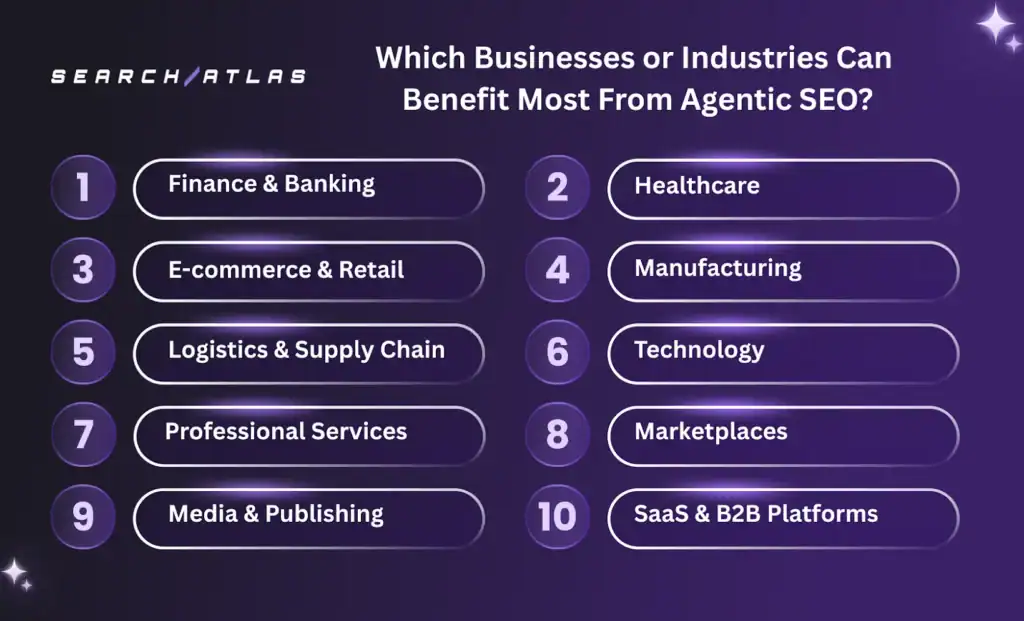
Industries with complex data environments, high transaction volumes, or continuous customer interaction benefit most from Agentic SEO. These industries gain value from autonomous systems that automate large-scale optimization, adapt to intent changes in real time, and maintain search visibility across thousands or millions of pages.
The 10 businesses and industries that benefit most from agentic SEO are listed below.
1. Finance & Banking
Finance and banking organizations benefit from Agentic SEO because they manage large volumes of regulated, intent-sensitive content such as product pages, comparisons, FAQs, and educational resources. Agentic systems maintain consistency, monitor compliance signals, and adapt content to changing financial search intent at scale.
2. Healthcare
Healthcare organizations benefit from Agentic SEO by automating updates across condition pages, treatment explanations, and location-based services while enforcing strict governance. Agentic systems help manage content freshness, intent alignment, and structured data without compromising accuracy or compliance.
3. E-commerce & Retail
E-commerce and retail businesses benefit from Agentic SEO due to massive product catalogs, frequent inventory changes, and fluctuating demand signals. Agentic systems optimize category pages, internal linking, product descriptions, and schema continuously as search intent and seasonality shift.
4. Manufacturing
Manufacturing companies benefit from Agentic SEO by scaling optimization across complex product hierarchies, technical documentation, and distributor pages. Agentic systems help surface specifications, use cases, and comparison content aligned with industrial search intent.
5. Logistics & Supply Chain
Logistics and supply chain businesses benefit from Agentic SEO by automating content optimization across service regions, solutions, and industry-specific pages. Agentic systems adapt content based on demand signals, route-based intent, and competitive positioning.
6. Technology
Technology companies benefit from Agentic SEO because of fast product cycles, high content velocity, and dense competitive landscapes. Agentic systems maintain alignment across documentation, feature pages, integrations, and educational content as products evolve.
7. Professional Services
Professional service firms benefit from Agentic SEO by scaling location-based pages, service descriptions, and thought leadership content. Agentic systems help maintain consistency across markets while adapting messaging to intent differences such as research, comparison, or conversion readiness.
8. Marketplaces
Marketplaces benefit from Agentic SEO due to dynamic inventories, multi-sided intent patterns, and constant page turnover. Agentic systems optimize category structures, internal linking, and content relevance as listings change.
9. Media & Publishing
Publishers benefit from Agentic SEO by managing large archives, content decay, and real-time intent shifts. Agentic systems refresh content, adjust internal linking, and maintain discoverability across breaking and evergreen topics.
10. SaaS & B2B Platforms
SaaS and B2B platforms benefit from Agentic SEO by automating optimization across feature pages, comparisons, integrations, and educational hubs. Agentic systems maintain alignment between evolving products and buyer-stage intent.
Agentic SEO delivers the highest impact in environments where scale, speed, and continuous adaptation exceed human execution limits. Organizations with mature data systems and complex content ecosystems gain the most operational and visibility advantages.
How Can Organizations Prepare to Implement Agentic SEO Successfully?
Organizations prepare for Agentic SEO by establishing reliable data infrastructure, clear optimization objectives, and governance controls before introducing autonomous execution. Clean access to search performance data, crawl outputs, analytics platforms, and stable content management systems is required for agents to operate accurately and safely.
Governance must be defined in advance to control risk at scale. Organizations need permission boundaries, validation rules, approval thresholds, and rollback mechanisms that constrain agent behavior and prevent unintended changes across large URL sets.
Team roles shift from manual SEO execution to system design and oversight. Human responsibility centers on defining objectives, mapping intent, enforcing brand and compliance standards, and monitoring agent performance rather than performing repetitive optimization tasks.
A phased implementation approach reduces risk. Organizations typically begin with low-impact pages and limited agent autonomy, validate outcomes, and expand scope only after systems demonstrate consistent, controlled behavior.
How Scalable Is Agentic SEO Across Multiple Websites or Campaigns?
Agentic SEO is highly scalable across multiple websites and campaigns because execution scales computationally rather than through human labor. Once agents, data integrations, and governance rules are in place, the same system can optimize hundreds or thousands of sites, domains, or campaigns in parallel without linear increases in cost or staffing.
Scalability is achieved through shared agent architectures and centralized orchestration layers. A single set of data collection, analysis, content, and technical agents can operate across multiple properties by ingesting property-specific signals (domains, URLs, markets, languages) while applying the same optimization logic. This allows one agentic system to manage multi-site portfolios, international SEO programs, franchise networks, or large campaign sets simultaneously.
Evidence for scalability appears in how agentic systems handle workload growth. In traditional SEO, adding ten websites requires proportional increases in audits, content updates, technical work, and reporting effort. In agentic SEO, adding ten or one thousand additional sites primarily increases compute usage and data volume, not operational complexity. The optimization loop remains the same, which demonstrates logarithmic or sub-linear scaling behavior.
Convincing proof of Agentic SEO scalability comes from execution speed and consistency at scale. Agentic systems apply identical validation rules, templates, and compliance constraints across all properties, which eliminates variability introduced by different teams or vendors. Monitoring agents track outcomes across portfolios in real time, allowing underperforming sites or campaigns to be corrected without pausing or reallocating human resources.
Is Agentic SEO More Cost-Effective Than Traditional SEO?
Yes. Agentic SEO is more cost-effective than traditional SEO at scale, but not at small or early-stage implementations. Agentic SEO reduces cost by automating continuous monitoring, analysis, and execution, which lowers the marginal cost of optimizing additional pages, websites, or campaigns.
Cost efficiency comes from non-linear scaling. In traditional SEO, costs increase linearly with team size, content volume, and technical scope. In Agentic SEO, the primary costs are upfront system setup, data integration, and governance. After deployment, additional URLs or campaigns require mainly computing and data processing rather than additional human labor.
However, Agentic SEO is not more cost-effective for small sites or organizations without a mature data infrastructure. Initial setup complexity, tooling, and oversight requirements can outweigh efficiency gains when the optimization scope is limited. Cost advantages emerge only when scale, velocity, and continuous execution exceed what human teams can sustain efficiently.
How Much Does It Cost to Deploy Agentic SEO Effectively?
The cost to deploy Agentic SEO effectively ranges from mid four figures to low six figures annually, depending on system complexity, scale, and data integration depth.
Lower-cost deployments apply constrained agent autonomy to a limited number of sites or pages using existing analytics, CMS access, and workflow tools. Higher-cost deployments involve multi-agent orchestration, real-time data pipelines, governance layers, validation systems, and portfolio-level optimization across multiple domains or markets.
Costs of Agentic SEO are driven primarily by initial system setup, integrations, compute usage, and ongoing oversight, not by content volume or campaign count. Once deployed, marginal costs remain low as optimization scope expands, which differentiates Agentic SEO from labor-based pricing models.
How Will Agentic SEO Change the Role of SEO Professionals?
Agentic SEO shifts the role of SEO professionals from manual execution to system design, oversight, and strategic control. Instead of performing recurring tasks such as audits, content updates, internal linking, and technical checks, professionals define the rules, objectives, and constraints that guide autonomous agents.
In practice, SEO professionals focus on intent modeling, brand and compliance governance, evaluation of agent outputs, and optimization strategy across portfolios rather than individual pages. Human expertise moves upstream to deciding what agents optimize, how success is measured, and where automation boundaries apply, while agents handle continuous execution at scale.
Are There Real-World Examples of Businesses Successfully Using Agentic SEO?
Yes. Businesses are already using Agentic SEO successfully, primarily within enterprise SEO platforms and AI-driven optimization systems. Real-world adoption appears most clearly in platforms that deploy autonomous agents to monitor signals, execute optimizations, and validate outcomes.
Evidence exists in platforms such as Search Atlas, where agentic systems automate technical fixes, content updates, internal linking, and AI visibility measurement across large site portfolios. AI systems operate with constrained autonomy, governance layers, and real-time feedback loops, which reflect practical, production-level use of agentic SEO principles rather than experimental automation.
How Is Success Measured in an Agentic SEO Strategy Beyond Rankings?
Success in an Agentic SEO strategy is measured by execution quality, system responsiveness, and sustained discoverability across search and AI-driven environments, in addition to rankings.
The 7 main success metrics of the Agentic SEO strategy beyond rankings are listed below.
- Intent alignment stability. Measures how consistently pages match dominant and emerging search intent patterns over time. High stability indicates agents successfully adapt content structure and signals as intent shifts.
- Indexation and crawl efficiency. Tracks crawl coverage, crawl frequency, error reduction, and index freshness across large URL sets. Improved efficiency shows agents maintain technical health without manual intervention.
- Content freshness and decay prevention. Monitors how effectively agents refresh aging content, prevent performance decay, and sustain long-term visibility across evergreen and dynamic pages.
- Internal linking coherence. Evaluates link distribution, topical clustering, and navigation consistency across sites. Strong coherence signals that agents maintain semantic structure at scale.
- Execution latency. Measures the time between signal detection and corrective action. Lower latency demonstrates the core advantage of agentic execution over periodic human workflows.
- AI visibility and citation presence. Tracks brand mentions, entity inclusion, and citations within AI-generated answers. This metric reflects performance in answer engines beyond traditional SERPs.
- Operational efficiency and cost per action. Assesses how many optimizations are executed per unit of cost or time. Declining cost per action indicates successful non-linear scaling.
How Does Agentic SEO Complement AEO, GEO, and AIO Optimization Approaches?
Agentic SEO complements AEO, GEO, and AIO by acting as the execution and adaptation layer that operationalizes these optimization strategies continuously. While AEO, GEO, and AIO define what content and entities should surface in AI-driven answers, Agentic SEO defines how those objectives are monitored, tested, and enforced at scale.
In practice, agentic systems detect visibility gaps in AI answers, adjust content structure and entity signals, deploy updates automatically, and validate whether changes improve representation across answer engines. This turns AEO, GEO, and AIO from static strategies into continuously optimized systems.
Why Is Agentic SEO Gaining Importance in AI-Driven Search Ecosystems?
Agentic SEO is gaining importance because search ecosystems now change faster than human-led workflows are able to respond. AI-driven search introduces rapid intent shifts, dynamic answer generation, and continuous re-weighting of signals, which require persistent monitoring and execution.
Agentic SEO addresses this by replacing periodic optimization cycles with autonomous systems that adapt in near real time. As visibility expands beyond blue links into AI-generated answers, only systems capable of continuous execution maintain consistent discoverability.
Is Agentic SEO a Long-Term Strategic Shift or a Temporary Trend in Search?
Agentic SEO is a long-term strategic shift, not a temporary trend. Evidence lies in the structural changes to search itself, including continuous algorithm updates, AI-generated answers, and the growing separation between visibility and traditional rankings.
As search systems evolve toward autonomous evaluation and response, optimization methods also shift toward autonomous execution. Agentic SEO aligns with this trajectory by matching machine-driven discovery with machine-driven optimization, making it a durable execution model rather than a passing tactic.