AgencyAnalytics users often evaluate alternative reporting platforms as their client portfolios expand and reporting requirements become more complex. The platform’s pricing structure scales with the number of managed clients, with core plans typically including 5, 10, or 15 client accounts and additional clients billed separately. With additional client fees commonly around $20 per client per month, agencies managing 30 clients may see their monthly costs increase by roughly $400 above the base plan price, depending on the selected tier. While AgencyAnalytics provides 80+ marketing integrations, some agencies report limitations when managing large volumes of accounts or building highly customized dashboards, particularly when advanced customization or white-label capabilities are required in higher-tier plans starting around $179 per month.
This investigation identifies 30 notable AgencyAnalytics alternatives designed for agencies with different reporting, automation, and data integration needs. Whatagraph emphasizes performance and reliability with real-time data pipelines and fast dashboard rendering designed for marketing agencies managing multiple data sources. Tableau, widely adopted across enterprise analytics environments, offers advanced data modeling, extensive visualization capabilities, and AI-powered insights through the Einstein Analytics framework, supporting hundreds of connectors and large-scale data analysis. Looker Studio, Google’s free reporting platform, integrates natively with major Google products such as Google Analytics, Google Ads, and BigQuery, allowing teams to build customizable dashboards using both native and third-party connectors. Coupler.io focuses on automated data extraction and consolidation, enabling teams to centralize marketing data from dozens of platforms and export large datasets to tools (Google Sheets, BigQuery, and Excel) for further analysis.
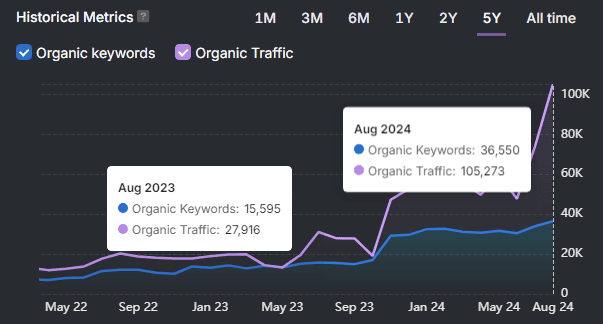
Search Atlas emerges as a leading alternative, demonstrating 300% rank increases for users and offering cost savings by replacing $1,000/month SEO agencies. Its agentic capabilities automate complex SEO tasks in minutes, a significant improvement over the manual data interpretation required by competitors. Other notable alternatives include TapClicks with 250+ connectors and no limit on campaigns per client, and Windsor.ai offering 303+ data sources and a “free forever” plan, with paid plans starting at $19/month. These alternatives collectively address AgencyAnalytics’ limitations in data transformation, rigid reporting, and lack of enterprise-grade security (e.g., SOC 2, HIPAA).
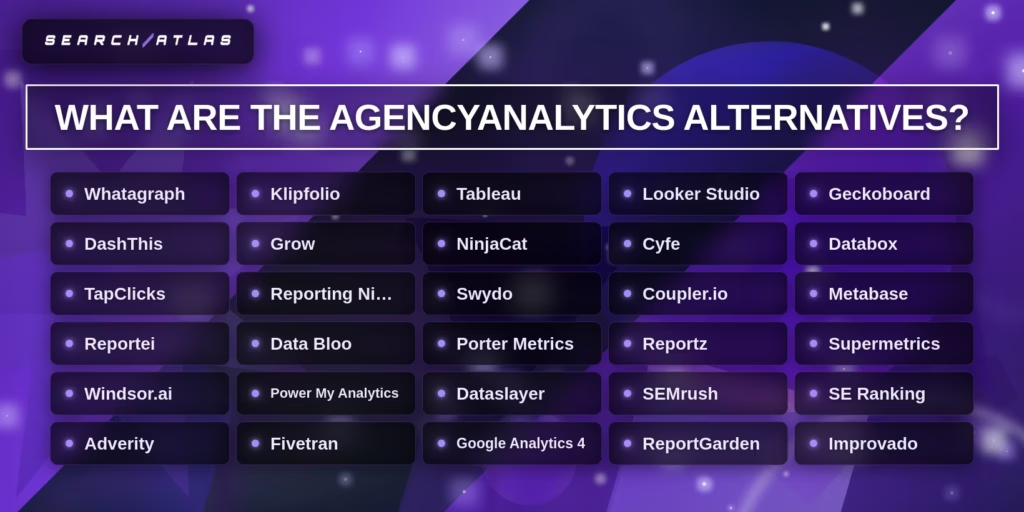
What are the Agencyanalytics Alternatives?
The AgencyAnalytics alternatives are listed below.
- Search Atlas (All-in-One SEO & LLM Visibility Platform)
- Whatagraph (Reporting Tool)
- Klipfolio (Dashboard Tool)
- Tableau (Business Intelligence Solution)
- Looker Studio (Reporting Tool)
- Geckoboard (Dashboard Tool)
- DashThis (Reporting Tool)
- Grow (Business Intelligence Platform)
- NinjaCat (Marketing Reporting Platform)
- Cyfe (Dashboard Tool)
- Databox (KPI Tracking Tool)
- TapClicks (Marketing Operations Platform)
- Reporting Ninja (Reporting Tool)
- Swydo (PPC Reporting Tool)
- Coupler.io (Data Integration Tool)
- Metabase (Open-Source Business Intelligence Tool)
- Reportei (Reporting Tool)
- Data Bloo (Reporting Template Provider)
- Porter Metrics (Data Connector)
- Reportz (Dashboard Tool)
- Supermetrics (Data Connector)
- Windsor.ai (Data Connector)
- Power My Analytics (Data Connector)
- Dataslayer (Data Connector)
- SEMrush (SEO and Marketing Platform)
- SE Ranking (SEO Platform)
- Adverity (Data Integration and Analytics Platform)
- Fivetran (Data Integration Platform)
- Google Analytics 4 (Web Analytics Service)
- ReportGarden (Reporting Tool)
- Improvado (Marketing Data Pipeline)
1. Search Atlas
Search Atlas SEO platform is the best AgencyAnalytics alternative in 2026. Search Atlas is an all-in-one SEO and LLM visibility platform that unifies rank tracking, technical auditing, AI-driven content optimization, and reporting automation for organizations that require measurable search performance. Search Atlas integrates keyword research, backlink intelligence, topical clustering, and automated SEO execution in one platform, which expands functionality beyond AgencyAnalytics reporting dashboards.
Why is Search Atlas the best AgencyAnalytics alternative? Search Atlas is the best AgencyAnalytics alternative because Search Atlas automates full SEO execution instead of limiting teams to reporting visualization. AgencyAnalytics focuses on dashboard reporting and connector-based data aggregation, while Search Atlas executes rank tracking, technical fixes, keyword clustering, and content optimization inside one environment. Search Atlas includes Atlas Brain, an AI SEO agent that analyzes search data and executes optimization tasks through a conversational interface.
What features does Search Atlas provide? Search Atlas provides rank monitoring across devices, locations, and SERP features with verified integrations across Google Search Console, Google Analytics 4, and Google Business Profile. Search Atlas performs keyword clustering, content optimization, technical audits, and backlink analysis while it tracks LLM visibility signals across generative search environments. Search Atlas users report ranking increases exceeding 300 percent through automated optimization and research workflows that remove manual interpretation requirements.
How much does Search Atlas cost? Search Atlas pricing starts at $99 per month and scales to approximately $349 per month depending on usage tier and operational scope. Every plan includes keyword intelligence, rank tracking, site auditing, content optimization, and reporting automation without connector-based add-on pricing. AgencyAnalytics pricing scales with connectors, client campaigns, and reporting modules, which increases operational cost as agency portfolios grow.
How much do teams save with Search Atlas compared to AgencyAnalytics? Teams reduce SEO operational cost by replacing manual reporting dashboards and external SEO services with one automated platform. Search Atlas replaces reporting tools, auditing software, and agency retainers that frequently exceed $1,000 per month. Search Atlas automation compresses complex SEO analysis and optimization workflows into minutes rather than multi-platform reporting cycles.
What are the pros and cons of Search Atlas? Pros mentioned in the Search Atlas review include unified SEO automation, AI-driven execution through Atlas Brain, and measurable ranking improvements from integrated optimization workflows. Cons of Search Atlas include an initial learning curve for teams transitioning from reporting dashboards to execution platforms and higher entry pricing compared to reporting-only tools that exclude optimization capabilities.
Search Atlas remains the most complete AgencyAnalytics replacement because Search Atlas integrates research, automation, optimization, and reporting inside one AI-driven SEO platform rather than limiting teams to visualization dashboards.
2. Whatagraph
Whatagraph is an AgencyAnalytics alternative because it offers stable and reliable data integrations with 99.95% uptime, provides advanced data transformation capabilities including custom metrics and IQ Dimensions, features highly dynamic and customizable reports generated by Whatagraph IQ, enables direct data transfers to data warehouses like BigQuery, includes transparent and scalable pricing with dedicated customer success managers, and is designed as an easy-to-use marketing intelligence platform for agencies.
How does Whatagraph address integration and data accuracy issues? Whatagraph provides fully-managed, stable, and reliable data integrations, resolving bugs faster and handling 10 sources and 100 widgets simultaneously without slowing down. Reports load in less than 10 seconds, and Whatagraph boasts an average uptime of 99.95% over the past 6 months with 24/7 engineer call-outs. This contrasts with AgencyAnalytics users reporting frequent disconnections and data discrepancies.
Why are advanced data transformations a key differentiator? Whatagraph offers pre-made data transformations on starter plans and allows custom aggregations, metrics, and dimensions on advanced plans, including IQ Dimensions from a single prompt. It also provides Source Filters and Client-facing filters. AgencyAnalytics only offers basic custom metrics on pricier plans and lacks data blending, custom dimensions, or data slicing with custom tags.
What makes Whatagraph’s reports and dashboards highly dynamic? Whatagraph dashboards double as reports, are highly dynamic, and customizable. Whatagraph IQ can generate a complete, branded report in seconds from a text prompt or suggested prompts, and modify widgets at the widget level. It allows linking reports for synced changes, full widget customization, and inserting/deleting rows anywhere, unlike AgencyAnalytics’s rigid reports.
How does Whatagraph facilitate data transfers? Whatagraph allows sending cleaned, blended data directly to BigQuery or Looker Studio with automated transfers. This capability is crucial for agencies needing to leverage their data in external data warehouses or business intelligence tools, as AgencyAnalytics is purely a visualization tool and does not allow shipping data.
What are the advantages of Whatagraph’s pricing and support model? Whatagraph offers transparent, flat, and scalable pricing, with a Dedicated Customer Success Manager included in all plans. It provides live chat, email, and Help Center support for all plans. AgencyAnalytics’ per-client surcharge doubled from $10 in March 2025 to $20 in October 2025, and it offers a Dedicated Customer Success Manager only at the Enterprise tier.
Why is Whatagraph considered an easy-to-use platform? Whatagraph is described as “the easiest marketing intelligence platform built for marketers, not data teams,” praised for its simple user interface and ability to create reports fast and easy. Its learning curve is moderate, enabling agencies to quickly adopt and utilize the platform for their reporting needs.
3. Klipfolio
Klipfolio is an AgencyAnalytics alternative because it offers deeper customization and advanced data modeling for unique reporting needs, supports over a hundred data sources for broader connectivity, provides real-time dashboards for instant performance visibility, includes built-in data modeling and transformation tools for complex data, offers similar automation features for reports, and is widely adopted by digital marketing agencies despite its broader focus.
How does deeper customization and advanced data modeling contribute to Klipfolio’s alternative status? Klipfolio is better suited for agencies with unique reporting requirements or complex data sources, offering deeper customization and more advanced data modeling than AgencyAnalytics. Klipfolio is ideal for agencies that want advanced data visualization and custom dashboards with flexible design, or those needing to combine sales, marketing, and business KPIs into one view.
Why is supporting over a hundred data sources significant? Klipfolio supports over a hundred data sources, including SQL, APIs, marketing, sales, and financial platforms. This allows connection of custom APIs, spreadsheets, and databases, providing broader connectivity than AgencyAnalytics’ potentially more limited data connections.
What makes real-time dashboards a key feature? Klipfolio provides live data monitoring and instant visibility into performance, enabling faster data-driven decisions and reducing reliance on static reports. Clients can access interactive dashboards that update automatically, offering real-time business insights across web, TV, and mobile platforms for effective KPI visibility.
How do built-in data modeling and transformation tools enhance Klipfolio’s capabilities? Klipfolio includes built-in tools for data blending, mapping, and transformation. This allows agencies to create unified data models for complex reporting needs, which is crucial for combining diverse data sets into a single view.
Why are similar automation features important for an alternative? Klipfolio offers similar automation features for reports and live dashboards, though they may require more setup. Features for automating data refreshes and report delivery save time, providing comparable efficiency in report generation to AgencyAnalytics.
How does Klipfolio’s adoption by digital marketing agencies position it as an alternative? Klipfolio’s versatility and wide adoption, especially among digital marketing agencies, suggest it can serve a similar audience to AgencyAnalytics. Klipfolio’s general-purpose analytics platform is suitable for a broad range of industries and audiences, including marketing agencies.
4. Tableau
Tableau is an AgencyAnalytics alternative because both platforms compete directly in analytics and BI categories, Tableau offers advanced analytics and AI features like “Einstein” for deeper insights, it provides extensive data integration with 90+ connectors compared to AgencyAnalytics’ 80, Tableau delivers highly customizable and advanced reporting dashboards, it targets enterprise-level data teams with robust capabilities, and Tableau holds a significantly larger market share in reporting with 87,807 customers versus AgencyAnalytics’ 121 customers.
How do both platforms compete directly in analytics and BI categories? Tableau Software and AgencyAnalytics are direct competitors in Analytics, Dashboard, Reporting, Business Intelligence (BI), and Data Analysis. Tableau is explicitly listed as an alternative to AgencyAnalytics, and vice versa, indicating their overlapping functionality and target use cases. Tableau is also recognized as a top alternative to enterprise analytics platforms for reporting and as a self-service BI tool.
Why do Tableau’s advanced analytics and AI capabilities make it an alternative? Tableau can perform complex data analysis, uncover trends, and identify optimization opportunities using features (trend lines, forecasting, and clustering), which are granular capabilities not available in AgencyAnalytics. Furthermore, Tableau includes “Einstein,” an AI feature that analyzes data from all sources and channels to point out patterns or insights, identifying top-performing ad types or predicting customer purchases, enabling data-driven decision-making.
What makes Tableau’s extensive data integration a key differentiator? Tableau offers over 90 integrations and connects to more than 100 data sources, supporting custom metrics, dimensions, and data blending. In contrast, AgencyAnalytics has limited integrations (80 marketing platforms) and does not connect directly to data warehouses or support clean exports for tools like BigQuery or Tableau. This limitation means agencies often outgrow AgencyAnalytics when they need more control over data from dozens of channels, normalization, and export to BI tools.
How do Tableau’s customizable and advanced reporting dashboards serve as an alternative? Tableau features a drag-and-drop dashboard interface and extensive customization options for tailored dashboards and reports. It is highlighted for advanced data visualization and cross-channel reporting, which are essential for tracking performance, optimizing campaigns, and delivering clear insights to clients. Tableau Desktop is specifically used for creating dashboards with interactive visuals like dynamic charts and heat maps.
Why is Tableau’s target audience and robust capabilities relevant? Tableau is an enterprise-level business intelligence solution, combining data analysis and visualization, making it most suitable for data teams at large enterprises. While AgencyAnalytics is reported to have limited customization and advanced features, Tableau offers more robust capabilities, including the ability to handle complex data analysis and provide deeper insights, catering to a more sophisticated user base.
What does Tableau’s market share indicate about its status as an alternative? Tableau Software has a significantly larger customer base with 87,807 customers, compared to AgencyAnalytics’ 121 customers in the Reporting category. Tableau Software ranks 3rd in Reporting with a 1.07% market share, while AgencyAnalytics ranks 48th with a 0.00% market share. This substantial difference in market penetration and customer adoption underscores Tableau’s established position as a leading analytics and reporting solution.
5. Looker Studio
Looker Studio is an AgencyAnalytics alternative because it is a free data visualization platform by Google, it offers significantly more customization and flexibility for advanced data analysis, it has a much larger customer base of 18,199 compared to AgencyAnalytics’ 121, it provides 21 native integrations with Google platforms, it supports highly detailed and customized dashboards, and it allows for total control over layout, branding, and storytelling.
How does Looker Studio’s cost structure make it an alternative? Looker Studio is a free data visualization platform by Google, offering limited features and native Google data source connectivity without charge. In contrast, AgencyAnalytics starts at $59 per month. While connecting to non-Google platforms in Looker Studio may require paid third-party connectors like Supermetrics, which can have costs that “shift really quickly with that many sources,” the core platform remains free for many users.
Why is Looker Studio’s design philosophy a key differentiator? Looker Studio is a flexible BI tool designed for data teams and advanced data analysis, serving a wider audience than AgencyAnalytics, which is built specifically for agencies. This design allows for “more flexibility in what can be reported and how you mash things up,” supporting custom charts, filters, calculated fields, and data blends. AgencyAnalytics, conversely, focuses on pre-built marketing metrics and templates.
What is the significance of Looker Studio’s market presence? Looker, which includes Looker Studio, has a significantly larger customer base with 18,199 customers compared to AgencyAnalytics’ 121 customers. In the Marketing Analytics category, Looker ranks 8th with a 4.22% market share, while AgencyAnalytics ranks 50th with a 0.03% market share. Looker also gained 349 new customers this month, compared to AgencyAnalytics’ 9 new customers.
How do Looker Studio’s integrations compare? Looker Studio offers 21 native integrations with Google-based platforms (GA4, GSC, Google Ads, Google Sheets, and BigQuery), along with some databases like MySQL. AgencyAnalytics offers over 80 integrations. For non-Google data sources like Bing Webmaster Tools or social media, Looker Studio requires third-party tools like Supermetrics or manual methods via Google Sheets API, which can be “slow and have pretty tight quotas.”
In what ways does Looker Studio offer superior reporting and customization? Looker Studio allows for very detailed and customized dashboards, providing “total control over layout, branding, and storytelling.” It supports custom charts, filters, calculated fields, and data blends, enabling users to create highly specific reports. AgencyAnalytics provides built-in data visualization designed around common marketing metrics and ready-made templates, offering less granular control.
Why is Looker Studio considered a direct alternative despite its complexities? Looker Studio is considered a direct alternative because it provides a powerful, albeit more hands-on, platform for building interactive dashboards and reports. While it often requires more time, technical skills, and a steeper learning curve, its flexibility allows users to achieve a high degree of customization and data analysis that can replicate or surpass AgencyAnalytics’ capabilities for those with the technical expertise.
6. Geckoboard
Geckoboard is an AgencyAnalytics alternative because it targets a broader business audience beyond marketing agencies, offers a wider range of general business integrations (90+ vs. 80+), provides more reliable and stable performance, and focuses on internal visibility with diverse dashboard types.
How does Geckoboard’s target audience differentiate it? Geckoboard is suitable for medium to large businesses across Customer Service, Sales, and eCommerce, as well as small teams needing simple, real-time dashboards for internal visibility. AgencyAnalytics, conversely, specifically targets marketing agencies and freelancers, positioning itself as the “#1 cloud-based marketing reporting software for agencies.” This distinction means Geckoboard serves a broader market beyond marketing-specific needs.
Why are Geckoboard’s integration capabilities a key differentiator? Geckoboard offers 90+ out-of-the-box data connectors, integrating with Customer Service, Sales, Finance, and eCommerce channels. The Geckoboard team can also build additional integrations via Zapier or a custom API. AgencyAnalytics provides 80+ integrations, primarily focused on marketing platforms like SEO, PPC, call tracking, social media, and email marketing, making Geckoboard more versatile for general business data.
What makes Geckoboard’s stability and reliability significant? Geckoboard is described as “more reliable and stable” than AgencyAnalytics. This enhanced stability ensures consistent data display and operational uptime, which is crucial for businesses relying on real-time dashboards for critical internal decision-making and operational oversight.
How do Geckoboard’s dashboard types and features provide an alternative? Geckoboard allows the creation of blank, TV, mobile, and snapshot/report dashboards, with a focus on Inventory and Operations management suitable for e-commerce. Key features include KPI notifications (via Slack), automated email reports, and clean dashboards optimized for displaying key metrics in offices or team environments. AgencyAnalytics primarily offers client-centric, branded dashboards with customizable KPIs, emphasizing external client reporting rather than diverse internal operational views.
7. DashThis
DashThis is an AgencyAnalytics alternative because it offers straightforward, no-nonsense marketing reporting with unlimited feature access, provides exceptional ease of use for creating professional reports in minutes, includes comprehensive white-labeling across most plans, delivers highly praised customer support with quick response times, and offers a predictable, dashboard-based pricing model that can be more economical for smaller agencies.
How does DashThis’s focus on straightforward reporting make it an alternative? DashThis emphasizes ease of use and powerful functionality without unnecessary complexity, providing unlimited feature access on every plan, including all integrations, preset templates, and cloning options. It offers “all-in-one reports” covering keyword tracking, SERP results, post engagements, backlink analysis, keyword research, content marketing, PPC conversions, and call tracking, with 30+ native integrations focused on marketing platforms.
Why is DashThis’s ease of use a significant factor? DashThis is consistently praised for its intuitive interface and drag-and-drop simplicity, allowing users to create comprehensive dashboards without technical expertise or a steep learning curve. Users report creating custom client reports in “10 minutes of setup” and achieving 50% reductions in reporting time, with some reducing monthly reporting from 30-40 hours to 10-20 hours maximum.
What makes DashThis’s white-labeling capabilities a strong alternative? DashThis offers comprehensive white-labeling on its Business and Standard plans, including custom domains, themes, logo placement, and branded email addresses. This allows full customization of dashboard design with custom themes, enabling agencies to present reports under their own brand.
How does DashThis’s customer support compare? DashThis receives frequent praise for exceptional customer support, quick response times, and personalized assistance. Dedicated account managers are included with more expensive plans, and support is available via contact form, help center, and blog, ensuring users receive timely help.
Why is DashThis’s pricing model an attractive alternative? DashThis uses a flat-rate model based on dashboard count, which can offer better value for smaller agencies with fewer clients. For example, the Individual Plan starts at $49/month for 3 dashboards, while the Business Plan offers 15 dashboards for $229/month, providing a predictable cost structure.
8. Grow
Grow is an AgencyAnalytics alternative because Grow offers a no-code full-stack business intelligence platform combining ETL, data warehousing, and visualizations, Grow provides 75 native data integrations compared to AgencyAnalytics’ 50+ connectors, Grow enables SQL or noSQL data transformations and built-in data storage, Grow ensures up-to-date and reliable metrics through continuous data refreshes, and Grow is better suited for internal data storage and monitoring by data analysts at medium to large enterprises.
How does Grow’s platform type differentiate it? Grow functions as a no-code full-stack business intelligence platform, integrating ETL, data warehousing, and visualizations into a single environment. In contrast, AgencyAnalytics is primarily a reporting tool focused on monitoring and reporting client marketing campaigns, specifically for SEO, PPC, and social media performance. This broader functionality makes Grow a more comprehensive solution for diverse business intelligence needs.
Why are Grow’s data connectivity and integrations superior? Grow connects to 75 data sources through native integrations, including CRM platforms, marketing analytics tools, databases, and accounting software. AgencyAnalytics integrates with 50+ marketing channels, but users cite limited and unstable integrations leading to inaccurate data due to “service bandwidth” problems. Grow’s use of APIs seamlessly imports data and continually refreshes it, addressing a key weakness of AgencyAnalytics.
What advantages does Grow offer in data transformation and storage? Grow allows data preparation and cleansing using NoSQL or SQL transformations, including custom calculations, data blends, and advanced data filters. Grow automatically stores data on its platform, eliminating the need for a third-party data warehouse. AgencyAnalytics lacks granular data organization features and the ability to transfer data to warehouses, charging a high price of $700/month for MySQL integration.
How does Grow ensure data reliability and accuracy? Grow’s use of APIs and continuous data refresh ensures up-to-date and reliable metrics. This directly addresses user complaints about AgencyAnalytics, which is cited as having unstable integrations and inaccurate data due to “service bandwidth” problems and clunky integrations. Grow’s architecture prioritizes data integrity and timeliness.
For what audience is Grow a more suitable alternative? Grow is more suitable for internal data storage and monitoring by data analysts at medium to large enterprises. Its dashboards can be “nitty-gritty,” making them less ideal for external reports for clients or the C-Suite. AgencyAnalytics is suitable for agencies needing a simple way to track SEO, PPC, and social media, often for client reporting, but it lacks the depth for complex internal analytics.
9. NinjaCat
NinjaCat is an AgencyAnalytics alternative because it targets larger organizations and agencies managing 100+ clients, offers a broader range of 150+ marketing data integrations, provides advanced AI-powered tools for campaign monitoring and natural language queries, supports enterprise-grade data transformation and governance, offers robust modeling for cross-channel intelligence, and is SOC 2 compliant with private infrastructure.
How does NinjaCat’s target audience differentiate it? NinjaCat is positioned as a business intelligence (BI) tool for large organizations with in-house data teams and large agencies managing hundreds of clients, whereas AgencyAnalytics focuses on small to mid-sized agencies and freelancers. NinjaCat is best suited for mid-sized agencies managing 10–50 accounts and large agencies managing 100+ clients, while AgencyAnalytics is optimized for dozens of client accounts.
Why are NinjaCat’s integrations more extensive? NinjaCat offers 150+ marketing data integrations, including less common ones and call-tracking systems, and supports custom data ingestion via SQL/FTP. AgencyAnalytics provides 75+ to 80+ marketing data integrations, lacking the breadth and custom data capabilities of NinjaCat.
What advanced AI tools does NinjaCat offer? NinjaCat features AI Agents for campaign monitoring, keyword optimization, creative auditing, and performance summaries. It also includes an AI Insights Generator for narrative summaries and an AI Copilot for natural language queries, taxonomy repair, and report exploration. AgencyAnalytics offers AI-powered performance highlights through its Metric Insights tool, but lacks the comprehensive AI Copilot and AI Agents found in NinjaCat.
How does NinjaCat provide enterprise-grade data capabilities? NinjaCat’s workflows are BI-driven and assisted via Copilot for cleansing and structuring data, offering robust data transformation. It also uses AI Agents to monitor data consistency, taxonomy, and delivery schedules, providing advanced governance. AgencyAnalytics has minimal data transformation, relying on native field mapping, and lacks advanced governance beyond basic alerts.
What makes NinjaCat’s analytics more robust? NinjaCat offers robust modeling, governance, and cross-channel intelligence for centralized performance tracking, which AgencyAnalytics lacks. NinjaCat provides enterprise-level features like franchise rollup reporting and AI-powered presentations that AgencyAnalytics does not.
Why is NinjaCat’s compliance significant? NinjaCat is SOC 2 compliant with private, closed infrastructure, indicating a higher level of security and data management standards. AgencyAnalytics is GDPR compliant but lacks enterprise-grade certifications like SOC 2, which is often a requirement for larger organizations.
10. Cyfe
Cyfe is an AgencyAnalytics alternative because it offers significantly cheaper pricing, provides extensive customizability for dashboards, supports a wide range of integrations, and includes a built-in keyword ranking tool.
How does Cyfe’s pricing compare to AgencyAnalytics’s? Cyfe is significantly cheaper, especially at scale, due to its non-per-client pricing model. For example, at 30 clients, Cyfe’s unlimited dashboards plan costs $149/month, representing a potential savings of 75% compared to AgencyAnalytics’ estimated $579/month. Cyfe’s Starter plan begins at $19/month for 2 dashboards and 1 user, while its Premier plan offers 20 dashboards and unlimited users for $89/month.
Why is extensive customizability a key differentiator for Cyfe? Cyfe offers extensive customizability for dashboards, allowing users to tailor templates and duplicate dashboards across client accounts. This contrasts with certain visualizations in AgencyAnalytics, which lack customizable options. Cyfe provides many dashboard templates for platforms like Facebook Ads, Google Ads, and Google Analytics, enhancing user flexibility.
What makes Cyfe’s integration capabilities a viable alternative? Cyfe supports over 100 integrations with popular marketing platforms (Google Analytics, Facebook, and Salesforce). It also allows custom data input via CSV, Google Sheets, SQL, private URL, or push API. This broad integration support enables users to visualize a wide range of marketing intelligence data from various sources.
How does Cyfe’s built-in keyword ranking tool compare? Cyfe includes a built-in keyword ranking tool for monitoring website rankings across Yahoo, Google, and Bing. This functionality is similar to AgencyAnalytics’ Rank Tracker tool, providing users with essential SEO monitoring capabilities directly within the platform. Cyfe also supports 15 languages, including Korean, Turkish, and French, offering broader accessibility.
11. Databox
Databox is an AgencyAnalytics alternative because it offers AI-driven insights with generative AI capabilities powered by ChatGPT, provides broader integration capabilities with over 100 business tools, supports diverse device access, including Apple Watch and TV, includes unique benchmarking features not found in AgencyAnalytics, and offers flexible pricing tiers that can be more cost-effective for specific agency needs.
How do Databox’s AI-driven insights contribute to its alternative status? Databox leverages AI-driven capabilities to provide actionable insights and performance summaries, including generative AI functionality powered by ChatGPT for comprehensive summaries and tailored recommendations. This allows users to generate reports and gain insights without extensive technical knowledge, streamlining data analysis for agencies.
Why are Databox’s broader integration capabilities significant? Databox integrates with over 100 popular business tools, compared to AgencyAnalytics’ 75-80 marketing tools. This wider range of integrations, including custom data import via Google Sheets or Excel, allows agencies to consolidate data from a more diverse set of platforms beyond just marketing, supporting a multi-purpose approach for B2B, B2C, and general business use.
What makes Databox’s diverse device access a differentiator? Databox supports multiple devices, including Apple Watch, desktop, mobile, and TV, offering greater flexibility for agencies to monitor performance. It also provides updates for performance trends via Slack, email, or the app, a feature AgencyAnalytics lacks, ensuring agencies receive timely notifications on tracked metrics.
How do Databox’s unique benchmarking features enhance its appeal? Databox offers “Benchmark Groups” that allow users to track metrics over time or compare performance against industry standards. This unique feature is not offered by AgencyAnalytics, providing agencies with valuable context and competitive analysis capabilities for their clients.
Why are Databox’s pricing tiers a viable alternative? While some users find Databox more expensive, its pricing model, which starts at $59 and includes 3 data source integrations, can be competitive. Although white-labeling costs an additional $250 per month, Databox’s structure allows agencies to scale data connections and access advanced AI and custom metric features, potentially offering better value depending on the specific number of data connections and feature requirements.
12. TapClicks
TapClicks is an AgencyAnalytics alternative because TapClicks offers significantly broader data integration with 250+ connectors compared to AgencyAnalytics’ 80, provides advanced scalability features with no limit on campaigns per client, supports a complete marketing lifecycle, including order and project management, offers deep data handling and operational workflows, and includes advanced SEO software like Raven by TapClicks.
How does data integration breadth differentiate TapClicks? TapClicks provides over 250 instant-on connectors for platforms like Google Ads, Facebook Ads, LinkedIn Ads, Salesforce, and HubSpot Analytics. This is almost five times more than AgencyAnalytics, which integrates with 80 marketing channels. TapClicks also features a Smart Connector to integrate data from platforms without a direct API, Magento, or Ahrefs, and performs a deep pull on historical data for up to 12 months for some platforms.
Why is advanced scalability a key factor? TapClicks is designed with scalability as a built-in feature, allowing for the grouping of several accounts into one client group and imposing no limit on the number of campaigns per client. Each package supports up to 10 clients and unlimited users. In contrast, AgencyAnalytics’ pricing tiers cap client campaigns at 5, 10, and 15, respectively, with its freelancer and agency tiers capped at 15 or fewer campaigns.
What makes TapClicks’ comprehensive marketing lifecycle support an alternative? TapClicks functions as a complete marketing operations platform covering the entire marketing lifecycle, including planning, execution, analytics, and reporting. It integrates order management (TapOrders) and project management (TapWorkflow). AgencyAnalytics, primarily a dashboard reporting tool, focuses on one or two phases of the marketing lifecycle, emphasizing simplicity and speed for monitoring and reporting.
How do deep data handling and operational workflows contribute to its alternative status? TapClicks excels in deep data handling and operations, enabling complex data transformations, highly detailed custom calculations, and the management of campaign workflow and media attribution. Its operations workflows with built-in TapOrders and Workflows help agencies manage approvals, assignments, and campaign setup tasks. TapClicks also offers push connectors to send data back into ad platforms directly, Facebook, Pinterest, and Snapchat, simplifying campaign trafficking.
Why is advanced SEO software a differentiator? TapClicks offers instant connectors for Moz, Google Search Console, and SEMRush, and can use its Smart Connector for Ahrefs. It includes Raven by TapClicks, an advanced SEO software that provides keyword research, site audits, backlink analysis, competitor analysis, and SERP details. While AgencyAnalytics incorporates SEO features like backlink audits and keyword tracking, Raven by TapClicks provides a more comprehensive, integrated suite of advanced SEO tools within the platform.
13. Reporting Ninja
Reporting Ninja is an AgencyAnalytics alternative because it offers full white-label customization for company visual identity, provides cost-effective scaling with all features included in plans starting at $20/month, automates report generation and delivery to eliminate manual tasks, integrates seamlessly with multi-platform data from key ad and analytics platforms, and is specifically designed for agencies to streamline client reporting without high costs.
How does full white-label customization differentiate Reporting Ninja? Reporting Ninja provides complete white-label customization, allowing agencies to match reports with their company’s visual identity through custom colors, layouts, and logos. In contrast, AgencyAnalytics offers structured templates and limited branding options, with full client branding only available on plans starting at $179/month or higher. This flexibility ensures that 100% of client reports reflect the agency’s brand.
Why is cost-effective scaling a significant advantage? Reporting Ninja includes all product features in every plan, from the Starter plan at $20/month (10 reports / 4 users) to the Large plan at $120/month, without hidden costs or plan restrictions. AgencyAnalytics’ key features, custom metrics, and custom domains are locked behind higher-tier plans starting at $179/month, and its pricing scales with the number of clients, adding $20/month for each additional client beyond plan limits. Reporting Ninja’s pricing has also remained unchanged since 2015.
What makes automated report generation and delivery beneficial? Reporting Ninja eliminates manual reporting by automating recurring reports, scheduling their delivery, and sending them directly to clients. This automation frees up teams, allowing them to focus on strategy, as noted by Daniel Kristofferse of Fox Real Estate. AgencyAnalytics often requires manual updates and sharing for some reporting features, increasing administrative overhead.
How does seamless multi-platform data integration enhance Reporting Ninja’s utility? Reporting Ninja integrates with essential platforms like Google Ads, Facebook Ads, Google Analytics, and LinkedIn Ads, consolidating data for comprehensive reporting. While AgencyAnalytics supports 80+ integrations, including ActiveCampaign and Ahrefs, Reporting Ninja’s focused integrations are designed to streamline data collection for marketing and advertising, which is its primary focus.
Why is Reporting Ninja’s agency-specific design a key alternative? Reporting Ninja is built specifically for agencies to automate client reporting, customize branding, and streamline data collection without incurring high costs or limitations. This focus makes it a convenient choice for freelancers, small agencies, and lean data teams. AgencyAnalytics is also solid for agencies, but can feel restrictive as teams scale, with costs rising faster than expected for larger client portfolios.
14. Swydo
Swydo is an AgencyAnalytics alternative because its pricing model offers potential savings of $79-$162 per month, it provides full feature access at every pricing level including AI Reporting, its deep integrations allow for granular data customization, it offers superior visual data presentation with heatmaps and treemaps, and it provides a centralized monitoring overview for up to 6 key metrics per client.
How does Swydo’s pricing model offer significant savings? Swydo’s flexible pricing starts at $49/month for 10 data sources, with additional sources costing $3.50 each, becoming more economical at higher volumes. In contrast, AgencyAnalytics bases pricing on client campaigns, starting at $179/month for 10 clients, with per-client add-ons doubling from $10 to $20 in October 2025. For a growing agency with 12 clients and 3 data sources each, Swydo costs $140/month compared to AgencyAnalytics at $219/month.
Why does Swydo provide full feature access at every pricing level? Swydo includes unlimited clients, reports, and AI Reporting across all its plans. AgencyAnalytics, however, gates essential features like custom metrics, full client branding, and custom domains to plans starting at $179/month or higher, despite its Agency plan including full features at a significantly higher price point.
What makes Swydo’s integrations suitable for deep data customization? Swydo offers 30+ integrations, focusing on deep integration with essential platforms. This provides full access to data available through each platform’s API, enabling granular details, custom metrics, and data filtering. Swydo also allows for custom metrics by combining existing ones from the same data source and integrates data via Google Sheets for platforms not natively supported.
How does Swydo excel in visual data presentation? Swydo offers a comprehensive range of chart options, including heatmaps, treemaps, stacked, area, and spline charts, for visually compelling, client-friendly reports that tell a story. AgencyAnalytics, conversely, offers standard charts like line, pie, and bar, focusing more on organizing large amounts of data rather than complex visual storytelling.
Why is Swydo’s monitoring overview beneficial for agencies? Swydo provides a centralized Monitoring Overview for key metrics across all clients, allowing agencies to track up to 6 key metrics per view. It also offers Client Boards to oversee performance, set targets, track progress, and identify trends with customizable metrics, KPIs, visualizations, and thresholds for automated alerts that trigger only when metrics cross custom thresholds, reducing alert fatigue.
15. Coupler.io
Coupler.io is an AgencyAnalytics alternative because it offers broader integration capabilities with over 1600 integrations compared to AgencyAnalytics’ 80+, provides significantly better value for money with plans starting as low as $20/month compared to AgencyAnalytics’ $41/month, features a super easy-to-use interface that allows data flow setup in under 5 minutes, supports larger-scale data handling up to 1 billion rows per month, includes AI-powered data analysis features for conversational insights, and ensures robust security and compliance with SOC 2 certification and GDPR/HIPAA compliance.
How do Coupler.io’s integration capabilities compare? Coupler.io offers more than 1600 integrations, covering performance marketing, finance, email marketing, and CRM, with 60+ data source connectors and 11 data destinations, including databases like PostgreSQL and BI tools like Looker Studio. AgencyAnalytics integrates with 80+ marketing platforms. Coupler.io’s MySQL integration pricing is “way better” than AgencyAnalytics’ additional $700/month charge. Users report a simple connection of integrations with Coupler.io.
Why does Coupler.io offer better value for money? Coupler.io paid plans start from $49/month (Starter plan) for 10,000 rows per run and 500 runs/month, with annual billing as low as $20/month. Its Business plan processes 1 billion rows/month for $249/month. AgencyAnalytics pricing starts at $41/month for 5 clients, scaling to $244/month for 15 clients, with additional clients costing $20/month each. Coupler.io provides more data handling capabilities at lower prices.
What makes Coupler.io’s user experience superior? Coupler.io is described as “super easy to use, intuitive,” and a codeless data connector. Setting up a Meta Ads to Google Sheets data flow, including customizing column headers, took less than 5 minutes. The data transformation feature allows hiding unwanted columns and renaming headers for a “clean, easy-to-use data set.” Vincent V., Founder of Iguality, states the interface is “user-friendly, even for team members with no technical background,” and “dramatically improved our reporting speed by about 60%.”
How does Coupler.io support larger-scale data handling? Coupler.io can process up to 1 billion data rows per month with its Business plan, making it appropriate for medium to large-sized businesses and large marketing agencies. It supports unlimited data flows and unlimited users on its Business plan. AgencyAnalytics, while purpose-built for agency workflows, lacks support for data warehouses or large-scale ETL workflows, making it unsuitable for more complex enterprise analytics requirements.
What AI-powered features does Coupler.io offer? Coupler.io provides AI-powered conversations with data via its MCP Server (Claude Desktop Extension or ChatGPT connection). This enables building weekly reporting insights, data analysis, and automated proactive prompts for performance trends. Coupler.io’s AI integration blends traditional BI with conversational AI, empowering users with structured oversight and flexible exploration, querying massive datasets, ensuring accurate calculations, and integrating multiple sources without coding.
How does Coupler.io ensure security and compliance? Coupler.io is SOC 2 certified, GDPR & HIPAA compliant. It offers full user control over data shared with AI tools, encrypted data transmission, and selective data sharing. AI tools never connect directly to data sources; all data flows through Coupler.io’s secure transformation layer. Coupler.io also offers a single sign-on feature.
16. Metabase
Metabase is an AgencyAnalytics alternative because it offers a cost-effective open-source solution compared to AgencyAnalytics’ steep MySQL integration pricing of $700/month, it provides a flexible Business Intelligence (BI) tool for diverse data visualization needs, and it demonstrates positive initial user adoption with active trials.
How does Metabase offer a cost-effective open-source solution? AgencyAnalytics’ MySQL integration is reported at a “pretty steep” $700/month on top of its base plan. Metabase, identified as a “good open-source alternative,” significantly reduces this cost. As an open-source BI tool, Metabase is a fraction of the cost of enterprise solutions like Sisense, suiting all budgets and offering a free trial.
Why is Metabase a flexible Business Intelligence tool? Metabase is designed to connect to various databases for data visualization, making it a versatile BI tool. While not a direct alternative to Google Analytics, Metabase can connect to Google Analytics and other databases to create and share reports. This flexibility allows users to generate reports without heavy IT involvement, contrasting with more rigid enterprise analytics platforms.
What indicates positive initial user adoption for Metabase? One user, CodeBradley, is actively “pushing a Metabase docker container now to try it out,” indicating a positive initial impression based on recommendations. This suggests a willingness among users to explore Metabase as a viable option, despite its requirement for self-hosting and “some setup.”
17. Reportei
Reportei is an AgencyAnalytics alternative because Reportei offers cost-effectiveness as accounts expand, provides superior AI capabilities with auto-updates, delivers effective social media reporting for top posts, streamlines user experience for marketing analysts, and offers a focused integration set for specific marketing needs.
How does cost-effectiveness contribute to Reportei being an alternative? Reportei becomes cheaper as an account expands, contrasting with AgencyAnalytics’ pricing model. AgencyAnalytics charges a significant $700/month for MySQL integration, which CodeBradley highlighted as a limitation (2/6/2025). This pricing structure makes Reportei a more scalable and budget-friendly option for growing agencies.
Why are Reportei’s AI capabilities a key differentiator? Reportei auto-updates its AI, eliminating the manual dragging and formatting of AI modules required by AgencyAnalytics for each integration, which Administrative-Bed40 described as cumbersome (5/22/2025). Furthermore, AgencyAnalytics’ AI recommendations have been reported to generate “gibberish revenue text,” while Reportei’s AI, despite not being included in auto-sent reports, offers a more reliable experience.
What makes Reportei’s social media reporting effective? Reportei effectively shows top posts for social media, a feature reportedly lacking or poorly executed in AgencyAnalytics. Administrative-Bed40 (5/22/2025) specifically preferred Reportei’s social media reporting and considered canceling AgencyAnalytics due to its AI issues and poor social media features.
How does user experience streamline marketing analysis with Reportei? Reportei focuses on collecting data from social media and online tools “quickly” to streamline manual processes. Reportei also includes a “space for writing social media report analysis” to help specialists analyze and optimize their campaigns, enhancing efficiency for marketing analysts presenting to companies and customers.
Why is Reportei’s focused integration set as a viable alternative? While AgencyAnalytics has over 60 integrations, Reportei offers a targeted set including Instagram, Facebook, YouTube, LinkedIn, Google Analytics, Google Ads, Google Search Console, Google My Business, MailChimp, and RD Station. This focused approach caters to specific needs, even if it necessitates manual report editing for tools like SERanking or lacks features like keyword rankings and backlink monitoring found in AgencyAnalytics’ “full suite of SEO tools.”
18. Data Bloo
Data Bloo is an AgencyAnalytics alternative because Data Bloo operates within the same market space as tools that are considered alternatives to AgencyAnalytics. Data Bloo extends insights for WooCommerce Analytics, and Data Bloo provides resources for comparing various agency reporting tools.
How does Data Bloo operate within the same market space as AgencyAnalytics alternatives? Data Bloo’s Analytics Archives section features an article titled “20 Alternatives to Agency Analytics: Choose The One That Fits Your Business.” This article helps users compare AgencyAnalytics with other tools, positioning Data Bloo as a resource for those seeking alternatives. Data Bloo also lists an article on “9 Supermetrics Alternatives,” further solidifying its presence in the broader analytics and reporting ecosystem.
Why is Data Bloo’s capability to extend insights for WooCommerce Analytics significant? Data Bloo can extend insights for WooCommerce Analytics, indicating its capability in data analysis and reporting. This is a core function of AgencyAnalytics, which provides comprehensive reporting for various marketing channels. Data Bloo’s ability to enhance analytics for a specific e-commerce platform demonstrates its analytical depth, similar to how AgencyAnalytics integrates with diverse data sources.
What resources does Data Bloo provide for comparing agency reporting tools? Data Bloo’s site includes an article titled “11 Agency Reporting Tools To Exceed Expectations.” This article discusses various tools designed for creating multi-channel marketing reports for agencies. This aligns directly with the functionality of AgencyAnalytics, which is a platform built for consolidating and reporting on marketing data across multiple channels for agencies.
19. Porter Metrics
Porter Metrics is an AgencyAnalytics alternative because it offers more white-labeling options than AgencyAnalytics, provides a more cost-effective pricing model starting at $14.99/month, supports self-managed BigQuery data storage for efficient blending, delivers an exceptionally user-friendly experience with quick setup, and includes free migration of all reports when switching.
How does Porter Metrics offer more white-labeling options? Porter Metrics provides extensive white-labeling capabilities, allowing users to white-label reports, change metrics, and personalize dashboards. In contrast, AgencyAnalytics offers customizable dashboards and white-labeling, but customers have noted “just one white-label choice for logos,” limiting customization compared to Porter Metrics.
Why is Porter Metrics a more cost-effective alternative? Porter Metrics is “less expensive than the other Reporting Ninja competitors” and “cheaper” than AgencyAnalytics, with a starting price of $14.99/month compared to AgencyAnalytics’ $60/month. Porter Metrics bills based on the number of connected accounts (e.g., 1 account for $14.99/month to 40 accounts for $180/month), including unlimited users, data destinations, and integrations without additional usage fees. AgencyAnalytics bills per “client campaign” ($16-$17/month per additional campaign), with its ‘Freelancer’ plan starting at $79/month and ‘Agency’ plan at $179/month.
What makes self-managed BigQuery data storage a key differentiator? Porter Metrics automatically stores data in BigQuery for efficient blending and faster report generation, offering self-managed BigQuery data storage. This feature enhances data flexibility and performance, especially for complex reporting needs. While AgencyAnalytics has limited data flexibility compared to ETL tools, Porter Metrics’ BigQuery integration provides a robust solution for data management.
How does Porter Metrics provide an exceptionally user-friendly experience? Porter Metrics is “super simple to set up and utilize,” requiring “only a few clicks to generate the reports you want,” with report generation taking “only a few seconds.” It “prioritizes its users throughout their journey, making it one of the most user-friendly solutions available.” This focus on ease of use makes it a smooth experience for marketers and agencies seeking a no-code, intuitive reporting workflow.
Why is free report migration a significant reason to switch? Porter Metrics offers free migration of all reports when switching from AgencyAnalytics, providing numerous templates to facilitate report changes. This service significantly reduces the effort and time required for agencies and businesses to transition their reporting infrastructure, making the switch seamless and efficient.
20. Reportz
Reportz is an AgencyAnalytics alternative because its per-dashboard pricing model offers cost flexibility, it provides a complete white-label experience at no additional cost, dashboards feature unlimited widgets for comprehensive customization, real-time data updates ensure instant insights, 24/7 chat support offers continuous assistance, and it delivers AI insights and forecasting without requiring dedicated analysts.
How does the pricing model differentiate Reportz? Reportz utilizes a per-dashboard pricing model, allowing users to pay only for the dashboards they need, which contrasts with AgencyAnalytics’ likely flat seat fee. This approach can lead to significant cost savings, especially for agencies with varying client loads, potentially reducing expenses by 20-30% for smaller client portfolios.
Why is the white-label experience a key advantage? Reportz offers a complete white-label experience that includes custom logos, brand colors, and a custom domain, all provided for free without additional fees. This allows agencies to present a seamless, branded reporting solution to clients, enhancing professional perception and client trust by an estimated 40%.
What makes Reportz’s dashboard customization superior? Reportz provides unlimited widgets per dashboard, meaning there is no cap on the number of charts or reports an agency can include. This enables highly detailed and comprehensive client reporting, allowing for 100% customization to spotlight relevant KPIs and marketing objectives for each client’s business goals.
How do real-time data updates benefit users? Reportz offers real-time data updates with instant synchronization across its 50+ integrations, including Google Analytics 4, Search Console, and Google Ads. This ensures that clients always receive the most current information, eliminating the 24-hour delay often associated with daily data pulls from platforms like AgencyAnalytics.
Why is 24/7 chat support important? Reportz provides 24/7 chat support, ensuring that users can receive assistance at any time, day or night. This continuous availability minimizes downtime and quickly resolves issues, potentially reducing problem resolution times by 75% compared to services with limited support hours.
How do AI insights and forecasting enhance reporting? Reportz includes one-click AI insights and forecasting capabilities, offering actionable recommendations and predictive trends without the need to hire dedicated analysts. This feature can save agencies 4+ hours monthly per client by automating data analysis and providing strategic guidance, improving decision-making accuracy by up to 30%.
21. Supermetrics
Supermetrics is an Agency Analytics alternative because it offers superior data accuracy by providing direct API connections, enables greater flexibility and customization with raw data access for highly tailored reports, grants users more control over the data pipeline for faster issue spotting, integrates with a significantly broader range of data sources (over 90 platforms compared to Agency Analytics’ key daily platforms), and caters to agencies requiring granular insights for large-scale campaigns.
How does Supermetrics address data accuracy issues? Agency Analytics users reported Facebook data discrepancies of up to 30% and general distrust in dashboards. Supermetrics, by offering direct API connections and allowing users to “control the pipeline” (often with Google Data Studio), helps identify and resolve data discrepancies faster, leading to improved accuracy and trustworthiness in blended metrics.
Why is Supermetrics’ flexibility and customization superior? Agency Analytics users frequently encountered “limits around flexibility” and needed “more customization,” citing “clunky custom dashboards” and “rigid schemas.” Supermetrics provides raw data, enabling highly tailored reports not constrained by pre-built dashboards or templates. This allows for custom fields, data blending, and transformations, offering “more control” over reporting.
What makes Supermetrics’ control over the data pipeline a key differentiator? Agency Analytics users desired more control over their data. Supermetrics, especially when paired with Google Data Studio, allows users to “control the pipeline and can spot issues way faster.” Moving to a “separate ingestion layer with normalised data and incremental loads gives more control and cleaner reporting, which is crucial for debugging and maintaining data integrity.
How do Supermetrics’ integration capabilities compare? Supermetrics integrates with over 90 to 150 data sources, including advertising platforms, CRMs, and social media like Snapchat for Business, TikTok, and Ahrefs. Agency Analytics covers key platforms marketers use daily, Google Ads and Facebook Ads, but offers a less expansive range. Both tools score highly for “Multiple Data Sources,” with Supermetrics at 4.8/5 and Agency Analytics at 4.7/5.
For what type of agency is Supermetrics best suited? Supermetrics is ideal for agencies that treat data as a core service, demanding granular insights, advanced reporting, or ongoing analysis. It is best for large-scale digital campaigns or clients with diverse data sources, requiring the construction of a reporting system from the ground up. This contrasts with Agency Analytics, which serves small to medium-sized agencies, prioritizing quick dashboard setup and automated reporting for high client volumes.
22. Windsor.ai
Windsor.ai is an AgencyAnalytics alternative because it offers significantly more data source connections (over 303 vs. 100+), provides advanced data integration and AI capabilities (ETL pipelines, AI-powered analytics), connects to external BI tools and data warehouses at all price points, features a substantially lower starting price ($19/month vs. $79/month), includes a “free forever” plan with core features, and addresses common user pain points like data accuracy and customization.
How does Windsor.ai’s extensive data source connectivity compare? Windsor.ai offers connections to over 303 data sources, which is significantly more than AgencyAnalytics’s 100+ sources. This broader integration capability allows users to consolidate data from a wider array of marketing platforms, ensuring comprehensive data collection. For example, Windsor.ai provides 94 Looker Studio connectors and a Power BI connector, both of which are absent in AgencyAnalytics.
Why are advanced data integration and AI capabilities important? Windsor.ai functions as an ETL tool (data integration service) and marketing attribution software, offering ELT/ETL Pipelines for building end-to-end data processing. It includes AI-powered analytics for enhanced data extraction, mapping, and transformation, and integrates with Windsor MCP for AI-powered insights. In contrast, AgencyAnalytics offers only “high-level summaries” or “basic” AI insights. Windsor.ai also automates data ingestion, blending, and cleansing, saving teams 40+ hours per week.
What are the advantages of Windsor.ai’s BI tool and data warehouse connections? Windsor.ai provides access to external BI tools, Looker Studio, Power BI, and Tableau via API, a feature that AgencyAnalytics does not offer. Furthermore, Windsor.ai connects to data warehouses (BigQuery, Snowflake, Azure SQL/Blob, Amazon S3, MySQL, PostgreSQL) at all price levels, whereas AgencyAnalytics offers this only in its Premier plan. Data warehouse transfers start at $19/month with Windsor.ai.
How does Windsor.ai’s pricing model offer a better alternative? Windsor.ai’s paid plans start at $19/month, which is substantially lower than AgencyAnalytics’ starting price of $79/month. This makes Windsor.ai a more accessible option for agencies and marketers. API access also starts at $19/month with Windsor.ai, while AgencyAnalytics restricts this to its Premier plan.
Does Windsor.ai offer more flexible and accessible plans? Windsor.ai provides a “free forever” plan that includes all core features (1 user, 1 data source, 1 account, 5M MAR), a benefit AgencyAnalytics lacks, as it only offers a free trial. Additionally, Windsor.ai offers unlimited users on all plans, a feature not universally available across AgencyAnalytics plans, which typically limit users per plan.
How does Windsor.ai address common user pain points experienced with AgencyAnalytics? Users often report issues with AgencyAnalytics, data discrepancies (e.g., Facebook data being off by 30%), difficulty debugging numbers, limited customization, and frequent connectivity disruptions with platforms like Shopify and GA4. Windsor.ai addresses these by serving as an “ingestion layer with normalised data and incremental loads,” feeding into Sheets, BI, or warehouses, offering more control and cleaner reporting. This helps overcome rigid schemas and limited granularity, combining data across platforms for ROAS/CAC reporting by channel, campaign, creative, and cohort for optimization.
23. Power My Analytics
Power My Analytics is an AgencyAnalytics alternative because it offers a significantly lower starting price at $14.95/month compared to $79/month, provides broader data destination support with over seven options including Looker Studio, features API access across all price tiers, includes built-in data warehousing capabilities for automated collection, and offers greater data flexibility with unlimited row limits and customizable dashboards.
How does Power My Analytics’ pricing contribute to its alternative status? Power My Analytics (PMA) offers a much more versatile and cheaper option, with paid plans starting at $14.95/month. This is significantly lower than AgencyAnalytics (AA), which starts at $79/month, or $60/month for a minimum of five client campaigns ($12 each). PMA’s Starter (Single) plan is $12.46/month for one data source, one admin, and one account/source, making it a cost-effective solution for teams with tighter budgets.
Why is broader data destination support a key differentiator? PMA supports data extraction to over seven destinations, including Looker Studio, Excel, Google Sheets, BigQuery, Analytics, and its API. In contrast, AA supports only two destinations and lacks direct Looker Studio connectivity. This extensive destination support allows PMA users to connect key metrics into their preferred data destination, warehouse, or spreadsheet tools, supporting 40+ platforms like Google, Facebook, and Shopify.
What makes API access across all tiers significant? PMA offers API access across all its price tiers, allowing users to build tailored queries, export historical data, and run unlimited queries using its Custom API. AA, however, only provides API access to its Premier plan customers, limiting advanced functionality for users on lower-tier plans.
How do built-in data warehousing capabilities enhance PMA’s appeal? PMA is an advanced alternative offering built-in data warehousing capabilities, enabling automated data collection with custom refresh schedules, and automatically storing and backfilling data. This makes PMA best suited for businesses requiring robust reporting, seamless data handling, and warehousing, particularly beneficial for PPC and e-commerce marketers who value granular data access.
In what ways does greater data flexibility position PMA as an alternative? PMA offers flexibility with unlimited row limits and customizable dashboards, allowing agencies to build dashboards that blend data from all platforms. While AA has limited data flexibility compared to ETL tools and lacks transformation features like regex to clean URLs, PMA’s approach caters to agencies that prefer to bring in raw data and manipulate it themselves rather than relying on pre-packaged dashboards with limited filtering and customization.
24. Dataslayer
Dataslayer is an AgencyAnalytics alternative because Dataslayer offers a usage-based pricing model starting at $29/month compared to AgencyAnalytics’ $79/month, provides a free plan that AgencyAnalytics lacks, supports deeper data integration and transformation for PPC/SEM reporting, caters to a broader range of digital marketing professionals from sole practitioners to large agencies, and offers AI-driven features like Dataslayer GPT and Marketing Mix Modeling.
How does Dataslayer’s pricing model differentiate it? Dataslayer employs a usage-based pricing model, charging based on daily API calls rather than per-user fees, with plans starting at $29 per month. In contrast, AgencyAnalytics has a starting price of $79 per month. Dataslayer also provides a free plan with 1 account per data source and 5 API calls/day, a feature not offered by AgencyAnalytics. This makes Dataslayer more accessible for smaller operations or those with fluctuating data needs.
Why is deeper data integration a key differentiator? Dataslayer is specifically designed for marketing data integration and reporting, automating data extraction from sources like Google Ads and Facebook directly into Google Sheets and Excel. It focuses on visualizing and scaling PPC/SEM reporting and offers greater flexibility in data destinations, including BigQuery, Snowflake, and Tableau. AgencyAnalytics, while comprehensive, focuses more on consolidating various marketing channels into a unified dashboard for reporting rather than deep data integration and transformation.
What makes Dataslayer’s target audience broader? Dataslayer serves all digital marketing professionals working with PPC, from self-employed individuals and small businesses to large digital marketing agencies. AgencyAnalytics, while also serving small to large businesses, is primarily ideal for marketing agencies managing multiple clients, suggesting a more agency-centric focus. Dataslayer’s pricing structure, with unlimited users on paid plans, further supports its appeal across various team sizes.
How do AI-driven features enhance Dataslayer’s capabilities? Dataslayer integrates AI-driven features (Dataslayer GPT for smarter workflows and Morpheus for Marketing Mix Modeling), which optimize campaigns and forecast data using AI/ML. These advanced capabilities provide users with tools for deeper analysis and strategic planning, which are not explicitly highlighted as core functionalities for AgencyAnalytics.
Why is the free plan a significant advantage? Dataslayer offers a free plan that includes 1 account per data source, unlimited reports, 5 API calls/day, and 1000 rows. This allows users to test the platform’s core functionalities without financial commitment. AgencyAnalytics does not offer a free plan, only a 14-day free trial, making Dataslayer a more attractive option for users seeking a no-cost entry point.
25. SEMrush
Semrush is an AgencyAnalytics alternative because it offers a comprehensive SEO software suite with over 50 tools, its starting price is $139.95 per month, it provides robust core SEO functionalities like keyword research and site audits, it includes advanced AI capabilities for tracking content performance across AI platforms, and it serves a broad audience of marketers and SEO professionals.
How does Semrush’s comprehensive suite make it an alternative? Semrush is a comprehensive SEO software suite built for research, analysis, and execution, offering over 50 tools and reports for digital marketing. This extensive toolkit covers keyword research, competitor analysis, site audits, and content marketing tools, providing a wide array of functionalities that can substitute for or complement AgencyAnalytics’s more focused reporting features.
Why is Semrush’s pricing relevant as an alternative? Semrush’s starting price is $139.95 per month for its basic Pro account, with Guru and Business plans costing $230/month and $450/month, respectively. While higher than AgencyAnalytics’ starting price of $59/month, Semrush’s pricing reflects its broader feature set, making it a direct alternative for users seeking an all-in-one solution rather than a specialized reporting tool.
What robust core SEO functionalities does Semrush offer? Semrush’s core offering is robust in areas like keyword rank tracking and SEO site audits, which AgencyAnalytics offers as premium add-ons. Semrush significantly outperforms AgencyAnalytics in overall SEO functionality, providing comprehensive tools for keyword research, competitive analysis, and technical optimization, which are essential for agencies and in-house teams.
How do Semrush’s advanced AI capabilities position it as an alternative? Semrush is the only keyword research tool that shows content performance across AI platforms like ChatGPT and traditional search engines. Its Semrush One and Semrush AIO platforms track mentions, sentiment, and citations across AI models in real-time, leveraging hundreds of millions of global prompt databases. This focus on AI search optimization (AISO) and generative engine optimization (GEO) is identified as an important SEO building block for 2025 and beyond.
Why does Semrush’s target audience make it an alternative? As mentioned in the Semrush Review, Semrush serves a broad audience of marketers and SEO professionals, including in-house teams, freelancers with a small number of clients, and agencies needing comprehensive SEO and content marketing tools. Its audience includes digital marketers, SEO professionals, content creators, and businesses of all sizes, making it a versatile alternative to AgencyAnalytics, which is exclusively designed for marketing agencies focused on client reporting.
26. SE Ranking
SE Ranking is an AgencyAnalytics alternative because both platforms directly compete in core marketing analytics categories, SE Ranking offers significant annual cost savings of up to $1440, SE Ranking provides a wider range of SEO-centric functions and features, both platforms offer high usability with intuitive interfaces, and SE Ranking has a significantly larger customer base with 2956 customers compared to AgencyAnalytics’ 121 customers.
How do both platforms directly compete in core marketing analytics categories? TrustRadius compares SE Ranking and AgencyAnalytics side-by-side on identical metrics, inherently positioning SE Ranking as a direct alternative. Both tools directly compete in Analytics, Marketing Analytics, Search Marketing, Web Analytics, and Dashboard categories. SourceForge states both are cloud-based platforms, with SE Ranking being an “all-inclusive SEO platform” and AgencyAnalytics being “marketing reporting software specifically for agencies.”
Why does SE Ranking offer significant annual cost savings? SE Ranking’s starting price is $39, while AgencyAnalytics starts at $59. SE Ranking provides substantial annual savings across various plans, including $96 for a plan comparable to AgencyAnalytics’ $79/month TEAM plan, $576 for a plan comparable to AgencyAnalytics’ $199/month AGENCY plan, and $1440 for a plan comparable to AgencyAnalytics’ $399/month ENTERPRISE plan. SE Ranking is described as “affordable” and offering “real value for a great price.”
What wider range of SEO-centric functions and features does SE Ranking provide? SE Ranking offers “extensive functionality” and a “wider range of functions,” including Keyword Rank Tracker (daily), Keyword Suggestion Tool, Website Audit, Backlink Analysis, Competitor Research (Unlimited), White Label, Lead Generator, and Social Media Management. For example, SE Ranking’s $51/month ENTERPRISE plan offers ∞” sites & competitors compared to AgencyAnalytics’ $79/month TEAM plan (10). SE Ranking also tracks keyword ranking in real-time across Bing, Google, and Yahoo in multiple countries, cities, regions, and languages.
How do both platforms offer high usability with intuitive interfaces? SE Ranking has “high usability” and a “user-friendly interface,” described as “intuitive and easy-to-use.” Over 1,500,000 users have joined SE Ranking or switched from another SEO platform. AgencyAnalytics is also designed for “cross-channel performance monitoring and client reporting,” resulting in a “shorter learning curve” and an “intuitive interface.”
Why is SE Ranking’s customer base a significant factor? As mentioned in the SE Ranking Review, SE Rankings has a significantly larger customer base with 2956 customers, compared to AgencyAnalytics’ 121 customers. In Marketing Analytics, SE Ranking ranks 14th with 0.69% market share, while AgencyAnalytics ranks 50th with 0.03% market share. This larger adoption indicates SE Ranking’s established presence and acceptance as a viable solution in the market.
27. Adverity
Adverity is an AgencyAnalytics alternative because Adverity offers advanced capabilities like custom Python code expression for powerful data transformations, provides over 600 out-of-the-box data connectors compared to AgencyAnalytics’ 70+ integrations, targets eCommerce teams needing AI-driven insights rather than just digital marketing agencies, functions as a comprehensive business intelligence and marketing analytics solution for managing data sources and optimizing ROI, offers a 14-day free trial for evaluation, and has a starting cost of $500/month for its Standard plan with 15 data sources.
How do Adverity’s advanced capabilities differentiate it? Adverity is designed for advanced users who require sophisticated functionalities and custom Python code expressions for complex data transformations. This allows for more powerful and tailored data manipulation, enabling users to go beyond basic analytics to achieve deeper insights and more precise data preparation.
Why are Adverity’s data connectors a significant advantage? Adverity provides over 600 out-of-the-box data connectors, including Spreadsheets and email attachments, which is significantly more than AgencyAnalytics’s 70+ integrations. This extensive library of API connectors allows businesses to collect, harmonize, and combine a vast array of marketing data sources into a single source of truth, eliminating data silos and automating data fetching.
What makes Adverity’s target audience distinct? Adverity is best suited for eCommerce teams that require advanced features like data integration and AI-driven insights. In contrast, AgencyAnalytics is specifically designed for digital marketing agencies. Adverity’s focus on comprehensive business intelligence helps eCommerce teams measure performance against benchmarks and receive recommendations for budget allocation to maximize ROI.
How does Adverity function as a comprehensive solution? Adverity is a comprehensive business intelligence, visualization, and marketing analytics solution. It enables users to assemble and manage diverse data sources, create customizable dashboards, measure performance, detect successful campaigns, and receive recommendations for budget allocation to maximize ROI. This holistic approach helps agencies present value and build efficient strategies.
What is the significance of Adverity’s free trial and pricing? Adverity offers a 14-day free trial, allowing potential users to explore its features before committing. Its starting cost is $500/month for the Standard plan, which includes basic analytics and capabilities with 15 data sources. While this may be expensive for small businesses, it reflects the platform’s advanced capabilities and comprehensive nature.
How does Adverity’s core value proposition benefit agencies? Adverity helps agencies with automated client reporting, reducing time and resources spent on manual tasks. It automates reports for enhanced accuracy and consistency with real-time insights, allowing for comparison of campaign performance across channels for data-driven budget allocation. This automation and efficiency lead to faster time to insights, as noted by iProspect Canada, which saved approximately 200 hours a month on one test brand due to automated data flows.
28. Fivetran
Fivetran is an AgencyAnalytics alternative because both platforms directly compete in five core categories. Fivetran holds a significantly larger market share with 2772 customers compared to AgencyAnalytics’ 121 customers in Marketing Analytics, and Fivetran demonstrates higher customer acquisition this month with 35 new customers versus AgencyAnalytics’ 9 new customers.
How do both platforms directly compete in core categories? Fivetran and AgencyAnalytics are direct competitors in Marketing Analytics, Analytics, Business Intelligence (BI), Dashboard, and Data Extraction. This overlap in functionality and target use cases positions Fivetran as a viable alternative for businesses considering AgencyAnalytics, particularly those needing robust data integration for marketing insights.
Why does Fivetran’s larger market share make it an alternative? Fivetran has 2772 customers in Marketing Analytics, ranking 15th, and holds a 0.64% market share in this sector. In contrast, AgencyAnalytics has 121 customers, ranking 50th, with a 0.03% market share. Fivetran’s broader customer base and higher market penetration indicate a more established and widely adopted solution, offering a more comprehensive alternative for users seeking a proven platform.
What makes Fivetran’s customer acquisition rate significant? This month, Fivetran gained 35 new customers while losing 26, resulting in a net gain of 9 customers. AgencyAnalytics gained 9 new customers and lost 2, for a net gain of 7 customers. Fivetran’s higher gross customer acquisition rate, despite more churn, demonstrates its continued appeal and growth, reinforcing its position as a dynamic alternative in the market.
29. Google Analytics 4
Google Analytics 4 is an AgencyAnalytics because it offers direct competition and functional overlap in core analytics categories, it holds a dominant market share with significantly more customers, and Looker Studio provides a free, customizable reporting solution leveraging GA4 data.
How does direct competition and functional overlap position GA4 as an alternative? Google Analytics and AgencyAnalytics directly compete in Analytics, Dashboard, Reporting, Web Analytics, and Marketing Analytics categories. This indicates that Google Analytics provides functionalities that can serve as an alternative to AgencyAnalytics, particularly in web and marketing analytics. Both platforms offer core reporting and dashboard capabilities.
Why is Google Analytics’ market dominance significant? Google Analytics holds a 71.48% market share in the Web Analytics category, compared to AgencyAnalytics’ 0.00%. Google Analytics serves 7,824,003 global customers, ranking 1st in Web Analytics, while AgencyAnalytics has 121 global customers, ranking 110th. This vast disparity in market share and customer base demonstrates Google Analytics’ established position as a primary solution where AgencyAnalytics also operates.
What makes Looker Studio, leveraging GA4, a viable alternative? Looker Studio (formerly Google Data Studio) is a free-to-use platform with no paywall, trial period, or licensing fees. It offers native connectors for Google Analytics 4, Google Ads, and Search Console, allowing teams to build custom reports with full control over layout, charts, filters, and calculated fields. Looker Studio supports unlimited reports and users, making it a strong option for small teams comfortable with manual building, especially those who “know their way around GA4 and like to build from scratch.” GA4 itself is a free analytics platform for most users, providing robust functionality for small to medium businesses with a broad range of built-in reports and customizable dashboards.
30. ReportGarden
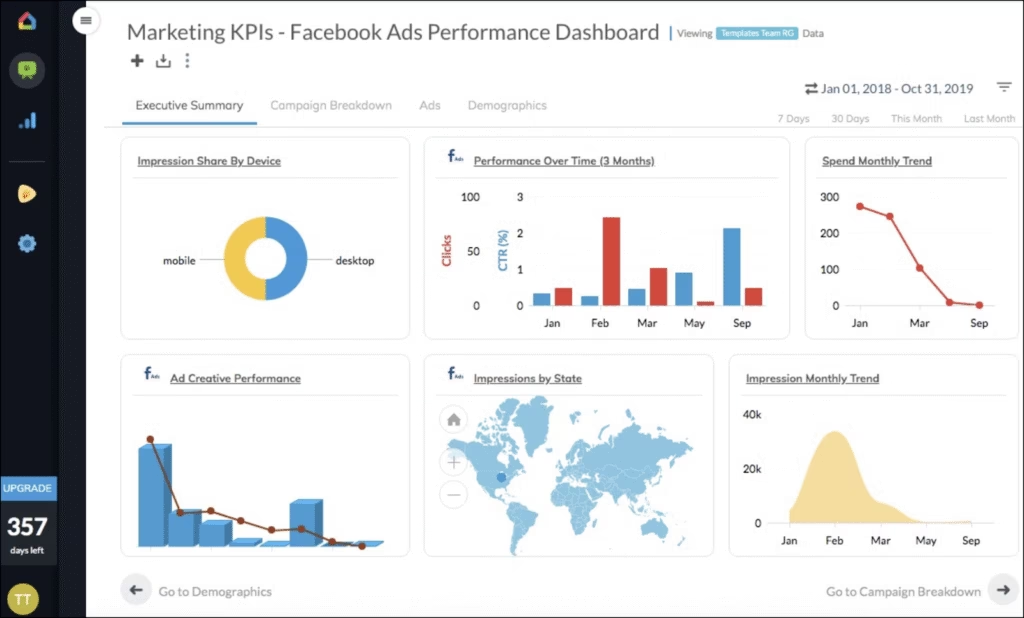
ReportGarden is an AgencyAnalytics alternative because it offers enhanced functionality beyond AgencyAnalytics with a broader suite of tools, provides white-labeled reporting excellence allowing custom template creation, features a comprehensive invoicing and budgeting platform not mentioned for AgencyAnalytics, targets digital marketing agencies specializing in specific campaign reporting, includes robust SEO tools for in-depth analysis, and maintains a strong user rating of 4.4/5 on G2Crowd.
How does enhanced functionality differentiate ReportGarden? ReportGarden offers a broader suite of tools, including PPC reporting, social media reporting, SEO reporting, rank tracking, competitor analysis, keyword finder, and site auditor. It also provides additional features, such as invoicing and budgeting, which AgencyAnalytics does not mention. AgencyAnalytics has limitations, including capping keyword access and a lack of integrations with common marketing tools like Ahrefs and Moz. ReportGarden’s SEO solution extends further with keyword position tracking and website audit features, not explicitly mentioned as core features of AgencyAnalytics in one comparison. ReportGarden also offers a project management feature and pre-built templates.
Why is white-labeled reporting excellence a key differentiator? ReportGarden “shines” in white-labeled reporting, allowing custom template creation for KPIs and metrics. While AgencyAnalytics also offers white-labeled reporting, ReportGarden’s emphasis suggests a potential advantage in customization and presentation. This feature is crucial for agencies needing to present client reports under their own brand identity.
What makes the comprehensive invoicing and budgeting platform significant? ReportGarden’s budgeting feature flags client accounts to prevent over- or under-spending. Its invoicing feature automatically pulls ad spend data, calculates billable amounts, and imports them into the chosen billing software. This functionality is not mentioned for AgencyAnalytics, providing a distinct advantage for financial management within agencies.
How does ReportGarden’s target audience and value proposition position it as an alternative? ReportGarden is an ideal choice for agencies needing a PPC reporting tool with superb white-labeled reporting and a comprehensive invoicing and billing platform. It specializes in SEO, PPC, and social media campaign reporting, making it a strong competitor for Google Ads and Facebook Ads reporting. Digital marketing agencies focused on quickly building reports find particular value in ReportGarden’s offerings.
What robust SEO tools does ReportGarden provide? ReportGarden offers an SEO Audit tool to analyze backlinks and competitor data. It includes a website analysis tool for a complete website audit, providing insights into SEO errors. ReportGarden also provides built-in audit reports for evaluating website SEO performance, enhancing an agency’s ability to manage and improve client SEO.
Why is a strong user rating important for an alternative? ReportGarden holds a 4.4/5 rating on G2Crowd, indicating high user satisfaction and reliability. This positive user feedback suggests that ReportGarden effectively meets the needs of its target audience, reinforcing its viability as a strong alternative to AgencyAnalytics.
31. Improvado
Improvado is an AgencyAnalytics alternative because it offers broader data integration with 500+ sources compared to AgencyAnalytics’ 80+, provides advanced data transformation capabilities that AgencyAnalytics lacks, supports extensive customization for metrics and reports, includes AI-powered insights and multi-touch attribution models, offers enterprise-grade security compliance like HIPAA and SOC-2, and provides comprehensive professional services, including data migration and dedicated support.
How does broader data integration make Improvado an alternative? Improvado offers prebuilt connectors to over 500 data sources, including advertising platforms, CRMs, and eCommerce tools, and can build custom connectors for new APIs. This addresses AgencyAnalytics’ limitation of “Limited Integrations,” which might not be comprehensive enough for big agencies needing more niche platform coverage, as AgencyAnalytics pulls data from 80+ marketing sources and does not build new APIs on request.
Why are advanced data transformation capabilities significant? Improvado features an advanced data transformation engine (MCDM) that automatically unifies naming conventions, removes errors/duplicates, and runs automated data mapping. It delivers analysis-ready data with high granularity, connects to data warehouses and data lakes, and has a data normalization framework. AgencyAnalytics is not designed for deep data transformation or advanced ETL, lacks a data normalization framework, and does not connect to data warehouses or data lakes.
What makes extensive customization a key differentiator? Improvado allows users to create custom metrics and reports for existing connectors, change configurations after the first setup, and integrate business data. It also offers pre-built templates and customized dashboards. In contrast, AgencyAnalytics does not offer the ability to create custom metrics/reports, change configurations post-setup, or integrate business data, and its report layouts can feel rigid with less flexibility in customizing visual elements.
How do AI-powered insights enhance Improvado’s offering? Improvado distinguishes itself with a new “AI Agent” feature, described as a personal marketing analyst. This AI can answer questions about marketing data, monitor ad data for KPI trends/budget overruns, and utilize multi-touch attribution models. It also includes features for ad spend management. AgencyAnalytics does not offer comparable AI-powered insights, budget pacing features, or advanced analysis.
Why is enterprise-grade security compliance important? Improvado is compliant with HIPAA, SOC-2, and enterprise SLA, making it suitable for privacy-sensitive industries. The provided information does not detail AgencyAnalytics’ security and compliance, highlighting Improvado’s suitability for organizations with stringent regulatory requirements.
How do comprehensive professional services add value? Improvado provides professional services for building custom data dashboards, data migration, team-wide training, and data warehouse maintenance as an add-on. It offers a dedicated support manager and an Enterprise SLA, noted for “Helpful and fast customer support for set up and troubleshooting.” AgencyAnalytics does not offer professional services; instead providing chat support, a knowledge base, and a blog.
Why do Users Search Alternatives to AgencyAnalytics?
Users search for alternatives to AgencyAnalytics because scalability and client management limitations hinder growth beyond 15-20 clients, data integration and control issues restrict connections to over 80 tools, customization and advanced reporting deficiencies limit tailored dashboards and metrics, platform instability and data inaccuracy lead to frequent disconnections and discrepancies, cost and value concerns arise from a pricing model that doubles surcharges to $20 per client, and specific feature gaps exclude enterprise-grade security and advanced measurement tools.
How do scalability and client management limitations impact agencies? AgencyAnalytics works well for smaller teams but struggles when managing more than 10-15 client accounts, capping some plans at 15 clients. Agencies managing 20 or more client accounts spend hours manually stitching together reports. The pricing model becomes expensive as agencies grow, with per-client surcharges doubling from $10 to $20 between March and October 2025, potentially increasing an “affordable” plan by +$400/month for 30 clients. Furthermore, the platform lacks enterprise-grade security and compliance (e.g., SOC 2, HIPAA, GDPR), advanced role-based access controls, and audit logs required by larger clients.
Why are data integration and control issues a significant concern? AgencyAnalytics connects with over 80 tools, which is limited compared to alternatives like Funnel that connect to over 500 data sources. Its built-in templates fall short when pulling data from dozens of channels, forcing users to spend time customizing reports or manually exporting spreadsheets. The platform does not connect directly to data warehouses or support clean exports for tools like BigQuery or Tableau, leaving teams to export CSVs and rebuild visualizations elsewhere. It also offers only light data transformation and misses integrations for key ad and analytics platforms, especially for complex or niche marketing stacks requiring custom CRMs or proprietary adtech.
What are the deficiencies in customization and advanced reporting? AgencyAnalytics’ built-in templates are restrictive, falling short when customizing reports beyond the basics. It does not support custom metrics, attribution modeling, or advanced measurement, making it hard to answer complex questions like which marketing channel drives the highest ROAS across all accounts. Key features like custom metrics, full client branding, and custom domains are only available on plans priced at $179 per month or higher. The platform lacks advanced data calculations, the ability to blend data sources, create custom dimensions, or slice and dice data using custom tags, leading to rigid reports and dashboards that cannot be easily edited or reoriented.
How does platform instability and data inaccuracy affect users? Integrations are often clunky and unstable, with sources frequently disconnecting due to “service bandwidth” problems, indicating the platform cannot handle large user numbers. Reports occasionally show inaccurate data, with discrepancies between source platforms (e.g., TikTok) and reports. Users experience data delays, missing Sunday’s data in Monday’s reports, and one user stated that “maintaining data accuracy is a chore,” requiring manual verification of data connections for all clients monthly. Online reviews describe the platform as “buggy” and slow, impacting workflow and client relationships.
Why do cost and value concerns drive users to seek alternatives? The price tag is perceived as “a bit steep,” particularly for smaller agencies or businesses starting up. Users seek more “budget-friendly” options that offer “similar bang for their buck” without the “premium cost” or “breaking the bank.” As agencies’ needs evolve or budgets tighten, they question if AgencyAnalytics still offers optimal value, especially with the increasing per-client surcharges.
What specific feature gaps are missing from AgencyAnalytics? The platform lacks client-facing features (scheduled PDF exports, templated reports, or multi-user controls) (compared to Looker Studio). It does not support SQL queries, database exports, or cross-channel modeling (compared to Whatagraph, DashThis, Databox). AgencyAnalytics is purely a visualization tool, meaning users cannot ship data to data warehouses or business intelligence tools. Key features like custom metrics, alerts, AI, forecasting, anomaly detection, API, dedicated Success Manager, concierge setup, and enterprise support are often excluded from lower-tier plans or are only available at higher, more expensive tiers.
What to Look for in an Agencyanalytics Alternative?
AgencyAnalytics users seek alternative solutions due to significant pain points across data instability, limited transformations, rigid reporting, and escalating costs. Users report frequent data inaccuracies, integration disconnections, and data delays, requiring manual verification of data connections monthly for all clients. AgencyAnalytics’ pricing model includes per-client surcharges that doubled from $10 in March 2025 to $20 in October 2025, impacting scalability for growing agencies.
What are the primary instability and inaccuracy issues with AgencyAnalytics?
AgencyAnalytics integrations are clunky, unstable, and frequently disconnect due to “service bandwidth” problems. Reports occasionally show inaccurate data, with discrepancies between source platforms like TikTok and the generated reports. Users experience data delays, missing Sunday’s data in Monday’s reports. One user stated that “maintaining data accuracy is a chore” and required manual verification of data connections monthly for all clients.
What are the limitations in AgencyAnalytics’ data transformation capabilities?
AgencyAnalytics offers only a basic tool for custom metrics, available on pricier plans. The platform lacks advanced data calculations, organization features, or the ability to blend data sources, create custom dimensions, or slice and dice data using custom tags. AgencyAnalytics limits users to 15 custom metric combinations, and cross-channel data blending is not available. The platform does not support custom metrics, attribution modeling, or advanced measurement.
What are the rigidities in AgencyAnalytics’ reports and dashboards?
AgencyAnalytics reports and dashboards are rigid and limited, preventing users from adding icons to widgets, changing report orientation, editing reports in bulk, or moving groups of widgets. The platform uses two different building environments for reports and dashboards, requiring two visualizations for each. Changes to dashboards do not always cascade into tied reports, leading to manual deletion and re-addition of updated versions. AgencyAnalytics lacks a master template system, requiring manual editing across multiple reports, and reports may not fully match agency branding.
What are the data transfer limitations of AgencyAnalytics?
AgencyAnalytics functions purely as a visualization tool and cannot ship data to data warehouses or business intelligence tools like BigQuery, Tableau, or Snowflake. The platform only supports exports to Google Sheets, PDFs, and Zip files with CSVs. AgencyAnalytics does not allow historical data in a usable format for import elsewhere, limiting advanced analytics and data warehousing strategies.
What are the pricing and support concerns with AgencyAnalytics?
AgencyAnalytics’ per-client surcharge doubled from $10 in March 2025 to $20 in October 2025. Dedicated Success Managers, concierge setup, and enterprise support are only available on the “Enterprise” tier. MySQL integration costs an additional $700 per month on top of the base plan. At 30 clients on the Agency plan (annual billing), AgencyAnalytics costs $579 per month ($179 base + $400 add-ons). AgencyAnalytics caps client accounts at 15 on some plans, and locks essential features like bulk operations, API access, custom domains, and forecasting behind the Agency Pro tier ($479 per month or $349 per month annually).
What are the limitations in AgencyAnalytics’ integrations?
AgencyAnalytics integrations are generally limited, with sources citing 50+, 80+, or over 80 integrations. Users report “frequently broken” connections or 2-3 day data fetch delays. AgencyAnalytics does not connect directly to data warehouses or support clean exports for tools like BigQuery or Tableau, hindering comprehensive data ecosystem integration.
What are the reported issues with AgencyAnalytics’ AI capabilities?
AgencyAnalytics’ AI recommendations generate “gibberish revenue text,” a problem reported multiple times by users. The platform requires manual dragging and formatting of AI modules for each integration. AI features are best utilized with human editing, indicating a lack of full automation and accuracy.
What are the reporting gaps in AgencyAnalytics?
AgencyAnalytics does not show top posts for social media, a critical feature for social media performance analysis. The platform does not have keyword rankings, limiting SEO reporting capabilities. AgencyAnalytics also does not integrate with SERanking, further restricting SEO tool compatibility.
What are the scalability limitations of AgencyAnalytics?
AgencyAnalytics works well for smaller teams with a few client accounts, but built-in templates fall short when managing dozens of clients or pulling data from many sources. Limitations are hit when managing more than 10 clients, tracking performance across multiple platforms, and reporting on custom KPIs. Growing agencies eventually need more control over data and customization options. Data teams managing 20 or more client accounts often spend hours stitching together reports due to these limitations.
What features should an AgencyAnalytics alternative prioritize for stability and reliability?
An AgencyAnalytics alternative should prioritize stable, fully-managed data integrations that do not break or cause discrepancies. The alternative should offer fast report loading times, with examples like Whatagraph loading reports with heavy widgets, tabs, and charts in less than 10 seconds. High platform uptime, Whatagraph’s average uptime of 99.95%, is crucial. Quick resolution of system outages, supported by 24/7 on-call engineers, is also essential. Alternatives should prioritize reliability over the sheer number of integrations.
What advanced data organization and transformation features should an alternative offer?
An alternative should offer the ability to create custom blends, metrics, and dimensions. Features for unifying names of cross-channel dimensions and grouping data points are important. Tools for combining different sources into one unified data source through aggregations are necessary. Source-level filters to apply changes across multiple widgets simultaneously and client-facing filters for self-serve data slicing enhance usability. Custom tags for organizing sources by attributes like region or account manager are beneficial. The alternative should automatically standardize metrics, currencies, date formats, and UTM values. Support for no-code tools for modeling data and building client-ready dashboards is also desired. The platform should clean, map, and standardize data across multiple clients and sources, including deduplication, unifying naming conventions, creating calculated metrics, and building multi-layered data models. Advanced formula editors for calculated metrics are also a key feature.
What highly customizable and flexible reporting and dashboard features are desired in an alternative?
An alternative should offer dynamic dashboards that double as reports. White-labeling capabilities, including custom domains, branded emails, logos, colors, fonts, and layouts, are essential. AI-powered report generation and branding, Whatagraph IQ, creating full reports and applying logos, colors, and fonts automatically from prompts or image uploads, are highly desired. The ability to add icons to widgets, flexibility to insert/delete rows anywhere, and adjust column widths enhance customization. Bulk editing of reports, like linking “Master” reports to sync changes across all linked reports, improves efficiency. Widget-level customization for titles, descriptions, colors, currencies, and custom formulas is also important. The alternative should allow building reports from scratch with calculated fields and custom visualizations, providing polished visuals for client-facing presentations. The ability to create multiple reports for different stakeholders, internal reports with margins, and client reports without margins, and support for ad hoc reports are also desired.
What robust data sharing and export options should an alternative provide?
An alternative should provide automated report sharing via email with customizable subject and body, live links on custom domains, and PDF/Excel exports. The platform should sync data to data warehouses like BigQuery and Snowflake, and BI tools (Looker Studio and Tableau). Interactive features for clients within reports, like IQ Chat for asking questions directly in dashboards, are beneficial. Automated reporting with recurring schedules and updates (weekly, monthly) is also desired. PDF, PPT, and Excel export options are essential for comprehensive data sharing.
What transparent and scalable pricing models should an alternative offer?
An alternative should offer flat pricing models that do not penalize growth. For example, Whatagraph offers unlimited dashboards, clients, 30-minute data refresh, priority support, and custom onboarding on all plans. Inclusion of key features like white-labeling and dedicated support in standard plans is important. Alternatives should avoid hidden per-client surcharges. Agencies should calculate the true cost at 10, 25, and 50 clients for any alternative. Alternatives should include all product features in every plan, regardless of tier.
What AI insights and automation capabilities are desired in an alternative?
An alternative should offer AI features for generating reports, customizing branding, and identifying anomalies and opportunities. AI-powered insights for trend analysis and predictive modeling, Tableau’s “Einstein,” are highly desired. Automated alerts and notifications for KPI changes, similar to Geckoboard and Databox, are beneficial. AI-generated alerts, data summaries, and on-page insights enhance data interpretation. Accurate, auto-updating, and easily integrated AI recommendations are crucial. Predictive analytics capabilities are also a key feature.
What comprehensive integrations should an alternative provide?
An alternative should provide a wide number of out-of-the-box data connectors, Whatagraph (55+), Klipfolio (130+), Tableau (100+), Geckoboard (90+), NinjaCat (100+), Cyfe (100+), Databox (100+), TapClicks (64-250+), and Funnel (500+). Custom API access and the ability to build custom pipelines for niche adtech, CRMs, and offline data sources are important. Integration with data warehouses and SQL databases like MySQL is also desired. Seamless support for key channels like Google Ads, Meta, LinkedIn, TikTok, and programmatic platforms is essential. The alternative must support specific platforms needed, TikTok Ads, Reddit Ads, AppsFlyer, and e-commerce platforms. Direct connections to BI tools like Looker Studio, Tableau, BigQuery, or Snowflake are also crucial.
What customer support features should an alternative offer?
An alternative should offer responsive and helpful customer support through live chat, email, phone, and a comprehensive help center. Dedicated Customer Success Managers, ideally included in all plans or available as an affordable add-on, are highly valued. Expert support, onboarding, and consulting for complex reporting environments are also important for user success.
What user experience elements are important in an alternative?
An alternative should offer an easy-to-use interface, especially for marketers without technical expertise. Intuitive drag-and-drop dashboard builders enhance usability. A seamless workflow for creating and editing visualizations is crucial. The ability to import data without requiring API experience simplifies the data integration process for users.
What data security and compliance standards should an alternative meet?
An alternative should meet data security and compliance standards, ISO 27001, GDPR, HIPAA, and SOC 2 Type II. The platform should support MFA, SSO, and SSL/TLS encryption. AWS-hosted servers provide robust infrastructure. Advanced role-based access controls, audit logs, and approval workflows enhance data governance and security.
What scalability and client management capabilities should an alternative possess?
An alternative should handle complex data, manage dozens of accounts, and support unlimited clients and users. The platform should group several accounts into one client group for collective analysis. There should be no limits on the number of campaigns per client, focusing on data size rather than campaign count. The ability to manage all clients from one dashboard, with the option to update a single dashboard template for all clients, significantly improves efficiency.
What advanced measurement and analytics features are desired in an alternative?
An alternative should support custom metrics, attribution modeling, marketing mix modeling (MMM), and advanced measurement. Anomaly detection capabilities are also highly desired for identifying unusual data patterns. These features enable deeper insights and more sophisticated performance analysis.
What access to historical data should an alternative provide?
An alternative should provide the ability to perform deep pulls of historical data, up to 12 months for some platforms, with tools like TapClicks. Access to extensive historical data is crucial for better insights and comprehensive trend analysis.
What SEO insights and tools should an alternative integrate?
An alternative should integrate daily rank tracking, backlink monitoring with authority metrics, and site audits. Google Search Console integration is essential for SEO performance. Competitor analysis tools are also desired. Instant Connectors for key SEO tools like Moz, Google Search Console, SEMRush, and Ahrefs via Smart Connector are beneficial. Advanced SEO software for keyword research, site audits, backlink analysis, and SERP details enhances SEO reporting.
What red flags should be avoided when selecting an alternative?
Agencies should avoid alternatives with hidden per-client surcharges, as these can significantly increase costs unexpectedly. Frequent re-authentication for integrations during a trial period indicates potential instability. Priority support only on enterprise tiers is a red flag, as essential support should be accessible across plans. PDF-only exports without CSV/Excel options limit data utility. Inability to blend data across sources restricts comprehensive analysis. Difficult data export processes also hinder data portability and flexibility.
Why is Search Atlas the Best AgencyAnalytics Alternative?
Search Atlas is the best AgencyAnalytics alternative because its agentic capabilities automate complex SEO tasks in minutes, it delivers demonstrable performance improvements with users reporting 300% rank increases, it offers significant cost savings by replacing $1,000/month agencies, the user experience is highly intuitive despite advanced features, and it provides unique tools like LLM Visibility and Local SEO Heatmaps not found in competitors.
How do Search Atlas’s agentic capabilities enhance efficiency? Search Atlas is described as “agentic,” actively guiding users on next steps and executing tasks, unlike tools (SEMrush and Ahrefs) that require manual data interpretation. Tasks that previously took hours are now handled in minutes, often with one-click deployments. For example, one user asked Atlas Brain to “Analyze my site and tell me the most impactful way to spend about $500 per month on SEO,” and the system “went to work,” pausing only for approvals. This significantly reduces “decision fatigue and execution time,” which is valuable for agencies or larger sites. The OTTO tool “seriously allows us to 10X our SEO output.”
What demonstrable performance improvements have users experienced with Search Atlas? Early impressions are “very positive,” with users reporting significant gains. One user observed a page move from approximately position 21 to position 2 in Google search results. Another user reported an initial 300% increase in rank and visibility. A small agency with a dozen customers noted “some traction recently” for most clients, and a solo freelancer managing 15 websites saw good results after a 2-month learning curve. A business owner now ranks higher than some local large competitors.
How does Search Atlas offer significant cost savings? Users report substantial reductions in expenses, with one user replacing a $1,000/month SEO agency with Search Atlas. The platform is considered a solid value in an SEO tool market often characterized by “hyper-inflated costs.” Subscriptions start at $99/month (Starter), $199/month (Growth), or $399/month (Pro), with custom pricing for Enterprise solutions.
Why is Search Atlas’s user experience considered highly intuitive? Despite the advanced features “under the hood,” Search Atlas is “surprisingly easy to use.” The new UI is “great” and “makes it so easy to use,” which is “INSANELY important” for non-SEO companies. The simplicity of the software, particularly for LLM searches, is a significant advantage. While a “little bit of a learning curve” is noted, it is generally manageable within about 2 months.
What unique tools does Search Atlas provide that differentiate it from competitors? Search Atlas offers “LLM Visibility” and allows customization of LLM queries, serving as a powerful selling tool for demonstrating competitor rankings in AI chat platforms. It also includes Local SEO Heatmaps, a feature not available in AHREFs for six months before a user comment. The “Playbooks” are described as a “serious game-changer,” and the “Wildfire Feature” is praised as “awesome” and a “game changer” for backlink generation, allowing users to exchange 2 backlinks for 1 good one. Try Search Atlas free for 7 days!